
Therapeutic Peptides Beginner

Peptides for Injury Healing: BPC-157, TB-500 and the Evidence

Do peptides like BPC-157 and TB-500 help injuries heal? What animal studies, the few human reports and registered trials show, plus FDA status in 2026.

10 min read Updated 25 sources InsidePeptides Editorial Team

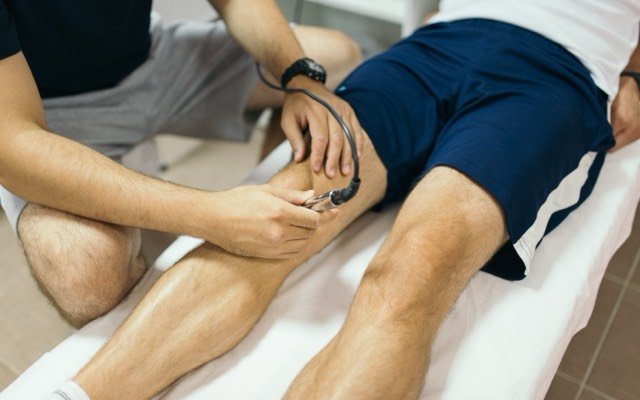
A practitioner's hands holding a handheld device against a person's knee on a treatment table
Photo: Shixart1985, CC BY 2.0, via Wikimedia Commons.

Plain-English Summary

BPC-157 and TB-500 are the peptides most often promoted for healing tendons, muscles, joints and the gut, but neither is an approved medicine and almost all of the evidence for them comes from animal and cell studies. The human data are a handful of small, uncontrolled reports, and the first placebo-controlled injury trial of BPC-157 is still recruiting. Full-length thymosin beta-4, a different molecule from TB-500, has been tested in small human trials for eye, skin-wound and heart conditions with mixed results. An FDA advisory committee voted in July 2026 to recommend BPC-157 and TB-500 for compounding, but that vote was not approval and FDA has not acted on it.

Key Takeaways

  • No peptide promoted for injury recovery, including BPC-157, TB-500, GHK-Cu and KPV, is an approved medicine for that use as of 17 October 2026.
  • A 2025 systematic review of BPC-157 in sports medicine included 35 preclinical studies and one clinical study, and found no clinical safety data.
  • The human BPC-157 reports are a 16-person knee-pain telephone survey, a 12-person bladder pilot and a two-person intravenous safety pilot, none with a control group.
  • The first randomised, placebo-controlled BPC-157 injury trial, in hamstring strains, was recruiting on ClinicalTrials.gov with no results.
  • TB-500 is a short fragment, not full-length thymosin beta-4; FDA found no human studies of the fragment, while the full-length protein has small eye, wound and heart trials.
  • Animal tendon studies use surgically cut healthy tendons and short time frames, so they cannot show that a peptide helps human injuries.
  • The July 2026 FDA committee vote was a non-binding recommendation about compounding for ulcerative colitis (BPC-157) and wound healing (TB-500), not approval.
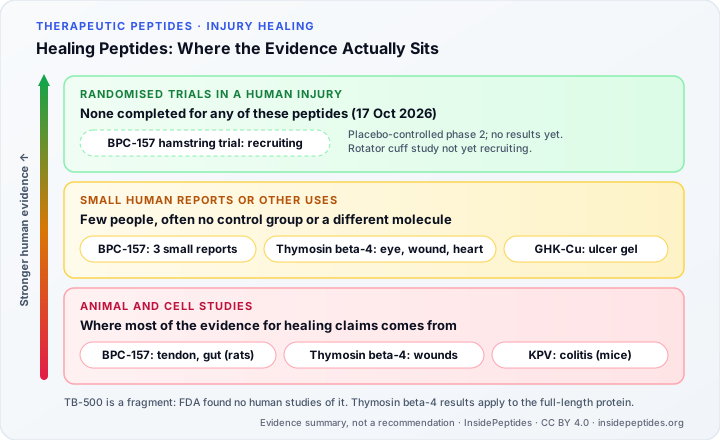
Diagram: an evidence ladder for healing peptides. Top rung, randomised human trials of an injury: none for BPC-157, TB-500, GHK-Cu or KPV; one BPC-157 hamstring trial is recruiting. Middle rung, small human reports or trials in other uses: BPC-157 knee, bladder and intravenous pilots without controls; full-length thymosin beta-4 eye, wound and heart trials; GHK-Cu diabetic ulcer gel. Bottom rung, animal and cell studies: BPC-157 tendon, muscle and gut models; thymosin beta-4 wound models; KPV mouse colitis.
Where the evidence for healing peptides sits: mostly animal and cell studies, a few small human reports, and no completed randomised trial in a human injury (status 17 October 2026). Diagram by InsidePeptides, CC BY 4.0: free to reuse with a credit and link. Download SVG

What “peptides for healing” usually means

The peptides most often promoted for injury healing, such as BPC-157 and TB-500, are not approved medicines for any injury anywhere, and almost all of the evidence behind them comes from animal and cell studies. FDA’s July 2026 review found no approved product containing BPC-157 in any country [1]. A peptide is simply a short chain of amino acids (see What Are Peptides?), so the word alone says nothing about whether a product works.

Online, “healing peptides” usually means four compounds:

  • BPC-157, a 15-amino-acid synthetic peptide described as derived from a protein in gastric juice, promoted for tendons, ligaments, muscles, joints and the gut.
  • TB-500, a short synthetic fragment linked to thymosin beta-4, a 43-amino-acid protein found in most human cells. The fragment and the full-length protein are different molecules with different evidence.
  • GHK-Cu, a copper-binding tripeptide used mainly in skin-care products and studied in wound care.
  • KPV, a three-amino-acid fragment of a melanocortin hormone studied for inflammation, including in the gut.

This guide sorts what is known about each into animal and cell evidence, small human reports and registered trials, and explains the regulatory position as of 17 October 2026. It gives no doses or instructions and is not medical advice. Decisions about an injury belong with a licensed clinician.

BPC-157: what the animal studies show

Most claims about BPC-157 trace back to experiments in rats and in cells. A 2025 systematic review from an orthopaedic sports medicine group searched the literature up to June 2024 and included 36 studies. Thirty-five were preclinical and one was a clinical study [2]. In those animal models, BPC-157 was reported to improve functional, structural and biomechanical outcomes after muscle, tendon, ligament and bone injuries, and to affect signals involved in blood-vessel growth and inflammation [2]. The review found no clinical safety data [2].

A typical example is a 2011 study that used rat tendon explants and cultured tendon cells. BPC-157 increased the outgrowth, survival and migration of tendon fibroblasts in the dish [3]. Findings like this explain how a peptide might act, but they do not show that an injured human tendon heals faster or better.

The gut story is similar. BPC-157 was nominated to FDA for ulcerative colitis, Crohn’s disease, coeliac disease and tendonitis. FDA evaluated only ulcerative colitis, because the nomination did not contain enough information on the other uses, and it did not identify clinical studies of BPC-157 in those other populations [1]. For ulcerative colitis, FDA found a single small trial reported only as a meeting abstract and concluded there was “a lack of evidence” to support effectiveness [1]. The wider research on gut peptides is collected in Gastrointestinal Peptides, and the tissue-repair literature in Tissue Repair Peptides.

BPC-157 in people: the few human reports and registered trials

Published human data on BPC-157 are very limited, and none of it comes from a randomised controlled trial of an injury.

  • Knee pain, retrospective chart review (2021). A clinic in Florida reviewed the charts of 17 people who had received knee injections of BPC-157, alone or with thymosin beta-4, and reached 16 by telephone. Of the 12 who had BPC-157 alone, 11 said their pain improved significantly. There was no comparison group, follow-up varied, and the authors state that no specific tools were used to measure function or quality of life [4].
  • Interstitial cystitis pilot (2024). The same lead author reported 12 women with bladder pain syndrome treated during a single procedure; all rated their symptoms as improved. The study had no control group and relied on a single questionnaire [5].
  • Intravenous safety pilot (2025). Two adults who had used intravenous BPC-157 before received two infusions on consecutive days. Blood tests over three days showed no measurable changes, and no side effects were reported [6]. Two people observed for three days cannot establish safety.

Two systematic reviews, with different scopes and search dates, summarise this evidence. The 2025 orthopaedic review, searched to June 2024, included one clinical study [2]. A 2026 systematic review of human studies of BPC-157 for any use, searched to 1 June 2026, found three studies with 30 people in total: the three reports above. It judged all three to be of poor methodological quality, rated the overall certainty of evidence very low, and concluded that BPC-157 “should not be used clinically in humans outside ethically approved, regulated, high-quality clinical trials” [24]. Since that search, a September 2026 report described three people with nerve injury after dental surgery who were treated with a mixture of peptides including BPC-157 and TB-500, together with a steroid and a local anaesthetic. Its authors state that spontaneous recovery and other factors “cannot be excluded, and causality cannot be established” [25].

ClinicalTrials.gov lists only four studies with BPC-157 as an intervention (searched 17 October 2026), and none has posted results:

  • A phase 1 safety and pharmacokinetics trial in healthy volunteers registered in 2015. Its status is unknown, and the record has not been updated since December 2015 [7].
  • A randomised, placebo-controlled phase 2 trial in acute hamstring muscle strain, which started in February 2026 and is recruiting an estimated 120 participants. Its main outcomes are time to return to sport and MRI injury volume [8].
  • A small randomised phase 1 study after rotator cuff repair surgery at the University of Arkansas, not yet recruiting, with an estimated start in January 2027 [9].
  • A single-group study of a commercial oral “peptide gummy” product, listed as completed with 40 participants; its outcomes were inflammation markers and self-reported recovery, and no results have been posted [10].

Registration is not evidence that a product works. Until the injury trials report, the honest summary is that BPC-157’s effect on human injuries is unknown. For more on reading registries, see How Clinical Trials Work.

TB-500 and thymosin beta-4: two different molecules

TB-500 is often sold as if it were thymosin beta-4. FDA’s 2026 review treated TB-500 as a seven-amino-acid fragment and noted that it is not the same as the full-length protein [11]. That distinction matters, because almost all of the research concerns the full-length molecule.

Animal work on full-length thymosin beta-4. In a 1999 rat study, thymosin beta-4 applied to the skin or given into the abdomen increased the closure of full-thickness skin wounds compared with saline [12].

Human trials of full-length thymosin beta-4 in other uses. Developers have tested the full-length protein, not TB-500, in a few defined conditions:

  • Eye. In a phase 2 trial of eye drops in 9 people with severe dry eye, symptom and staining scores improved more than with the inactive drops [13]. In a phase 3 trial in neurotrophic keratopathy, a hard-to-heal corneal condition, complete healing at four weeks occurred in 6 of 10 treated people and 1 of 8 on placebo; that main comparison did not reach conventional statistical significance (p = 0.0656) [14]. The trial was sponsored by the developer.
  • Skin wounds. Developer-led reviews describe two phase 2 trials in venous and pressure ulcers in which healing was faster among those who healed [15].
  • Heart. In a randomised, placebo-controlled trial of 96 people treated for a major heart attack, the overall difference in infarct size at 90 days between the recombinant protein and placebo was not statistically significant; a subgroup treated soonest after the artery was reopened did better [16]. A larger phase 2 trial of the same product is registered and not yet recruiting [17].

TB-500 itself. FDA’s briefing states that neither the nominator nor FDA identified any clinical studies of TB-500 in humans, or any in-vivo animal studies testing whether it promotes wound healing. The one cell study FDA found reported that TB-500 did not induce healing in scratch-wounded fibroblast cultures [11]. One small randomised phase 1/2 trial of the fragment, in people with stable cardiovascular disease, has been recruiting since February 2026; its main outcomes are adverse events [18]. No human injury trial of TB-500 is registered. See BPC-157 vs TB-500 for a side-by-side profile.

GHK-Cu and KPV in brief

GHK-Cu has a longer human record than BPC-157, but mostly as a topical product. In a randomised, evaluator-blinded trial published in 1994, a GHK-copper gel applied to diabetic foot ulcers alongside standard wound care increased ulcer closure compared with an inactive gel [19]. Its widest use today is in cosmetics; see Topical Peptides for Skin. Evidence for skin creams and wound gels does not extend to injected products, and GHK-Cu is among the peptides FDA has said its compounding advisory committee will discuss before the end of February 2027 (see the July panel vote).

KPV is studied mainly for inflammation. In a 2008 study, KPV reduced inflammatory signalling in human intestinal cells and, given in drinking water, reduced chemically induced colitis in mice [20]. No published randomised human trials of KPV for gut or injury healing were found. Comparisons are set out in BPC-157 vs KPV.

Why animal tendon studies don’t prove human benefit

A positive rat study is a reason to run a human trial, not a substitute for one. When researchers followed up 76 highly cited animal studies, only 28 (37%) were later replicated in human randomised trials [21]. Several features of injury research widen the gap:

  • Different injuries. Animal tendon studies usually cut a healthy young tendon surgically. Most human tendon problems develop slowly with age and overuse, in tissue that has already changed.
  • Different measures. Animal studies often report tissue strength or microscope findings at a fixed time. People care about pain, function and return to activity months later.
  • Different exposure. Amounts, routes and timing in rodents cannot simply be scaled to humans, and the drug may be handled differently by the body.
  • Small, unblinded studies. Small animal experiments are prone to optimistic results, especially when the people scoring outcomes know which animals were treated.

Human reports without a control group have their own problem. Many injuries and episodes of joint pain improve with time, and people often seek treatment when symptoms are at their worst, so improvement afterwards is expected whatever is given. Only a randomised, blinded comparison can separate a treatment effect from natural recovery and expectation. These ideas are covered in Human vs Preclinical Research, Correlation vs Causation and why promising peptide research often fails.

Regulatory status as of 17 October 2026

On 23 July 2026, FDA’s Pharmacy Compounding Advisory Committee voted 8–6, with 1 abstention, to recommend adding BPC-157, KPV and TB-500 to the 503A bulks list, the list of substances pharmacies may use for compounding [22]. FDA’s own scientists had proposed adding none of them [22]. The votes covered only the uses FDA reviewed: ulcerative colitis for BPC-157 and wound healing for TB-500 [1][11]. Tendon repair and general “recovery” were not assessed.

As of 17 October 2026:

  • No BPC-157, TB-500 or KPV product is approved as a medicine, and the July vote is a non-binding recommendation that FDA has not acted on [1][22].
  • BPC-157 was removed from FDA’s “significant safety concerns” list on 22 April 2026 because the nominations were withdrawn, but it was not moved to the list of substances pharmacies may use while FDA decides.
  • An FDA “interim access” policy for some peptides has been under White House review since 14 October 2026, and its text is not public.
  • In sport, BPC-157 is prohibited under the S0 class and TB-500 and thymosin beta-4 under S2, at all times [23].

For the dated detail, see Is BPC-157 Legal? A Dated Timeline, FDA Panel Votes on BPC-157 and 6 Peptides and the interim access plan. A “research use only” label does not make a product legal or tested for human use; see what “research use only” means and compounded peptides.

What is known about safety

Very little. The 2025 systematic review found no clinical safety data for BPC-157 [2]. The 2026 review of human studies reported no treatment-related adverse events in the three small studies it found, but rated the certainty of that evidence very low [24]. FDA found no human studies of TB-500 and no animal toxicity studies of the fragment [11]. FDA’s BPC-157 review also raised questions about identity, purity and impurities, and about possible immune reactions [1]. Products sold outside the medicine supply chain may not contain what their label says; see peptide impurities and immunogenicity.

Blends that combine these peptides, such as “GLOW” and “KLOW”, add further unknowns, because the combinations have not been tested at all (GLOW and KLOW explained). Reports from people who say they were harmed are covered in Peptide Side Effects. For injuries, established treatments such as rehabilitation, and for ulcerative colitis many approved medicines, have trial evidence that these peptides lack [1].

Frequently asked questions

Do peptides help injuries heal?

In animals, BPC-157 and thymosin beta-4 have been reported to speed the healing of tendons, muscles and skin wounds [2][12]. In people, there are no published randomised trials of any of these peptides for musculoskeletal injuries. A placebo-controlled BPC-157 trial in hamstring strains is recruiting, with no results yet [8].

Do peptide injections work for joint pain?

The only published human report is a retrospective telephone survey of 16 people given knee injections, with no comparison group [4]. That design cannot show whether the injections, natural recovery or expectation explain the improvement. Treatment of joint pain is a decision for a clinician.

Are there peptides for gut healing?

BPC-157 and KPV reduce gut inflammation in rodent studies [20], but FDA found a lack of evidence that BPC-157 is effective for ulcerative colitis in people [1], and no human trials of KPV for gut conditions were found. Approved medicines with trial evidence exist for inflammatory bowel disease.

What is the right dose of BPC-157 or TB-500?

None has been established. A dose is set through trials that measure benefit and harm at different amounts, and those trials have not been done for injuries. Amounts circulating online come from animal studies or personal anecdotes, not from evidence of human safety.

Is BPC-157 FDA approved?

No. No BPC-157 medicine is approved in any country, and the July 2026 committee vote was a non-binding recommendation about compounding, not approval [1][22].

Is TB-500 the same as thymosin beta-4?

No. TB-500 is a short fragment; thymosin beta-4 is the full 43-amino-acid protein. The eye, wound and heart trials tested the full-length protein, and FDA found no human studies of the TB-500 fragment [11][14][16].

Core Scientific Definitions

Precise biomedical definitions for terms used throughout this guide.

Preclinical study
Research done in cells, tissue samples or animals before, or instead of, testing in people. It can suggest how a substance acts but cannot show benefit or safety in humans.
Retrospective chart review
A study that looks back at existing medical records. It has no planned comparison group, so improvement cannot be attributed to the treatment.
Thymosin beta-4
A 43-amino-acid protein found in most human cells that binds actin and is involved in cell movement. TB-500 is a much shorter synthetic fragment related to it.
503A bulks list
An FDA list of bulk substances that state-licensed pharmacies may use to compound medicines for individual patients. Being on it is not FDA approval.
Natural history
How a condition changes over time without treatment. Many injuries and episodes of joint pain improve on their own, which is why controlled trials are needed.

Peer-Reviewed References & Primary Sources

This educational guide is built strictly upon peer-reviewed literature, official regulatory guidance, and authoritative biochemical repositories.

  1. FDA Briefing Document: BPC-157-related bulk drug substances U.S. Food and Drug Administration. Briefing document: BPC-157-related bulk drug substances. Pharmacy Compounding Advisory Committee, 23–24 July 2026. U.S. Food and Drug Administration · 2026
  2. Emerging Use of BPC-157 in Orthopaedic Sports Medicine: A Systematic Review Vasireddi N et al. HSS J 2025;21:485-95. HSS J · 2025
  3. The promoting effect of pentadecapeptide BPC 157 on tendon healing involves tendon outgrowth, cell survival, and cell migration Chang CH et al. J Appl Physiol 2011;110:774-80. J Appl Physiol · 2011
  4. Intra-Articular Injection of BPC 157 for Multiple Types of Knee Pain Lee E, Padgett B. Altern Ther Health Med 2021;27:8-13. PMID 34324435. Altern Ther Health Med · 2021
  5. Effect of BPC-157 on Symptoms in Patients with Interstitial Cystitis: A Pilot Study Lee E, Walker C, Ayadi B. Altern Ther Health Med 2024;30:12-17. PMID 39325560. Altern Ther Health Med · 2024
  6. Safety of Intravenous Infusion of BPC157 in Humans: A Pilot Study Lee E, Burgess K. Altern Ther Health Med 2025;31:20-24. PMID 40131143. Altern Ther Health Med · 2025
  7. PCO-02 - Safety and Pharmacokinetics Trial ClinicalTrials.gov NCT02637284. Phase 1; status unknown; last updated 22 December 2015; no results posted. Checked 17 October 2026. ClinicalTrials.gov · 2015
  8. BPC 157 for Acute Hamstring Muscle Strain Repair ClinicalTrials.gov NCT07437547. Phase 2; recruiting; start 2 February 2026; estimated enrolment 120. Checked 17 October 2026. ClinicalTrials.gov · 2026
  9. Impact of BPC-157 on Recovery Following Rotator Cuff Repair Surgery ClinicalTrials.gov NCT07803250. Sponsor: University of Arkansas. Phase 1; not yet recruiting; estimated start 1 January 2027. Checked 17 October 2026. ClinicalTrials.gov · 2026
  10. A Clinical Trial to Evaluate the Effects of Peptide Gummies on Markers of Inflammation, Physical Performance, and Recovery ClinicalTrials.gov NCT07752381. Single-group study; completed; 40 participants; no results posted. Checked 17 October 2026. ClinicalTrials.gov · 2026
  11. FDA Briefing Document: TB-500-related bulk drug substances U.S. Food and Drug Administration. Briefing document: TB-500-related bulk drug substances. Pharmacy Compounding Advisory Committee, 23–24 July 2026. U.S. Food and Drug Administration · 2026
  12. Thymosin beta4 accelerates wound healing Malinda KM et al. J Invest Dermatol 1999;113:364-8. J Invest Dermatol · 1999
  13. Thymosin β4 significantly improves signs and symptoms of severe dry eye in a phase 2 randomized trial Sosne G, Dunn SP, Kim C. Cornea 2015;34:491-6. Cornea · 2015
  14. 0.1% RGN-259 (Thymosin ß4) Ophthalmic Solution Promotes Healing and Improves Comfort in Neurotrophic Keratopathy Patients in a Randomized, Placebo-Controlled, Double-Masked Phase III Clinical Trial Sosne G et al. Int J Mol Sci 2022;24:554. Int J Mol Sci · 2022
  15. The regenerative peptide thymosin β4 accelerates the rate of dermal healing in preclinical animal models and in patients Treadwell T et al. Ann N Y Acad Sci 2012;1270:37-44. Ann N Y Acad Sci · 2012
  16. Recombinant human thymosin beta 4 improves ischemic cardiac dysfunction in mice and patients with acute ST-segment elevation myocardial infarction after reperfusion Zhang Y et al. Cardiovasc Res 2025;121:2747-58. Cardiovasc Res · 2025
  17. Recombinant Human Thymosin Beta 4 for Injection(NL005) for Acute Myocardial Infarction ClinicalTrials.gov NCT07586865. Sponsor: Beijing Northland Biotech. Phase 2; not yet recruiting; estimated enrolment 189. Checked 17 October 2026. ClinicalTrials.gov · 2026
  18. TB-500 (Thymosin Beta 4 17-23 Fragment) for Cardiovascular Biomarkers in Stable ASCVD ClinicalTrials.gov NCT07487363. Phase 1/2; recruiting; start 5 February 2026; estimated enrolment 80. Checked 17 October 2026. ClinicalTrials.gov · 2026
  19. Enhanced healing of ulcers in patients with diabetes by topical treatment with glycyl-l-histidyl-l-lysine copper Mulder GD et al. Wound Repair Regen 1994;2:259-69. Wound Repair Regen · 1994
  20. PepT1-mediated tripeptide KPV uptake reduces intestinal inflammation Dalmasso G et al. Gastroenterology 2008;134:166-78. Gastroenterology · 2008
  21. Translation of research evidence from animals to humans Hackam DG, Redelmeier DA. JAMA 2006;296:1731-2. JAMA · 2006
  22. FDA panel backs 6 peptides for compounding American Journal of Managed Care (AJMC). FDA panel backs 6 peptides for compounding. 31 July 2026. AJMC · 2026
  23. What’s new on the 2027 WADA Prohibited List U.S. Anti-Doping Agency. What’s new on the 2027 WADA Prohibited List. Accessed 17 October 2026. USADA · 2026
  24. Human evidence for BPC-157 in orthopaedic and regenerative medicine: a systematic review of efficacy and safety Poolton JT, Minett J, Kazmi A. Acta Orthop Belg 2026;92(3). Acta Orthop Belg · 2026
  25. Case Report: Regenerative peptides for inferior alveolar nerve injury: a narrative review with hypothesis-generating three clinical cases Froum S, Estrin N, Pico G, et al. Front Oral Health 2026;7:1907109. Front Oral Health · 2026
Written By InsidePeptides Editorial Team
Review Status Scientific review pending
Last Updated
Last Evidence Review Pending verification

Educational Disclaimer: This guide is for education only and is not medical advice, diagnosis or treatment. Many peptides discussed here are not approved for human use. Talk to a licensed clinician before making any health decision.