
Is BPC-157 Legal? A Dated Timeline of Its Status in 2026
BPC-157 left FDA's Category 2 on 22 April 2026, won a nonbinding panel vote in July and is still not approved. Every official step, dated, plus UK and WADA.

Key takeaways
- FDA removed BPC-157 from its Category 2 safety-concerns list on 22 April 2026 but did not add it to Category 1, so there is still no federal compounding route.
- An FDA advisory committee voted 8–6 in July 2026 to recommend it for ulcerative colitis; the vote is not binding and FDA has not acted.
- An interim access policy reached White House review on 14 October 2026; its text is unpublished and BPC-157 remains unapproved everywhere.
In this article
BPC-157 is not an approved medicine in the United States or in any other country, and as of 21 October 2026 US pharmacies still have no federal route to compound it. What has changed in 2026 is its paperwork: FDA took it off its "significant safety concerns" list in April, an advisory panel voted for it in July, and a White House review of a temporary "interim access" plan began on 14 October.12356
Online, these steps are often reported as "FDA approved BPC-157" or "BPC-157 is legal now". Neither is true. This guide puts every official step in date order, explains what each one did and did not change, and sums up the position in the UK, Australia, the EU and sport. It describes regulation only. It is not legal or medical advice and gives no dosing information.
The short version
- Not approved anywhere. FDA's July 2026 review found "no approved product containing BPC-157-related BDSs [bulk drug substances] in any country at this time".3
- Off the "do not compound" list, but not on the "may compound" list. FDA placed BPC-157 in Category 2 on 29 September 2023 and removed it on 22 April 2026 because the nominations were withdrawn. It did not move it to Category 1, the group FDA tolerates pharmacies using while it decides.129
- The July vote is a recommendation. FDA's advisory committee voted 8–6, with 1 abstention, to recommend BPC-157 for the 503A bulks list, for the use FDA reviewed: ulcerative colitis. FDA's own scientists had advised against it, and FDA has not acted on the vote.345
- A temporary plan is under White House review. FDA's "Interim Access Policy for Compounding Using Certain Peptides" reached the Office of Management and Budget on 14 October 2026. Its text is not public.67
- "Research use only" is not a legal loophole for human use, according to FDA's warning letters.10
- Banned in sport at all times. BPC-157 is named under S0 of the World Anti-Doping Agency (WADA) list.1415
Why the online answers disagree
Search for "is BPC-157 legal" and you will find dates from 2022 to 2026, and claims that it was "cleared", "reclassified" or "approved". Most of the confusion comes from three things:
- FDA has several lists, and none of them is approval. Category 1, Category 2 and the 503A bulks list only decide whether a pharmacy may compound a substance. Approval is a separate process for a specific product. Our compounded peptides guide explains the difference.
- FDA updated its list twice in one week. On 15 April 2026 FDA gave notice that BPC-157 "will be removed from category 2 after seven calendar days". The version dated 22 April 2026 records that it "has been removed".1 Both dates are correct; they describe different steps.
- Many top results are written by sellers or clinics that benefit from the most hopeful reading.
The timeline
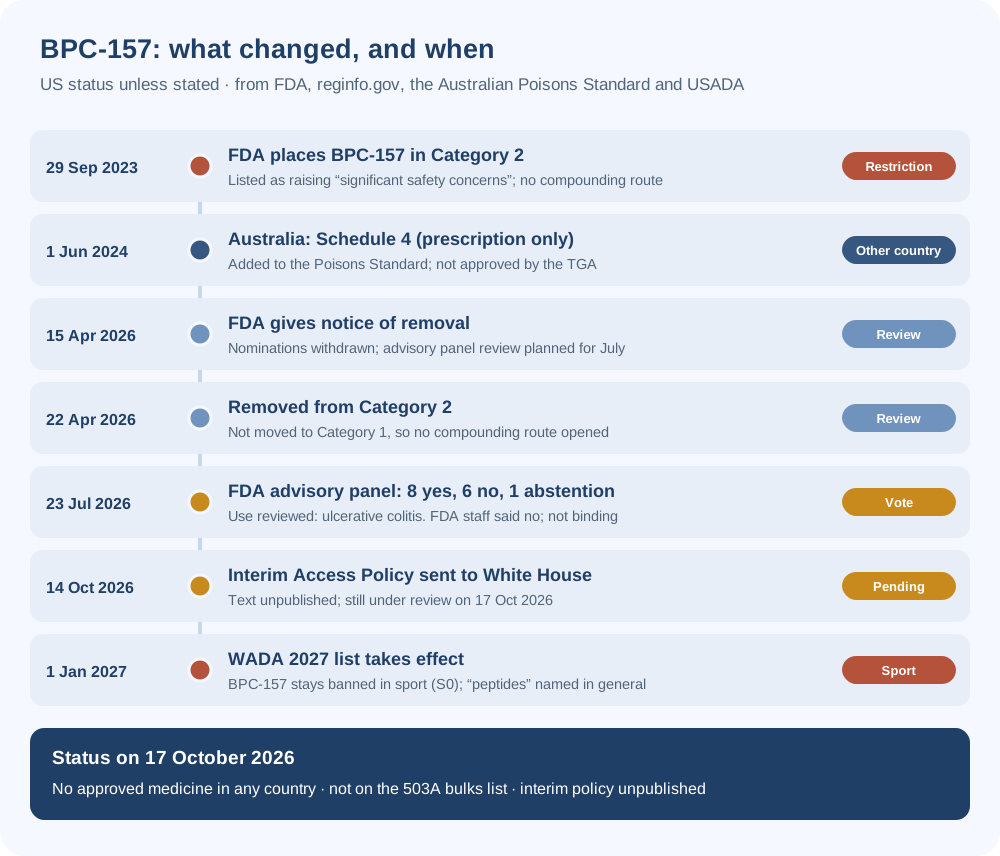
29 September 2023: FDA places BPC-157 in Category 2
FDA's list of bulk substances that "may present significant safety risks" recorded BPC-157 as added to 503A Category 2 on 29 September 2023. FDA said compounded BPC-157 "may pose risk for immunogenicity" (an unwanted immune reaction) and that it had "no, or only limited, safety-related information for the proposed routes of administration."2 Category 2 is FDA's group of nominated substances that "raise significant safety concerns"; FDA's interim policy gives enforcement leeway only to substances in Category 1.19
15 and 22 April 2026: removed from Category 2
FDA's 15 April 2026 update gave seven days' notice that BPC-157 would leave Category 2 "because the nominations were withdrawn by the nominators", and said it would ask its advisory committee about BPC-157 on 23 July 2026. The 22 April version confirms the removal.1 FDA's safety-risks page now lists BPC-157 under "Bulk drug substances nominated but withdrawn", with the same safety concerns still attached.2
What this did not do: it did not put BPC-157 into Category 1. FDA's interim policy, which lets pharmacies use certain substances while FDA decides, applies only to Category 1 substances that meet extra conditions.9 Removal from Category 2 therefore left BPC-157 outside both lists.
23 July 2026: the advisory committee vote
FDA reviewed BPC-157 (both the free base and the acetate form) for one proposed use, ulcerative colitis, and proposed that it not be added to the 503A bulks list.3 The Pharmacy Compounding Advisory Committee voted 8–6, with 1 abstention, to recommend adding it.5 FDA must still decide whether to accept the committee's "nonbinding recommendations".5 Adding a substance to the bulks list requires formal rulemaking with public comment.16
Our article on the July panel vote covers all seven peptides and FDA's reasons in detail.
14 and 15 October 2026: the interim access plan
On 7 October 2026, The Washington Post reported that the administration was planning a temporary route for some restricted peptides.8 On 14 October, FDA sent a document titled "Interim Access Policy for Compounding Using Certain Peptides" to the White House Office of Information and Regulatory Affairs. The official listing calls it a "Notice", not economically significant, and on 21 October 2026 still showed it as pending review.6 The Associated Press reported on 15 October that the policy would let pharmacies temporarily compound "some of the most popular peptides, including BPC-157", citing two anonymous sources.7
Until FDA publishes the text, nobody outside government knows which peptides it covers or what conditions apply. See our explainer on the stopgap plan for the background and the safety concerns raised.
What is legal today: a plain summary
| Question | Answer on 21 October 2026 |
|---|---|
| Is BPC-157 an FDA-approved drug? | No. No approved product exists in any country.3 |
| Can a 503A pharmacy compound it under federal law? | No federal route: it is not on the bulks list, has no USP monograph, is not part of an approved drug and is not in Category 1.139 |
| Is it still on FDA's Category 2 list? | No. It was removed on 22 April 2026, but FDA's safety concerns still stand.12 |
| Has the July vote changed anything? | Not yet. It is a recommendation that FDA has not acted on.5 |
| Is the interim access policy in force? | No. It is under White House review and unpublished.6 |
| Does a "research use only" label make human use legal? | No. FDA treats products marketed for people as unapproved drugs despite that label.10 |
| Can I import it for personal use? | FDA says importing drugs for personal use is illegal "in most circumstances"; its discretion is limited to narrow conditions.11 |
Is it illegal to own BPC-157 in the US? We found no federal rule that makes simple possession of BPC-157 a crime. The legal limits fall mainly on making, selling, importing and marketing it as a drug. See why anyone can still buy it online. This is a general description, not legal advice.
Outside the United States
- United Kingdom: BPC-157 is not a licensed medicine.3 In April 2026 the Medicines and Healthcare products Regulatory Agency (MHRA) said that if clinics offering peptide injections "make medicinal claims for those treatments, the products will be considered medicines" under the Human Medicines Regulations 2012, and that it "will take action" against clinics breaking the law. One clinic removed BPC-157 claims after being contacted.13
- Australia: BPC-157 was added to Schedule 4 of the Poisons Standard (prescription-only medicines) from 1 June 2024.12 No BPC-157 medicine is approved there or anywhere else.3
- European Union: no BPC-157 medicine is authorised; FDA's July review found no approved product in any country, and BPC-157 is not in the European Pharmacopoeia.3 Rules on unlicensed products differ between member states.
Athletes and sport
BPC-157 is named under S0, "non-approved substances", on WADA's 2026 Prohibited List, which means it is banned in and out of competition.14 USADA says that on the 2027 list, which takes effect on 1 January 2027, "'peptides' in general are now named as prohibited substances in the S0 class", and BPC-157 remains listed.15 See our WADA peptide rules page.
How to read new claims
When you see "BPC-157 is now legal" or "FDA approved BPC-157":
- Look for an FDA document. A real change will appear on FDA's compounding pages or in the Federal Register.
- Check which list is meant. Leaving Category 2 is not the same as joining Category 1 or the bulks list.
- Check the date. Pages written before 22 April or 23 July 2026 describe an older position.
- Separate "may be compounded" from "approved". Even if pharmacies are later allowed to compound it, BPC-157 would remain unapproved, with the safety gaps FDA described. Our BPC-157 evidence profile sets out what the research shows, and our article on GLOW and KLOW blends covers products that mix it with other peptides.
Frequently asked questions
Is BPC-157 FDA approved?
No. No BPC-157 medicine has been approved by FDA or by any other country's regulator.3
When was BPC-157 removed from Category 2?
FDA gave notice on 15 April 2026 and removed it on 22 April 2026, because the people who had nominated it withdrew their nominations.1
Did the FDA panel make BPC-157 legal?
No. On 23 July 2026 the advisory committee voted 8–6 to recommend it, but the vote is not binding and FDA has not acted on it.5
Can compounding pharmacies make BPC-157 now?
Not under current federal policy. It is not on the 503A bulks list or in Category 1. An interim access policy that might change this was under White House review on 21 October 2026.169
Is BPC-157 legal in the UK or Australia?
It is not a licensed medicine in the UK, where the MHRA treats products with medicinal claims as medicines. In Australia it is a prescription-only (Schedule 4) substance.1213
Is BPC-157 banned for athletes?
Yes. It is prohibited at all times under WADA's S0 class.1415
How we reviewed this article
Sources
InsidePeptides relies on primary sources: peer-reviewed studies, trial registries and regulators’ own documents. Read our editorial policy.
- FDA. Bulk drug substances nominated for use in compounding under section 503A of the Federal Food, Drug, and Cosmetic Act. Versions updated 15 April 2026 and updated 22 April 2026 (archived copies). Current version: fda.gov/media/94155.
- FDA. Certain bulk drug substances for use in compounding that may present significant safety risks. Content current as of 22 April 2026. Earlier version listing BPC-157 as added to Category 2 on 29 September 2023: archived copy, September 2024.
- FDA. Briefing document: BPC-157-related bulk drug substances. Pharmacy Compounding Advisory Committee, 23–24 July 2026.
- FDA. July 23–24, 2026 Meeting of the Pharmacy Compounding Advisory Committee. Agenda and materials.
- AJMC: FDA panel backs 6 peptides for compounding. 31 July 2026.
- Office of Information and Regulatory Affairs. Pending EO 12866 regulatory review: Interim Access Policy for Compounding Using Certain Peptides. HHS/FDA, RIN 0910-ZD94, received 14 October 2026. Checked 21 October 2026.
- Associated Press. Trump administration advances plan for peptide drugs favored by RFK Jr. Published by STAT, 15 October 2026.
- Roubein R. The Trump administration is paving way for temporary sale of some unapproved peptides. The Washington Post, 7 October 2026.
- FDA. Interim Policy on Compounding Using Bulk Drug Substances Under Section 503A of the Federal Food, Drug, and Cosmetic Act. Guidance for industry.
- FDA. Warning letter: Peak Performance Peptides, 24 August 2026. Center for Drug Evaluation and Research.
- FDA. Personal importation. Content current as of 18 August 2025.
- Australian Government, Federal Register of Legislation. Explanatory statement: Therapeutic Goods (Poisons Standard—June 2024) Instrument 2024. Commenced 1 June 2024.
- Aesthetics Journal: MHRA investigates clinics following peptide claims. 15 April 2026, reporting a Guardian investigation.
- World Anti-Doping Agency. 2026 Prohibited List. Section S0, non-approved substances.
- USADA. What's new on the 2027 WADA Prohibited List. Effective 1 January 2027.
- 21 U.S. Code § 353a: Pharmacy compounding. Section 503A of the Federal Food, Drug, and Cosmetic Act. Legal Information Institute.
History
Each entry records a dated change to this article’s content. Link and formatting changes are not listed.
Current version
Written by InsidePeptides Editorial Team
Scientific review pending
Last updated
Status dates rechecked and updated to 21 October 2026.
Published


