

Evidence & Regulation Beginner

Peptide Stacks: Do Combinations Work, and Are They Safe?

What peptide stacks such as Wolverine, GLOW and KLOW are, why combinations of unapproved peptides lack evidence, and what proper combination trials look like.

9 min read Updated 18 sources InsidePeptides Editorial Team

A loose pile of plain round white tablets on a clean white surface
Photo: Christian Schnettelker from Essen, Deutschland, CC BY 2.0, via Wikimedia Commons.

Plain-English Summary

A peptide stack is a combination of peptides used together, usually unapproved peptides chosen by users, clinics or sellers. The best-known stacks, such as Wolverine, GLOW and KLOW, combine peptides that each have little or no human safety data, and the combinations themselves have not been tested in any human trial. Mixing products makes it impossible to tell which ingredient caused a benefit or a reaction, adds the quality risks of every ingredient and raises the possibility of interactions. Real combination medicines are tested in trials that compare the combination with each component.

Key Takeaways

  • A peptide stack is an informal combination of peptides, usually unapproved ones; it is different from a tested combination medicine or a single molecule that acts on several receptors.
  • The Wolverine stack (BPC-157 and TB-500), GLOW (adding GHK-Cu) and KLOW (adding KPV) combine ingredients for which the FDA found little or no human safety data.
  • No human trial of these named stacks was found; the only controlled study of BPC-157 with TB-500 was in rats and found no added benefit from combining them.
  • When a product contains several peptides, it is often impossible to tell which ingredient caused a benefit or a reaction, as the FDA found in one case report.
  • Combining products can create interactions and multiplies the manufacturing and contamination risks of each ingredient.
  • Approved combinations were tested in trials comparing the combination with each component; informal stacks have no equivalent evidence.
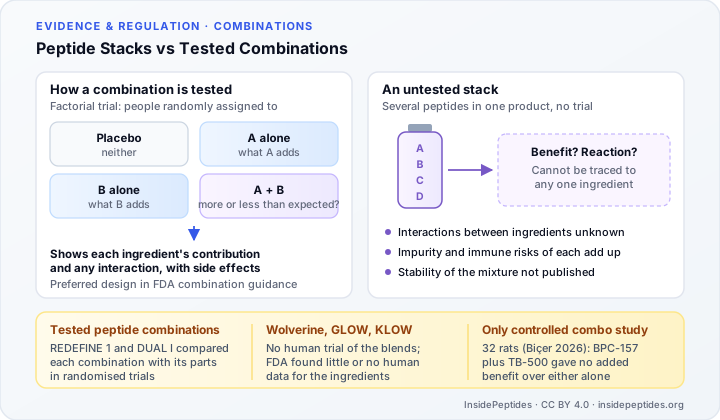
Diagram: a factorial trial with four groups (placebo, peptide A, peptide B, A plus B) can show what each ingredient contributes, whereas an untested stack mixes ingredients so that benefits and reactions cannot be attributed and quality risks add up.
How combinations are tested: a factorial trial compares each ingredient and the combination with placebo. Informal peptide stacks skip this step, so benefits and harms cannot be attributed to any one ingredient. Diagram by InsidePeptides, CC BY 4.0: free to reuse with a credit and link. Download SVG

What a peptide stack is

A peptide stack is a combination of two or more peptides used together, either mixed in one product or taken side by side, in the hope that each will add something to the others. The term comes from online fitness, wellness and anti-ageing communities rather than from medicine. Stacks are usually built from unapproved peptides, and they are often given memorable names. Scientific American described how many people combine BPC-157 with TB-500 in a regimen called the “Wolverine” stack, named after the fast-healing X-Men character, and how adding GHK-Cu and KPV produces stacks called “glow” or “KLOW” [1].

It helps to separate three things that are sometimes all called combinations:

  • Informal stacks: mixtures chosen by users, clinics or sellers, usually without any trial of the combination itself.
  • Combination medicines: two active ingredients developed together and tested in trials designed to show what each one adds, such as the insulin and GLP-1 combinations discussed in section 6.
  • Single molecules with several actions: drugs such as tirzepatide, one peptide engineered to activate more than one receptor. These are not stacks at all; see Multi-Receptor Agonists.

This guide is about the first group. It explains what is known about whether stacks work and whether they are safe. It does not give, and should not be read as giving, any guidance on how to use them.

Wolverine, GLOW and KLOW at a glance

The best-known stacks combine four unapproved peptides. No authority defines what a named stack must contain, so the contents can vary between products. As commonly described, the Wolverine stack is BPC-157 plus TB-500; GLOW adds GHK-Cu; and KLOW adds KPV as well [1]. The human evidence for each ingredient on its own is limited:

  • BPC-157. The FDA concluded in July 2026 that there is insufficient clinical safety information to characterise its safety profile [2]. A 2025 systematic review found 35 preclinical studies and one clinical study, and no clinical safety data [3].
  • TB-500. The FDA states that TB-500 is a short synthetic fragment of the natural protein thymosin beta-4 and that the two are not the same substance. It had not identified any clinical studies or human exposure data for TB-500 by any route [4].
  • GHK-Cu. For injectable forms, the FDA notes a possible risk of immune reactions and limited human data to inform safety [5].
  • KPV. The FDA said it is particularly concerned about the lack of any human data on products containing KPV by any route [6].

A stack built from these ingredients therefore starts from a weak base: if the safety and effects of each part are largely unknown in people, the combination cannot be better understood than its parts. For a fuller breakdown, including regulatory status, see GLOW and KLOW Peptide Stacks: What’s in Them and What the Evidence Shows.

Do peptide stacks work?

There is no good evidence that the popular peptide stacks work in people, and very little evidence of any kind about the combinations. The usual claim is that combining peptides produces an additive or even a synergistic effect, where the combination does more than the sum of its parts. That is a testable claim, but it has barely been tested.

The only controlled study of the BPC-157 and TB-500 combination that we identified was in rats. In 2026, researchers randomly assigned 32 rats with repaired Achilles tendons to no treatment, BPC-157, TB-500 or both. Some tissue measures improved with the single peptides, but the combined treatment did not provide additional benefits compared with either peptide alone [7]. A rat tendon study cannot show what happens in people, but it offers no support for the idea that combining these two adds anything.

The only human data on the combination come from a chart review at one US clinic. Of 16 patients with knee pain reached by telephone, four had received BPC-157 together with thymosin beta-4. There was no control group and no standard outcome measure, so the study cannot show whether either treatment, or the combination, worked [8]. A search of ClinicalTrials.gov on 17 October 2026 found registered trials of BPC-157, TB-500 or GHK-Cu used alone, but no trial testing them in combination and none of the named stacks [9].

Before-and-after accounts and testimonials cannot fill this gap, because they cannot separate the effect of the peptides from natural healing, other treatments or expectation. See Correlation vs Causation and Human vs Preclinical Research.

The attribution problem: which ingredient did what?

Combining products makes it harder to learn anything from what happens next, whether the outcome is good or bad. If someone feels better, there is no way to tell which ingredient, if any, was responsible. If someone has a reaction, the same problem arises.

The FDA met exactly this problem in its review of BPC-157. One adverse event report described a patient who used an injectable product, labelled for “research purposes only”, that contained both BPC-157 and TB-500. The reaction recurred when the patient used the product again, which the FDA said made it likely that the product caused it. But the agency concluded that, because the product contained two peptides, it was not possible to assess whether BPC-157 was responsible [2].

Reports outside the formal system show the same pattern. KFF Health News described a man who developed a severe migraine with facial numbness within days of taking BPC-157 together with TB-4, another unapproved peptide, in a combination known as the Wolverine stack [10]. A single account cannot establish cause, and with two unapproved peptides involved, it cannot even indicate which one to suspect.

This matters for safety as well as for effectiveness. When the cause of a reaction cannot be identified, it cannot be avoided in future, and regulators cannot attach a warning to the right substance. For how individual reports are interpreted, see Peptide Side Effects: What Users Report and What the Evidence Shows.

Interactions and multiplied quality risks

Is stacking peptides safe? Nobody knows, because the combinations have not been studied, and there are specific reasons to think combining adds risk rather than reducing it.

Interactions. Two substances can change each other’s effects even when each has been studied alone. Approved peptide medicines show this clearly. The Wegovy label warns that semaglutide lowers blood glucose and that the risk of hypoglycaemia increases when it is used with insulin or with drugs that stimulate insulin release. It adds that the use of Wegovy in patients already treated with insulin has not been evaluated. Because semaglutide slows stomach emptying, it may also affect the absorption of other medicines taken by mouth [11]. These interactions were identified because the medicines were studied in detail. For combinations of unapproved peptides, no comparable information exists.

Quality risks multiply. Every ingredient in a stack brings its own manufacturing risks. The FDA raised concerns about impurities, aggregation and immune reactions separately for BPC-157, TB-500 and injectable GHK-Cu [2] [4] [5]. A product combining several peptides combines those uncertainties, and a problem with any one ingredient affects the whole product. Quality problems are not hypothetical: when researchers obtained single-ingredient semaglutide from illegal online pharmacies, all three vials received had low purity, the wrong content and detectable bacterial endotoxin [12]. To our knowledge, no independent data have been published on whether the peptides in these blends stay stable when mixed. For background, see Peptide Impurities, Immunogenicity and Certificates of Analysis.

If something goes wrong. Anyone who feels unwell after using a peptide product should seek medical help and tell the clinician every ingredient the product claimed to contain. Suspected reactions can be reported to the FDA’s MedWatch programme in the United States [13].

What evidence would show a combination works

Medicine already has well-established methods for testing combinations, which shows what is missing for informal stacks. Under U.S. regulations, two or more drugs may be combined in a single product when each component contributes to the claimed effects and the combination is safe and effective for the intended patients [14]. FDA guidance on developing two new drugs together states that a factorial study, designed to assess the effects attributable to each drug in the combination, is generally the preferred design [15].

In the simplest factorial trial, participants are randomly assigned to receive drug A alone, drug B alone, both, or neither. Comparing the four groups shows what each drug contributes and whether the combination does more, or less, than expected from its parts, which is called an interaction. A review of factorial trials stressed that results can only be interpreted correctly when data for each treatment group are reported separately [16].

Two peptide combinations show what this evidence looks like in practice:

  • Cagrilintide and semaglutide. The REDEFINE 1 trial randomly assigned 3,417 adults with obesity or overweight to the combination, semaglutide alone, cagrilintide alone or placebo for 68 weeks. It measured the effect of the combination against placebo and recorded side effects: digestive adverse events affected 79.6% of people on the combination and 39.9% on placebo, and were mainly temporary and mild to moderate [17].
  • Insulin degludec and liraglutide. The DUAL I trial compared a fixed combination of the two with each component given alone in 1,663 adults with type 2 diabetes. It found that the combination lowered average blood glucose more than either component, and that its safety profile reflected those of its parts: nausea was less common than with liraglutide alone, while hypoglycaemia was more common than with liraglutide and less common than with insulin alone [18].

Informal stacks have no equivalent of either trial. Showing that a stack works and is acceptably safe would require, at a minimum, well-characterised products, human trials that compare the combination with each component and with placebo, and enough participants followed for long enough to detect uncommon harms. See Randomised Controlled Trials and Understanding Sample Size.

Frequently asked questions

What is a peptide stack?

A combination of two or more peptides used together, usually unapproved peptides chosen by users, clinics or sellers rather than tested as a combination [1].

Do peptide stacks work?

There is no human trial evidence that they do. The one controlled study of BPC-157 with TB-500 was in rats and found no added benefit from combining them [7].

Is stacking peptides safe?

Its safety is unknown. The ingredients of popular stacks have little or no human safety data [2] [4] [6], combinations may interact, and when a reaction occurs it is often impossible to tell which ingredient caused it [2].

What is the Wolverine stack?

A name used online for BPC-157 combined with TB-500 [1]. Neither is an approved medicine, and the FDA found no human data at all for TB-500 [4].

What are GLOW and KLOW?

Names for blends that add GHK-Cu (GLOW), or GHK-Cu and KPV (KLOW), to BPC-157 and TB-500 [1]. Neither blend has been tested in a human trial [9]. See GLOW and KLOW Peptide Stacks: What’s in Them and What the Evidence Shows.

Are there any approved peptide combinations?

Yes, but they were developed and tested differently. Combinations such as insulin degludec with liraglutide were compared with each component in randomised trials before approval [18]. That kind of evidence does not exist for informal stacks.

Core Scientific Definitions

Precise biomedical definitions for terms used throughout this guide.

Peptide stack
An informal combination of two or more peptides used together, either mixed in one product or taken side by side, usually without a trial of the combination.
Factorial trial
A randomised trial in which participants are assigned to each treatment alone, to the combination, or to neither, so that the contribution of each treatment and any interaction between them can be measured.
Drug interaction
A change in the effect of one substance caused by another taken at the same time, which can increase, reduce or alter the expected effects or side effects.
Synergy
An effect of a combination that is greater than would be expected from adding together the effects of its parts; it has to be shown in a study that measures each part separately.
Fixed-combination medicine
An approved product containing two or more active ingredients in set proportions, for which regulators require evidence that each component contributes to the claimed effect.

Peer-Reviewed References & Primary Sources

This educational guide is built strictly upon peer-reviewed literature, official regulatory guidance, and authoritative biochemical repositories.

  1. The science behind the peptide craze Brookshire B. The science behind the peptide craze. Scientific American, 18 April 2026. Scientific American · 2026
  2. FDA Briefing Document: BPC-157-related bulk drug substances U.S. Food and Drug Administration. FDA Briefing Document: BPC-157-related bulk drug substances. Pharmacy Compounding Advisory Committee meeting, 23–24 July 2026. U.S. Food and Drug Administration · 2026
  3. Emerging use of BPC-157 in orthopaedic sports medicine: a systematic review Vasireddi N, Hahamyan H, Salata MJ, et al. HSS J 2025;21:485-95. HSS J · 2025
  4. FDA Briefing Document: TB-500-related bulk drug substances U.S. Food and Drug Administration. FDA Briefing Document: TB-500-related bulk drug substances. Pharmacy Compounding Advisory Committee meeting, 23–24 July 2026. U.S. Food and Drug Administration · 2026
  5. Certain bulk drug substances for use in compounding that may present significant safety risks U.S. Food and Drug Administration. Certain bulk drug substances for use in compounding that may present significant safety risks. Content current as of 22 April 2026. U.S. Food and Drug Administration · 2026
  6. FDA Briefing Document: KPV-related bulk drug substances U.S. Food and Drug Administration. FDA Briefing Document: KPV-related bulk drug substances. Pharmacy Compounding Advisory Committee meeting, 23–24 July 2026. U.S. Food and Drug Administration · 2026
  7. Effects of BPC-157 and TB-500 on Achilles tendon healing in rats: a histopathological and biomechanical study Biçer O, Adanir O, Güleryüz Y, et al. Jt Dis Relat Surg 2026;37:822-37. Jt Dis Relat Surg · 2026
  8. Intra-articular injection of BPC 157 for multiple types of knee pain Lee E, Padgett B. Altern Ther Health Med 2021;27:8-13. Altern Ther Health Med · 2021
  9. ClinicalTrials.gov registry search: BPC-157, TB-500, KPV, GHK-Cu and named peptide stacks ClinicalTrials.gov. Registry searches for BPC-157, TB-500, KPV and GHK-Cu, for BPC-157 combined with TB-500, and for the names Wolverine, GLOW and KLOW. Searched 17 October 2026. U.S. National Library of Medicine · 2026
  10. People say these peptides hurt them. Their stories are muffled in MAHA’s push for medical freedom Maxmen A. People say these peptides hurt them. Their stories are muffled in MAHA’s push for medical freedom. KFF Health News, 13 October 2026. KFF Health News · 2026
  11. Wegovy (semaglutide) injection and tablets: full prescribing information Novo Nordisk. Wegovy (semaglutide) prescribing information, revised June 2026. DailyMed, U.S. National Library of Medicine. Accessed 17 October 2026. DailyMed (U.S. National Library of Medicine) · 2026
  12. Multifactor quality and safety analysis of semaglutide products sold by online sellers without a prescription: market surveillance, content analysis, and product purchase evaluation study Ashraf AR, Mackey TK, Vida RG, et al. J Med Internet Res 2024;26:e65440. J Med Internet Res · 2024
  13. MedWatch: The FDA Safety Information and Adverse Event Reporting Program U.S. Food and Drug Administration. MedWatch: The FDA Safety Information and Adverse Event Reporting Program. Accessed 17 October 2026. U.S. Food and Drug Administration · 2026
  14. 21 CFR § 300.50: Fixed-combination prescription drugs for humans 21 CFR 300.50. Fixed-combination prescription drugs for humans. Code of Federal Regulations (via Legal Information Institute). Accessed 17 October 2026. Code of Federal Regulations · 2026
  15. Codevelopment of Two or More New Investigational Drugs for Use in Combination U.S. Food and Drug Administration. Codevelopment of Two or More New Investigational Drugs for Use in Combination. Guidance for industry, June 2013. U.S. Food and Drug Administration · 2013
  16. Analysis and reporting of factorial trials: a systematic review McAlister FA, Straus SE, Sackett DL, Altman DG. JAMA 2003;289:2545-53. JAMA · 2003
  17. Coadministered cagrilintide and semaglutide in adults with overweight or obesity Garvey WT, Blüher M, Osorto Contreras CK, et al. N Engl J Med 2025;393:635-47. N Engl J Med · 2025
  18. Efficacy and safety of a fixed-ratio combination of insulin degludec and liraglutide (IDegLira) compared with its components given alone: results of a phase 3, open-label, randomised, 26-week, treat-to-target trial in insulin-naive patients with type 2 diabetes Gough SC, Bode B, Woo V, et al. Lancet Diabetes Endocrinol 2014;2:885-93. Lancet Diabetes Endocrinol · 2014
Written By InsidePeptides Editorial Team
Review Status Scientific review pending
Last Updated
Last Evidence Review Pending verification

Educational Disclaimer: This guide is for education only and is not medical advice, diagnosis or treatment. Many peptides discussed here are not approved for human use. Talk to a licensed clinician before making any health decision.