
GLOW and KLOW Peptide Stacks: What’s in Them and What the Evidence Shows
GLOW and KLOW blend GHK-Cu, BPC-157, TB-500 and KPV. What is in each, the human evidence (almost none), FDA’s view and the risks of mixing peptides.

Key takeaways
- GLOW is GHK-Cu, BPC-157 and TB-500 in one vial; KLOW adds KPV. Both are seller-made names, not medicines.
- No human trial has tested either blend, and FDA found no human data at all for TB-500 or KPV.
- Mixing peptides makes side effects impossible to trace to one ingredient, as FDA noted in a 2026 case.
In this article
"GLOW" and "KLOW" are names for injectable peptide blends that have spread fast on TikTok, Reddit and seller websites in 2026. GLOW usually means GHK-Cu, BPC-157 and TB-500 in one vial; KLOW adds a fourth peptide, KPV. No human trial has tested either blend, and FDA has found no human safety data at all for two of the four ingredients.1234
Most search results for these names are run by people who sell them. This guide sets out what is actually in the blends, what is known about each ingredient, what FDA and anti-doping bodies say, and the questions to ask before trusting any claim. It gives no dosing information, recommends no seller and is not medical advice.
The short version
- What they are: seller-made blend names, not defined medicines. GLOW = GHK-Cu + BPC-157 + TB-500. KLOW = GLOW + KPV. BPC-157 + TB-500 alone is sold as the "Wolverine stack".12
- No combination trial exists. We searched PubMed and ClinicalTrials.gov in October 2026 and found no human trial of GLOW, KLOW or the Wolverine stack. A 2026 rat study found that adding TB-500 to BPC-157 gave "no additional benefits".5
- Human data for the ingredients are thin. FDA has "not identified any clinical studies or human exposure data" for TB-500 or KPV. BPC-157 has three small uncontrolled pilot studies. GHK-Cu has been studied in humans only on the skin, not by injection.3467
- None is FDA-approved. In July 2026 an FDA advisory committee voted 8–6 to recommend BPC-157, TB-500 and KPV for pharmacy compounding, against FDA staff advice. That is not approval, and FDA has not acted on it.89
- Mixing makes problems harder to trace. In one FDA case report involving a two-peptide product, FDA said "it is not possible to assess" which ingredient caused the reaction.3
Why everyone is searching for GLOW and KLOW
Peptide "stacking" means combining several peptides, often in one vial, to chase several effects at once. The names come from online communities and sellers, not from science. Scientific American described the progression in April 2026: "many people combine BPC-157 with injections of TB-500... named after the rapidly healing X-Men character. Add injections of GHK-Cu and KPV, and the stack is called 'glow' or 'KLOW.'"1
The marketing pitch is simple: BPC-157 and TB-500 for "healing", GHK-Cu for skin and hair, KPV for inflammation. That pitch rides on a wider boom in unapproved peptides. Our explainer on what "research use only" means covers the size of that market.
The same blends are now turning up in reports of harm. KFF Health News described a 46-year-old man who "got an excruciating migraine within days of taking BPC-157 with TB-4, another unapproved peptide — a combination called the 'Wolverine Stack'."2 One report cannot show that the peptides caused it, as our article on peptide side effects explains, but it shows these products are being injected outside any trial.
A note on names. No authority defines GLOW or KLOW, so the contents, proportions and even the form of each ingredient can differ between products. FDA has warned that for these peptides it "has encountered multiple salts, and derivatives, including different active moieties, sold commercially under the same common name".4
What is in each blend
| Ingredient | What it is | In GLOW? | In KLOW? |
|---|---|---|---|
| GHK-Cu | A three-amino-acid peptide bound to copper, found naturally in blood plasma; used in cosmetic creams | Yes | Yes |
| BPC-157 | A synthetic 15-amino-acid peptide based on a protein fragment from stomach juice | Yes | Yes |
| TB-500 | A synthetic seven-amino-acid fragment of the natural protein thymosin beta-4 | Yes | Yes |
| KPV | A three-amino-acid fragment (lysine-proline-valine) from the hormone alpha-MSH | No | Yes |
Sources: FDA briefing documents and FDA's compounding safety page.34610
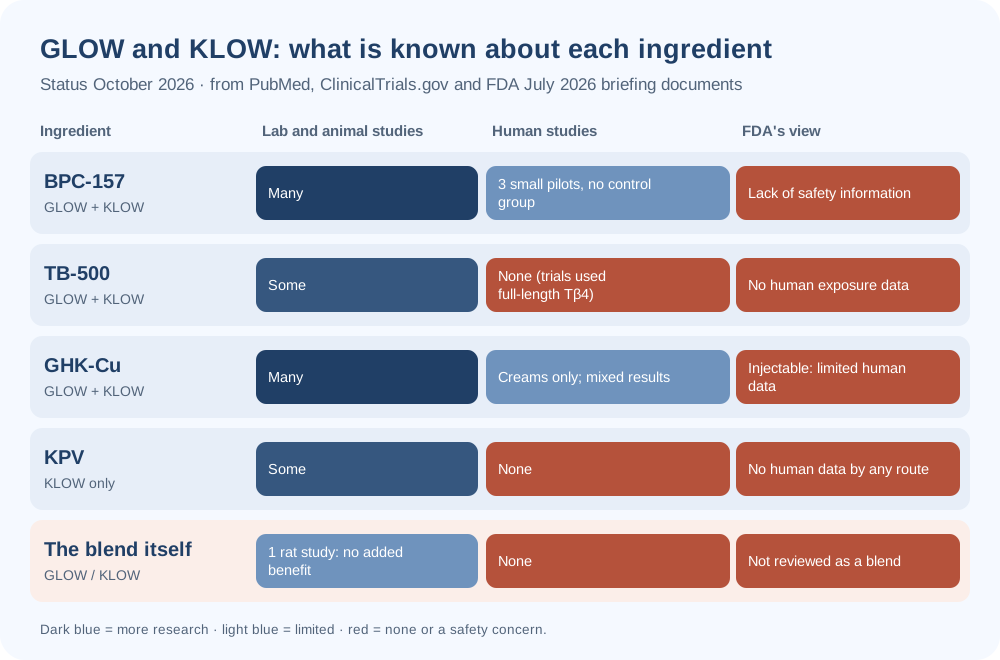
What the evidence shows for each ingredient
BPC-157
BPC-157 is the most-studied ingredient, but almost all of that research is in animals. A 2025 systematic review found "36 studies were included (35 preclinical studies, 1 clinical study)" and "No clinical safety data were found."11 The human data consist of three small pilot studies without control groups, all from one clinical group in Florida: a chart review of knee-pain patients, a study of 12 women with interstitial cystitis and an intravenous safety study in two people.121314
FDA's July 2026 review concluded that "there is a lack of information on the safety profile and immunogenicity risks" of BPC-157 and "insufficient evidence to make a conclusion on the effectiveness" for the use it examined.3 Read our full BPC-157 evidence profile.
TB-500
TB-500 is often described as "thymosin beta-4", but it is not. FDA explains that TB-500 is "a synthetic N-acetylated heptapeptide containing the amino acid sequence 17 through 23 (LKKTETQ) of the full-length (43-amino acid) peptide thymosin β4," and that the two "are not the same substance."4
That matters because the human trials people cite were done with full-length thymosin beta-4, mainly as eye drops for dry eye and corneal damage, and as a topical gel for leg ulcers.151617 For TB-500 itself, FDA said: "The nomination did not include, and FDA has not identified, any clinical studies or human exposure data using TB-500 via any ROA [route of administration]."4
GHK-Cu
GHK-Cu is a real ingredient in cosmetic creams. But its human evidence comes from creams, and even there results are mixed. In a controlled trial in 86 people with leg ulcers, a copper-peptide cream did no better than placebo.18 In a small controlled trial of copper-peptide creams after laser skin resurfacing, "Objective evaluation found no significant improvement in wrinkles or overall skin quality," although patients were more satisfied.19 Many of the bigger anti-ageing claims trace back to reviews by authors linked to a skin-care company.20
We found no human trial of injected GHK-Cu. FDA says injectable GHK-Cu "may pose risk for immunogenicity due to the potential for aggregation and peptide-related impurities. There are limited data in humans to inform safety-related considerations."10 Immunogenicity means the risk of an unwanted immune reaction; see our immunogenicity guide.
KPV
KPV has been studied in cells and in mouse models of colitis, where researchers suggested it "might be a new therapeutic agent for IBD."21 It has never been tested in people. FDA's July 2026 review said FDA "has not identified, any clinical studies or human exposure data for KPV via any route of administration," and that it is "particularly concerned about the lack of any human data."6
What happens when you combine them?
Nobody knows, because combinations have not been tested in people. Dan Cushman of the University of Utah told Scientific American there is very little information on most of these peptides, "let alone on what happens if they are combined."1
What evidence exists does not support the idea that stacking adds benefit:
- The only controlled combination study was in rats. In 32 rats with Achilles tendon injuries, "Combined BPC-157 and TB-500 treatment did not confer additional benefits compared to either agent alone."5
- The only human combination data are four people. In the knee-pain chart review, four patients received BPC-157 plus "TB4". There was no control group and outcomes came from phone calls, so the result cannot show whether the injections worked.12
There are also practical reasons blends are riskier than single products:
- Side effects cannot be traced. FDA's review described a woman who developed darkening of the skin and gums after a "research purposes only" product containing BPC-157 and TB-500, and had the same reaction when she used it again. FDA concluded: "because the product contained two peptides it is not possible to assess a potential relationship between BPC-157 and the reported AEs."3
- Each ingredient adds its own quality risk. FDA raised impurity, aggregation and immune-reaction concerns separately for BPC-157, TB-500 and injectable GHK-Cu.3410 A blend combines all of them, from synthesis steps you cannot see.
- Mixtures are harder to test. We found no published, independent data on whether these peptides stay stable when mixed in one vial. That question is simply unanswered. A seller's purity certificate usually covers one test on one sample; see what a certificate of analysis can show.
- Cancer questions are unresolved. BPC-157 and thymosin beta-4 are studied because they encourage new blood vessel growth and cell movement.22 A researcher running a heart trial of full-length thymosin beta-4 told KFF Health News that volunteers would be screened for early signs of cancer because the protein "triggers vessel growth and cell migration, which might exacerbate malignant growths."2 This is a theoretical concern, not a proven effect, but no long-term human data exist to rule it out.
Legal and regulatory status (October 2026)
| BPC-157 | TB-500 | GHK-Cu (injectable) | KPV | |
|---|---|---|---|---|
| FDA-approved medicine? | No | No | No | No |
| July 2026 advisory vote | 8 yes, 6 no, 1 abstention | 8 yes, 6 no, 1 abstention | Not reviewed; due at a later meeting | 8 yes, 6 no, 1 abstention |
| FDA staff view | Do not add | Do not add | "Limited data in humans" | Do not add |
| WADA (sport) | Prohibited (S0) | Prohibited (S2) | Not named; S0 covers non-approved substances | Not named; S0 covers non-approved substances |
Sources: FDA, PharmExec, RAPS and WADA.34689102324
What the vote did and did not do. The committee's recommendation "went against the scientific conclusion of FDA's staff scientists."25 It is not binding. None of these peptides has been added to the list pharmacies may use for compounding. Our explainer on the vote covers the detail.
The stopgap plan. On 15 October 2026, the Associated Press reported that HHS had sent a peptides "interim access policy" to the White House for review. According to two anonymous sources, it is "intended to allow pharmacies to temporarily compound some of the most popular peptides, including BPC-157." The filing gives no specifics.25 A temporary policy of this kind would mean FDA choosing not to enforce its rules. It would not be approval and would create no new safety data. See what we know about the plan.
"Research use only" sellers. Most GLOW and KLOW vials are sold online with "research use only" labels. FDA has repeatedly said that label does not stop it treating the product as an unapproved drug for human use.26
Athletes. BPC-157 is named under S0 and TB-500 under S2 on WADA's 2026 list.23 USADA says that from 1 January 2027 "'peptides' in general are now named as prohibited substances in the S0 class."24 See WADA peptide rules.
How to judge a GLOW or KLOW claim
When a video, clinic or seller makes a claim, ask:
- Was this tested in people, with the blend itself? For GLOW and KLOW, the answer is currently no.5
- Is the study about the same molecule? Thymosin beta-4 trials are not TB-500 trials, and skin-cream studies of GHK-Cu are not injection studies.410
- Was there a comparison group? Before-and-after photos and testimonials cannot separate the peptide from time, other treatments or expectation.
- Who is making the claim? Most top search results for these names are sellers or clinics that profit from them.
- Does the claim cite the FDA vote as approval? That is incorrect.9
Our Check a Peptide Claim tool and peptide evidence checklist can help.
If you have used a blend and feel unwell
- Get medical help for serious symptoms, and tell the clinician every peptide the product claimed to contain. Bring the vial and label if you can.
- Report it to FDA MedWatch in the US or the MHRA Yellow Card scheme in the UK. Reports are one of the few ways regulators learn about harms from products with no trial data.
- Keep the product. Testing can show whether a problem came from an ingredient or a contaminant.
Frequently asked questions
What is the GLOW peptide blend?
A seller-made combination of GHK-Cu, BPC-157 and TB-500, usually in one injectable vial. It is not an approved medicine, and its exact contents can vary between products.14
What is the difference between GLOW and KLOW?
KLOW adds KPV, a three-amino-acid fragment of the hormone alpha-MSH, to the three GLOW peptides. FDA has found no human data on KPV by any route.16
Does the GLOW peptide work for skin or hair?
There is no human evidence for the injected blend. GHK-Cu has been tested in creams, with mixed results, and not as an injection. BPC-157, TB-500 and KPV have not been tested in people for skin or hair.101819
Is the Wolverine stack safe?
Its safety is unknown. TB-500 has no human exposure data, BPC-157 has only small uncontrolled studies, and the combination has never been tested in a human trial.3411
Are GLOW and KLOW legal?
None of the ingredients is an FDA-approved drug, and FDA treats products sold for human use as unapproved drugs even when they are labelled "research use only". Licensed pharmacies cannot currently compound BPC-157, TB-500 or KPV under the federal bulks list.926
How we reviewed this article
Sources
InsidePeptides relies on primary sources: peer-reviewed studies, trial registries and regulators’ own documents. Read our editorial policy.
- Brookshire B. Peptides promise longevity and healing. Does the science back them up? Scientific American, 18 April 2026.
- Maxmen A. People Say These Peptides Hurt Them. Their Stories Are Muffled in MAHA's Push for Medical Freedom. KFF Health News, 13 October 2026.
- FDA. Briefing document: BPC-157-related bulk drug substances. Pharmacy Compounding Advisory Committee, 23–24 July 2026.
- FDA. Briefing document: TB-500-related bulk drug substances. Pharmacy Compounding Advisory Committee, 23–24 July 2026.
- Biçer O et al. 2026. Effects of BPC-157 and TB-500 on Achilles tendon healing in rats: a histopathological and biomechanical study. Joint Diseases and Related Surgery 37(3):822–837. PMID: 42542926. DOI: 10.52312/jdrs.2026.2951.
- FDA. Briefing document: KPV-related bulk drug substances. Pharmacy Compounding Advisory Committee, 23–24 July 2026.
- ClinicalTrials.gov. Searches for BPC-157 combined with TB-500, thymosin, GHK or KPV, and for "GLOW", "KLOW" and "Wolverine" peptide blends, returned no combination trials. Checked 16 October 2026.
- FDA. July 23–24, 2026 Meeting of the Pharmacy Compounding Advisory Committee. Agenda, substances and uses reviewed. Checked 16 October 2026.
- FDA. Certain bulk drug substances for use in compounding that may present significant safety risks. Content current as of 22 April 2026.
- Vasireddi N et al. 2025. Emerging use of BPC-157 in orthopaedic sports medicine: a systematic review. HSS Journal 21(4):485–495. PMID: 40756949. DOI: 10.1177/15563316251355551.
- Lee E, Padgett B. 2021. Intra-articular injection of BPC 157 for multiple types of knee pain. Alternative Therapies in Health and Medicine 27(4):8–13. PMID: 34324435.
- Lee E, Walker C, Ayadi B. 2024. Effect of BPC-157 on symptoms in patients with interstitial cystitis: a pilot study. Alternative Therapies in Health and Medicine 30(10):12–17. PMID: 39325560.
- Lee E, Burgess K. 2025. Safety of intravenous infusion of BPC157 in humans: a pilot study. Alternative Therapies in Health and Medicine 31(5):20–24. PMID: 40131143.
- Sosne G et al. 2022. 0.1% RGN-259 (thymosin ß4) ophthalmic solution promotes healing and improves comfort in neurotrophic keratopathy patients in a randomized, placebo-controlled, double-masked phase III clinical trial. International Journal of Molecular Sciences 24(1):554. PMID: 36613994. DOI: 10.3390/ijms24010554.
- Sosne G et al. 2015. Thymosin β4 significantly improves signs and symptoms of severe dry eye in a phase 2 randomized trial. Cornea 34(5):491–496. PMID: 25826322. DOI: 10.1097/ICO.0000000000000379.
- Guarnera G et al. 2010. The effect of thymosin treatment of venous ulcers. Annals of the New York Academy of Sciences 1194:207–212. PMID: 20536470. DOI: 10.1111/j.1749-6632.2010.05490.x.
- Bishop JB et al. 1992. A prospective randomized evaluator-blinded trial of two potential wound healing agents for the treatment of venous stasis ulcers. Journal of Vascular Surgery 16(2):251–257. PMID: 1495150. DOI: 10.1067/mva.1992.37086.
- Miller TR et al. 2006. Effects of topical copper tripeptide complex on CO2 laser-resurfaced skin. Archives of Facial Plastic Surgery 8(4):252–259. PMID: 16847171. DOI: 10.1001/archfaci.8.4.252.
- Pickart L et al. 2015. GHK peptide as a natural modulator of multiple cellular pathways in skin regeneration. BioMed Research International 2015:648108. PMID: 26236730. DOI: 10.1155/2015/648108. Authors listed with Skin Biology, a skin-care company.
- Dalmasso G et al. 2008. PepT1-mediated tripeptide KPV uptake reduces intestinal inflammation. Gastroenterology 134(1):166–178. PMID: 18061177. DOI: 10.1053/j.gastro.2007.10.026.
- McGuire FP et al. 2025. Regeneration or risk? A narrative review of BPC-157 for musculoskeletal healing. Current Reviews in Musculoskeletal Medicine 18(12):611–619. PMID: 40789979. DOI: 10.1007/s12178-025-09990-7.
- World Anti-Doping Agency. 2026 Prohibited List. S0 and S2.
- USADA. What's new on the 2027 WADA Prohibited List. Athlete advisory, October 2026.
- Associated Press. Trump administration advances plan for peptide drugs favored by RFK Jr. Published by STAT, 15 October 2026.
- FDA. Warning letter: Peak Performance Peptides, 24 August 2026. Center for Drug Evaluation and Research.
History
Each entry records a dated change to this article’s content. Link and formatting changes are not listed.
Current version
Written by InsidePeptides Editorial Team
Scientific review pending
Last updated
Published


