
1. The skin barrier: what a peptide is up against
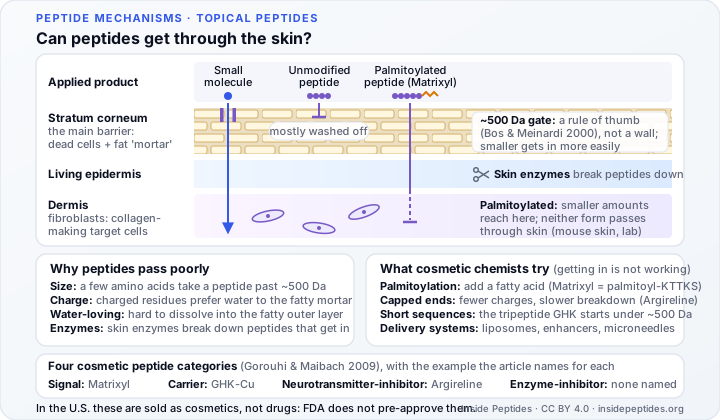
Human skin's first job is to keep water in and the outside world out. The layer that does most of this work is the stratum corneum, a thin sheet of flattened, dead skin cells (corneocytes) packed in layers of fats, often compared to bricks held together by mortar [1]. Below it lies the living epidermis, and below that the dermis, where collagen-producing cells called fibroblasts sit. Most anti-ageing peptides are meant to act on those deeper cells.
For a molecule applied to the skin, the main route in is to dissolve into and diffuse through the fatty mortar of the stratum corneum. That favours molecules that are small and moderately fat-soluble. Peptides tend to be the opposite: they are chains of amino acids that are often electrically charged and water-loving, and many are too large for easy passage [1]. Skin also contains enzymes that break down peptides, so a peptide that does get in may not stay intact [2].
2. The 500 Dalton rule and its limits
In 2000, dermatologists Jan Bos and Marcus Meinardi argued that a compound's molecular weight generally needs to be below about 500 daltons (a dalton is the unit used for the mass of molecules) to be absorbed through skin [3]. Their argument was observational: almost all common contact allergens, the most widely used topical medicines and the drugs then used in skin patches fall under that size, and larger molecules were not known to cause contact allergy, which suggested they cannot get in [3].
The rule is useful, but it is a rule of thumb rather than a physical wall. Absorption falls off steadily as size increases; it does not stop at one number, and other properties matter as well. A review of transdermal delivery describes first-generation skin patches as suited to drugs that are small and fat-soluble, and notes that larger molecules such as insulin generally need devices that disrupt the stratum corneum, such as microneedles, to get through [1].
For peptides the point is simple. A tripeptide such as GHK sits under the 500 dalton line. Argireline, a six-amino-acid peptide, and palmitoyl pentapeptide-4 (Matrixyl), a five-amino-acid peptide with a fatty acid attached, both sit well above it. Larger growth factors and proteins are far beyond it.
3. Size, charge and fat-solubility
Three properties do most of the work in deciding how far a molecule gets into skin [1]:
- Size. Bigger molecules diffuse more slowly through the packed fats of the stratum corneum. Each extra amino acid adds roughly 110 daltons on average, so peptides cross the 500 dalton mark quickly.
- Charge. Charged molecules prefer water and do not dissolve well in the fatty layers. Many cosmetic peptides contain charged amino acids; Argireline, for example, contains two glutamic acid and two arginine residues, which carry charges at skin pH.
- Lipophilicity. This is a molecule's preference for fat over water. Molecules need enough fat-solubility to enter the stratum corneum, but enough water-solubility to leave it again and move into the more watery living layers beneath. Very water-loving peptides struggle with the first step.
Direct measurements show what these properties mean in practice. In a study by FDA scientists, Argireline in a cosmetic emulsion was applied to human and hairless guinea pig skin in the laboratory. Most of it was washed off the surface. Less than one percent of the applied amount was found in the stratum corneum, about one hundredth of a percent reached the living epidermis, and none was detected in the dermis or in the fluid beneath the skin [4].
4. How cosmetic chemists try to get peptides in
Because unmodified peptides penetrate poorly, cosmetic chemists use several approaches [5]:
- Palmitoylation. Attaching palmitic acid makes a peptide more fat-soluble. Matrixyl is the collagen fragment KTTKS with a palmitoyl group added. In a laboratory study on hairless mouse skin, unmodified KTTKS was not detected in any skin layer, whereas the palmitoylated version was found in the stratum corneum, epidermis and, in smaller amounts, the dermis. Neither version passed all the way through the skin, and both were broken down quickly by skin enzymes, though the palmitoylated form lasted longer [2].
- Acetylation and amidation. Capping the ends of a peptide (as in Argireline's acetylated start and amidated end) removes charges and can slow breakdown by enzymes.
- Keeping peptides short. Very short sequences, such as the three-amino-acid GHK, start out below the 500 dalton line.
- Delivery systems. Liposomes, penetration enhancers and devices such as microneedles are used to get past the stratum corneum [1]. These change what a product delivers, so results from one formulation cannot be assumed for another.
These approaches can increase how much peptide is found in the upper skin layers. They do not show, on their own, that enough peptide reaches the target cells to produce a visible effect.
5. The four categories of cosmetic peptides
A widely cited review by Gorouhi and Maibach grouped topical anti-ageing peptides into four categories [5]:
- Signal peptides are intended to prompt skin cells to make more collagen or other structural proteins. Matrixyl (palmitoyl pentapeptide-4) is the leading example; its sequence comes from a fragment of type I procollagen that stimulated collagen and fibronectin production in cultured cells [6].
- Carrier peptides deliver trace metals that enzymes need. GHK-Cu, a copper complex of a three-amino-acid peptide, is the main example.
- Neurotransmitter-inhibitor peptides are designed to interfere with nerve signals to facial muscles. Argireline (acetyl hexapeptide-8) was designed to mimic part of SNAP-25, a protein nerve endings use to release signals, and reduced signal release in laboratory tests [7]. SNAP-8 is an extended version of the same sequence.
- Enzyme-inhibitor peptides are intended to slow enzymes that break down collagen or other skin proteins.
These labels describe what each peptide was designed to do, usually based on cell or biochemical experiments. They do not describe what has been shown in people. Argireline's proposed mechanism has a particular problem: it needs to reach nerve endings at the muscle, deep below the skin, while laboratory measurements found none in the dermis [4].
6. What the human evidence actually shows
Inside Peptides rates Matrixyl, Argireline and GHK-Cu as early human evidence and SNAP-8 as insufficient. The published trials explain why.
- Matrixyl. The main trial was a 12-week, double-blind, split-face study in 93 white women, comparing a moisturiser with and without palmitoyl pentapeptide-4. It reported improvement in wrinkles and fine lines measured from images [8]. The authors worked for Procter & Gamble, which sells products containing the ingredient.
- Argireline. The original report came from the team that designed the peptide, with a small group of volunteers and wrinkle measurements over about a month [7]. A randomized, placebo-controlled study in 60 Chinese participants lasted four weeks and reported improvements in wrinkle roughness [9]. Neither is long or large enough to show durable effects, and neither compares Argireline with botulinum toxin.
- GHK-Cu. In a randomized study of 13 patients after laser skin resurfacing, blinded evaluators and computer analysis found no difference in redness, wrinkles or overall skin quality between the copper peptide regimen and the comparison regimen, although patients using the copper peptide reported higher satisfaction [10]. A separate randomized, evaluator-blinded trial of a GHK-Cu wound gel in diabetic foot ulcers, published in 1994, reported faster ulcer closure [11]; that was a wound product tested on broken skin, not a cosmetic on intact skin.
- SNAP-8. Inside Peptides found no published peer-reviewed human trial testing SNAP-8 on its own. Headline wrinkle-reduction figures come from the ingredient supplier.
Common limitations run through this literature: small samples, short follow-up, outcomes based on skin images or self-assessment rather than tissue changes, multi-ingredient products that make it hard to isolate the peptide, and funding or authorship by companies with a commercial interest. None of this shows the peptides do nothing. It means the size and reliability of any effect are not well established.
7. Cosmetic or drug? The regulatory line
In the United States, the legal category of a product depends largely on its intended use, which is shown by the claims made for it. A cosmetic is intended to cleanse, beautify or alter appearance. A product intended to treat or prevent disease, or to affect the structure or any function of the body, is a drug, and drugs generally need FDA approval before sale [12].
Cosmetic products and ingredients, apart from color additives, do not need FDA approval before they go on the market [12]. This is why peptide skin-care products are typically described as reducing the appearance of fine lines rather than rebuilding collagen or relaxing muscles: a claim to change skin structure or block nerve signals could make the product an unapproved drug [12].
For readers, the practical consequence is that a peptide cream on sale has not been through the regulatory testing for effectiveness that an approved medicine has. Claims that a cream works "like Botox" or "rebuilds collagen" go beyond both the regulatory category and the published human evidence. Injecting cosmetic peptides is a separate matter: topical studies say nothing about injection safety, and FDA has raised concerns about injectable GHK-Cu (see the GHK-Cu profile).
Core Scientific Definitions
Precise biomedical definitions for terms used throughout this guide.
- Stratum corneum
- The outermost layer of the skin, made of flattened dead cells embedded in layers of fats; it is the main barrier that stops substances on the skin surface from entering the body.
- 500 Dalton rule
- A rule of thumb, proposed by Bos and Meinardi in 2000, that a compound generally needs a molecular weight below about 500 daltons to be absorbed through intact skin in meaningful amounts.
- Palmitoylation
- The chemical attachment of palmitic acid, a 16-carbon fatty acid, to a peptide to make it more fat-soluble and help it enter the fatty outer layers of the skin.
- Cosmetic peptide
- A short peptide used as an ingredient in a skin-care product sold as a cosmetic; it is not evaluated or approved as a medicine.
- Neurotransmitter-inhibitor peptide
- A cosmetic peptide designed to interfere, in laboratory tests, with the release of chemical signals from nerves to muscles, with the aim of softening expression lines; Argireline is the best-known example.
Peer-Reviewed References & Primary Sources
This educational guide is built strictly upon peer-reviewed literature, official regulatory guidance, and authoritative biochemical repositories.
-
Dermal Stability and In Vitro Skin Permeation of Collagen Pentapeptides (KTTKS and palmitoyl-KTTKS) Biomol Ther (Seoul) · 2014
-
The 500 Dalton rule for the skin penetration of chemical compounds and drugs Exp Dermatol · 2000
-
In vitro skin penetration of acetyl hexapeptide-8 from a cosmetic formulation Cutan Ocul Toxicol · 2015
-
Role of topical peptides in preventing or treating aged skin Int J Cosmet Sci · 2009
-
A pentapeptide from type I procollagen promotes extracellular matrix production J Biol Chem · 1993
-
A synthetic hexapeptide (Argireline) with antiwrinkle activity Int J Cosmet Sci · 2002
-
Topical palmitoyl pentapeptide provides improvement in photoaged human facial skin Int J Cosmet Sci · 2005
-
The anti-wrinkle efficacy of argireline, a synthetic hexapeptide, in Chinese subjects: a randomized, placebo-controlled study Am J Clin Dermatol · 2013
-
Effects of topical copper tripeptide complex on CO2 laser-resurfaced skin Arch Facial Plast Surg · 2006
-
Enhanced healing of ulcers in patients with diabetes by topical treatment with glycyl-l-histidyl-l-lysine copper Wound Repair Regen · 1994
-
Is It a Cosmetic, a Drug, or Both? (Or Is It Soap?) U.S. Food and Drug Administration · 2026
Educational Disclaimer: This guide is produced strictly for biomedical educational purposes and does not constitute medical advice, diagnosis, or treatment recommendations. Experimental peptides discussed herein may lack regulatory authorization for human clinical use. Consult a licensed medical practitioner before considering any therapeutic intervention.