
Evidence & Regulation Beginner

Peptide Dosing: Why There Is No Standard Dose for Unapproved Peptides

Looking for a peptide dosage chart or calculator? Why unapproved peptides such as BPC-157 have no tested human dose, how real doses are set, and the risks of guessing.

10 min read Updated 15 sources InsidePeptides Editorial Team

Hands holding a clear 96-well plate filled with coloured samples in a bright laboratory
Photo: Jaime Neto, CC BY-SA 4.0, via Wikimedia Commons.

Plain-English Summary

A medicine's dose is not a guess: it is worked out step by step in human trials, starting with cautious dose-escalation studies, then dose-ranging trials that compare several doses, and finally large trials of the chosen dose, which is then written into the approved label. Unapproved peptides such as BPC-157 have never been through that process, so no tested human dose exists. Online dosing charts and calculators are usually built from animal studies, which do not convert reliably to people, or from personal anecdote. Guessing adds further risks, including products of unknown purity and strength, contamination, and measuring errors of the kind the FDA has reported with compounded semaglutide. InsidePeptides publishes no doses for any peptide; dosing of approved medicines is a matter for the prescriber and the label.

Key Takeaways

  • For approved medicines, the dose comes from a sequence of human trials and is printed in the prescribing information; it is not derived from a formula.
  • Phase 1 trials raise doses cautiously to find what is tolerated; phase 2 trials compare several doses to find which balance benefit and harm; phase 3 trials confirm the chosen dose.
  • Animal doses do not translate reliably to people. FDA guidance uses animal data only to choose a cautious starting point for a first human trial, not a treatment dose.
  • BPC-157 and most other peptides sold online have no completed controlled human trials, so any “standard dose” quoted online has no trial basis.
  • Guessing a dose compounds other unknowns: the product's real identity, purity and strength, contamination, and simple measuring mistakes.
  • The FDA has reported hospitalisations linked to dosing errors with compounded semaglutide, including confusion between different ways of measuring a dose.
  • InsidePeptides publishes no doses. Questions about the dose of an approved medicine belong with the prescriber, the pharmacist and the label.
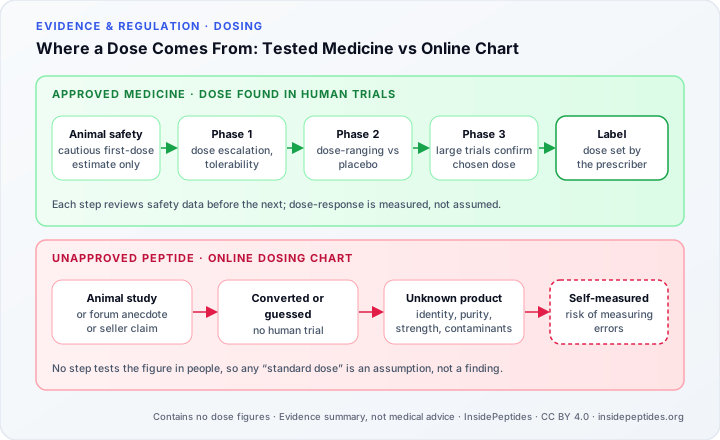
Diagram comparing two paths to a dose. Upper path, how an approved medicine's dose is set: animal safety studies give a cautious starting point; phase 1 trials escalate doses carefully in people; phase 2 trials compare several doses; phase 3 trials confirm the chosen dose; the dose is written on the approved label and used by a prescriber. Lower path, how an online dosing chart is made: animal studies or anecdote are converted or guessed, applied to a product of unknown identity, purity and strength, and measured by the user, with no human trial at any step.
An approved medicine’s dose is the end product of a sequence of human trials. An online dosing chart for an unapproved peptide skips every human step. Contains no dose figures. Diagram by InsidePeptides, CC BY 4.0: free to reuse with a credit and link. Download SVG

Why this site has no peptide dosage chart

There is no standard dose for unapproved peptides such as BPC-157, TB-500 or MOTS-c, because no one has done the human trials needed to find one. A dose is not a property of a molecule that can be looked up or calculated. It is the result of a long, structured series of studies in people that tests what range is tolerated, which amount gives the best balance of benefit and harm, and how that varies between people.

Searches for “peptide dosage”, “peptide dosage chart” and “peptide calculator” are among the most common on this topic. This guide answers the question behind them: where would a reliable dose come from, and why the numbers circulating online do not meet that standard. It deliberately contains no doses, measurements, schedules or calculations, and InsidePeptides does not publish them for any peptide, approved or not.

The reasons are straightforward. For unapproved peptides, there is no trial-based figure to report, and repeating an untested number would lend it authority it does not have. For approved peptide medicines, a tested dose does exist, but the right dose for a person depends on their condition, other medicines, kidney function, side effects and response, and the label sets out how a prescriber adjusts it. That is a clinical decision, not something a reference website can make. The difference between the two groups is explained in Approved vs Unapproved Peptides.

How doses are established for medicines

Finding a dose is one of the main jobs of drug development. The general process is described in Peptide Drug Development and How Clinical Trials Work; the dose-related steps are summarised here.

Before people: animal safety studies

Laboratory and animal studies identify how a compound behaves and the highest exposure that caused no significant harm in each species. FDA guidance explains how developers use those findings, with a deliberate safety margin, to choose a cautious starting dose for the very first human trial in healthy volunteers [1].

Phase 1: dose escalation

Small groups of volunteers receive the starting dose, and later groups receive higher doses only after the safety data from earlier groups have been reviewed. The aim is to learn how the body handles the drug and what range is tolerated, not whether it works. This caution exists because animal data cannot rule out serious reactions in people. In the first-in-human trial of TGN1412 (an antibody, not a peptide), every volunteer who received a single dose developed a severe inflammatory reaction within hours and became critically ill [3]. Events like this are why first doses are kept low and raised only in steps.

Phase 2: dose-ranging

Patients with the target condition are randomly assigned to several different doses, often with a placebo, so that researchers can see how benefit and side effects change as the dose changes. The international guideline on dose-response information, adopted by U.S., European and Japanese regulators, explains why this is needed: historically, some medicines were first marketed at doses later recognised as excessive, sometimes with harmful consequences, and dose-ranging early in development helps avoid building a database of ineffective or excessive doses [2]. Semaglutide's development for obesity included exactly such a randomised, placebo-controlled, dose-ranging phase 2 trial before the large phase 3 programme [6].

Phase 3 and the label

Large randomised trials then test the chosen dose or doses against placebo or existing treatment. If a regulator approves the medicine, the tested dosing, including how to start, how to increase and when to adjust or stop, is written into the prescribing information. The Wegovy label, for example, sets out a gradual dose-escalation schedule and instructions for what to do if side effects are not tolerated [7]. What approval means is covered in What FDA Approval Means.

Why animal doses don’t convert to human doses

Most online peptide charts trace back to doses used in rats or mice. Converting those to a human dose is not reliable, for several reasons.

  • Scaling by body weight is wrong. Small animals clear drugs much faster relative to their size than people do. Simply multiplying an animal dose by human body weight can give a figure that is far too high, which is why pharmacologists have warned against it [4].
  • Better scaling still gives only a starting estimate. Methods based on body surface area, described in the FDA's 2005 guidance and in practice guides, are designed to estimate a cautious first dose for a phase 1 trial [1][5]. The FDA guidance applies a safety factor because of uncertainties such as differences between human and animal receptor sensitivity, and it covers only the starting dose for a first trial in healthy volunteers; it states that it does not address dose escalation or maximum doses, let alone what dose would treat a condition [1].
  • Species differ in biology. Receptors, enzymes, immune responses and the way a peptide is absorbed and broken down can all differ between species. A peptide that acts strongly in rats may act weakly, differently or not at all in people (see Human vs Preclinical Research).
  • Animal studies test different things. They often use injection routes, injury models and durations that do not match how a product is used by people, and many use a wide range of doses without establishing which one would suit a human condition.

BPC-157 illustrates the problem. Its pharmacokinetics have been described in rats and dogs [8], and a systematic review of its use in orthopaedic sports medicine found that almost all of the evidence came from preclinical studies, with only a single small clinical study [9]. None of that work establishes a human dose.

Online dosing charts and calculators: what they are based on

Online “dosage charts” for peptides such as BPC-157, TB-500, ipamorelin or MOTS-c usually present a confident-looking figure and schedule. When their sources can be traced at all, they tend to come from one of three places: animal studies converted to human figures, personal experience posted on forums or social media, or a seller's marketing material. None of these is a human dose-finding trial.

The human evidence for BPC-157 shows how thin the base is. A systematic review published in October 2026 searched the medical literature and trial registries and found only a few small human studies, all judged to be of poor methodological quality, with the overall certainty of evidence rated very low. The authors concluded that BPC-157 should not be used clinically outside ethically approved, regulated, high-quality trials [10]. The largest of those studies was a retrospective review of knee injections, with no control group [11]. None was a randomised trial designed to find a dose.

Regulators have reached the same conclusion from a safety angle. The FDA lists BPC-157 among bulk substances that may present significant safety risks in compounding, noting a possible risk of immune reactions, complexities with peptide-related impurities, and that it has identified no, or only limited, safety information, so the agency “lacks sufficient information to know whether the drug would cause harm when administered to humans” [12]. Its dated legal history is set out in Is BPC-157 Legal?.

“Peptide calculators” add a further layer. They convert a chosen dose into a volume to draw from a vial, which assumes that the starting figure is valid and that the vial contains exactly what its label says. As the next section explains, neither assumption is safe for unapproved products. A precise calculation applied to an untested figure and an unverified product produces precision without accuracy. Combining several such peptides compounds the uncertainty (see Peptide Stacks).

The risks of guessing a dose

A guessed dose carries the uncertainty of the figure itself plus every uncertainty about the product and how it is measured.

  • Purity and identity. Peptides sold outside the medicine supply chain are not made under pharmaceutical quality controls. A certificate of analysis from the seller is not an independent guarantee (see Peptide Purity and Certificate of Analysis).
  • Strength that does not match the label. When researchers bought semaglutide from illegal online pharmacies and tested it, the vials were judged probably substandard or falsified: the measured amount of semaglutide differed from the labelled amount, and the measured purity fell far short of the purity claimed on the label [13]. If the strength is wrong, every calculated dose is wrong.
  • Contamination. The same study found bacterial endotoxin in every vial tested [13]. Synthetic peptides can also carry related impurities from manufacture (see Peptide Impurities).
  • Measuring errors. In 2024 the FDA warned of adverse events, some needing hospital care, linked to dosing errors with compounded semaglutide. Patients drew up several times the intended amount from multiple-dose vials, and clinicians miscalculated doses. The FDA said confusion between different ways of measuring a dose, unfamiliar syringes and varying product concentrations contributed [14]. A poison control centre separately reported cases of large accidental overdoses of compounded semaglutide, with nausea, vomiting and abdominal pain lasting days [15]. If such errors occur with a medicine that has a tested dose and a prescriber, the risk is greater when the figure itself is a guess.

Semaglutide is an approved medicine, and these problems arose with compounded or illegally sold versions rather than with the approved pens. The same lessons apply even more strongly to unapproved peptides, where neither the product nor the dose has been tested. Compounding rules are explained in Compounded Peptides and the FDA's recent policy in Compounded Semaglutide and Tirzepatide Explained.

What to ask a prescriber

For an approved peptide medicine, the dose is set by a licensed prescriber using the label and the person's own circumstances. Useful questions to ask include:

  • Is this an FDA-approved product, a compounded product, or something else, and why was that option chosen?
  • How will the dose be started and changed over time, and what should prompt a change?
  • Exactly how is each dose measured? Is it a prefilled pen, or a vial and syringe, and how exactly do the instructions express each dose?
  • Which side effects are expected, which are warning signs, and who should be contacted about them?
  • What should happen if a dose is missed or the medicine needs to be stopped?
  • How does this medicine interact with other medicines, supplements or health conditions?

Pharmacists can also check how a dose should be measured and whether the product supplied matches the prescription. If a clinic or website offers an unapproved peptide, it is reasonable to ask what human trial evidence supports its use and its dose, and whether it is legally supplied. The answer for most peptides sold online is that no such trial exists (see Are Peptides Legal? and Are Peptides Safe?). Suspected side effects of any medicine can be reported to the FDA's MedWatch programme.

Frequently asked questions

What is the correct dosage for BPC-157?

No tested human dose exists. BPC-157 has no completed controlled human trials, the few human reports are small and of poor quality [10], and the FDA says it lacks sufficient information to know whether it would cause harm in people [12]. Figures quoted online are not based on trials.

Is there a reliable peptide dosage chart?

Not for unapproved peptides. A reliable dose comes from dose-escalation and dose-ranging trials in people [1][2], and those trials have not been done. For approved medicines, the dosing is in the official prescribing information and is applied by a prescriber.

Can you convert an animal peptide dose to a human dose?

Not reliably. Scaling methods exist, but they are designed to pick a cautious starting point for a first human trial, not a treatment dose [1][4], and species differences can make predictions badly wrong [3].

Are peptide calculators accurate?

A calculator can only convert a chosen dose into a volume. It cannot make an untested dose valid, and it assumes the product's strength matches its label, which testing of illegally sold peptides has shown may not be true [13].

Why doesn't InsidePeptides list doses?

For unapproved peptides there is no trial-based dose to report. For approved medicines, dosing depends on the individual and is a decision for the prescriber, guided by the label. Publishing figures would invite the kind of self-measured dosing that has led to reported errors and hospital care [14].

Where can I find the dose of an approved peptide medicine?

In the official prescribing information and from the prescriber or pharmacist, who can explain how it applies to a particular person. Approved peptide medicines are listed in Approved Peptide Medicines.

Core Scientific Definitions

Precise biomedical definitions for terms used throughout this guide.

Dose escalation
A phase 1 trial design in which small groups of volunteers receive progressively higher doses, with safety reviewed before each step, to find the range people can tolerate.
Dose-ranging trial
A trial, usually phase 2, that randomly assigns participants to several different doses and often a placebo, to see how benefit and side effects change with dose.
Dose-response
The relationship between the amount of a drug given and the size of its effects, both wanted and unwanted. Regulators expect it to be characterised before approval.
Human equivalent dose
An estimate, made by scaling an animal dose to human body size, used to pick a cautious starting dose for a first-in-human trial. It is not an estimate of an effective or safe treatment dose.
Prescribing information (label)
The official document for an approved medicine that sets out its approved uses, dosing, warnings and side effects, based on the evidence the regulator reviewed.

Peer-Reviewed References & Primary Sources

This educational guide is built strictly upon peer-reviewed literature, official regulatory guidance, and authoritative biochemical repositories.

  1. Guidance for Industry: Estimating the Maximum Safe Starting Dose in Initial Clinical Trials for Therapeutics in Adult Healthy Volunteers U.S. Food and Drug Administration, Center for Drug Evaluation and Research. Guidance for Industry, July 2005. U.S. Food and Drug Administration · 2005
  2. Dose-Response Information to Support Drug Registration (E4) International Conference on Harmonisation. ICH Harmonised Tripartite Guideline E4, Step 4 version, 10 March 1994. International Council for Harmonisation (ICH) · 1994
  3. Cytokine storm in a phase 1 trial of the anti-CD28 monoclonal antibody TGN1412 Suntharalingam G et al. N Engl J Med 2006;355:1018-28. PMID: 16908486. N Engl J Med · 2006
  4. Dose translation from animal to human studies revisited Reagan-Shaw S, Nihal M, Ahmad N. FASEB J 2008;22:659-61. PMID: 17942826. FASEB J · 2008
  5. A simple practice guide for dose conversion between animals and human Nair AB, Jacob S. J Basic Clin Pharm 2016;7:27-31. PMID: 27057123. J Basic Clin Pharm · 2016
  6. Efficacy and safety of semaglutide compared with liraglutide and placebo for weight loss in patients with obesity: a randomised, double-blind, placebo and active controlled, dose-ranging, phase 2 trial O'Neil PM et al. Lancet 2018;392:637-49. PMID: 30122305. Lancet · 2018
  7. WEGOVY (semaglutide) prescribing information Novo Nordisk. Wegovy (semaglutide) injection and tablets prescribing information, DailyMed, revised June 2026, accessed 17 October 2026. DailyMed, U.S. National Library of Medicine · 2026
  8. Pharmacokinetics, distribution, metabolism, and excretion of body-protective compound 157, a potential drug for treating various wounds, in rats and dogs He L et al. Front Pharmacol 2022;13:1026182. PMID: 36588717. Front Pharmacol · 2022
  9. Emerging Use of BPC-157 in Orthopaedic Sports Medicine: A Systematic Review Vasireddi N et al. HSS J 2025;21:485-95. PMID: 40756949. HSS J · 2025
  10. Human evidence for BPC-157 in orthopaedic and regenerative medicine: a systematic review of efficacy and safety Poolton JT, Minett J, Kazmi A. Acta Orthop Belg 2026;92(3). PMID: 42885452. Acta Orthop Belg · 2026
  11. Intra-Articular Injection of BPC 157 for Multiple Types of Knee Pain Lee E, Padgett B. Altern Ther Health Med 2021;27:8-13. PMID: 34324435. Altern Ther Health Med · 2021
  12. Certain Bulk Drug Substances for Use in Compounding that May Present Significant Safety Risks U.S. Food and Drug Administration. Certain bulk drug substances for use in compounding that may present significant safety risks, content current as of 22 April 2026, accessed 17 October 2026. U.S. Food and Drug Administration · 2026
  13. Multifactor Quality and Safety Analysis of Semaglutide Products Sold by Online Sellers Without a Prescription: Market Surveillance, Content Analysis, and Product Purchase Evaluation Study Ashraf AR et al. J Med Internet Res 2024;26:e65440. PMID: 39509151. J Med Internet Res · 2024
  14. FDA alerts health care providers, compounders and patients of dosing errors associated with compounded injectable semaglutide products U.S. Food and Drug Administration. Drug safety alert, content current as of 26 July 2024, accessed 17 October 2026. U.S. Food and Drug Administration · 2024
  15. Administration errors of compounded semaglutide reported to a poison control center-Case series Lambson JE, Flegal SC, Johnson AR. J Am Pharm Assoc (2003) 2023;63:1643-5. PMID: 37392810. J Am Pharm Assoc (2003) · 2023
Written By InsidePeptides Editorial Team
Review Status Scientific review pending
Last Updated
Last Evidence Review Pending verification

Educational Disclaimer: This guide is for education only and is not medical advice, diagnosis or treatment. Many peptides discussed here are not approved for human use. Talk to a licensed clinician before making any health decision.