
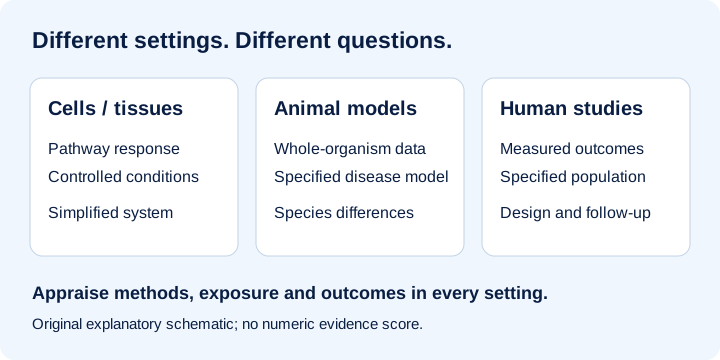
Why an animal finding is not a human result
Animal studies can show what happens in a particular model; they cannot establish that the same treatment benefits people. Species, disease models, exposure, outcomes and study methods can all differ. A positive finding can justify further research without establishing a useful medicine.
Comparing animal studies vs human trials requires checking both biological relevance and research quality. Preclinical translation means carrying a finding from laboratory work toward an answer in people. It is uncertain, rather than a guaranteed progression. [1]
Keep the distinction between evidence quality and regulatory approval: neither an animal result nor a registered human study is a marketing authorization.
What each research setting can answer
| Setting | Useful question | Important limit |
|---|---|---|
| Cell or tissue experiment | Does a compound affect the measured pathway under these conditions? | The concentration or simplified system may differ from a living patient. |
| Animal experiment | What happens to exposure, an outcome or toxicity in this species and model? | The disease, metabolism and measured outcome may not match people. |
| Early human study | What initial tolerability, exposure or biological response is observed? | Short follow-up or healthy volunteers may not answer treatment-benefit questions. |
| Controlled human trial | How do outcomes compare in a specified population? | The comparator, missing data, bias and follow-up still constrain conclusions. |
In vitro means outside a living organism; in vivo means within one, including humans. The study's methods establish which setting was used. Trial phases describe development questions; they do not supply a certainty score. [2]
Five differences to check before generalizing
The model and the patient may have different diseases
A deliberately induced injury or a missing gene can isolate a mechanism. A patient may instead have a longstanding disease, other conditions and other treatments. Ask which aspect of the human condition the model reproduces and which it leaves out.
The body may handle the compound differently
Pharmacokinetics means how the body absorbs, distributes and removes a substance. An animal's exposure cannot be inferred from a human product's label or vice versa. Delivery route, formulation and measured concentration matter; a milligram-per-kilogram calculation alone does not establish a safe human regimen.
A laboratory outcome may be distant from a patient benefit
A hormone concentration, tissue stain or molecular marker can support a biological explanation. It does not automatically demonstrate pain relief, restored function, fewer hospitalizations or longer life.
Methods can make a promising signal less dependable
Check allocation methods, blinded outcome assessment, exclusions and the actual experimental unit. Ten measurements from one animal are not ten independent animals. The ARRIVE 2.0 reporting guidance identifies essential details, including sample size, randomization and blinding. Reporting compliance alone does not prove biological relevance. [3]
The published record can be incomplete
Selective reporting or missing negative findings can distort the apparent pattern. Look for independent replication and systematic searches rather than counting only the positive papers in a promotional reference list. [1]
Worked peptide example: CJC-1295 and the outcome gap
A 2006 mouse study examined CJC-1295 in animals genetically lacking growth hormone-releasing hormone. It reported normalization of growth and body composition in that deficiency model. That answers a question about those mice, not whether the compound improves health or recovery in otherwise healthy adults. [4]
A separate 2006 human report described two randomized, placebo-controlled, double-blind studies lasting 28 and 49 days in healthy adults aged 21–61. It measured hormone responses and the compound's behavior in the body. Growth hormone and IGF-I increased; the report did not establish longer life, injury healing or athletic benefit. [5]
The two reports illustrate a change in population and outcome. They are not a demonstration that an animal effect failed, or that a human benefit was established. Do not transfer their results to differently named formulations without confirming compound identity. Read the CJC-1295 dossier for compound-specific context.
Sometimes findings agree; sometimes they do not
A 2007 systematic comparison examined animal and clinical evidence for six interventions. It found agreement for some questions and discordance for others, including corticosteroids in traumatic head injury and tirilazad in stroke. The authors identified bias and imperfect disease models as possible explanations. This was not a peptide-specific failure-rate survey. [1]
A useful assessment therefore asks why a model is informative for a particular question. It should neither dismiss all animal work nor treat it as direct clinical proof. Historical findings are examples of translation problems, not estimates of how often a new peptide will succeed.
A checklist for a claim based on animal research
- Find the original paper and identify species, model, sex and sample size.
- Identify the exact compound, formulation, route and measured exposure.
- Name the outcome and distinguish mechanism from meaningful clinical benefit.
- Check controls, randomization, blinding, exclusions and independent replication.
- Find human studies separately, including their comparator, duration and limitations.
- Write the conclusion at the level actually supported: for example, “improved the measured outcome in this mouse model.”
For the next steps, use the clinical trial search walkthrough and the worked results-table guide. A lack of adequate human evidence leaves a question unresolved; it does not establish either benefit or safety.
Core Scientific Definitions
Precise biomedical definitions for terms used throughout this guide.
- In Vitro
- Latin for "in glass." Biological experiments conducted outside a living organism in controlled laboratory equipment, such as cultured cells, receptor-binding assays, or test tubes.
- In Vivo
- Latin for "in the living." Biological experiments conducted within whole living organisms, such as laboratory mice, rats, rabbits, or humans.
- Randomized Controlled Trial (RCT)
- A prospective study in which human participants are randomly allocated to receive either the experimental intervention or a control (placebo/standard of care), minimizing selection bias.
- Surrogate Endpoint
- A laboratory measurement or physical sign used as a substitute for a clinically meaningful medical endpoint (e.g., measuring an enzyme level instead of actual patient survival or functional recovery).
Peer-Reviewed References & Primary Sources
This educational guide is built strictly upon peer-reviewed literature, official regulatory guidance, and authoritative biochemical repositories.
-
Comparison of treatment effects between animal experiments and clinical trials: systematic review BMJ · 2007
-
ARRIVE guidelines 2.0: animal research reporting checklist (PDF) NC3Rs / ARRIVE · 2020
-
Once-daily administration of CJC-1295, a long-acting growth hormone-releasing hormone (GHRH) analog, normalizes growth in the GHRH knockout mouse American Journal of Physiology, Endocrinology and Metabolism · 2006
-
Prolonged stimulation of growth hormone (GH) and insulin-like growth factor I secretion by CJC-1295, a long-acting analog of GH-releasing hormone, in healthy adults Journal of Clinical Endocrinology & Metabolism · 2006
Educational Disclaimer: This guide is produced strictly for biomedical educational purposes and does not constitute medical advice, diagnosis, or treatment recommendations. Experimental peptides discussed herein may lack regulatory authorization for human clinical use. Consult a licensed medical practitioner before considering any therapeutic intervention.