
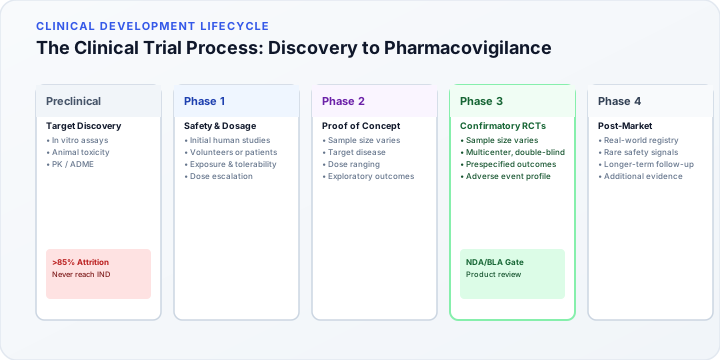
What each phase can establish
A phase is a study's purpose, not a certificate that a peptide works. Phase 1 mainly investigates initial safety and how the body handles a substance. Phase 2 explores treatment effects and dose selection. Phase 3 seeks confirmatory evidence in a defined population. Studies can combine phases, and sample sizes vary. [1]
| Phase | Main questions | What it cannot establish alone |
|---|---|---|
| 1 | Initial tolerability, exposure, and biological effects in the studied people | Reliable treatment benefit or long-term safety |
| 2 | Whether there is a useful signal, which exposures to investigate, and further safety information | That an exploratory result will replicate or merits approval |
| 3 | Confirmatory benefits and harms against the chosen comparator | Identical effects in excluded populations or absence of rare harm |
| 4 | Additional evidence after approval, including longer-term and broader use | That every safety question has been settled |
FDA describes typical phase sizes; these are educational examples rather than fixed requirements. The real sample size should be taken from the specific study. Phase 4 occurs after approval, so it is inaccurate to say that four phases must be completed before a medicine can be approved.
Phase 1: a hormone response is not a treatment result
Teichman and colleagues' 2006 CJC-1295 study used two randomized, placebo-controlled, double-blind ascending-exposure trials lasting 28 and 49 days. It studied healthy adults aged 21–61 and measured drug handling and growth hormone/IGF-1 responses. [2]
Pharmacokinetics means absorption, distribution, breakdown, and removal. Pharmacodynamics means the effects a substance produces in the body. The observed hormone changes did not establish injury healing, longevity, or meaningful body-composition benefits. The study also cannot validate differently formulated products marketed as “CJC-1295 no DAC.” Read the compound dossier for its evidence limitations.
Phase 2: exploratory evidence can be substantial without being final
O'Neil and colleagues' 2018 semaglutide phase 2 obesity trial randomized 957 participants, comparing several treatment groups with liraglutide and placebo over 52 weeks. This is a useful counterexample to treating “a few hundred participants” as a hard phase 2 limit. [3]
The trial investigated weight change and tolerability across exposures. It helped answer development questions, but later trials still needed to test confirmatory hypotheses. Its once-daily semaglutide study regimen is historical research context, not instructions for current marketed products. No experimental dosing protocol is supplied here.
Phase 3: read the endpoint, comparator, and uncertainty
The 2021 STEP 1 trial randomized 1,961 adults without diabetes and followed the treatment comparison for 68 weeks. Both groups received lifestyle intervention. It evaluated defined weight outcomes in participants who met eligibility criteria, rather than a universal benefit from all peptides. [4]
A well-designed phase 3 study can support a strong conclusion about its specified question. A small effect, imprecise estimate, negative primary outcome, missing data, or an unsuitable comparator can still limit what a phase 3 label tells you. Regulatory review considers the complete application, including manufacturing and safety; trial phase alone is not approval.
Primary outcomes and changes to the plan
A primary endpoint is a main outcome defined in the study plan. Secondary and exploratory outcomes answer additional questions. Compare the registry, protocol, analysis plan, and paper; record changes and their timing. A transparent, justified amendment is not automatically invalid, but an unplanned favorable subgroup should not be promoted as the original main finding.
STEP 1's public protocol and analysis plan provide an actual example. The protocol includes both percentage weight change and the proportion achieving a specified weight-loss threshold as primary endpoints. Reading only one endpoint can leave an incomplete picture. [5]
Participant protection and what permission means
Ethical and regulatory oversight protects participants and evaluates whether research may proceed. It does not certify that an experimental treatment will benefit them. Informed consent communicates the study and its uncertainties; monitoring plans depend on the study. FDA can impose a clinical hold when its criteria are met. [1]
Likewise, an investigational application is different from marketing approval. Avoid reading “FDA-authorized trial” as “FDA-approved treatment.”
How to verify the phase and findings
Open the original NCT record, check study type, recorded phase, actual versus estimated enrollment, primary outcomes, posted results, and publication links. “Completed” describes conduct, not success. A registered plan cannot supply findings that have not been reported.
Use the expanded ClinicalTrials.gov search walkthrough, then compare findings with the evidence framework. For an individual decision, clinical benefit, harms, current approved use, and personal circumstances all matter.
Core Scientific Definitions
Precise biomedical definitions for terms used throughout this guide.
- Primary Endpoint
- The principal result that is measured at the end of a study to see if a given treatment worked, pre-specified before trial unblinding.
- Institutional Review Board (IRB)
- An independent committee formally designated to review, approve, and monitor biomedical research involving human subjects to protect their rights and welfare.
- Data and Safety Monitoring Board (DSMB)
- An independent group of clinical experts that monitors patient safety and treatment efficacy data while a trial is ongoing.
Peer-Reviewed References & Primary Sources
This educational guide is built strictly upon peer-reviewed literature, official regulatory guidance, and authoritative biochemical repositories.
-
CJC-1295 initial human pharmacology Journal of Clinical Endocrinology & Metabolism · 2006
-
STEP 1: Research Study Investigating How Well Semaglutide Works in People Suffering From Overweight or Obesity ClinicalTrials.gov · 2026
Educational Disclaimer: This guide is produced strictly for biomedical educational purposes and does not constitute medical advice, diagnosis, or treatment recommendations. Experimental peptides discussed herein may lack regulatory authorization for human clinical use. Consult a licensed medical practitioner before considering any therapeutic intervention.