
1. Overview & Definition
In biochemistry, a peptide is a chemical polymer formed by linking amino acids together in a specific sequence through covalent bonds. If amino acids are considered the alphabet of biological chemistry, a peptide is a precise word, while a protein is a complex paragraph or entire book [1].
Peptides exist in every organ system of the human body. They serve as endocrine hormones circulating in the bloodstream, local paracrine modulators signaling to neighboring cells, neurotransmitters orchestrating neurological circuits, and antimicrobial defense shields on mucosal barriers [2].
Historically, the International Union of Pure and Applied Chemistry (IUPAC) and the International Union of Biochemistry and Molecular Biology (IUBMB) define peptides as molecules containing two or more amino acids joined by peptide bonds, typically encompassing chains up to approximately 50 residues in length [1]. Beyond this threshold, molecules generally take on the stable three-dimensional folded configurations characteristic of proteins.
2. The Molecular Building Blocks
All biological peptides are assembled from amino acids. In standard terrestrial biology, 20 canonical amino acids are genetically encoded into ribosomal translation, with two additional non-standard amino acids (selenocysteine and pyrrolysine) incorporated under specialized conditions [3].
Every amino acid shares a fundamental molecular architecture centered around an alpha-carbon (Cα) atom, to which four chemical groups are attached:
- A basic amino group (-NH₂), which is protonated to -NH₃⁺ at physiological pH.
- An acidic carboxyl group (-COOH), which is deprotonated to -COO⁻ at physiological pH.
- A hydrogen atom (-H).
- A variable side chain (the R group), which confers distinct physical and chemical characteristics, such as hydrophobic, hydrophilic, positively charged, negatively charged, or aromatic properties.
The specific linear sequence of these R groups dictates the three-dimensional flexibility, receptor affinity, enzymatic vulnerability, and solubility of the resulting peptide molecule [4].
3. How Peptide Bonds Form
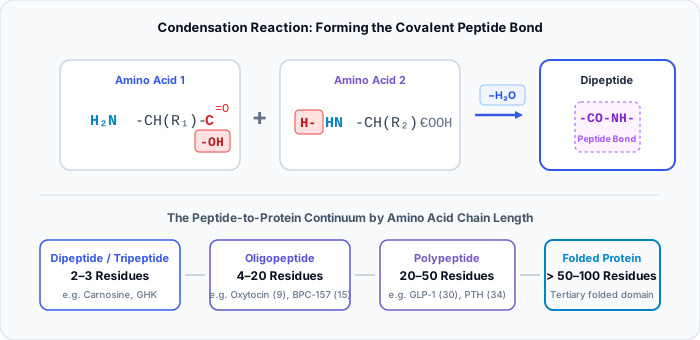
Peptide chains grow through a fundamental biochemical reaction known as a condensation or dehydration synthesis reaction. In this process, the nucleophilic alpha-amino nitrogen of an incoming amino acid attacks the electrophilic carboxyl carbon of the preceding amino acid [1].
This reaction expels one molecule of water (H₂O) and establishes a covalent amide bond (-CO-NH-), termed a peptide bond. Because of resonance delocalization between the carbonyl double bond and the nitrogen lone pair, the peptide bond possesses partial double-bond character (approximately 40%), restricting rotation around the C-N axis and locking the bond into a predominantly planar trans configuration [3].
This rigid planar geometry, combined with free rotational freedom around the adjacent Cα-N (phi) and Cα-C (psi) bonds, allows peptide chains to sample dynamic conformational ensembles, enabling rapid induced-fit binding to target receptors.
4. The Peptide-to-Protein Continuum
The scientific boundary between a peptide and a protein is based on chain length, molecular mass, and structural folding complexity, though the exact numerical cutoff varies between biochemical and regulatory contexts [5]:
- Dipeptides and Tripeptides (2–3 amino acids): Extremely short molecules such as carnosine (beta-alanyl-L-histidine) or glutathione (gamma-glutamyl-cysteinyl-glycine).
- Oligopeptides (4–20 amino acids): Short chains including oxytocin (9 amino acids), vasopressin (9 amino acids), and experimental research compounds like BPC-157 (15 amino acids).
- Polypeptides (20–50 amino acids): Intermediate chains including glucagon-like peptide-1 (GLP-1, 30–31 amino acids), adrenocorticotropic hormone (ACTH, 39 amino acids), and parathyroid hormone (PTH 1-34, 34 amino acids).
- Folded Proteins (>50–100 amino acids): Macromolecules with defined tertiary 3D cores, such as human serum albumin (585 amino acids) or monoclonal IgG antibodies (~1,300 amino acids across 4 chains).
The U.S. Food and Drug Administration (FDA) draws a formal statutory line: polymers composed of 40 or fewer amino acids are regulated under the Federal Food, Drug, and Cosmetic Act (FD&C Act), while polymers exceeding 100 amino acids are classified as biological products regulated under the Public Health Service Act (PHS Act) [5]. For an in-depth analysis, explore our dedicated comparison guide: Peptides vs Proteins.
5. Natural vs Synthetic Peptides
Understanding the distinction between endogenous peptides and synthetic analogues is essential for navigating scientific literature and therapeutic pharmacology:
A molecule's origin does not determine its product category. Compare peptide supplements, approved medicines, and research products to understand how formulation, evidence, and regulatory review differ. For benefit claims, read what human evidence can establish about peptide effectiveness.
Natural (Endogenous) Peptides: Produced inside living cells through ribosomal translation of messenger RNA (mRNA), followed by enzymatic post-translational processing by convertases inside the endoplasmic reticulum and Golgi apparatus. Endogenous peptides typically exhibit rapid circulating turnover (half-lives measured in minutes), ensuring that endocrine signals can be precisely switched off [6].
Synthetic Peptides: Assembled in laboratory facilities using chemical manufacturing protocols. The advent of Solid-Phase Peptide Synthesis (SPPS), pioneered by Robert Bruce Merrifield in 1963 (for which he was awarded the 1984 Nobel Prize in Chemistry), enabled the rapid, automated construction of peptides with identical sequence to native hormones, or engineered with unnatural amino acids, D-stereoisomers, cyclization bridges, or fatty acid lipid chains [7].
6. Biological Roles in the Human Body
Peptides participate in virtually all physiological homeostatic systems. Key biological functional classes include:
- Endocrine Hormones: Long-distance signaling molecules secreted by endocrine glands into the circulatory system to orchestrate energy balance and metabolism (e.g., insulin, glucagon, GLP-1, and GIP) [6].
- Neuropeptides: Chemical messengers produced by neurons to modulate synaptic transmission, pain threshold, appetite, and emotional state (e.g., endorphins, enkephalins, substance P, and neuropeptide Y).
- Antimicrobial Host-Defense Peptides (AMPs): Cationic, amphipathic peptides produced by epithelial cells and neutrophils that physically disrupt microbial cell membranes (e.g., defensins and LL-37/cathelicidin) [8].
- Vasoactive Regulators: Peptides governing arterial tone and renal hemodynamics, such as angiotensin II, bradykinin, and atrial natriuretic peptide (ANP).
For an organ-by-organ map with examples, see where peptides are naturally found in the human body.
To examine the full taxonomy of biological and structural classes, consult our guide on Types of Peptides.
7. Therapeutic Peptides as Medicines
Peptide therapeutics represent one of the fastest-growing categories of modern medicine. Since the clinical introduction of animal-derived insulin in 1921, more than 80 peptide drugs have received formal regulatory approval from the U.S. FDA, European Medicines Agency (EMA), and other global health authorities [4].
Peptides offer several distinct clinical advantages over traditional small-molecule drugs:
- High Target Specificity: Peptides mimic natural evolutionary ligands, binding their cognate receptors with nanomolar or picomolar affinity, dramatically reducing off-target toxicities.
- Low Tissue Accumulation: Peptides are metabolized by ubiquitous proteases and peptidases into harmless standard amino acids, avoiding the toxic metabolic intermediates common to small-molecule xenobiotics.
- Lower Immunogenicity than Large Biologics: Small peptides rarely elicit neutralizing antibody responses compared to large recombinant proteins or therapeutic antibodies [4].
Modern peptide drug design has overcome historical limitations in metabolic stability through engineering strategies such as fatty-acid acylation (e.g., semaglutide, tirzepatide), enabling weekly dosing intervals for major metabolic conditions [6]. Explore our Metabolic Peptides Research Area for detailed clinical trial data.
8. Common Misconceptions: What Peptides Are Not
Due to widespread marketing on unregulated online forums and commercial clinics, peptides are frequently surrounded by scientific misinformation. Clear distinctions are vital:
- Peptides are NOT anabolic steroids: As established above, peptides are hydrophilic amino acid chains that bind cell-surface GPCRs, whereas steroids are lipophilic cholesterol derivatives acting on intracellular nuclear receptors. Their pharmacological effects, safety profiles, and mechanisms are entirely distinct.
- Peptides are NOT dietary protein shakes: Dietary protein is digested non-specifically in the stomach and small intestine into free amino acids and di/tripeptides by pepsin, trypsin, and chymotrypsin. Orally consumed signaling peptides are almost entirely denatured and destroyed in the gastrointestinal tract, rendering them inactive unless formulated with specialized permeation enhancers or protected by oral delivery carriers [4].
- Peptides are NOT universal "regen" panaceas: Unregulated internet vendors frequently describe experimental research fragments as "miracle healing peptides." In reality, each compound has narrow, specific receptor interactions, and the vast majority of preclinical animal findings do not translate into clinical efficacy in humans [9]. Read our detailed analysis: Human vs Preclinical Research.
Core Scientific Definitions
Precise biomedical definitions for terms used throughout this guide.
- Peptide
- A biological compound composed of two or more amino acid residues linked by amide (peptide) bonds, generally containing fewer than 50 amino acids.
- Amino Acid
- The organic monomeric building block of peptides and proteins, containing an amine group (-NH₂), a carboxylic acid group (-COOH), and a variable side chain (R group).
- Peptide Bond
- A covalent amide linkage (-CO-NH-) formed by a dehydration/condensation reaction between the carboxyl carbon of one amino acid and the alpha-amino nitrogen of another.
- Endogenous
- Originating or produced naturally from within an organism, tissue, or cell (for example, native insulin produced by pancreatic beta cells).
- Solid-Phase Peptide Synthesis (SPPS)
- A chemical manufacturing method invented by Robert Bruce Merrifield where peptide chains are assembled stepwise on an insoluble polymeric resin support.
Peer-Reviewed References & Primary Sources
This educational guide is built strictly upon peer-reviewed literature, official regulatory guidance, and authoritative biochemical repositories.
-
Nomenclature and Symbolism for Amino Acids and Peptides (IUPAC-IUBMB Joint Commission on Biochemical Nomenclature) Pure and Applied Chemistry · 1984 · 56(5): 595–624
-
Therapeutic peptides: Historical perspectives, current development trends, and future directions Bioorganic & Medicinal Chemistry · 2018 · 26(10): 2700–2707
-
Lehninger Principles of Biochemistry (8th Edition) Macmillan Learning · 2021 · Chapter 3: Amino Acids, Peptides, and Proteins
-
Peptide therapeutics: current status and future directions Drug Discovery Today · 2015 · 20(1): 122–128
-
Definition of the Term "Biological Product" (Final Rule / Guidance for Industry) U.S. Food and Drug Administration (FDA) CDER · 2020 · 21 CFR Part 600 / Federal Register 85 FR 10057
-
Mechanisms of Action and Therapeutic Application of Glucagon-like Peptide-1 Cell Metabolism · 2018 · 27(4): 740–756
-
Solid Phase Peptide Synthesis. I. The Synthesis of a Tetrapeptide Journal of the American Chemical Society · 1963 · 85(14): 2149–2154
-
Antimicrobial peptides of multicellular organisms Nature · 2002 · 415(6870): 389–395
-
Why 90% of clinical drug development fails and how to improve it Acta Pharmaceutica Sinica B · 2022 · 12(7): 3049–3062
Educational Disclaimer: This guide is produced strictly for biomedical educational purposes and does not constitute medical advice, diagnosis, or treatment recommendations. Experimental peptides discussed herein may lack regulatory authorization for human clinical use. Consult a licensed medical practitioner before considering any therapeutic intervention.