
Peptide Side Effects: What Users Report and What the Evidence Shows
People report migraines, fatigue and hospital stays after unapproved peptides. What FDA and published case reports show, what is unknown, and what to do.

Key takeaways
- Most reports of harm from unapproved peptides are anecdotes or unverified FDA database entries.
- FDA found too little human data to describe BPC-157’s safety; melanotan II has published case reports of serious harm.
- If you react to a peptide, tell your doctor exactly what you used and report it to MedWatch or Yellow Card.
In this article
On 13 October 2026, KFF Health News and The Washington Post published accounts from people who say unapproved peptides harmed them: months of fatigue and anxiety after BPC-157, a two-month migraine with facial numbness, and two women intubated after injections at an anti-aging conference.1 These stories are appearing while US officials discuss making some of these peptides easier to obtain.2
Personal accounts cannot prove that a peptide caused a symptom. But they are not nothing either. This article sets out what users report, what FDA's reviewers and the published medical literature actually show, which risks are documented and which are unknown, and what to do if you have a reaction. It gives no dosing information and is not medical advice.
The short version
- Reports of harm are growing, but most are anecdotes or brief, unverified entries in FDA's adverse event database.13
- For BPC-157, FDA found three adverse event reports and no published case reports up to December 2025, and said there is "insufficient clinical safety information to characterize the safety profile".3 Absence of reports is not evidence of safety: pharmacies that compound these products "generally do not report adverse events to FDA."3
- Some unapproved peptides do have documented serious harms. Melanotan II has published case reports of rhabdomyolysis, priapism, brain swelling (PRES) and changes in moles, including melanoma.45,6,7,8,9,10
- Products bought online add a second risk. Laboratory tests of semaglutide from illegal online sellers found low purity, wrong amounts and bacterial endotoxin in every vial tested.11
- If you have a reaction, tell a doctor what you injected, and report it to FDA MedWatch (US) or the Yellow Card scheme (UK).1213
What users are reporting
The KFF Health News investigation, written by Amy Maxmen and republished by The Washington Post, describes several people who used unapproved peptides1:
- Months of symptoms after BPC-157. Dylan Meetze said that after three days of a nasal BPC-157 product, "It was like I was underwater, like it took the most to do anything." He reported fatigue, anxiety and eye and muscle twitching for months.
- Severe migraine. A 46-year-old man who combined BPC-157 with TB-4 (the so-called "Wolverine Stack") developed "an excruciating migraine within days". He said: "My left eye started throbbing really badly, and the left side of my face became numb."
- Self-injection from a "not for human use" seller. A woman who used BPC-157 and retatrutide stopped when she felt pain: "I sought out this substance from a lab that clearly labeled it not for human use, purchased a syringe, and injected this in my kitchen."
- Hospital admissions. At an anti-aging conference in Las Vegas in summer 2025, "two women were rushed to the hospital and intubated after being injected with experimental peptides and vitamins", according to citations issued by Nevada's state pharmacy board.
Earlier reporting found similar patterns. A February 2026 investigation for Undark and STAT described online posts reporting a full-body itch, intense anxiety and anhedonia (an inability to feel pleasure) after BPC-157, while noting that "it can be hard to determine what link — if any — exists."14 An emergency physician and toxicologist told ABC7 in April that "almost all" such peptides "lack high-quality human data, especially long-term safety data."15
How to read these stories: they are signals worth investigating, not proof. People who feel unwell after a product are more likely to speak out, and symptoms like fatigue, anxiety and headache have many causes. The problem is that, for most of these peptides, there are no controlled human trials that could tell us how often such effects happen.
What FDA's reviewers found
FDA's briefing documents for its July 2026 advisory committee are the most detailed official safety review of BPC-157. They reported3:
- Three adverse event reports. A search of FDA's Adverse Event Reporting System (FAERS) up to 4 December 2025 found three reports, all involving injectable products: an injection-site reaction, shortness of breath that led to an emergency-room visit, and darkening of the skin and gums. FDA said "it is unclear whether these AEs were attributable to BPC-157."
- No published case reports. "We did not identify any case reports associated with BPC-157 published in the literature."
- Immune reactions. "BPC-157 may pose a significant risk for immunogenicity, potentially amplified by aggregation as well as potential peptide-related impurities." See our guide to immunogenicity.
- Missing quality tests. On the certificate of analysis submitted with the nomination, "there were no testing results for" aggregates, bioburden or bacterial endotoxin.
- Bottom line. "There is insufficient clinical safety information to characterize the safety profile of BPC-157."
KFF Health News found more recent FAERS reports, including a 36-year-old woman who was hospitalised in December after taking BPC-157 for weight control and a skin disorder. It stresses that such reports "are brief, unverified, and voluntary."1
FDA's public safety page also summarises risks for several other peptides4:
| Peptide | What FDA says |
|---|---|
| BPC-157 | Limited safety information; FDA "lacks sufficient information to know whether the drug would cause harm when administered to humans" |
| TB-500 | "FDA has not identified any human exposure data" |
| GHK-Cu (injectable) | May pose risk of immune reactions from aggregation and impurities; "limited data in humans" |
| Melanotan II | Published case reports of "melanoma, posterior reversible encephalopathy syndrome, sympathomimetic toxidrome and priapism" |
| CJC-1295 | Serious adverse events "including increased heart rate and systemic vasodilatory reaction" |
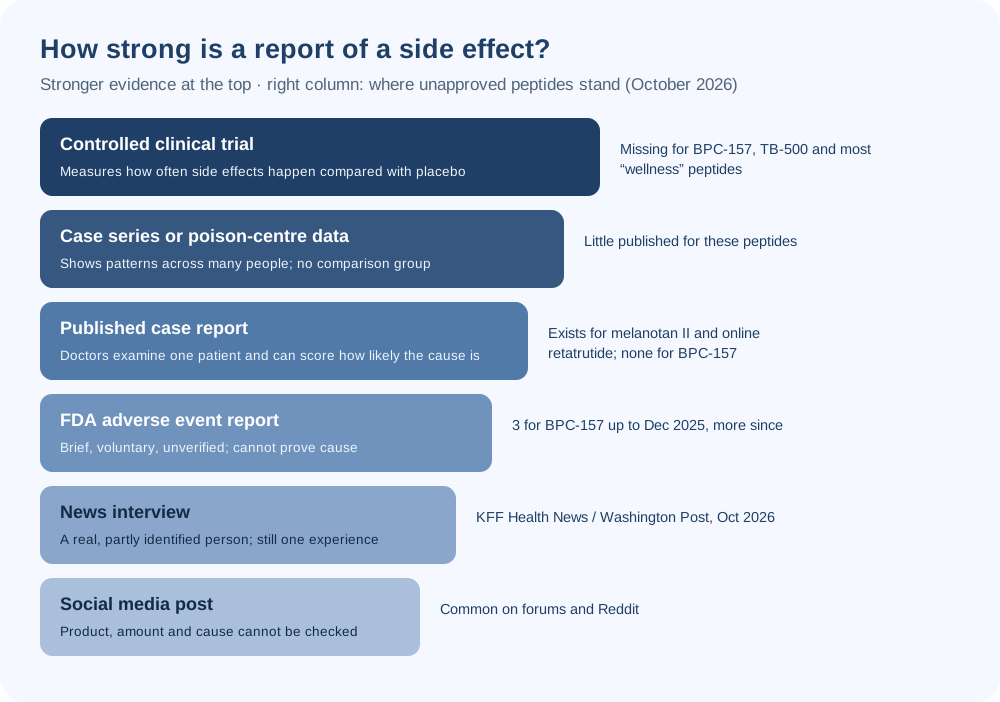
Why so little is known
There are almost no human trials. ECRI and the Institute for Safe Medication Practices (ISMP) found that for BPC-157, "35 of 36 published studies were conducted in animals, with no published Phase 1 human safety data."16 Phase 1 trials are where a drug's basic human safety is first measured. Read more in human vs preclinical research.
Reactions are rarely reported. Compounding pharmacies are generally not required to report adverse events to FDA, and people buying "research" products have no prescriber or pharmacist in the loop.3 People may also not think of an injection from a wellness clinic as a medicine. A Swiss case report this month described a woman whose cause of severe vomiting was found only after "repeated, non-judgemental" questioning revealed injections of a product said to contain retatrutide, given by "a self-described life coach without medical qualification".17
Slow harms take time to appear. Brian Lee, an advisory committee member who voted against the peptides in July, said that without clinical studies, harms that take time to develop, such as liver damage and cancer, might not be spotted for years.1
Documented harms: what the medical literature shows
Some unapproved peptides do have published, peer-reviewed reports of harm. Case reports cannot show how common a side effect is, but they show what can happen.
Melanotan II (sold as a "tanning" injection) has the longest record:
- Rhabdomyolysis and kidney problems: a case of "sympathomimetic symptoms, rhabdomyolysis, and renal dysfunction" after an internet-bought product confirmed as melanotan II by laboratory testing.5
- Priapism: at least two case reports of painful, prolonged erections, one requiring surgery.67
- Moles and melanoma: reports of new moles appearing and existing moles darkening within 24 hours of an injection, and of melanoma in users.89 Causation is hard to prove: one 2026 report of five melanomas also involved tanning-bed use.10
- Brain swelling: a report of posterior reversible encephalopathy syndrome (PRES).18
Retatrutide bought online is an investigational drug with large phase 3 trials, but products sold as "research peptides" are not the trial drug. Two 2026 case reports describe severe vomiting after unverified products17 and, in a man with type 1 diabetes, vomiting, diarrhoea, high ketones and acute kidney injury, although an infection was also present and "causation cannot be established".19 See our retatrutide profile for the trial data.
Semaglutide from unregulated sources has caused harms that FDA has tracked. FDA has received reports of patients taking "five to 20 times more than the intended dose" of compounded semaglutide, with nausea, vomiting, fainting, pancreatitis and gallstones among the effects.20 Counterfeit semaglutide has also been linked to euglycemic ketoacidosis in an 18-year-old.21
Product quality: a second, separate risk
A peptide's own effects are one risk. What is actually in the vial is another.
When researchers bought semaglutide from illegal online pharmacies and tested it, "endotoxin was detected in all samples", purity ranged from 7.7% to 14.37%, and the amount of drug was 28.56% to 38.69% higher than labelled. The branded pens they ordered never arrived.11 The study tested only three vials, so it cannot say how common these problems are, but each is a serious safety issue for an injection.
No peer-reviewed laboratory survey of BPC-157, TB-500 or GHK-Cu products had been published as of October 2026. FDA's review found that the certificate of analysis supplied for BPC-157 did not include endotoxin or sterility-related testing.3 Our guides to what a certificate of analysis can and cannot show, peptide impurities and what "research use only" means explain why this matters.
What has not been shown
To keep the picture balanced:
- No reliable rates. Without controlled trials, nobody knows how often BPC-157, TB-500 or most similar peptides cause any given side effect.
- No proof of causation in most reports. FDA itself said it could not attribute the BPC-157 reports to the drug.3
- Contamination vs. the peptide. Supporters argue that poor manufacturing, not the peptides themselves, causes harm.1 That may be true for some reports, but it cannot be checked without quality-controlled products and proper studies, and it does not make an unregulated product safer for the person injecting it.
If you think a peptide has made you unwell
- Get medical help for serious symptoms. In the US, call 911 for collapse, seizures or trouble breathing. For advice, US Poison Help is free and confidential on 1-800-222-1222.12
- Tell the clinician exactly what you used, including the product name, where it came from and the label. Bring the vial if you can. Doctors may not ask about peptides unless you mention them.17
- Report it. In the US, use FDA MedWatch. In the UK, use the MHRA Yellow Card scheme.13 Reports are how regulators spot problems, especially for products with no trial data.
- Keep the product. If it is tested, the result can show whether the problem was the peptide or a contaminant.
Frequently asked questions
Does BPC-157 have side effects?
Nobody knows how often it causes side effects, because it has not been tested in published human safety trials. FDA has received a small number of adverse event reports, and users describe symptoms including fatigue, anxiety and migraine, but none has been shown to be caused by BPC-157.13 Read our BPC-157 evidence profile.
Are peptides from a compounding pharmacy safer than "research" peptides?
A licensed pharmacy should use better-controlled ingredients and sterile methods than an anonymous online seller. But compounded drugs are not FDA-approved, and pharmacy quality does not create the human safety data that is missing. See compounded peptides.
Would FDA approval of compounding make these peptides safe?
No. The July 2026 advisory vote and the reported plan for temporary sales concern access, not safety. FDA's own reviewers recommended against all seven peptides reviewed.23 See our explainers on the panel vote and the temporary sales plan.
References
- Maxmen A. People Say These Peptides Hurt Them. Their Stories Are Muffled in MAHA's Push for Medical Freedom. KFF Health News, 13 October 2026. Also published by The Washington Post as "Some who have taken hyped, unregulated peptides have regrets" (subscription).
- Roubein R. The Trump administration is paving way for temporary sale of some unapproved peptides. The Washington Post, 7 October 2026 (syndicated by the Anchorage Daily News).
- FDA. Briefing document: BPC-157-related bulk drug substances. Pharmacy Compounding Advisory Committee, 23–24 July 2026.
- FDA. Certain bulk drug substances for use in compounding that may present significant safety risks. Content current as of 22 April 2026.
- Nelson ME, et al. Melanotan II injection resulting in systemic toxicity and rhabdomyolysis. Clin Toxicol (Phila). 2012. PMID: 23121206. doi:10.3109/15563650.2012.740637.
- Mallory CW, et al. Melanotan tanning injection: a rare cause of priapism. Sex Med. 2021. PMID: 33460908. doi:10.1016/j.esxm.2020.100298.
- Dreyer BA, et al. Melanotan-induced priapism: a hard-earned tan. BMJ Case Rep. 2019. PMID: 30796078. doi:10.1136/bcr-2018-227644.
- Schulze F, et al. Eruptive naevi and darkening of pre-existing naevi 24 h after a single mono-dose injection of melanotan II. Eur J Dermatol. 2014. PMID: 24334249. doi:10.1684/ejd.2013.2227. See also Cousen P, et al. Eruptive melanocytic naevi following melanotan injection. Br J Dermatol. 2009. PMID: 19575725.
- Paurobally D, et al. Melanotan-associated melanoma. Br J Dermatol. 2011. PMID: 21564053. doi:10.1111/j.1365-2133.2011.10273.x.
- Vadner DJ, et al. Five primary melanomas in situ in a patient with recent tanning bed use, melanotan exposure, and anabolic hormone use. JAAD Case Rep. 2026. PMID: 42328529. doi:10.1016/j.jdcr.2026.05.009.
- Ashraf AR, et al. Multifactor quality and safety analysis of semaglutide products sold by online sellers without a prescription. J Med Internet Res. 2024. PMID: 39509151. doi:10.2196/65440.
- Poison Control, National Capital Poison Center. poison.org. Poison Help line 1-800-222-1222.
- FDA. MedWatch: The FDA Safety Information and Adverse Event Reporting Program. MHRA. Yellow Card.
- Talpos S. BPC-157: The peptide with big claims and scant evidence. Undark, republished by STAT, 3 February 2026.
- Dador D. As unregulated peptides grow in popularity, doctors warn of unknown risks. ABC7, 24 April 2026.
- ECRI and ISMP. Patients using wellness peptides have no reliable information about whether they are safe or effective. 5 May 2026.
- Buzzi RM, Huber LC. Emerging risks of health optimisation: refractory nausea associated with peptide injections reported to contain retatrutide. BMJ Case Rep. 2026;19(10):e276106. PMID: 42843917. doi:10.1136/bcr-2026-276106.
- Kaski D, et al. Melanotan and the posterior reversible encephalopathy syndrome. Ann Intern Med. 2013. PMID: 23648958. doi:10.7326/0003-4819-158-9-201305070-00020.
- Branine N. Online-sourced retatrutide complicating impending diabetic ketoacidosis in a patient with type 1 diabetes and concurrent Shigella gastroenteritis. Cureus. 2026;18(8):e115260. PMID: 42669023. doi:10.7759/cureus.115260.
- FDA. FDA alerts health care providers, compounders and patients of dosing errors associated with compounded injectable semaglutide products. 26 July 2024.
- Sterckx M, De Keyser L. Euglycemic ketoacidosis following the use of counterfeit semaglutide for weight loss. Cureus. 2026. PMID: 41773123. doi:10.7759/cureus.102627.


