

Evidence & Regulation Beginner

Are Peptides Legal? How the Rules Work in the US, UK, EU, Australia and Canada

Whether a peptide is legal depends on the product, its claims and the country. How approval, compounding, research-use-only labels, imports and sport rules work.

10 min read Updated 20 sources InsidePeptides Editorial Team

A dark wooden gavel with a gold band resting on its round sound block
Photo: Blogtrepreneur, CC BY 2.0, via Wikimedia Commons.

Plain-English Summary

There is no single answer to whether peptides are legal, because the law treats peptide products according to what they are and how they are marketed, not because they are peptides. Approved peptide medicines such as insulin and semaglutide are legal on prescription. Compounded peptides are allowed only within narrow pharmacy rules and are not FDA-approved. Unapproved peptides sold for human use, including those labelled “research use only”, are treated as unapproved drugs in the US and as unlawful in Canada, Australia and New Zealand. Cosmetics with peptide ingredients are legal if they make no drug claims, and sport has its own stricter bans. This guide is general information, not legal advice.

Key Takeaways

  • Whether a peptide product is legal depends on what the product is, what claims are made for it and which country you are in, not on the fact that it contains a peptide.
  • Approved peptide medicines, such as insulin, semaglutide, tirzepatide and teriparatide, are legal and normally supplied on prescription; many peptides promoted online, such as BPC-157 and TB-500, have no approved product.
  • In the US, compounded drugs are not FDA-approved, and pharmacies may compound from a bulk peptide only if it meets the conditions in section 503A or 503B, such as being on the relevant bulks list.
  • A “research use only” label does not make supply for human use lawful: FDA, Health Canada, the TGA and Medsafe have all said so.
  • FDA says importing drugs for personal use is illegal in most circumstances, with discretion only in narrow cases.
  • On 17 October 2026, FDA’s proposed interim access policy for compounding certain peptides was still under White House review and unpublished, so the legal position had not changed.
  • Sport rules are separate and stricter: BPC-157 is banned at all times, and from 1 January 2027 WADA names peptides in general under its S0 class.
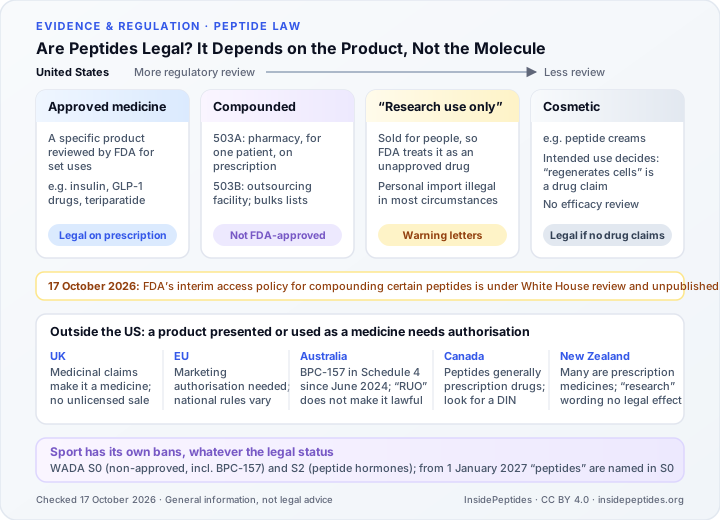
Diagram: four kinds of peptide product and how the law treats each one in the United States (approved medicines, compounded medicines, unapproved products sold for human use, cosmetics), with a summary of the UK, EU, Australia, Canada and New Zealand and a note on sport.
How the law sorts peptide products: approval, compounding, unapproved products and cosmetics, with the position in other countries and sport. Status checked on 17 October 2026; general information, not legal advice. Diagram by InsidePeptides, CC BY 4.0: free to reuse with a credit and link. Download SVG

The short answer: it depends on what the product is

“Peptide” describes a type of molecule, not a legal category. Insulin, semaglutide and the copper peptide in a face cream are all peptides, yet the law treats them very differently. Whether a peptide product is legal depends mainly on three things: what the product is, what claims are made for it, and where you are.

In most countries the rules sort peptide products into a few broad groups:

  • Approved medicines. A specific product has been reviewed and authorised by a regulator for a specific use, and is normally supplied on prescription.
  • Compounded medicines. A pharmacy prepares a medicine for an individual patient under rules that are narrower than many people assume. In the United States, compounded drugs are not FDA-approved [1].
  • Unapproved products sold for human use. This includes vials labelled “research use only”. Regulators in the US, Canada, Australia and New Zealand have said the label does not make supply for human use lawful [6] [15] [17] [18].
  • Cosmetics. Skin products containing peptide ingredients can be sold as cosmetics, provided they are not marketed with drug claims [8].

Sport has its own, stricter rules that apply whatever a product’s legal status (see section 7). This guide explains each group in plain terms. It is general information, not legal advice. Laws differ between countries and, in the US and Australia, between states, and they change; for a decision about your own situation, ask a qualified lawyer or the relevant regulator.

United States: approved peptide medicines

The clearest legal route is an FDA-approved drug product. Approval covers a particular product from a particular manufacturer for the uses on its label; it is not a blanket approval of a molecule. Our guide to what FDA approval means explains what that review involves.

Which peptides are FDA approved? Many peptide medicines are, including insulin products for diabetes, GLP-1 receptor agonists such as semaglutide, the dual agonist tirzepatide, teriparatide for osteoporosis and octreotide for certain hormone-secreting tumours. Our FDA-approved peptides registry lists them, and Approved Peptide Medicines explains how they were developed.

Many of the peptides promoted online for recovery, anti-ageing or muscle growth, such as BPC-157 and TB-500, are not approved. FDA’s page on bulk substances that may present significant safety risks in compounding sets out concerns about both, including possible immune reactions and impurities, and for TB-500 it says it “has not identified any human exposure data” [5].

Does peptide therapy require a prescription? For approved peptide medicines such as semaglutide and tirzepatide, yes: FDA advises patients to get a prescription from their doctor and fill it at a state-licensed pharmacy [7]. A prescription does not turn an unapproved substance into an approved one, however. A doctor may prescribe an approved drug “off-label”, but that is different from prescribing a substance that has no approved product at all.

United States: compounded peptides, the bulks lists and Categories 1 and 2

Compounding means a pharmacy prepares a medicine itself, often from a raw “bulk drug substance”. FDA states plainly that compounded drugs are not FDA-approved, which means FDA does not verify their safety, effectiveness or quality before they are marketed [1]. Two sections of the Federal Food, Drug, and Cosmetic Act set the rules.

  • Section 503A covers state-licensed pharmacies and physicians compounding for an “identified individual patient based on the receipt of a valid prescription order” [2]. A 503A pharmacy may use a bulk substance only if it has a USP or National Formulary monograph, is a component of an FDA-approved drug, or appears on a list FDA develops through regulations, known as the 503A bulks list [2].
  • Section 503B covers registered “outsourcing facilities”, which can make larger batches. Their bulk substances must generally be on a separate list of substances for which FDA has found a “clinical need”, set through Federal Register notices with a public comment period, or be used for a drug on FDA’s shortage list [3].

While nominated substances are being evaluated, FDA sorts them into categories. Under its January 2025 interim policy for 503A compounding, Category 1 substances “may be eligible for inclusion on the 503A bulks list”, and FDA does not intend to take action against compounding with them while specified conditions are met. Category 2 covers substances for which FDA “has identified significant safety risks”, so that policy does not extend to them [4].

Category labels can change, and leaving one list is not the same as joining another. BPC-157, for example, was removed from Category 2 in April 2026 after its nominations were withdrawn, but that did not place it in Category 1 or on the bulks list. Our dated BPC-157 timeline sets out each step. For the safety side of compounding, see compounded peptides, and for the end of bulk compounding of semaglutide and tirzepatide, see our explainer on FDA’s plan.

United States: “research use only”, buying and importing

Many unapproved peptides are sold online in vials labelled “research use only” or “not for human consumption”. FDA looks past the label to the evidence of intended use. In an August 2026 warning letter to an online seller, FDA said that “despite statements on your product labeling” of that kind, evidence from the company’s website established that its products were “intended to be drugs for human use”. The letter cited the provisions on unapproved new drugs, which prohibit introducing them into interstate commerce [6]. FDA has issued similar warnings about semaglutide and tirzepatide labelled “for research purposes” but sold to consumers for human use [7]. Our guide to what “research use only” means covers the label in more detail.

Is buying peptides illegal in the US? The federal provisions FDA cites in these letters are aimed mainly at people who make, market, ship or sell unapproved drugs [6]. Importing is treated more strictly: FDA says that “in most circumstances, it is illegal for individuals to import drugs or devices into the U.S. for personal use” [9]. Its staff may use discretion in narrow cases, for example where a drug treats a serious condition for which effective treatment may not be available in the US, the product does not pose an unreasonable risk and the quantity is generally no more than a three-month supply [9]. Products that appear to be for commercial distribution can be refused [9]. State laws may add further restrictions. None of this is a safety assessment: an unapproved product’s contents, purity and sterility are unverified, as our guides to peptide purity and peptide testing explain.

Where things stand on 17 October 2026

On 14 October 2026, FDA sent a document titled “Interim Access Policy for Compounding Using Certain Peptides” to the White House Office of Information and Regulatory Affairs for review. The official listing describes it as a “Notice” that is not economically significant, and on 17 October 2026 it was still shown as pending review [10]. The Associated Press reported, citing two people familiar with the plan, that it is intended to let pharmacies temporarily compound some popular peptides, including BPC-157, and that the filing “doesn’t give specifics” [11].

As of that date, the text had not been published and no Federal Register notice had appeared. Nothing about the legal status of these peptides has changed yet, and even if the policy takes effect, compounded peptides would still not be FDA-approved [1]. Our explainer on the interim access plan and our report on the July 2026 advisory committee vote will be updated as official documents appear.

Peptides in cosmetics

Peptides are common ingredients in skin creams and serums. Under US law, whether a product is a cosmetic or a drug “is determined by a product’s intended use”, which FDA judges from label and advertising claims, consumer perception and ingredients with well-known therapeutic uses [8].

A cream marketed to improve the look of skin can be a cosmetic. A product whose claims describe a therapeutic effect can be treated as a drug even if it is marketed as a cosmetic. FDA’s examples of claims that make a product a drug include regrowing hair, reducing cellulite, changing skin pigment production and regenerating cells [8].

So a peptide face serum is not illegal because it contains a peptide. What matters is how it is presented. The cosmetic route also says nothing about effectiveness: cosmetics do not go through drug approval. Our guide to topical peptides and the skin reviews what the evidence shows for ingredients such as GHK-Cu and Matrixyl.

UK, EU, Australia, Canada and New Zealand

Outside the US the details differ, but the same basic idea applies: a product presented or used as a medicine needs authorisation, and a “research” label does not change that.

United Kingdom

Under the Human Medicines Regulations 2012, a “medicinal product” includes any substance “presented as having properties of preventing or treating disease in human beings”, as well as substances used to restore, correct or modify a physiological function. A person “may not sell or supply, or offer to sell or supply, an unauthorised medicinal product”, and a prescription-only medicine may be sold or supplied only on a prescription from an appropriate practitioner [12]. A narrow exemption allows unlicensed “specials” to be supplied to meet the special needs of an individual patient, made to a prescriber’s specification [12]. In April 2026 the Medicines and Healthcare products Regulatory Agency (MHRA) said that if clinics offering peptide injections “make medicinal claims for those treatments, the products will be considered medicines”, and that it “will take action” against clinics breaching the law [13].

European Union

EU law says that no medicinal product may be placed on the market of a member state without a marketing authorisation, granted either nationally or through the EU’s centralised procedure [14]. Member states may exempt products supplied for an individual patient’s special needs, on a bona fide unsolicited order from an authorised health professional [14]. Prescription rules, pharmacy rules and enforcement are largely national, so the practical position varies between countries.

Australia

The Therapeutic Goods Administration (TGA) says that peptide products are regulated as therapeutic goods, and that unapproved peptide products are those not included in the Australian Register of Therapeutic Goods. It names BPC-157, GHK-Cu, TB-500, retatrutide and CJC-1295 as examples [15]. The TGA states that “research use only” disclaimers do not make supply lawful, that poorly labelled products “will not be considered for release” under the Personal Importation Scheme, and that advertising prescription-only medicines to the public is prohibited [15]. Australia controls many medicines through the schedules of the Poisons Standard; BPC-157 was added to Schedule 4, prescription-only medicines, from 1 June 2024 [16].

Canada

Health Canada says that “in Canada, peptides are generally regulated as prescription drugs”, that “unauthorized drug products are illegal in Canada”, and that “For Research Use Only” labels do not make them legal. Authorised prescription drugs carry an eight-digit Drug Identification Number (DIN), which can be checked in Health Canada’s Drug Product Database [17].

New Zealand

Medsafe says that under the Medicines Act 1981 many peptide products are prescription medicines, and that it is unlawful to import, supply, possess or procure prescription medicines unless this is authorised. It describes the “for research purposes only” wording as having “no legal effect” [18].

Peptides in sport

Anti-doping rules are separate from medicines law. A substance can be lawful to prescribe and still banned in sport. The World Anti-Doping Agency (WADA) Prohibited List has two classes that matter most for peptides [19]:

  • S0, non-approved substances: substances with no current approval for human therapeutic use. BPC-157 is named here and is prohibited at all times, in and out of competition.
  • S2, peptide hormones, growth factors, related substances and mimetics: this class includes growth hormone, its fragments and releasing factors, as well as testosterone-stimulating peptides in males.

The rules are tightening. The US Anti-Doping Agency (USADA) says that on the 2027 list, which takes effect on 1 January 2027, “peptides” in general are named as prohibited substances in the S0 class, and that a peptide not specifically named may still be prohibited [20]. Athletes are strictly liable for what is in their system [20]. See our pages on WADA peptide rules and peptides and athletes.

Frequently asked questions

Are peptides legal in the US?

Some are, as approved prescription medicines. Others can be compounded only if they meet the rules in section 503A or 503B. Unapproved peptides marketed for human use, including those labelled “research use only”, are treated by FDA as unapproved drugs [2] [3] [6].

Are peptides FDA approved?

Specific peptide medicines are, including insulin products, semaglutide, tirzepatide and teriparatide. Many peptides promoted online, such as BPC-157 and TB-500, are not, and compounded versions of any peptide are not FDA-approved [1] [5].

Is buying peptides illegal?

In the US, federal law mainly targets those who make, market and sell unapproved drugs, but FDA says importing drugs for personal use is illegal in most circumstances [6] [9]. In New Zealand, Medsafe says it is unlawful to procure or possess prescription medicines without authorisation [18]. Rules differ by country and state, so this is not legal advice.

Are peptides legal in the UK?

Licensed peptide medicines are, on prescription where required. Unlicensed products presented with medicinal claims are treated as medicines, which may not be sold or supplied without authorisation [12] [13].

Are peptides legal in Australia or Canada?

Approved peptide medicines are. The TGA and Health Canada both say that unapproved peptide products cannot be lawfully supplied for human use, and that “research use only” labels do not change that [15] [17].

Are peptides banned in sport?

Many are. BPC-157 is prohibited at all times under WADA’s S0 class, growth hormone-related peptides fall under S2, and from 1 January 2027 peptides in general are named under S0 [19] [20].

Core Scientific Definitions

Precise biomedical definitions for terms used throughout this guide.

Approved medicine
A specific drug product that a regulator such as FDA, the MHRA, the European Commission, the TGA or Health Canada has authorised for specific uses after reviewing evidence of its quality, safety and effectiveness.
Compounding
The preparation of a medicine by a pharmacy or outsourcing facility, often from a raw bulk substance. In the US, compounded drugs are not FDA-approved and must meet the conditions of section 503A or 503B of the Federal Food, Drug, and Cosmetic Act.
503A bulks list
A list, created by FDA through regulations, of bulk drug substances that 503A pharmacies may use even though they have no USP monograph and are not part of an approved drug.
Category 1 and Category 2
Interim FDA groupings for nominated bulk substances still under evaluation. FDA does not intend to act against compounding with Category 1 substances when its conditions are met; Category 2 substances are those for which FDA has identified significant safety risks.
Personal importation policy
FDA guidance on when its staff may use discretion not to refuse drugs imported for an individual’s own use. FDA says such imports are illegal in most circumstances; the discretion is limited and not a right.

Peer-Reviewed References & Primary Sources

This educational guide is built strictly upon peer-reviewed literature, official regulatory guidance, and authoritative biochemical repositories.

  1. Compounding and the FDA: Questions and Answers U.S. Food and Drug Administration. Content current as of 16 September 2025. U.S. Food and Drug Administration · 2025
  2. 21 U.S. Code § 353a: Pharmacy compounding 21 U.S.C. § 353a (section 503A of the Federal Food, Drug, and Cosmetic Act). Legal Information Institute, Cornell Law School. United States Code · 2026
  3. 21 U.S. Code § 353b: Outsourcing facilities 21 U.S.C. § 353b (section 503B of the Federal Food, Drug, and Cosmetic Act). Legal Information Institute, Cornell Law School. United States Code · 2026
  4. Interim Policy on Compounding Using Bulk Drug Substances Under Section 503A of the Federal Food, Drug, and Cosmetic Act U.S. Food and Drug Administration. Guidance for industry, January 2025. U.S. Food and Drug Administration · 2025
  5. Certain Bulk Drug Substances for Use in Compounding that May Present Significant Safety Risks U.S. Food and Drug Administration. Content current as of 22 April 2026. U.S. Food and Drug Administration · 2026
  6. Warning letter: Peak Performance Peptides (MARCS-CMS 735127) U.S. Food and Drug Administration, Center for Drug Evaluation and Research. Warning letter, 24 August 2026. U.S. Food and Drug Administration · 2026
  7. FDA’s Concerns with Unapproved GLP-1 Drugs Used for Weight Loss U.S. Food and Drug Administration. Content current as of 1 October 2026. U.S. Food and Drug Administration · 2026
  8. Is It a Cosmetic, a Drug, or Both? (Or Is It Soap?) U.S. Food and Drug Administration. Content current as of 11 September 2024. U.S. Food and Drug Administration · 2024
  9. Personal Importation U.S. Food and Drug Administration. Content current as of 18 August 2025. U.S. Food and Drug Administration · 2025
  10. Pending EO 12866 Regulatory Review: Interim Access Policy for Compounding Using Certain Peptides Office of Information and Regulatory Affairs. HHS/FDA, RIN 0910-ZD94, received 14 October 2026; still pending when checked on 17 October 2026. Reginfo.gov · 2026
  11. Trump administration advances plan for peptide drugs favored by RFK Jr. Associated Press. Published by STAT, 15 October 2026. STAT · 2026
  12. The Human Medicines Regulations 2012 The Human Medicines Regulations 2012 (SI 2012/1916), regulations 2, 46, 167 and 214. legislation.gov.uk, revised text checked 17 October 2026. UK Statutory Instruments · 2012
  13. MHRA investigates clinics following peptide claims Aesthetics Journal, 15 April 2026, reporting an MHRA statement following a Guardian investigation. Aesthetics Journal · 2026
  14. Directive 2001/83/EC: Community code relating to medicinal products for human use Directive 2001/83/EC of the European Parliament and of the Council on the Community code relating to medicinal products for human use, consolidated text, Articles 5 and 6. EUR-Lex. Official Journal of the European Union · 2001
  15. Understanding your responsibilities when importing, compounding and supplying unapproved peptide products Therapeutic Goods Administration, Australian Government. Safety alert published 13 April 2026. Therapeutic Goods Administration · 2026
  16. Therapeutic Goods (Poisons Standard—June 2024) Instrument 2024: explanatory statement Federal Register of Legislation, Australian Government. Explanatory statement; instrument commenced 1 June 2024. Federal Register of Legislation · 2024
  17. Think twice before injecting peptides bought online: unauthorized products can seriously harm your health Health Canada. Public advisory RA-81874, 9 April 2026. Government of Canada, Recalls and safety alerts · 2026
  18. Consumer advisory: Unapproved peptide products health warning Medsafe, New Zealand Medicines and Medical Devices Safety Authority. 21 May 2026. Medsafe · 2026
  19. World Anti-Doping Code International Standard: Prohibited List 2026 World Anti-Doping Agency. In effect from 1 January 2026; sections S0 and S2. World Anti-Doping Agency · 2025
  20. What’s new on the 2027 WADA Prohibited List U.S. Anti-Doping Agency. Athlete advisory; list effective 1 January 2027. USADA · 2026
Written By InsidePeptides Editorial Team
Review Status Scientific review pending
Last Updated
Last Evidence Review Pending verification

Educational Disclaimer: This guide is for education only and is not medical advice, diagnosis or treatment. Many peptides discussed here are not approved for human use. Talk to a licensed clinician before making any health decision.