
GHK-Cu: the basics
What is it?
A three-amino-acid peptide attached to copper. Related copper peptides occur naturally in the body and appear in some skin-care products.
Research paper 1 ↗Research paper 2 ↗What do people claim it helps with?
Smoother skin, fewer wrinkles, hair growth and wound repair. The strength of evidence differs by claim and by how the product is applied.
What has research actually shown?
Laboratory work examines skin repair and copper delivery. Limited cosmetic skin studies are different from evidence that injections heal injuries or regrow hair.
Research paper 1 ↗Research paper 2 ↗Has this been demonstrated in people?
Mainly laboratory and animal research, with limited human topical evidence. Research using human skin outside the body is still laboratory research, not a clinical trial.
Research paper 1 ↗Research paper 2 ↗What side effects, risks and unknowns should I understand?
Skin irritation is possible with topical products. Injected safety, interactions and long-term effects are uncertain; FDA flags limited injectable safety data.
FDA safety information 1 ↗Research paper 2 ↗Is it an approved medicine?
No FDA-approved medicine contains this peptide. Availability online or through a clinic does not mean it has been approved.
FDA safety information 1 ↗Research paper 2 ↗Approval here means U.S. FDA approval and applies to a particular product, formulation and use. This is a starting overview, not a complete side-effect list. Sources checked 10 October 2026; independent scientific review pending.
How is it used or studied?
Available in some topical cosmetics; experimental injection and other preparations are separate from cosmetic use.
Different routes and formulations can have different effects. A study of one product does not validate every product with the same peptide name.
A common misunderstanding
A cosmetic cream and an injection expose the body differently. Cosmetic availability is not FDA drug approval.
What should I ask a clinician?
- What diagnosis or goal are we trying to address, and what established options are available?
- Was the expected benefit shown in people like me, using this exact product?
- How could my medicines, health conditions or pregnancy plans affect the risks?
- What monitoring is needed, and what would tell us the treatment is helping or should be stopped?
What do the research words mean?
- Peptide
- A short chain of amino acids, the building blocks of proteins.
- Preclinical
- Research in cells, tissues or animals before dependable treatment evidence in people.
- Controlled trial
- A study comparing a treatment with another treatment or a placebo to help separate its effects from other explanations.
- Biomarker
- A measurement, such as a hormone level. A change does not necessarily mean someone feels better or lives longer.
GHK-Cu: Skin Research vs Marketing Claims
Human Study Limits
Good-quality evidence requires identifiable formulations, credible controls, meaningful outcomes and adequate follow-up. GHK-Cu has some original human topical research, including a small randomized study with no objective advantage. Older cosmetic reports and recent evidence reviews do not turn every product or route into a validated therapy.
Laboratory & In Vivo Assays
Copper binding, fibroblast responses (cells that help make connective tissue) and wound experiments are research leads. Human cells or skin studied outside the body are still laboratory evidence. Changes in collagen markers do not automatically mean visible improvement, wound healing in people or longer life.
What is GHK-Cu?
Copper Tripeptide-1 is GHK-Cu is a copper complex of a three-amino-acid peptide. Laboratory findings and limited topical human research do not establish that commercial creams reverse aging or that injections are safe and effective. Aliases include: Glycyl-L-histidyl-L-lysine copper, Copper peptide, GHK copper complex.
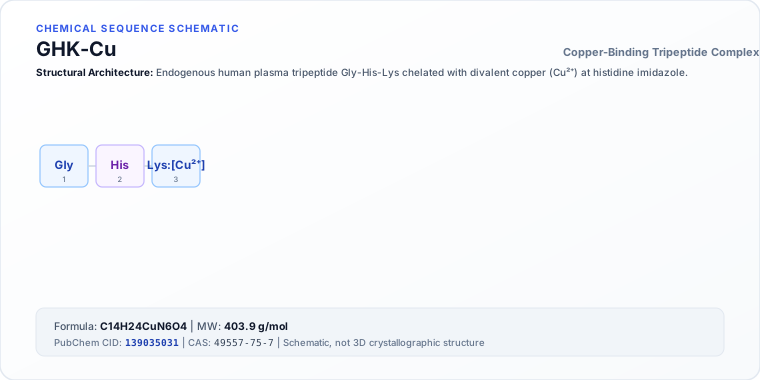
- Sequence (one-letter)
- GHK:Cu
- Molecular formula
- C14H22N6O4·Cu
- Molecular weight
- 401.9 g/mol
- CAS Number
- 89030-95-5
- UNII Code
- 6BJQ43T1I9
- PubChem CID
- 71587328
Identifiers are for prezatide copper, the 1:1 copper complex of GHK (FDA GSRS and PubChem). CAS 49557-75-7, often quoted for GHK-Cu, is not registered by FDA.
Identifiers checked against PubChem and FDA's Global Substance Registration System on 13 October 2026. FDA substance record ↗ · PubChem record ↗ See all names and codes in the peptide name index.
What the original topical studies show
Human research can examine tolerability, symptoms or patient outcomes. The design and comparator determine what each result can establish.
Effects of topical copper tripeptide complex on CO2 laser-resurfaced skin [1]
What was reported
No significant between-group improvement in measured redness, wrinkles or overall skin quality. Patient-reported satisfaction/skin-quality improvement favored GHK-Cu (p=0.04).
What limits the conclusion
Small, specialized post-laser setting. Subjective satisfaction differs from objective benefit; this is not a general anti-aging or injection trial.
Enhanced healing of ulcers in patients with diabetes by topical glycyl-L-histidyl-L-lysine copper [2]
What was reported
The report described better plantar-ulcer area closure with a specific gel added to standardized wound care.
What limits the conclusion
Older, formulation-specific evidence and subgroup detail. Participants received debridement, pressure-relieving footwear and other wound care. This does not establish effectiveness for an ordinary cosmetic serum or systemic injection.
How the compound may work
Mechanisms describe how GHK-Cu may affect biological processes. Laboratory findings and patient outcomes answer different questions.
Connective-tissue experiments
A primary experiment studied connective-tissue accumulation in rat wounds. Rat tissue responses can inform hypotheses; they do not prove patient benefits or the effectiveness of a different formulation. [3]
Areas Being Studied
These research topics reflect active areas of scientific exploration, distinct from unverified commercial marketing claims.
Cosmetic appearance
Ask whether an original controlled study tested the finished formulation and measured an outcome important to users. A product containing the ingredient is not necessarily the product studied. [1]
Wound research
A topical clinical result cannot be transferred automatically to injections, microneedling, hair restoration or all wound types. [2]
Recent evidence mapping
A 2026 review describes sparse and inconsistently characterized human evidence. Its review and proposed development framework are not regulatory approval or independently replicated product effectiveness. [4]
Compare the study designs.
| Study | Design / sample | Outcome type | Key limitation |
|---|---|---|---|
| Post-laser skin care · 2006 [1] | Randomized post-treatment regimens with blinded objective evaluators n = 13 |
Clinical endpoint evaluation | Small, specialized post-laser setting. Subjective satisfaction differs from objective benefit; this is not a general anti-aging or injection trial. |
| Diabetic neuropathic ulcers · 1994 [2] | Multicenter randomized evaluator-blinded placebo-controlled topical study n = not stated in abstract |
Clinical endpoint evaluation | Older, formulation-specific evidence and subgroup detail. Participants received debridement, pressure-relieving footwear and other wound care. This does not establish effectiveness for an ordinary cosmetic serum or systemic injection. |
Regulatory Status & Clinical Safety
Regulatory Classification
United States, verified 10 October 2026: FDA does not generally pre-approve cosmetics or cosmetic ingredients (with exceptions for certain color additives). Cosmetic product listing is not drug approval. Disease-treatment or structure/function claims can make a product a drug. FDA’s current compounding resource identifies limited human safety information and potential immune-response/impurity concerns for injectable GHK-Cu. [5][6]
Safety Realities & Impurities
Evidence from topical application does not establish injection safety. Formulation, copper chemistry, contamination control and route change the exposure. “Naturally occurring,” “copper peptide” and a purity percentage do not establish clinical safety or an effective treatment. [6]
Clinical Trials Registry Records
Official registry records from ClinicalTrials.gov. Study registration does not imply government endorsement or guaranteed efficacy.
Topical GHK-Cu Gel for Acute Skin Wound Healing [7]
- Planned enrollment
- 60 (estimated enrollment)
- Posted results
- Pending in registry
- Sponsor
- Hudson Biotech
- Last updated
- 2026-02-27
WADA & Anti-Doping Regulations
WADA Anti-Doping Status
No blanket sport clearance is provided here. WADA S0 can apply to unapproved pharmacological substances; the route, product and current list matter. Athletes should obtain qualified anti-doping advice.
Research Timeline
-
1994
Specific wound-gel research
An original randomized study examines diabetic neuropathic ulcers alongside standardized wound care. [2]
-
2006
Mixed post-laser findings
Objective outcomes show no significant advantage; patient-reported satisfaction differs. [1]
-
2026
Current evidence review
A review maps the evidence and formulation gaps; a registry entry describes ongoing research rather than proven benefit. [4]
What Researchers Still Don't Know
Finished-product effectiveness
Does the exact formulation have reproducible benefit in adequately controlled human studies?
Route-specific safety
What are the long-term risks of each proposed route? Topical findings cannot establish injected exposure is safe.
Clinical meaning
Do changes in laboratory markers produce meaningful outcomes that persist? A biological signal is not the same as an established therapy.
References
Primary sources verified against PubMed / NLM and regulatory databases.
-
Primary topical randomized study
Effects of topical copper tripeptide complex on CO2 laser-resurfaced skin ↗ (external website)
Original abstract accessed via Europe PMC; 13 completers, objective negative findings and subjective result distinguished.
DOI: 10.1001/archfaci.8.4.252 ↗ (external website) -
Primary topical randomized study
Abstract reviewed; study denominator not stated in accessible abstract.
DOI: 10.1046/j.1524-475X.1994.20406.x ↗ (external website) - Primary animal research DOI: 10.1172/JCI116842 ↗ (external website)
-
2026 evidence review
GHK-Cu as a Bioactive Metallopeptide and Drug-Delivery Cargo ↗ (external website)
Review, not primary clinical evidence or a consensus regulatory standard.
DOI: 10.3390/pharmaceutics18091077 ↗ (external website) - FDA · official regulatory explanation
- FDA · injectable safety context
-
Official registry, not results
NCT07437586, acute wound research ↗ (external website)
Official v2 API checked 10 October 2026. No posted registry results; registration is not independent proof of conduct or effectiveness.