
TB-500: the basics
What is it?
A name commonly used for a short fragment of thymosin beta-4, a protein involved in cell movement and repair. Product naming is inconsistent.
FDA safety information ↗What do people claim it helps with?
Injury recovery, muscle repair, flexibility and reduced inflammation. Reliable benefits from TB-500 in people are not established.
What has research actually shown?
Much of the cited wound-healing work concerns full-length thymosin beta-4, not the TB-500 fragment. Those results cannot automatically be transferred to TB-500.
FDA safety information ↗Has this been demonstrated in people?
The fragment lacks established human treatment evidence. FDA reports it has not identified human exposure data for the LKKTETQ fragment; studies of full-length thymosin beta-4 are a separate evidence set.
FDA safety information ↗What side effects, risks and unknowns should I understand?
Human side effects and long-term risks remain poorly characterized. FDA notes immune-reaction and impurity concerns.
FDA safety information ↗Is it an approved medicine?
No FDA-approved medicine contains this peptide. Availability online or through a clinic does not mean it has been approved.
FDA safety information ↗Approval here means U.S. FDA approval and applies to a particular product, formulation and use. This is a starting overview, not a complete side-effect list. Sources checked 10 October 2026; independent scientific review pending.
How is it used or studied?
Studied using specific research preparations. There is no FDA-approved treatment formulation; an online vial, capsule or spray is not necessarily the product used in a study.
Different routes and formulations can have different effects. A study of one product does not validate every product with the same peptide name.
A common misunderstanding
Thymosin beta-4 and its short fragment are not interchangeable. Check which molecule a paper actually tested.
What should I ask a clinician?
- What diagnosis or goal are we trying to address, and what established options are available?
- Was the expected benefit shown in people like me, using this exact product?
- How could my medicines, health conditions or pregnancy plans affect the risks?
- What monitoring is needed, and what would tell us the treatment is helping or should be stopped?
What do the research words mean?
- Peptide
- A short chain of amino acids, the building blocks of proteins.
- Preclinical
- Research in cells, tissues or animals before dependable treatment evidence in people.
- Controlled trial
- A study comparing a treatment with another treatment or a placebo to help separate its effects from other explanations.
- Biomarker
- A measurement, such as a hormone level. A change does not necessarily mean someone feels better or lives longer.
TB-500 and Thymosin Beta-4: What Is Known?
Human Study Limits
No human treatment evidence for the defined TB-500 fragment was identified in FDA’s 2026 assessment. The human studies below concern full-length thymosin beta-4, not TB-500. Sharing part of a sequence does not make two substances interchangeable.
Laboratory & In Vivo Assays
Laboratory studies explore cell responses, including actin, a structural protein involved in cell shape and movement. Experiments on non-acetylated LKKTETQ, its acetylated version and the full-length parent must be distinguished.
What is TB-500?
Thymosin Beta-4 Synthetic Heptapeptide is TB-500 refers here to the N-acetylated seven-amino-acid fragment Ac-LKKTETQ. It is not identical to 43-amino-acid thymosin beta-4. Human findings for the full-length peptide cannot establish that the fragment repairs injuries. Aliases include: Ac-LKKTETQ, N-acetylated thymosin beta-4 fragment.
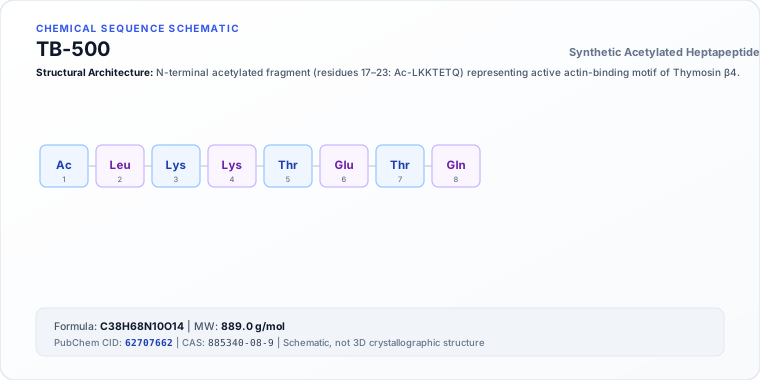
- Sequence (one-letter)
- Ac-LKKTETQ
- Molecular formula
- C38H68N10O14
- Molecular weight
- 889.0 g/mol
- CAS Number
- 885340-08-9
- UNII Code
- QHK6Z47GTG
- PubChem CID
- 62707662
Identifiers are for the TB-500 fragment (Ac-LKKTETQ). Full-length thymosin beta-4 is a different substance (CAS 77591-33-4).
Identifiers checked against PubChem and FDA's Global Substance Registration System on 13 October 2026. FDA substance record ↗ · PubChem record ↗ See all names and codes in the peptide name index.
Human studies of the parent peptide, not TB-500
The following studies tested full-length thymosin beta-4. They are included to explain a common misattribution, not as evidence that the TB-500 fragment is effective.
Recombinant human thymosin beta-4 (NL005) in healthy volunteers [1]
What was reported
Mild-to-moderate adverse events and no serious adverse events or dose-limiting toxicities were reported during the short monitored studies.
What limits the conclusion
Healthy volunteers and short observation; no injury-recovery efficacy endpoint. Tests full-length recombinant peptide, not Ac-LKKTETQ.
RGN-259 in neurotrophic keratopathy (a condition with reduced corneal sensation) [2]
What was reported
Complete healing after four weeks: 6/10 versus 1/8. The reported p value was 0.0656; this comparison did not meet a conventional 0.05 threshold.
What limits the conclusion
Very small trial, industry involvement and additional outcomes/time points. Eye-drop results cannot support systemic fragment injections.
How the compound may work
Mechanisms describe how TB-500 may affect biological processes. Laboratory findings and patient outcomes answer different questions.
Identity changes the question
The fragment has seven amino acids with an added acetyl group; the parent has 43. Removing most of a peptide or changing its chemical cap can alter activity. A study must identify the exact material tested. [3]
Areas Being Studied
These research topics reflect active areas of scientific exploration, distinct from unverified commercial marketing claims.
Full-length thymosin beta-4
Early intravenous tolerability and a small ophthalmic trial do not establish efficacy for the TB-500 fragment. [1]
Defined TB-500 fragment
FDA’s assessment did not identify human administration studies for the evaluated fragment. Evidence of clinical wound healing was insufficient. [3]
Compare the study designs.
| Study | Design / sample | Outcome type | Key limitation |
|---|---|---|---|
| Full-length parent: IV phase 1 · 2021 [1] | Randomized, double-blind, placebo-controlled phase 1 n = 84 |
Clinical endpoint evaluation | Healthy volunteers and short observation; no injury-recovery efficacy endpoint. Tests full-length recombinant peptide, not Ac-LKKTETQ. |
| Full-length parent: eye drops · 2022 [2] | Randomized, placebo-controlled, double-masked study n = 18 |
Clinical endpoint evaluation | Very small trial, industry involvement and additional outcomes/time points. Eye-drop results cannot support systemic fragment injections. |
Regulatory Status & Clinical Safety
Regulatory Classification
United States, checked 10 October 2026: FDA’s TB-500 compounding assessment is not an approved medicine label. Committee advice on the 503A list does not establish drug approval. WADA’s 2026 list explicitly names thymosin beta-4 and derivatives such as TB-500 under S2.3, prohibited at all times. [3][4]
Safety Realities & Impurities
A tolerability result for recombinant full-length thymosin beta-4 cannot establish the fragment’s safety. Formulation, route, chemical identity and follow-up all matter. Longer-term harms and interactions for the fragment remain unresolved. [3]
Clinical Trials Registry Records
Official registry records from ClinicalTrials.gov. Study registration does not imply government endorsement or guaranteed efficacy.
SEER-1: RGN-259 in neurotrophic keratopathy, full-length peptide, not TB-500 [5]
- Planned enrollment
- 18 (actual enrollment)
- Posted results
- Available
- Sponsor
- ReGenTree, LLC
- Last updated
- 30 August 2023
WADA & Anti-Doping Regulations
WADA Section S2: Prohibited Substance
The World Anti-Doping Agency (WADA) classifies TB-500 under Section S2 of the Prohibited List. Prohibited at all times (in- and out-of-competition). Last verified: October 2026. [4]
Research Timeline
-
2021
Parent-peptide phase 1
Recombinant full-length thymosin beta-4 is assessed for short-term tolerability in healthy volunteers. [1]
-
2022
Parent-peptide eye trial
An 18-participant ophthalmic study is published; the four-week healing comparison remains statistically uncertain. [2]
-
2026
FDA fragment assessment
The official compounding briefing distinguishes molecular identities and evidence gaps. [3]
What Researchers Still Don't Know
Fragment effectiveness
Whether a precisely characterized TB-500 fragment produces meaningful patient benefit against an appropriate comparator.
Fragment safety
Long-term harms, interactions and immune responses in people have not been established by the parent-peptide studies.
Product identity
A product name alone does not establish that its contents match a research material. Verify the exact sequence, modification and formulation.
References
Primary sources verified against PubMed / NLM and regulatory databases.
- Primary human study · parent peptide DOI: 10.1111/jcmm.16693 ↗ (external website)
-
Primary human study · parent peptide
RGN-259 ophthalmic solution in neurotrophic keratopathy ↗ (external website)
DOI: 10.3390/ijms24010554 ↗ (external website) -
FDA · official assessment
TB-500-related bulk drug substances: July 2026 PCAC briefing ↗ (external website)
41-page PDF. Identity and evidence assessment; not a final approval decision.
- WADA · current standard
-
Registry · parent peptide
NCT02600429, SEER-1 ↗ (external website)
Official v2 record checked 10 October 2026; terminated, actual enrollment 18, results posted.