
HHS Plan to Allow Temporary Sales of Unapproved Peptides: What We Know
A reported HHS plan would let pharmacies supply some unapproved peptides before FDA rules are final. What is confirmed, how it could work, and the risks.

Key takeaways
- The plan was reported by The Washington Post from unnamed sources; nothing has been announced.
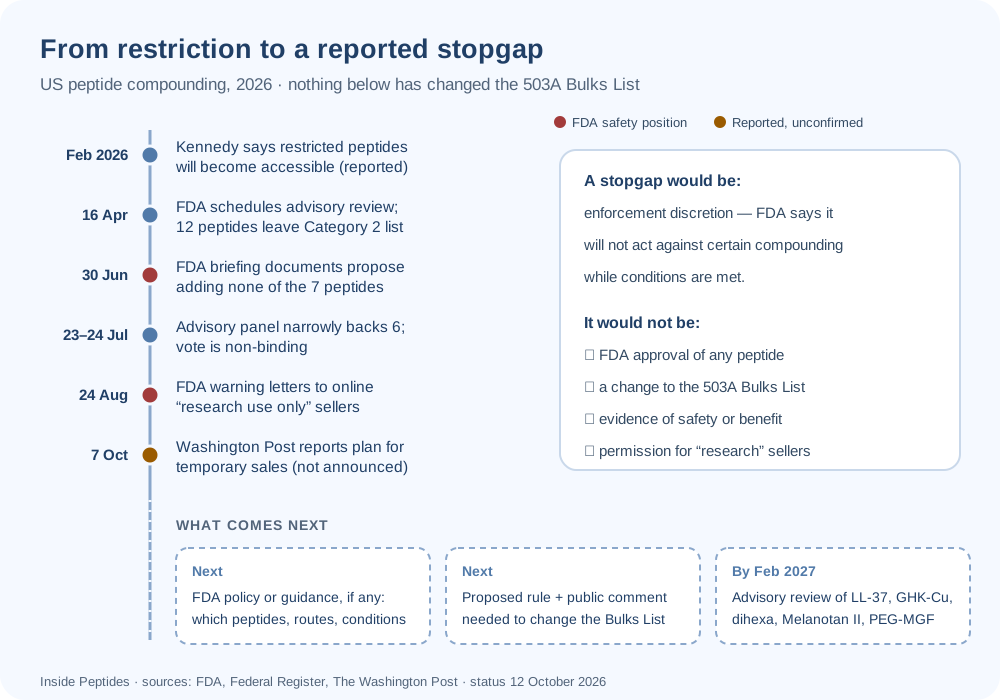
- A stopgap would most likely mean FDA enforcement discretion, not approval or a change to the 503A Bulks List.
- FDA's own reviewers recommended against all seven peptides reviewed in July 2026.
In this article
On 7 October 2026, The Washington Post reported that the Trump administration is "crafting plans that would allow the temporary sale of certain previously restricted peptides" while FDA works on formal rules. The report relied on two unnamed sources. HHS did not comment, the plan has not been announced, and it is not known which peptides it would cover.1 As of 12 October 2026, no FDA policy, guidance or Federal Register notice has been published.
This article separates what has been reported from what is official, explains the legal mechanism being discussed, and sets out the safety concerns FDA's own reviewers have raised. It describes regulation only. It is not legal or medical advice and gives no dosing information.
The short version
- Reported, not announced. According to the Post, the plan "has not yet been announced and timing was unclear, meaning it could still change."1
- What it would do: let some compounding pharmacies dispense certain peptides before FDA finishes the rulemaking that the law normally requires.1
- Which peptides: unknown. The obvious candidates are the six peptides an FDA advisory committee recommended in July 2026: BPC-157, TB-500, KPV, MOTS-c, Semax and Epitalon. The Post did not confirm the list.13
- The likely tool is "enforcement discretion": FDA says it will not act against certain compounding while conditions are met. Pharmacy groups have asked for exactly that.16
- FDA's scientists said no. Its July briefing documents proposed that none of the seven peptides reviewed be added to the compounding list.34
- It would not be FDA approval. Even under a stopgap, these would remain unapproved drugs with limited human safety data.
What the Washington Post reported
The report says federal officials "are seeking guardrails around the peptide policy" and that the move "would allow some compounding pharmacies to dispense certain peptides marketed as new medical treatments and wellness products even as the claims for what they treat have not been fully safety tested."1
It also reported:
- No official comment. "The Department of Health and Human Services did not comment."1
- Rulemaking timing is unknown. "It's not clear when formal rulemaking will be released. The FDA isn't required to take the panel's advice."1
- Lobbying for interim access. Scott Brunner, chief executive of the Alliance for Pharmacy Compounding, said his group had met FDA twice to request "interim enforcement discretion."1
- Divided expert reaction. Stem-cell researcher Paul Knoepfler said, "I think it just puts people at more risk." Former FDA official Ilisa Bernstein said that "having appropriate guardrails with the enforcement discretion could help identify safety concerns."1
Health Secretary Robert F. Kennedy Jr. has described himself as a "big fan" of peptides and has said he wants them more widely available.1
How to read this: an anonymously sourced report of a plan under discussion. It does not change any rule. Treat social-media posts or clinic marketing saying peptides are "now legal" as unreliable until FDA publishes something.
How a pharmacy could legally compound these peptides
Under section 503A of the Federal Food, Drug, and Cosmetic Act, a pharmacy may compound with a bulk drug substance only if it2:
- meets a USP or National Formulary monograph, or
- is a component of an FDA-approved drug, or
- appears on a list FDA creates "through regulations", the 503A Bulks List.
BPC-157, TB-500 and the other July peptides have no monograph and are not part of any approved medicine. That leaves the Bulks List, and getting onto it requires formal notice-and-comment rulemaking after an advisory committee is consulted.23 Our panel-vote explainer covers that process in detail.
What "enforcement discretion" would mean
Enforcement discretion is not a change in the law. It is FDA saying it does not intend to take action against certain conduct, usually temporarily and under conditions. FDA has used it in compounding before.
The 503A interim policy. Since 2017, FDA guidance has allowed pharmacies to compound with some substances still under evaluation, known as "Category 1". The current version, finalised in January 2025, says FDA "does not intend to take action" against such compounding until a final rule is issued, provided four conditions are met5:
- the substance is in Category 1;
- it comes from an FDA-registered manufacturer;
- it has a valid certificate of analysis;
- all other 503A conditions are met.
Why that policy may not simply apply here. The same guidance says FDA "does not intend to categorize" substances nominated on or after 7 January 2025.5 FDA's July briefing materials also record that the nominations for all seven peptides were withdrawn, although FDA chose to evaluate them anyway.3 On our reading of these documents, a stopgap for these peptides would most likely require a new or revised FDA policy rather than the existing Category 1 route. No official source has described the mechanism, so treat this as analysis, not reporting.
What industry is asking for. The Alliance for Pharmacy Compounding has proposed conditions including "validated sourcing of cGMP-compliant active ingredients", "USP-compliant preparation", "enhanced patient disclosures" and "serious adverse-event reporting".6 Those conditions would address some quality risks. They would not create the clinical trial evidence that FDA's reviewers said is missing.
What FDA's own reviewers found
FDA's briefing package for the July meeting is the most detailed official assessment available. For BPC-157 it reported4:
- Quality: "the stability, pharmacological activity, and immunogenic properties of peptides are highly sensitive to the manufacturing process and quality attributes of the compounded/finished drug product."
- Immune reactions: FDA "is concerned about the potential for immunogenicity of BPC-157 (free base) when formulated in an injectable dosage form due to the potential for aggregation as well as potential peptide-related impurities".
- Effectiveness: "There is a lack of evidence to support the effectiveness of BPC-157" for ulcerative colitis, the use under review.
- Adverse events: a search of FDA's adverse event database found three reports involving injectable BPC-157 products, including one emergency-department visit for shortness of breath. FDA cautioned that it "cannot make definitive conclusions" from those data and that 503A compounders "generally do not report adverse events to FDA."
FDA's safety page for compounding substances notes that for KPV, MOTS-c and several others it "has not identified any human exposure data".7 Read more in our guides to immunogenicity and peptide impurities.
Who supports it and who objects
| Position | Who | Main argument |
|---|---|---|
| Supports interim access with conditions | Alliance for Pharmacy Compounding16 | Regulated pharmacies are safer than illicit online markets |
| Supports fast access | American Academy of Peptide Medicine1 | Would "help eliminate the gray and black market" |
| Opposes | FDA career reviewers (July briefing documents)34 | Poor characterization, little human evidence |
| Opposes | ECRI and ISMP, patient-safety organisations8 | "Substantial gaps in evidence for the peptides' safety or efficacy" |
| Concerned (outside the US) | Prof. Peter Shepherd, University of Auckland9 | Politics "overruling the safety procedures that have been built up over the last 50 or 60 years" |
After the July vote, ECRI and ISMP warned that "repeated injections of synthetic peptides can trigger immune reactions" and that "drug policy must be based on sound clinical evidence in order to protect patients."8
What has not changed
- No peptide was approved. Compounded drugs are not FDA-approved, with or without a stopgap. See compounded peptides.
- "Research use only" sellers are still targeted. In August 2026 FDA warned an online seller that "research use only" labels did not stop its products being treated as unapproved drugs for human use.10 See what "research use only" means.
- Sport rules are separate. From 1 January 2027, WADA names peptides under S0, its class for non-approved substances, which are prohibited at all times, whatever FDA decides. See WADA peptide rules.
- The evidence is the same. A policy change does not create human trial data. Our profiles of BPC-157, TB-500, KPV, MOTS-c, Semax and Epitalon show what has and has not been studied.
What to watch next
- An FDA announcement or guidance document, the most likely form of any stopgap. Check its scope: which peptides, which routes (oral, topical or injectable), and which conditions.
- A proposed rule in the Federal Register to add any peptide to the 503A Bulks List. This would open a public comment period.
- The next advisory committee meeting, due before the end of February 2027. It will review LL-37, GHK-Cu, dihexa, Melanotan II and PEG-MGF.11
We will update this article when official information is published.
Frequently asked questions
Are BPC-157 and other peptides legal to buy now?
Nothing official has changed. No final rule has added these peptides to the 503A Bulks List, and the reported stopgap has not been announced.12
Would a stopgap mean FDA thinks these peptides are safe?
No. Enforcement discretion is a decision about enforcement priorities, not a finding of safety or effectiveness. FDA's reviewers recommended against all seven peptides in July 2026.34
Which peptides would be included?
Unknown. The Post said it was "not immediately clear which peptides" were involved.1
References
- Roubein R. The Trump administration is paving way for temporary sale of some unapproved peptides. The Washington Post, 7 October 2026 (syndicated by the Anchorage Daily News). Original article (subscription).
- 21 U.S. Code § 353a: Pharmacy compounding. Section 503A of the Federal Food, Drug, and Cosmetic Act. Legal Information Institute.
- FDA. Briefing document, introduction: Pharmacy Compounding Advisory Committee, 23–24 July 2026. FDA proposals and nomination history. Meeting page: July 23–24, 2026 PCAC meeting.
- FDA. Briefing document: BPC-157-related bulk drug substances. July 2026.
- FDA. Interim Policy on Compounding Using Bulk Drug Substances Under Section 503A of the Federal Food, Drug, and Cosmetic Act. Guidance for industry, January 2025. PDF.
- Alliance for Pharmacy Compounding. FDA digs into APC's peptide proposal. Industry statement; checked 12 October 2026.
- FDA. Certain bulk drug substances for use in compounding that may present significant safety risks. Content current as of 22 April 2026.
- ECRI. ECRI & ISMP Statement in Response to PCAC Decision on Compounding Peptides. 24 July 2026. See also the ECRI and ISMP white paper on compounded peptide products, April 2026.
- RNZ. Loosening of US peptide standards worries NZ expert. 11 October 2026.
- FDA. Warning letter: Peak Performance Peptides, 24 August 2026.
- FDA. Meeting of the Pharmacy Compounding Advisory Committee. Upcoming meeting topics; content current as of 15 April 2026.


