
BPC-157: the basics
What is it?
A laboratory-made chain of 15 amino acids, the small building blocks of proteins. It is being investigated for possible tissue-repair effects.
Research paper 1 ↗Research paper 2 ↗Research paper 3 ↗Research paper 4 ↗What do people claim it helps with?
Faster tendon or muscle healing, relief of joint pain, and gut repair. These are proposed benefits, not dependable treatment outcomes.
What has research actually shown?
Animal and cell experiments have reported repair-related effects. Small reports in people describe knee-pain or bladder-symptom improvement, but cannot establish that BPC-157 caused it or repaired tissue.
Research paper 1 ↗Research paper 2 ↗Research paper 3 ↗Research paper 4 ↗Has this been demonstrated in people?
Mostly laboratory and animal studies, plus a few small human reports. These include uncontrolled symptom reports and a two-person, short-term intravenous safety pilot; none settles effectiveness or long-term safety.
Research paper 1 ↗Research paper 2 ↗Research paper 3 ↗Research paper 4 ↗What side effects, risks and unknowns should I understand?
Reliable rates of side effects, interactions and long-term harms are unknown. FDA highlights immune-reaction and impurity concerns.
FDA safety information 1 ↗FDA briefing 2 ↗Is it an approved medicine?
No FDA-approved medicine contains this peptide. Availability online or through a clinic does not mean it has been approved.
FDA safety information 1 ↗FDA briefing 2 ↗Approval here means U.S. FDA approval and applies to a particular product, formulation and use. This is a starting overview, not a complete side-effect list. Sources checked 10 October 2026; independent scientific review pending.
How is it used or studied?
Studied using specific research preparations. There is no FDA-approved treatment formulation; an online vial, capsule or spray is not necessarily the product used in a study.
Different routes and formulations can have different effects. A study of one product does not validate every product with the same peptide name.
A common misunderstanding
Less pain does not necessarily mean a tendon has healed. A short report of no side effects does not establish long-term safety.
What should I ask a clinician?
- What diagnosis or goal are we trying to address, and what established options are available?
- Was the expected benefit shown in people like me, using this exact product?
- How could my medicines, health conditions or pregnancy plans affect the risks?
- What monitoring is needed, and what would tell us the treatment is helping or should be stopped?
What do the research words mean?
- Peptide
- A short chain of amino acids, the building blocks of proteins.
- Preclinical
- Research in cells, tissues or animals before dependable treatment evidence in people.
- Controlled trial
- A study comparing a treatment with another treatment or a placebo to help separate its effects from other explanations.
- Biomarker
- A measurement, such as a hormone level. A change does not necessarily mean someone feels better or lives longer.
Most of the evidence is still preclinical.
36 studies in one systematic review
- Preclinical
- 35
- Clinical
- 1
Vasireddi et al., 2025 · Search through 3 June 2024 [1]
A 2025 orthopaedic systematic review included 35 preclinical studies and one clinical study. This is the review’s selected musculoskeletal literature, not a count of every BPC-157 paper or all current human research.
Small reports. Large uncertainty.
The reports below provide observations, not a dependable estimate of treatment benefit or long-term risk. Keep design and sample size alongside each finding. [2][3][4]
Useful for asking better questions.
Cell and animal studies investigate possible mechanisms. They cannot establish effectiveness in patients. [5][6]
What is BPC-157?
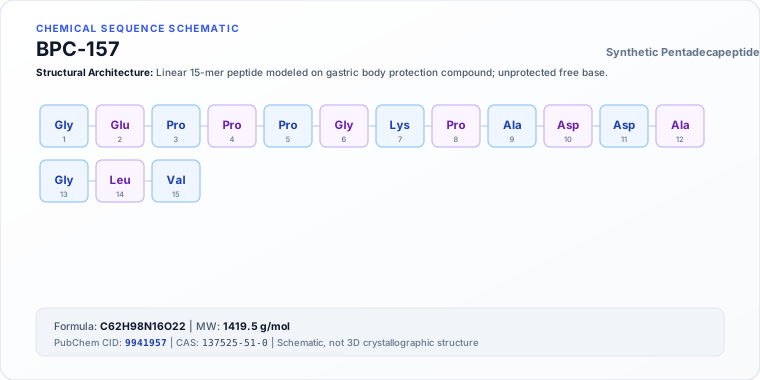
Body Protection Compound 157 is a synthetic pentadecapeptide: a chain of 15 amino acids. “PL 14736” and “Bepecin” are other names used in the literature and regulatory record. [7][5]
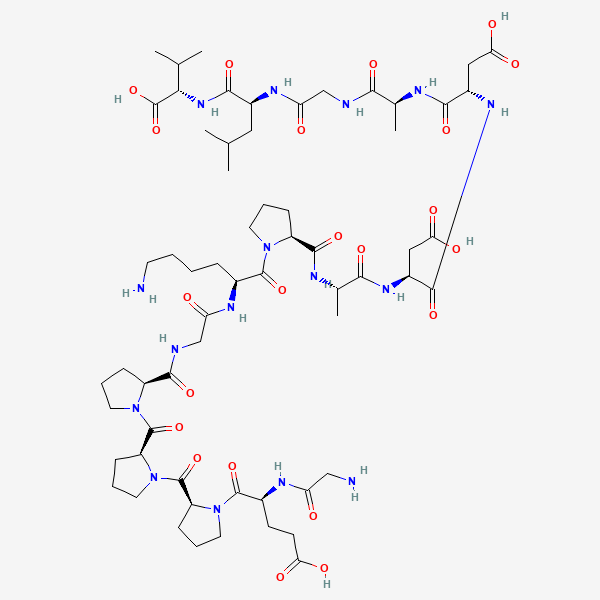
- Sequence (one-letter)
- GEPPPGKPADDAGLV
- Molecular formula
- C62H98N16O22
- Molecular weight
- 1419.5 g/mol (free base)
- CAS · free base
- 137525-51-0
- UNII · free base
- 8ED8NXK95P
Identifiers describe a molecule; they do not establish benefit or verify a commercial product. Free-base and salt forms should be distinguished. [7][11]
Read the sample size. Then the headline.
These reports ask different questions. Their participant counts must not be combined into one trial or interpreted as an efficacy score.
Intra-Articular Injection of BPC 157 for Multiple Types of Knee Pain [2]
What was reported
In the BPC-157-only subgroup, 11 of 12 respondents reported pain improvement. This self-reported outcome is not proof of structural repair.
What limits the conclusion
No control group, varied follow-up and no standardized functional outcome instrument. Four respondents received a second peptide as well.
Effect of BPC-157 on Symptoms in Patients with Interstitial Cystitis: A Pilot Study [3]
What was reported
The authors reported symptom improvement on a questionnaire and no adverse events in this small cohort.
What limits the conclusion
No comparator or blinded assessment. Subjective improvement cannot separate treatment effects from expectations or other influences.
Safety of Intravenous Infusion of BPC157 in Humans: A Pilot Study [4]
What was reported
No side effects or meaningful changes in the tested biomarkers were reported across three days of observation.
What limits the conclusion
Two participants and brief monitoring cannot establish general safety, interactions or rare and delayed adverse effects.
A mechanism is a research lead.
Preclinical mechanisms are explanations of how a substance might work, investigated in cells, tissues, or animals. These primary papers explore those questions; they do not establish that a treatment works or is safe in people.
Tendon-cell migration
A 2011 study observed fibroblast outgrowth, migration and changes in FAK/paxillin phosphorylation. A cell experiment does not establish that an injured human tendon will heal faster. [5]
Vascular signaling
A 2017 paper investigated VEGFR2–Akt–eNOS signaling using cell assays, chick membranes and rat hind-limb ischemia. Human-derived cells in a dish are still preclinical evidence. [6]
Original explanatory diagram. Questions to test, not guaranteed progression. Compare evidence types →
Areas Being Studied
These are research topics, not approved indications or established benefits.
Tendon & connective tissue
Explants and cell models examine migration and tissue responses. [5]
Blood vessels
Vascular assays investigate signaling and blood-flow responses. [6]
Knee pain
A retrospective series measured patient-reported symptoms. [2]
Bladder symptoms
A small single-arm study used a symptom questionnaire. [3]
BPC-157: What Human Research Actually Shows
| Study | Design / sample | Outcome type | Key limitation |
|---|---|---|---|
| Healthy-volunteer tolerability · 2002–2003 [7] | Placebo-controlled phase 1; meeting abstracts summarized by FDA n = 32 32 randomized; 24 received BPC-157 | Short-term tolerability and pharmacokinetics (how the body handles the compound) | Abstract-level detail; not evidence of injury recovery or long-term safety. |
| Ulcerative colitis · 2005 [7] | Randomized, double-blind, placebo-controlled; meeting abstract summarized by FDA n = 53 53 randomized; 46 completed two weeks | Disease-activity score; between-group confidence interval included no difference | Unclear outcome definition and methods; insufficient evidence of effectiveness. Rectal formulation is not an injection or oral capsule. |
| Knee pain · 2021 [2] | Retrospective chart review and telephone follow-up n = 16 16 respondents; 12 received BPC-157 alone | Self-reported symptoms | No control group, varied follow-up and no standardized functional outcome instrument. Four respondents received a second peptide as well. |
| Bladder symptoms · 2024 [3] | Single-arm pilot report n = 12 12 women at one private clinic | Self-reported symptoms | No comparator or blinded assessment. Subjective improvement cannot separate treatment effects from expectations or other influences. |
| Short-term IV safety · 2025 [4] | Single-arm pilot observation n = 2 2 adults, both with prior BPC-157 exposure | Short-term biomarkers and reported tolerability | Two participants and brief monitoring cannot establish general safety, interactions or rare and delayed adverse effects. |
Regulatory discussion is not drug approval.
The U.S. FDA’s 2026 briefing states that neither BPC-157 free base nor its acetate form is a component of an FDA-approved drug. Evaluation for the section 503A compounding list is a separate process. [7]
IN THE FDA’S WORDS“FDA has identified no, or only limited, safety-related information”
What the current source says
The FDA safety-risk page lists BPC-157 under substances nominated but withdrawn, and discusses immune-response risk, peptide impurities and characterization difficulties. Read the current entry rather than treating the old Category 2 description as permanent. [8]
What a meeting does not decide
The July 2026 committee considered compounding nominations. Its advice is non-binding. Discussion or recommendation is not an approved medicine label. [9]
A registered plan is not a result.
Selected official registry records checked 13 October 2026. Sponsor-supplied registration is not government validation of safety or effectiveness. [12]
A Clinical Trial to Evaluate the Effects of Peptide Gummies on Markers of Inflammation, Physical Performance, and Recovery [13]
- Planned enrollment
- 40 (actual enrollment)
- Posted results
- None in this record
- Sponsor
- Parlay Wellness
- Registry last updated
- 2026-08-07
PCO-02 - Safety and Pharmacokinetics Trial [14]
- Planned enrollment
- 42 (estimated enrollment)
- Posted results
- None in this record
- Sponsor
- PharmaCotherapia d.o.o.
- Registry last updated
- 2015-12-22
BPC 157 for Acute Hamstring Muscle Strain Repair [15]
- Planned enrollment
- 120 (estimated enrollment)
- Posted results
- None in this record
- Sponsor
- Hudson Biotech
- Registry last updated
- 2026-02-27
Impact of BPC-157 on Recovery Following Rotator Cuff Repair Surgery [16]
- Planned enrollment
- 30 (estimated enrollment)
- Posted results
- None in this record
- Sponsor
- University of Arkansas
- Registry last updated
- 2026-09-03
Registry status may be stale. “Recruiting” is registry-reported, not independently confirmed here. Estimated enrollment is not a completed participant count.
Prohibited at all times.
Category S0: Non-approved Substances
The 2026 WADA Prohibited List names BPC-157 in S0. This applies in- and out-of-competition. Anti-doping classification is separate from an evidence grade. [10]
Follow the source, not the clip.
Official documents and a full FDA meeting provide context that short promotional reels can omit. The original artwork below does not imply FDA endorsement of Inside Peptides.
 FDA · 23 JULY 2026
Watch the regulatory discussion.
The FDA’s Pharmacy Compounding Advisory Committee meeting includes the BPC-157 discussion. Committee advice concerns compounding and is non-binding; it is not drug approval. [9]
Watch on YouTube ↗ (external website) FDA · SOURCE DOCUMENT
Read the assessment behind the headlines.
The 68-page briefing distinguishes chemical identity, historical human experience, effectiveness and safety. It is background for an advisory meeting, not a final approval decision. [7]
Open FDA briefing · PDF ↗ (external website)External resources open in the same tab. The webcast includes public presentations; individual speakers’ statements are not automatically FDA conclusions.
Research timeline.
- 2011
Tendon-cell study
A primary paper investigates fibroblast migration in preclinical models. [5]
- 2021
Knee-pain case series
A small retrospective human report is published. [2]
- 2024–2025
Small human pilot reports
Bladder-symptom and short-term IV observations appear. [4]
- 2026
FDA advisory discussion
BPC-157-related bulk substances are discussed at the July committee meeting. [9]
What Researchers Still Don't Know
Reliable clinical benefit
Which outcomes would improve against a credible comparison, and by how much?
Long-term human safety
What harms, interactions or delayed effects would appear with larger studies and longer follow-up?
Translation across formulations
Would findings for one formulation, route or population apply to another?
Questions left open by the limitations documented above, not claims of an established treatment.
References
Sources checked 13 October 2026. Human and mechanism summaries use original PubMed abstracts; abstract access is not a claim of full-text review.
- Systematic review
Emerging Use of BPC-157 in Orthopaedic Sports Medicine: A Systematic Review ↗ (external website)
Search cutoff: 3 June 2024. Abstract and bibliographic record checked.
DOI: 10.1177/15563316251355551 ↗ (external website) - Human · retrospective
Intra-Articular Injection of BPC 157 for Multiple Types of Knee Pain ↗ (external website)
Original abstract checked: 17 charts, 16 respondents, 12 BPC-157-only respondents.
- Human · pilot
Original abstract checked; 12 participants.
- Human · pilot
Safety of Intravenous Infusion of BPC157 in Humans: A Pilot Study ↗ (external website)
Original abstract checked; two participants and three days of observation.
- Preclinical · primary study
Original abstract checked; rat-derived tendon and cell experiments.
DOI: 10.1152/japplphysiol.00945.2010 ↗ (external website) - Preclinical · primary study
Original abstract checked; cellular and animal assays.
DOI: 10.1007/s00109-016-1488-y ↗ (external website) - FDA · briefing
PDF: chemical identity pp. 11–14; human experience Appendix 1, pp. 54–55. Background assessment, not final determination.
- FDA · safety context
Current BPC-157 entry appears under substances nominated but withdrawn. Checked 6 October 2026.
- FDA · official event & video
July 23–24, 2026: Meeting of the Pharmacy Compounding Advisory Committee ↗ (external website)
Official agenda, briefing materials and YouTube webcast links.
- WADA · 2026 standard
2026 Prohibited List, S0: Non-approved substances ↗ (external website)
BPC-157 is named in S0. Prohibited in- and out-of-competition; applicable 2026 list.
- PubChem · compound record
Compound Summary: BPC-157, CID 9941957 ↗ (external website)
Formula and molecular weight verified against PUG REST. Structure image generated by PubChem.
- Registry · disclaimer
ClinicalTrials.gov disclaimer ↗ (external website)
Registration is not U.S. government approval of a study’s safety or science.
- Registry · not a published result
Official v2 API checked 10 October 2026. Sponsor-supplied record; registration is not independent validation or evidence of effectiveness.
- Registry · not a published result
NCT02637284, PCO-02 - Safety and Pharmacokinetics Trial ↗ (external website)
Official v2 API checked 10 October 2026. Sponsor-supplied record; registration is not independent validation or evidence of effectiveness.
- Registry · not a published result
NCT07437547, BPC 157 for Acute Hamstring Muscle Strain Repair ↗ (external website)
Official v2 API checked 10 October 2026. Sponsor-supplied record; registration is not independent validation or evidence of effectiveness.
- Registry · not a published result
Official v2 API checked 10 October 2026. Sponsor-supplied record; registration is not independent validation or evidence of effectiveness.