
Explore peptide science by research area.

Peptide research bridges biochemistry and physiology, spanning metabolic regulation, neurological signaling, tissue remodeling, endocrine pathways, immune biology, and cellular aging. Explore how peptide hormones and synthetic analogues are investigated across primary scientific domains.

10
research fields
6
biological systems
Claim-specific
evidence context
Abstract scientific visualization mapping branches of peptide signaling across biological research areas
Peptide signaling pathways branch across organ systems, connecting cellular receptors to physiological outcomes.

Find a field. Follow the science.

Explore peptide signaling by biological domain, from molecular mechanisms to the human outcomes under investigation.

Each field brings together its mechanisms, compounds, evidence, and limitations.

  1. 01

    Metabolism & Energy Balance

    Hormonal signaling in glucose regulation, appetite control, incretin biology, lipid handling, and energy expenditure.

    Research focusIncretins, insulin signaling, dual/triple agonists, gastrointestinal peptides
    Explore Metabolic Peptides →
  2. 02

    Tissue Repair & Wound Biology

    Preclinical and clinical investigations into cell migration, extracellular matrix deposition, angiogenesis, and musculoskeletal recovery.

    Research focusGrowth factor fragments, cytoprotective peptides, collagen synthesis
    Explore Tissue Repair Peptides →
  3. 03

    Neuropeptides & CNS Signaling

    Endogenous peptide neurotransmitters and synthetic neuromodulators involved in neuroprotection, circadian rhythms, and synaptic plasticity.

    Research focusOrexins, endorphins, neurotrophic fragments, hypothalamic-pituitary peptides
    Explore Neuropeptides →
  4. 04

    Growth Hormone Axis & Pituitary Signaling

    Endocrine regulation of somatotroph axis, GHRH analogues, and synthetic growth hormone secretagogue receptor (GHSR) ligands.

    Research focusGHRH analogues, ghrelin mimetics, IGF-1 axis modulators
    Explore Growth Hormone Axis →
  5. 05

    Dermal & Connective Tissue Biology

    Copper-binding peptide complexes, extracellular matrix modulation, dermal fibroblasts, and follicular biology.

    Research focusGHK-Cu, matrikines, signal peptides, barrier function
    Explore Skin & Hair Peptides →
  6. 06

    Longevity & Cellular Aging Biology

    Mitochondrial-derived peptides, metabolic resilience, cellular senescence markers, and proteostatic maintenance in aging models.

    Research focusMitochondrial peptides (MOTS-c, humanin), telomeric signaling, autophagy
    Explore Longevity Peptides →
  7. 07

    Immune Biology & Host Defense

    Antimicrobial peptides (AMPs), thymic peptide hormones, and immune-checkpoint modulators studied for host defense.

    Research focusThymic peptides, defensins, cathelicidins, immunomodulatory fragments
    Explore Immune Peptides →
  8. 08

    Reproductive Endocrinology & Fertility

    Hypothalamic-pituitary-gonadal (HPG) axis control, GnRH analogues, kisspeptin signaling, and oxytocinergic pathways.

    Research focusGnRH receptor agonists/antagonists, kisspeptins, oxytocin derivatives
    Explore Reproductive Peptides →
  9. 09

    Gastrointestinal & Enteric Peptides

    Enteric endocrine signaling, gut barrier integrity, motility control, mucosal cytoprotection, and gut-brain axis communication.

    Research focusBPC-157, ghrelin, GLP-2, motilin, secretin, VIP
    Explore Gastrointestinal Peptides →
  10. 10

    Cardiovascular & Vasoactive Peptides

    Vascular tone regulation, natriuretic peptides, cardiac remodeling, blood pressure control, and endothelial function.

    Research focusANP, BNP, CNP, vasopressin, angiotensin II, endothelin-1
    Explore Cardiovascular Peptides →
Evidence Standards

Research by Evidence Type

Understanding peptide science requires distinguishing rigorous human clinical outcomes from early exploratory, animal, and in vitro models.

Controlled Clinical Trials

Human Clinical Research

Rigorous Phase 1–3 randomized trials measuring clinically meaningful patient outcomes, pharmacokinetics, and safety profiles in humans.

How clinical trials are evaluated →
Pilot & Exploratory Trials

Early Human Research

Small pilot studies, single-center series, and exploratory cohorts. Crucial for generating hypotheses, but vulnerable to bias and placebo responses.

Understand early human evidence →
Animal Disease Models

Preclinical Research

In vivo experiments in rodents and higher mammals assessing organ physiology, toxicity, and tissue repair. Important for mechanism, but translation is non-guaranteed.

Why animal models have limits →
Cell Culture & Assays

Mechanistic & In Vitro Research

Receptor-binding assays, surface plasmon resonance, and cell cultures isolating molecular targets. Demonstrates what can happen in a tube, not a patient.

Explore our evidence levels →

How Inside Peptides Evaluates Research

Explore our transparent, claim-specific methodology and source prioritization framework.

Read Methodology →
Organ Systems

Peptide Signaling Across Biological Systems

Peptide molecules function as endocrine hormones, paracrine modulators, and neurotransmitters coordinating physiological homeostasis.

Metabolic & Digestive System

Incretin hormones (GLP-1, GIP), pancreatic insulin/glucagon, and gut satiety peptides orchestrating systemic energy balance.

Representative Peptides: GLP-1, GIP, Amylin, Ghrelin, PYY

Central & Peripheral Nervous System

Neuropeptides modulating pain pathways, autonomic tone, hypothalamic neuroendocrine secretion, and synaptic plasticity.

Representative Peptides: Neuropeptide Y, Endorphins, Oxytocin, Orexin

Endocrine & Pituitary Axis

Hypothalamic releasing hormones governing systemic growth, thyroid hormone regulation, and adrenocortical responses.

Representative Peptides: GHRH, Somatostatin, TRH, CRH

Immune & Lymphatic System

Thymic maturation factors, antimicrobial host defense peptides, and cytokine-modulating fragments.

Representative Peptides: Thymosins, Defensins, LL-37

Integumentary & Musculoskeletal System

Peptide fragments promoting fibroblast motility, collagen maturation, chondrocyte survival, and microvascular blood flow.

Representative Peptides: GHK, Matrikines, Preclinical cytoprotective peptides

Reproductive System

Pulsatile gonadotropin-releasing hormone peptides and neurokinin signaling governing gametogenesis and steroidogenesis.

Representative Peptides: GnRH, Kisspeptin, Oxytocin
Translation Pipeline

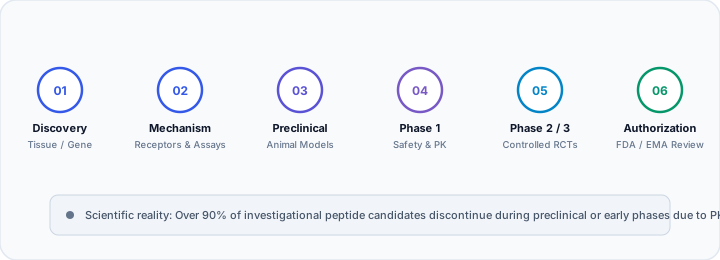
The Peptide Research & Translation Journey

Follow the questions researchers ask from discovery to regulatory evaluation. Studies may overlap, stop, or take a different route; entering a trial does not guarantee approval.

Diagram showing the 6 stages of peptide research from biological discovery to regulatory approval
01

Biological Discovery

Identification of an endogenous peptide hormone or sequence fragment in animal or human tissue.

02

Mechanistic Research

Mapping cellular receptors, binding affinities, structural biology, and signaling second-messenger cascades.

03

Preclinical Testing

Evaluation in animal models for therapeutic response, allometric dosing, in vivo stability, and toxicology.

04

Early Human Trials

Phase 1 safety, tolerability, and pharmacokinetic profiling in healthy adult volunteers.

05

Confirmatory Clinical Trials

Multicenter Phase 2 and randomized double-blind Phase 3 trials establishing clinical efficacy and safety.

06

Regulatory Evaluation

Rigorous review by regulatory agencies (FDA, EMA) for formal marketing authorization and approved labeling.

Authoritative Databases

Primary Research Repositories

We source scientific data directly from verified biomedical databases, clinical trial registries, and official regulatory agencies.

PubMed / NCBI

Biomedical Literature

National Library of Medicine repository indexed for peer-reviewed biomedical literature, systematic reviews, and clinical trial publications.

Access database

ClinicalTrials.gov

Clinical Trial Registry

Global database of publicly and privately funded clinical studies, tracking active recruitment, trial protocols, endpoints, and completed results.

Access database

PubChem Database

Chemical & Molecular Data

Authoritative chemical database providing verified molecular weights, formulas, CAS numbers, 3D conformers, and patent cross-references.

Access database

U.S. FDA Drug Information

Regulatory & Safety Oversight

Official repository for approved drug labels, DailyMed inserts, compounding bulk drug substance lists, and post-market safety communications.

Access database

European Medicines Agency (EMA)

EU Centralised Authorisation

European regulatory agency providing European Public Assessment Reports (EPAR), scientific opinions, and pharmacovigilance reports.

Access database

DrugBank Online

Pharmacological Database

Bioinformatics database with drug, target, and mechanism information.

Access database