

Therapeutic Peptides Beginner

What Is Peptide Therapy? What Clinics Mean, and What the Evidence Shows

Peptide therapy can mean approved medicines such as insulin and GLP-1 drugs, or unapproved wellness injections. How each works, the evidence, safety and legal status.

8 min read Updated 15 sources InsidePeptides Editorial Team

A long, quiet hospital corridor with glass walls, wooden benches and soft daylight
Photo: Chris Olszewski, CC BY-SA 4.0, via Wikimedia Commons.

Plain-English Summary

“Peptide therapy” is used for two very different things. One is the prescription of approved peptide medicines, such as insulin, GLP-1 receptor agonists and teriparatide, for diagnosed conditions; these have been tested in large randomised trials and have known side effects. The other is “wellness” or anti-ageing injections of peptides such as BPC-157, TB-500 or CJC-1295, which are not approved for those uses and have little human evidence. Most peptide medicines are injected because the gut breaks peptides down. Safety, approval and legal status depend on which kind is meant, and simple questions about approval, product source, prescriber and evidence can help tell them apart. This guide gives no dosing information or medical advice.

Key Takeaways

  • “Peptide therapy” can mean approved peptide medicines prescribed for diagnosed conditions, or wellness and anti-ageing injections of unapproved peptides; the two differ greatly in evidence and regulation.
  • More than 80 peptide drugs have reached the market since insulin, for conditions including diabetes, cancer and osteoporosis.
  • Approved peptide medicines such as semaglutide, tirzepatide and teriparatide have been tested in large randomised placebo-controlled trials with published side effects.
  • Patient-safety organisations ECRI and ISMP found that none of the 12 peptides FDA removed from its Category 2 safety list in April 2026 had undergone adequate clinical evaluation for their marketed uses.
  • Most peptide medicines are injected, usually under the skin, because peptides are broken down in the gut; oral semaglutide is a notable exception.
  • Compounded peptides are not FDA-approved, and “research use only” products are treated by regulators as unlawful when supplied for human use.
  • Asking whether a product is approved, who made it, who prescribes it and what human trials support it helps tell established treatment from unproven offers.
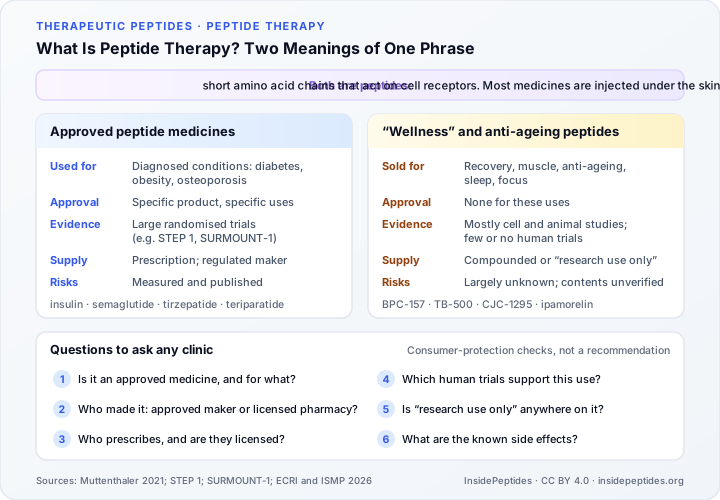
Diagram comparing two meanings of peptide therapy: approved peptide medicines for diagnosed conditions, with regulator approval, randomised trials and regulated manufacture, versus wellness and anti-ageing peptide injections, with no approval for the marketed use, little human evidence and unverified products; with six questions to ask a clinic.
Two meanings of “peptide therapy”: approved peptide medicines for diagnosed conditions versus unapproved wellness peptides, and the questions that tell them apart. Diagram by InsidePeptides, CC BY 4.0: free to reuse with a credit and link. Download SVG

What “peptide therapy” means: two very different things

“Peptide therapy” is not a medical specialty or a single treatment. The phrase is used for two quite different things, and most confusion about whether peptide therapy “works” or is “safe” comes from mixing them up.

  • Established peptide medicines. Doctors have prescribed peptide drugs for diagnosed diseases for about a century. Since insulin was introduced, more than 80 peptide drugs have reached the market, for conditions including diabetes, cancer, osteoporosis, multiple sclerosis, HIV infection and chronic pain [1]. These medicines are rarely described as “peptide therapy”; they are simply treatments for a condition.
  • “Wellness” or anti-ageing peptide therapy. Some clinics, telehealth services and online sellers use the phrase for injections of peptides that are not approved medicines, promoted for muscle building, slowing ageing, faster healing, sleep, focus or general wellbeing. A 2026 white paper from the patient-safety organisations ECRI and ISMP describes these products as promoted “despite little research behind the claims” [12].

The two groups share a chemical description: a peptide is a short chain of amino acids (see What Are Peptides?). They differ in almost everything that matters to a patient: regulatory approval, the amount of human evidence, manufacturing oversight and what is known about side effects. ECRI and ISMP state that FDA-approved peptide medications “are not the same as the unregulated wellness peptides sold online, and the two should not be confused” [12].

This guide describes both, explains how peptide treatments act in the body and how they are given, and lists questions people can ask any clinic. It does not give dosing information or medical advice.

Established peptide medicines and what they are used for

What are peptide injections used for? In mainstream medicine, mostly for long-term conditions in which a hormone or signalling pathway can be replaced, copied or blocked. Examples on our site include:

  • Insulin for diabetes, the first therapeutic peptide [1] [2].
  • GLP-1 receptor agonists such as semaglutide, and the dual GIP and GLP-1 receptor agonist tirzepatide, for type 2 diabetes and, for some products, obesity.
  • Teriparatide, a fragment of parathyroid hormone, for osteoporosis.
  • Somatostatin analogues such as octreotide, used for certain hormone-related conditions.

These medicines have been tested in large randomised controlled trials. In the STEP 1 trial, 1,961 adults with overweight or obesity were randomly assigned to weekly semaglutide or placebo, alongside lifestyle support. Average body weight fell by 14.9% with semaglutide and 2.4% with placebo over 68 weeks; nausea and diarrhoea were the most common side effects [4]. In SURMOUNT-1, 2,539 adults received tirzepatide or placebo for 72 weeks; average weight change ranged from −15.0% to −20.9% across the tirzepatide groups compared with −3.1% with placebo [5]. In a trial of 1,637 postmenopausal women with previous spinal fractures, new vertebral fractures occurred in 14% of women on placebo and in 4% to 5% of those given parathyroid hormone (1-34), the peptide later marketed as teriparatide [6].

This is the kind of evidence that sits behind an approved peptide medicine: a defined condition, a specific product, randomised comparison with placebo, and side effects that are recorded and published. Our FDA-approved peptides registry and Approved Peptide Medicines list many more.

“Wellness” and anti-ageing peptide therapy

The peptides most often offered as wellness or anti-ageing therapy are a different group. Regulators’ 2026 warnings name, among others, BPC-157, TB-500, CJC-1295, ipamorelin, GHK-Cu and the investigational weight-loss drug retatrutide [13] [14].

What these have in common is that they are not approved medicines for the uses they are marketed for, and the human evidence for those uses is thin or absent:

  • ECRI and ISMP reviewed the 12 peptides that FDA removed from its Category 2 safety list in April 2026 and concluded that none “has undergone adequate clinical evaluation for the indications for which they are widely marketed” [12].
  • FDA has raised concerns about possible immune reactions and impurities with compounded BPC-157 and TB-500, and says it “has not identified any human exposure data” for TB-500 [10].
  • Much of the case for these peptides rests on cell and animal studies. Our guide to human versus preclinical research explains why such results often fail to carry over to people.

Anti-ageing claims also have a history worth knowing. Several popular peptides, such as CJC-1295 and ipamorelin, are promoted for their effect on growth hormone (see growth hormone secretagogues). A systematic review of randomised trials of growth hormone itself in healthy older people found small changes in body composition, with less fat and more lean mass but no change in weight, and higher rates of side effects including swelling, joint pain, carpal tunnel syndrome and breast enlargement in men. The authors concluded that growth hormone “cannot be recommended as an antiaging therapy” [7]. That review did not study secretagogue peptides, but it shows that changing a hormone level is not the same as showing a health benefit.

How peptide therapy works and how it is given

How does peptide therapy work? Most peptide medicines act like, or block, the body’s own signalling molecules. They bind to specific receptors on the surface of cells and switch a signal on or off. GLP-1 receptor agonists, for example, copy a gut hormone that increases insulin release when blood glucose is raised. Our guides to how peptides work and peptide receptors explain this in more detail.

A plausible mechanism is where the evidence for a treatment starts, not where it ends. Many wellness peptides are marketed by describing a pathway they might affect. Whether that leads to a measurable benefit in people can be shown only by human trials.

How is peptide therapy administered? Peptides are broken down in the stomach and intestine, so most peptide drugs are given by injection [2]. Most are injected under the skin (subcutaneously); some are given into a vein in hospital [2]. Oral delivery is difficult because of the gut’s barriers, but advances in formulation led to the approval of an oral form of semaglutide for type 2 diabetes [3]. A small number of products use other routes, and skin creams with peptide ingredients are generally sold as cosmetics; see peptide drug delivery and topical peptides and the skin. This guide does not cover how to prepare or inject any product.

The answer depends on which kind of peptide therapy is meant.

Approved peptide medicines have known side-effect profiles from trials and post-marketing monitoring. They are not risk-free: in STEP 1, more people stopped semaglutide than placebo because of gastrointestinal side effects [4]. But the risks have been measured and are described in the product information.

Compounded peptides are not FDA-approved, and FDA does not verify their safety, effectiveness or quality before they are marketed [8]. With compounded GLP-1 drugs, FDA had received 990 adverse event reports for compounded semaglutide and more than 730 for compounded tirzepatide by 31 May 2026, and says it has received reports, some involving hospitalisation, that may be linked to dosing errors [9].

Unapproved peptides sold for human use carry the most uncertainty. The TGA has received reports linked to these products that include severe allergic reactions requiring adrenaline and hospital treatment, and systemic inflammatory response syndrome [13]. Health Canada warns that such products may contain the wrong amount of active ingredient, unlisted ingredients or contaminants [14]. FDA has warned online sellers that “research use only” labels do not stop their products being treated as unapproved drugs for human use [11].

Is peptide therapy legal? Approved peptide medicines are legal on prescription. Compounded and unapproved peptides are subject to rules that differ by country and change over time; our guide Are Peptides Legal? sets out the position in the US, UK, EU, Australia, Canada and New Zealand, including the US interim access policy that was under White House review on 17 October 2026. For a wider view of risk, see Are Peptides Safe?

Peptide therapy for women and for men

Clinics often market peptide therapy separately to women and men, for example around menopause, sexual function, muscle or ageing. In medicine, though, peptide drugs are approved for conditions, and the evidence applies to the people studied.

  • Some approved peptide medicines were tested in, or are approved only for, one group. The teriparatide fracture trial enrolled postmenopausal women with previous spinal fractures [6]. Bremelanotide (Vyleesi) is approved for premenopausal women with acquired, generalised hypoactive sexual desire disorder, and its label states that it is not indicated for postmenopausal women or men, or to enhance sexual performance [15].
  • Claims aimed at men often involve muscle, recovery or growth hormone. Raising growth hormone in healthy older adults produced only small changes in body composition, with more side effects, in randomised trials [7]. Many growth hormone-related peptides are also banned in sport; see peptides and athletes.

A treatment approved for one group does not automatically work, or have the same risks, in another. A claim that a peptide “balances hormones” or is “for women” or “for men” should be checked against the trials behind it: who took part, what was measured and for how long.

Questions to ask a peptide therapy clinic

The questions below are a consumer-protection checklist drawn from regulators’ and patient-safety bodies’ advice. They are not a recommendation to use any treatment. Answers that are vague, or that avoid the question, are themselves informative.

  1. Is this an approved medicine, and for what? Ask for the product name and the regulator that approved it. ECRI and ISMP advise that, unless a product is explicitly approved by FDA, there is insufficient evidence to establish the safety or efficacy of wellness peptides [12].
  2. If it is compounded, who made it? Compounded drugs are not FDA-approved [8]. FDA advises patients prescribed GLP-1 drugs to use state-licensed pharmacies [9]. In Canada, authorised prescription drugs carry an eight-digit Drug Identification Number that can be checked in Health Canada’s Drug Product Database [14].
  3. Who is prescribing, and are they licensed? Ask whether a licensed clinician will assess you, review your other medicines and follow you up, as ECRI and ISMP recommend [12].
  4. What human evidence supports this use? Ask for published randomised trials in people, for the purpose being offered. Animal studies, testimonials and “mechanism” explanations are not the same thing. Our evidence checklist can help.
  5. Is the product labelled “research use only” anywhere in its supply chain? Regulators in the US, Canada and Australia have said that label does not make supply for human use lawful [11] [13] [14].
  6. What are the known side effects, and how are problems reported? Approved medicines have published safety information. For unapproved products, the honest answer is often that the risks are not well known [10] [12].

Frequently asked questions

What is peptide therapy?

The term covers both approved peptide medicines prescribed for diagnosed conditions, such as insulin and GLP-1 receptor agonists, and “wellness” injections of unapproved peptides offered by some clinics. The two differ greatly in evidence and regulation [1] [12].

Does peptide therapy work?

Some peptide medicines have strong evidence from large randomised trials for specific conditions [4] [5] [6]. For many wellness peptides, adequate human trials for their marketed uses have not been done [12]. Our article Do Peptides Work? looks at this compound by compound.

Is peptide therapy safe?

Approved peptide medicines have measured, published risks. Compounded and unapproved products have not been reviewed by FDA for safety or quality, and regulators have received reports of serious reactions [8] [9] [13].

Is peptide therapy FDA approved?

Specific peptide medicines are FDA-approved for specific uses. Compounded peptides are not FDA-approved, and many peptides offered as wellness therapy have no approved product at all [8] [10].

How is peptide therapy given?

Most peptide medicines are injected, usually under the skin, because peptides are broken down in the gut. A few, such as oral semaglutide, are taken by mouth [2] [3].

Core Scientific Definitions

Precise biomedical definitions for terms used throughout this guide.

Peptide therapy
An informal term for treatment with peptides. It is used both for approved peptide medicines prescribed for diagnosed conditions and for wellness or anti-ageing injections of unapproved peptides.
Approved peptide medicine
A specific peptide drug product that a regulator has authorised for specific uses after reviewing evidence of its quality, safety and effectiveness, such as insulin, semaglutide or teriparatide.
Wellness peptide
A term used by clinics and sellers for unapproved peptides, such as BPC-157 or TB-500, promoted for goals like recovery, muscle, sleep or anti-ageing without adequate human trials for those uses.
Subcutaneous injection
An injection into the layer of fat just under the skin; the most common route for peptide medicines.
Compounded drug
A medicine prepared by a pharmacy or outsourcing facility rather than an approved manufacturer’s product. In the US, compounded drugs are not FDA-approved.

Peer-Reviewed References & Primary Sources

This educational guide is built strictly upon peer-reviewed literature, official regulatory guidance, and authoritative biochemical repositories.

  1. Trends in peptide drug discovery Muttenthaler M, King GF, Adams DJ, Alewood PF. Nat Rev Drug Discov 2021;20:309-25. Nat Rev Drug Discov · 2021
  2. Therapeutic peptides: current applications and future directions Wang L, Wang N, Zhang W, Cheng X, et al. Signal Transduct Target Ther 2022;7:48. Signal Transduct Target Ther · 2022
  3. Advances in oral peptide therapeutics Drucker DJ. Nat Rev Drug Discov 2020;19:277-89. Nat Rev Drug Discov · 2020
  4. Once-Weekly Semaglutide in Adults with Overweight or Obesity Wilding JPH, Batterham RL, Calanna S, Davies M, et al. N Engl J Med 2021;384:989-1002. N Engl J Med · 2021
  5. Tirzepatide Once Weekly for the Treatment of Obesity Jastreboff AM, Aronne LJ, Ahmad NN, Wharton S, et al. N Engl J Med 2022;387:205-16. N Engl J Med · 2022
  6. Effect of parathyroid hormone (1-34) on fractures and bone mineral density in postmenopausal women with osteoporosis Neer RM, Arnaud CD, Zanchetta JR, Prince R, et al. N Engl J Med 2001;344:1434-41. N Engl J Med · 2001
  7. Systematic review: the safety and efficacy of growth hormone in the healthy elderly Liu H, Bravata DM, Olkin I, Nayak S, et al. Ann Intern Med 2007;146:104-15. Ann Intern Med · 2007
  8. Compounding and the FDA: Questions and Answers U.S. Food and Drug Administration. Content current as of 16 September 2025. U.S. Food and Drug Administration · 2025
  9. FDA’s Concerns with Unapproved GLP-1 Drugs Used for Weight Loss U.S. Food and Drug Administration. Content current as of 1 October 2026. U.S. Food and Drug Administration · 2026
  10. Certain Bulk Drug Substances for Use in Compounding that May Present Significant Safety Risks U.S. Food and Drug Administration. Content current as of 22 April 2026. U.S. Food and Drug Administration · 2026
  11. Warning letter: Peak Performance Peptides (MARCS-CMS 735127) U.S. Food and Drug Administration, Center for Drug Evaluation and Research. Warning letter, 24 August 2026. U.S. Food and Drug Administration · 2026
  12. Compounded Peptide Products Marketed as Wellness Therapies ECRI and Institute for Safe Medication Practices (ISMP). White paper, April 2026. ECRI · 2026
  13. Understanding your responsibilities when importing, compounding and supplying unapproved peptide products Therapeutic Goods Administration, Australian Government. Safety alert published 13 April 2026. Therapeutic Goods Administration · 2026
  14. Think twice before injecting peptides bought online: unauthorized products can seriously harm your health Health Canada. Public advisory RA-81874, 9 April 2026. Government of Canada, Recalls and safety alerts · 2026
  15. Vyleesi (bremelanotide injection) prescribing information U.S. Food and Drug Administration. Vyleesi (bremelanotide injection) prescribing information, NDA 210557; initial U.S. approval 2019. U.S. Food and Drug Administration (Drugs@FDA) · 2019
Written By InsidePeptides Editorial Team
Review Status Scientific review pending
Last Updated
Last Evidence Review Pending verification

Educational Disclaimer: This guide is for education only and is not medical advice, diagnosis or treatment. Many peptides discussed here are not approved for human use. Talk to a licensed clinician before making any health decision.