
Matrixyl: the basics
What is it?
A short chain of five amino acids copied from a piece of collagen, with a fatty acid attached so it mixes into skin creams. It is a cosmetic ingredient.
Research paper 1 ↗Research paper 2 ↗Research paper 3 ↗What do people claim it helps with?
Fewer wrinkles and firmer skin by encouraging skin to make more collagen. These are marketing claims for a cosmetic, not proven medical effects.
What has research actually shown?
Cell experiments show the KTTKS fragment can boost collagen production. A few small skin-cream trials report modest wrinkle improvements, but the largest one was run by a skin-care company.
Research paper 1 ↗Research paper 2 ↗Research paper 3 ↗Has this been demonstrated in people?
Laboratory cell studies plus a few small human skin-cream trials lasting weeks to a few months. There are no large independent trials.
Research paper 1 ↗Research paper 2 ↗Research paper 3 ↗What side effects, risks and unknowns should I understand?
Skin-cream studies reported it was well tolerated. Long-term data are limited, and creams contain many other ingredients that can irritate some people.
Research paper 1 ↗Research paper 2 ↗Is it an approved medicine?
No FDA-approved medicine contains this peptide. It is sold as a cosmetic ingredient, and FDA does not pre-approve cosmetic ingredients.
FDA safety information 1 ↗FDA safety information 2 ↗Approval here means U.S. FDA approval and applies to a particular product, formulation and use. This is a starting overview, not a complete side-effect list. Sources checked 10 October 2026; independent scientific review pending.
How is it used or studied?
Used in topical creams and serums. It is not an approved injection, and cream results say nothing about injecting it.
Different routes and formulations can have different effects. A study of one product does not validate every product with the same peptide name.
A common misunderstanding
Matrixyl 3000 is a different blend of two other peptides. Results for one Matrixyl product do not apply to another.
What should I ask a clinician?
- What diagnosis or goal are we trying to address, and what established options are available?
- Was the expected benefit shown in people like me, using this exact product?
- How could my medicines, health conditions or pregnancy plans affect the risks?
- What monitoring is needed, and what would tell us the treatment is helping or should be stopped?
What do the research words mean?
- Peptide
- A short chain of amino acids, the building blocks of proteins.
- Preclinical
- Research in cells, tissues or animals before dependable treatment evidence in people.
- Controlled trial
- A study comparing a treatment with another treatment or a placebo to help separate its effects from other explanations.
- Biomarker
- A measurement, such as a hormone level. A change does not necessarily mean someone feels better or lives longer.
Matrixyl Evidence & Clinical Profile
Human Study Limits
Matrixyl has been investigated in clinical contexts. Patient outcomes must be evaluated against study size, design, and control cohorts.
Laboratory & In Vivo Assays
Cellular and animal disease models examine receptor binding affinities and signaling cascades, which require human confirmation.
What is Matrixyl?
Palmitoyl Pentapeptide-4 (Pal-KTTKS) is Palmitoyl pentapeptide-4 is a five-amino-acid collagen fragment (KTTKS) attached to a fatty acid so it sits better in skin. It is a cosmetic ingredient, not a medicine. A few small topical studies, several run by skin-care manufacturers, report modest wrinkle improvements; independent, larger trials are lacking. Aliases include: Palmitoyl Pentapeptide-4, Pal-KTTKS, Palmitoyl Pentapeptide-3, Pal-Lys-Thr-Thr-Lys-Ser.
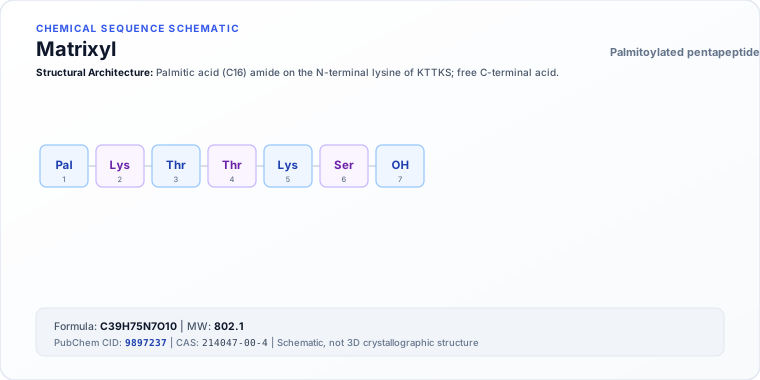
- Sequence (one-letter)
- Pal-KTTKS
- Molecular formula
- C39H75N7O10
- Molecular weight
- 802.1 g/mol
- CAS Number
- 214047-00-4
- UNII Code
- KK181SM5JG
- PubChem CID
- 9897237
Identifiers checked against PubChem and FDA's Global Substance Registration System on 13 October 2026. FDA substance record ↗ · PubChem record ↗ See all names and codes in the peptide name index.
Clinical Trials & Human Cohorts
Human research can examine tolerability, symptoms or patient outcomes. The design and comparator determine what each result can establish.
Topical palmitoyl pentapeptide provides improvement in photoaged human facial skin [1]
What was reported
The moisturizer containing pal-KTTKS was well tolerated and improved measured wrinkles and fine lines compared with the same moisturizer without it, by image analysis and expert grading.
What limits the conclusion
All authors worked for Procter & Gamble, a skin-care manufacturer. One population, 12 weeks, cosmetic appearance outcomes only; no independent replication of this size.
Double-blind, Randomized Trial on the Effectiveness of Acetylhexapeptide-3 Cream and Palmitoyl Pentapeptide-4 Cream for Crow's Feet [2]
What was reported
Improvements were seen in some participants; the palmitoyl pentapeptide-4 cream appeared to do better than acetyl hexapeptide-3 and placebo on measurements, photos and self-assessment.
What limits the conclusion
Very small groups. The authors call it an initial study and ask for larger, longer trials.
Efficacy of anti-aging products for periorbital wrinkles as measured by 3-D imaging [3]
What was reported
Products containing niacinamide, Pal-KT, Pal-KTTKS, carnosine and other actives improved periorbital skin smoothness over 4 weeks.
What limits the conclusion
Multi-ingredient products compared with no treatment, so the effect of pal-KTTKS alone cannot be separated. Manufacturer-run (Procter & Gamble).
How the compound may work
Mechanisms describe how Matrixyl may affect biological processes. Laboratory findings and patient outcomes answer different questions.
Collagen-fragment signaling
KTTKS is a short piece of the type I procollagen propeptide. In cultured cells it was the minimum sequence needed to stimulate collagen and fibronectin production. This is a laboratory finding, not proof of effects in living skin. [4]
Why the palmitoyl group was added
Unmodified KTTKS was quickly broken down and was not found in skin layers. The palmitoylated form was more stable and reached the outer skin layers, but neither form passed fully through the skin in this model. [5]
Areas Being Studied
These research topics reflect active areas of scientific exploration, distinct from unverified commercial marketing claims.
Facial wrinkles and fine lines
The best-known trial is manufacturer-run. A 2011 review noted few clinical studies and little skin-penetration data for KTTKS and its derivatives. [6]
Matrixyl 3000 is a different ingredient
Matrixyl 3000 contains palmitoyl tripeptide-1 (Pal-GHK) and palmitoyl tetrapeptide-7 (Pal-GQPR), not palmitoyl pentapeptide-4. Evidence for one should not be applied to the other. [7]
Cosmetic safety evaluation
An industry framework screened palmitoyl pentapeptide-4 with bioinformatic tools and found sequence similarity to skin matrix proteins without toxin or allergen flags. The authors work for a company that makes products with these peptides. [8]
Compare the study designs.
| Study | Design / sample | Outcome type | Key limitation |
|---|---|---|---|
| Split-face wrinkle trial · 2005 [1] | 12-week double-blind, placebo-controlled, split-face randomized study n = 93 |
Clinical endpoint evaluation | All authors worked for Procter & Gamble, a skin-care manufacturer. One population, 12 weeks, cosmetic appearance outcomes only; no independent replication of this size. |
| Crow's feet pilot · 2023 [2] | 8-week double-blind randomized three-arm trial (pal-KTTKS cream, acetyl hexapeptide-3 cream, placebo) n = 21 |
Clinical endpoint evaluation | Very small groups. The authors call it an initial study and ask for larger, longer trials. |
| Multi-ingredient eye-area products · 2009 [3] | Two double-blind, randomized, split-face studies of finished products versus no treatment n = 77 |
Clinical endpoint evaluation | Multi-ingredient products compared with no treatment, so the effect of pal-KTTKS alone cannot be separated. Manufacturer-run (Procter & Gamble). |
Regulatory Status & Clinical Safety
Regulatory Classification
United States, checked 11 October 2026: palmitoyl pentapeptide-4 is sold as a cosmetic ingredient, not as a drug. FDA does not pre-approve cosmetic products or ingredients (except some color additives), so there is no FDA approval to look up. Cosmetic companies are responsible for product safety and labeling. A product that claims to treat disease or change the body's structure or function can be regulated as a drug. Matrixyl 3000 is a different blend (palmitoyl tripeptide-1 plus palmitoyl tetrapeptide-7) and is not covered by this profile's evidence.
Safety Realities & Impurities
Safety depends on the molecule, formulation, route and evidence. A laboratory purity measurement alone cannot establish safety for human use.
Clinical Trials Registry Records
Official registry records from ClinicalTrials.gov. Study registration does not imply government endorsement or guaranteed efficacy.
WADA & Anti-Doping Regulations
WADA Anti-Doping Status
Matrixyl is not prohibited under current World Anti-Doping Agency (WADA) regulations. However, athletes must ensure unregulated preparations or unverified vendor products do not violate Section S0 (Non-approved substances). Last verified: October 2026.
Research Timeline
-
1993
KTTKS identified
Cell research identifies Lys-Thr-Thr-Lys-Ser as a collagen-stimulating procollagen fragment. [4]
-
2005
Split-face trial
A manufacturer-run 93-person trial reports wrinkle improvements with a pal-KTTKS moisturizer. [1]
-
2011
Evidence gaps noted
A review highlights few clinical studies and missing skin-penetration data. [6]
-
2023
Small randomized pilot
A 21-person trial in Indonesian women reports favorable but preliminary results. [2]
-
2026
Still a cosmetic ingredient
No FDA drug approval exists; FDA does not pre-approve cosmetic ingredients. [9]
What Researchers Still Don't Know
Long-term safety profiles
Multi-year observational data in broader heterogeneous cohorts remains uncharacterized.
Optimal dose-response thresholds
Comparative trials optimizing minimal effective exposure versus adverse event rates.
Formulation bioavailability
Differences between oral, subcutaneous, and modified peptide delivery vehicles.
References
Primary sources verified against PubMed / NLM and regulatory databases.
- Randomized split-face trial (manufacturer-run)
- Small randomized trial
- Randomized split-face studies (multi-ingredient, manufacturer-run)
-
Cell research
A pentapeptide from type I procollagen promotes extracellular matrix production ↗ (external website)
- Laboratory skin study (mouse)
- Review
-
Human skin permeation study
Permeation behaviour of cosmetic actives into the human stratum corneum ↗ (external website)
-
Industry safety framework
A framework for the safety evaluation of peptides in cosmetics ↗ (external website)
- FDA regulatory explanation
-
FDA regulatory explanation
Is It a Cosmetic, a Drug, or Both? (Or Is It Soap?) ↗ (external website)