
Teriparatide: the basics
What is it?
A prescription fragment of parathyroid hormone that stimulates new bone formation.
Research paper ↗What do people claim it helps with?
Reducing fracture risk in high-risk osteoporosis is supported. Claims about routine sports-injury recovery or general stronger bones go beyond that indication.
What has research actually shown?
Controlled trials in osteoporosis found increased bone density and fewer fractures. The benefit applies to studied osteoporosis populations, not every bone injury.
Research paper ↗Has this been demonstrated in people?
Demonstrated in people, including controlled clinical trials for the uses described here. Evidence for one diagnosis does not establish benefit for every other claim.
Research paper ↗What side effects, risks and unknowns should I understand?
Nausea, dizziness and leg cramps can occur. Calcium can rise and kidney-stone risk needs consideration. People at increased baseline risk of bone cancer generally should avoid it under label guidance.
Prescribing information ↗Is it an approved medicine?
Yes. FDA-approved teriparatide products treat specified forms of osteoporosis in patients at high fracture risk.
Prescribing information ↗Approval here means U.S. FDA approval and applies to a particular product, formulation and use. This is a starting overview, not a complete side-effect list. Sources checked 10 October 2026; independent scientific review pending.
How is it used or studied?
Prescription injection as part of a clinician-managed osteoporosis plan.
Different routes and formulations can have different effects. A study of one product does not validate every product with the same peptide name.
A common misunderstanding
More bone density is one measurement; fracture reduction is a separate, more direct patient outcome.
What should I ask a clinician?
- What diagnosis or goal are we trying to address, and what established options are available?
- Was the expected benefit shown in people like me, using this exact product?
- How could my medicines, health conditions or pregnancy plans affect the risks?
- What monitoring is needed, and what would tell us the treatment is helping or should be stopped?
What do the research words mean?
- Peptide
- A short chain of amino acids, the building blocks of proteins.
- Preclinical
- Research in cells, tissues or animals before dependable treatment evidence in people.
- Controlled trial
- A study comparing a treatment with another treatment or a placebo to help separate its effects from other explanations.
- Biomarker
- A measurement, such as a hormone level. A change does not necessarily mean someone feels better or lives longer.
Teriparatide Evidence & Clinical Profile
Established Clinical Trials
Teriparatide has been investigated in clinical contexts. Patient outcomes must be evaluated against study size, design, and control cohorts.
Laboratory & In Vivo Assays
Cellular and animal disease models examine receptor binding affinities and signaling cascades, which require human confirmation.
What is Teriparatide?
Teriparatide (Forteo / rhPTH 1-34) is An FDA-approved recombinant human parathyroid hormone fragment (rhPTH 1-34). The first approved bone anabolic medicine, stimulating osteoblast activity and new trabecular bone formation to reduce osteoporotic fracture risk. Aliases include: Forteo, rhPTH(1-34), Recombinant Human Parathyroid Hormone 1-34.
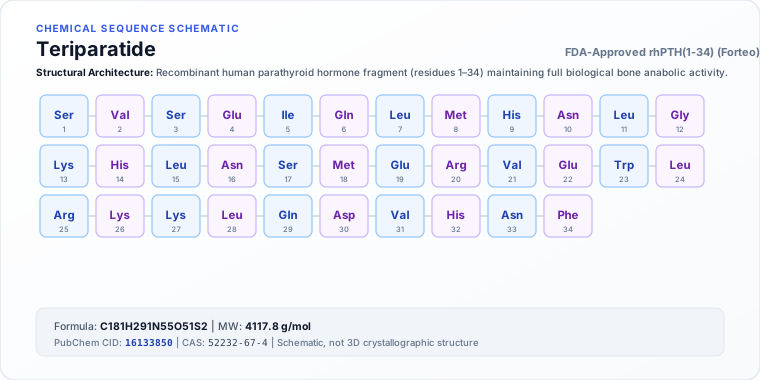
- Sequence (one-letter)
- SVSEIQLMHNLGKHLNSMERVEWLRKKLQDVHNF
- Molecular formula
- C181H291N55O51S2
- Molecular weight
- 4117.8 g/mol
- CAS Number
- 52232-67-4
- UNII Code
- 10T9CSU89I
- PubChem CID
- 16133850
Identifiers are for the free base; teriparatide acetate carries UNII 9959P4V12N.
Identifiers checked against PubChem and FDA's Global Substance Registration System on 13 October 2026. FDA substance record ↗ · PubChem record ↗ See all names and codes in the peptide name index.
Clinical Trials & Human Cohorts
Human research can examine tolerability, symptoms or patient outcomes. The design and comparator determine what each result can establish.
Effects of Parathyroid Hormone (1-34) on Fractures and Bone Density in Postmenopausal Women [1]
What was reported
New vertebral fractures fell from 14% with placebo to 5% and 4% in the two PTH(1-34) groups (relative risks 0.35 and 0.31); nonvertebral fragility fractures fell from 6% to 3% (relative risks 0.47 and 0.46).
What limits the conclusion
Median observation of 21 months in women with prior vertebral fractures; the higher dose had more side effects without further fracture benefit.
Teriparatide Versus Alendronate in Glucocorticoid-Induced Osteoporosis [2]
What was reported
Lumbar spine BMD rose more with teriparatide than alendronate (7.2% vs 3.4%), with fewer new vertebral fractures (0.6% vs 6.1%); nonvertebral fractures were similar.
What limits the conclusion
More teriparatide patients had at least one elevated serum calcium measurement; daily injections required.
How the compound may work
Mechanisms describe how Teriparatide may affect biological processes. Laboratory findings and patient outcomes answer different questions.
Intermittent PTH1R Activation
Intermittent PTH increases osteoblast number, in part by activating survival signaling and delaying osteoblast apoptosis, so bone formation exceeds the bone removed by osteoclasts. [3]
Growth Factor and Wnt Signaling
Mouse genetic studies suggest the anabolic effect of intermittent PTH requires IGF-I and FGF-2, and perhaps Wnt signaling. [3]
Areas Being Studied
These research topics reflect active areas of scientific exploration, distinct from unverified commercial marketing claims.
Postmenopausal Osteoporosis
Rapid restoration of trabecular architecture and bone mineral density. [1]
Glucocorticoid-Induced Osteoporosis
Compared with alendronate in patients on long-term glucocorticoids, with greater spine BMD gains and fewer new vertebral fractures. [2]
Compare the study designs.
| Study | Design / sample | Outcome type | Key limitation |
|---|---|---|---|
| Fracture Prevention Trial · 2001 [1] | Double-blind multinational RCT n = 1637 |
Clinical endpoint evaluation | Median observation of 21 months in women with prior vertebral fractures; the higher dose had more side effects without further fracture benefit. |
| Glucocorticoid Osteoporosis Trial · 2007 [2] | 18-month double-blind randomized active comparator RCT n = 428 |
Clinical endpoint evaluation | More teriparatide patients had at least one elevated serum calcium measurement; daily injections required. |
Regulatory Status & Clinical Safety
Regulatory Classification
FDA approved (NDA 021318) for severe osteoporosis in postmenopausal women and men at high risk.
Safety Realities & Impurities
Safety depends on the molecule, formulation, route and evidence. A laboratory purity measurement alone cannot establish safety for human use.
Clinical Trials Registry Records
Official registry records from ClinicalTrials.gov. Study registration does not imply government endorsement or guaranteed efficacy.
A Randomized Trial of Teriparatide vs Alendronate for Glucocorticoid-Induced Osteoporosis [2]
- Planned enrollment
- 428 (patients)
- Posted results
- Available
- Sponsor
- Eli Lilly
- Last updated
- 2008
WADA & Anti-Doping Regulations
WADA Anti-Doping Status
Teriparatide is not prohibited under current World Anti-Doping Agency (WADA) regulations. However, athletes must ensure unregulated preparations or unverified vendor products do not violate Section S0 (Non-approved substances). Last verified: October 2026.
Research Timeline
What Researchers Still Don't Know
Long-term safety profiles
Multi-year observational data in broader heterogeneous cohorts remains uncharacterized.
Optimal dose-response thresholds
Comparative trials optimizing minimal effective exposure versus adverse event rates.
Formulation bioavailability
Differences between oral, subcutaneous, and modified peptide delivery vehicles.
References
Primary sources verified against PubMed / NLM and regulatory databases.
- Landmark RCT
-
Phase 3 Active Comparator RCT
Teriparatide or alendronate in glucocorticoid-induced osteoporosis ↗ (external website)
-
Mechanism Review
Molecular and cellular mechanisms of the anabolic effect of intermittent PTH ↗ (external website)
-
Regulatory
Forteo (Teriparatide) FDA Prescribing Information ↗ (external website)
-
Regulatory
Drugs@FDA: Forteo (teriparatide injection), NDA 021318 ↗ (external website)