
Compounded Semaglutide and Tirzepatide: FDA’s Plan to End Bulk Compounding Explained
FDA proposed keeping semaglutide, tirzepatide and liraglutide off the 503B bulks list. What it changes, what it does not, and where compounded GLP-1s stand.

Key takeaways
- FDA proposed in May 2026 that outsourcing facilities have no clinical need to compound semaglutide, tirzepatide or liraglutide from bulk.
- The proposal is not final; it does not change the separate limits on 503A pharmacies.
- FDA’s September 2026 letter to Empower Pharmacy called differences from approved drugs “pretextual”.
In this article
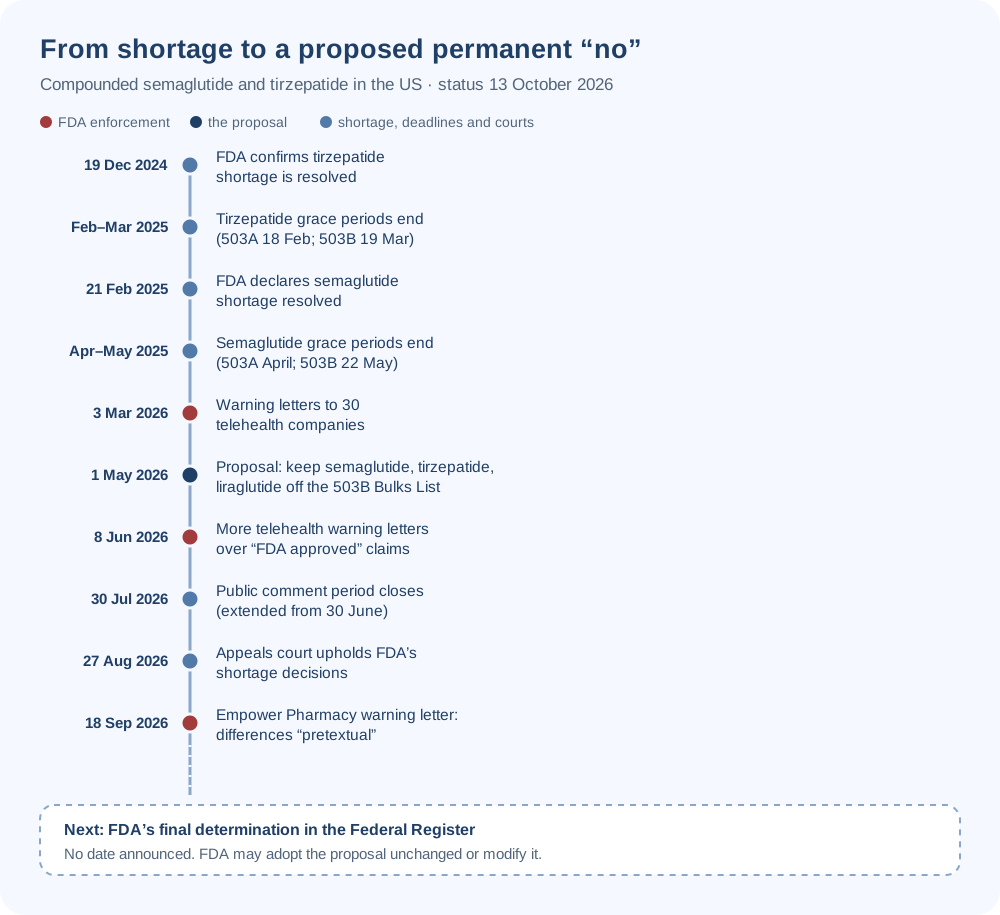
On 1 May 2026, FDA proposed that semaglutide, tirzepatide and liraglutide should not be placed on the 503B Bulks List, the list that would let large "outsourcing facilities" make copies of these drugs from raw ingredients.12 The public comment period closed on 30 July 2026. As of 13 October 2026, FDA has not published a final decision.3
Meanwhile FDA has kept up pressure on the compounded GLP-1 market: a September warning letter to one of the largest compounding pharmacies, letters to telehealth companies over misleading advertising, and court wins against compounders. This article explains what the proposal does, what it does not do, where compounded semaglutide and tirzepatide stand legally now, and what to watch next. It describes regulation only. It is not legal or medical advice and gives no dosing information.
The short version
- What FDA proposed: that there is "no basis to conclude that there is a clinical need" for outsourcing facilities to compound semaglutide, tirzepatide or liraglutide from bulk ingredients.1
- Why: FDA-approved versions are available, and FDA does not treat cost, convenience or past supply problems as a "clinical need".1
- Status: a proposal. Comments closed 30 July 2026; no final decision has been published.3
- Who it affects: 503B outsourcing facilities. It does not change the separate rules for ordinary 503A pharmacies, which already limit "essentially copies" of approved drugs.45
- The shortages are over. FDA declared the tirzepatide shortage resolved in December 2024 and the semaglutide shortage in February 2025; the grace periods for compounders ended in 2025.5 A federal appeals court upheld those decisions in August 2026.6
- Enforcement continues. FDA's September 2026 warning letter to Empower Pharmacy said the differences between its products and the approved drugs appeared "pretextual".7
Why compounded GLP-1s became so common
Compounding normally fills gaps: a pharmacist prepares a medicine for a patient who cannot use an approved product, for example because of an allergy to an ingredient. Compounded drugs are not FDA-approved, and FDA does not check them for safety, effectiveness or quality before they are sold.8 Read more in our guide to compounded peptides.
When demand for semaglutide (Ozempic, Wegovy) and tirzepatide (Mounjaro, Zepbound) outstripped supply in 2022–2024, both drugs were on FDA's shortage list. Federal law allows compounders much more freedom to copy a drug while it is in shortage, so a large market of compounded versions grew up, much of it sold through telehealth websites.5
That freedom ended with the shortages:
| Drug | Shortage declared resolved | 503A pharmacy grace period ended | 503B outsourcing facility grace period ended |
|---|---|---|---|
| Tirzepatide | 19 December 2024 (after re-evaluation) | 18 February 2025 | 19 March 2025 |
| Semaglutide | 21 February 2025 | April 2025 (after a court denied an injunction on 24 April) | 22 May 2025 |
Source: FDA, "FDA clarifies policies for compounders as national GLP-1 supply begins to stabilize", content current as of 1 April 2026.5
Compounders challenged both decisions in court. On 27 August 2026 the US Court of Appeals for the Fifth Circuit ruled for FDA, finding that any procedural error by the agency was "harmless".6
What the May 2026 proposal says
The Federal Register notice, "List of Bulk Drug Substances for Which There Is a Clinical Need Under Section 503B", was published on 1 May 2026 (91 FR 23431, docket FDA-2018-N-3240).1 FDA announced it the day before.2
The legal test. An outsourcing facility may compound from a bulk drug substance only if that substance is on FDA's list of substances "for which there is a clinical need", or if the drug is on the shortage list at the time.4 Neither semaglutide nor tirzepatide is currently on either list.5 The proposal would formally decide that they do not belong on the clinical-need list.
FDA's reasoning. For each drug, FDA found "no basis to conclude that there is an attribute of the FDA-approved drug products … that makes them medically unsuitable to treat certain patients".1 It also set out what does not count as clinical need:
- "FDA does not interpret supply issues, such as backorders, to be within the meaning of 'clinical need'".1
- FDA "does not consider convenience in administering a particular compounded drug product … or the cost of the compounded drug product as compared with an FDA-approved drug product" to be clinical need.1
The timeline. Comments were originally due on 30 June 2026. FDA extended the deadline by 30 days, to 30 July 2026, rather than the 60 days some commenters requested, saying a longer delay would cause "significant delay of Agency action".3 FDA says it will publish a final determination in the Federal Register and may adopt the proposal unchanged or modify it.1
Liraglutide is a special case. Liraglutide injection was still listed as "Currently in Shortage" on FDA's shortage database in September 2026.9 While that remains true, the separate shortage route still applies to it, whatever happens to the bulks list.
503A vs 503B: who the proposal affects
Most confusion comes from the two kinds of compounder.4
| 503A compounding pharmacy | 503B outsourcing facility | |
|---|---|---|
| What it is | State-licensed pharmacy compounding for individual patients | Facility registered with FDA, can make larger batches, including without patient-specific prescriptions |
| Manufacturing standard | State pharmacy rules and USP standards | Federal current good manufacturing practice (CGMP) |
| Copies of approved drugs | Cannot compound "essentially copies" of a commercially available drug "regularly or in inordinate amounts" | Cannot compound a drug that is "essentially a copy of one or more approved drugs" |
| Exception | A change that makes a "significant difference" for an identified patient, as determined by the prescriber | A change that makes a "clinical difference" for an individual patient, as determined by the prescriber |
| Affected by the May 2026 proposal? | No, not directly | Yes |
FDA's current policy treats a 503A product as "essentially a copy" if it has the same active ingredient in the "same, similar or easily substitutable strength" and the same route. FDA has said that adding vitamin B12 to semaglutide does not by itself avoid this if the amounts are "within 10%" of approved products. FDA does not intend to act against a pharmacy filling "four or fewer prescriptions of that compounded drug product during a calendar month".5
Our reading: the May proposal closes the 503B route permanently. Patients may still be offered compounded semaglutide or tirzepatide by 503A pharmacies under the "significant difference" exception. FDA's recent enforcement shows it is examining how that exception is being used.
What FDA's enforcement shows
Empower Pharmacy, 18 September 2026. After inspecting the pharmacy in November 2025, FDA cited products including tirzepatide with niacinamide and semaglutide with cyanocobalamin (vitamin B12).7 The letter said:
- "The volume of products you are producing suggests that differences between products you are compounding and the FDA-approved products are pretextual."
- Prescriber statements of "significant difference" "appear to be repeated verbatim across many records".
- It raised concerns about "third-party technology platforms that provide prescribers with pre-selected menu options" for those statements.
The letter also cited manufacturing and sanitation problems.7
Telehealth advertising. In March 2026 FDA announced warning letters to 30 telehealth companies over marketing of compounded GLP-1s.10 A further round in June 2026 cited website claims such as "our compounding pharmacies are all FDA approved".11 FDA reminded telehealth firms that it "does not approve or license any facility" and that compounded drugs are not FDA-approved.12
"Research use only" sellers. In August 2026 FDA warned online sellers that products including semaglutide, tirzepatide and retatrutide are "unapproved new drugs" despite "research" labels.13 See what "research use only" really means.
The safety concerns behind the policy
FDA's page on unapproved GLP-1 drugs, updated 1 October 2026, lists its main concerns8:
- Adverse event reports. As of 31 May 2026, FDA had received "990 reports of adverse events associated with compounded semaglutide" and "more than 730" for compounded tirzepatide. FDA notes such events are likely underreported.
- Dosing errors. FDA has received reports of hospitalisations that may be related to patients measuring incorrect doses from multi-dose vials, and to health professionals miscalculating doses. In 2024 it warned of patients taking "five to 20 times more than the intended dose".14
- Salt forms. Some compounders have used "semaglutide sodium and semaglutide acetate", which FDA says "are different active ingredients than are used in the approved drugs". FDA is "not aware of any lawful basis for their use in compounding."8
- Investigational drugs. "Retatrutide and cagrilintide cannot be used in compounding under federal law."8 Neither is approved. See our profiles of retatrutide and cagrilintide.
Laboratory tests of semaglutide sold online without a prescription have found very low purity, more drug than the label stated, and bacterial endotoxin in every vial tested.15 Our article on peptide side effects covers reports of harm from unregulated products.
What this means if you use compounded semaglutide or tirzepatide
Nothing in the May proposal is final, and it does not by itself cancel prescriptions from 503A pharmacies. Neither FDA document addresses existing patients directly. Practical points:
- Check what you are getting. Ask your prescriber whether the product comes from a 503A pharmacy or a 503B outsourcing facility, and why a compounded version was chosen over an approved one.
- Be wary of "FDA-approved" claims. Compounded drugs are not FDA-approved, and FDA does not approve pharmacies.12
- Ask about the active ingredient. Salt forms such as semaglutide sodium or acetate are not the ingredient in approved products.8
- Compare approved options. FDA-approved options now include injectable semaglutide and tirzepatide, oral semaglutide tablets for weight management (approved December 2025), and orforglipron (Foundayo), approved on 1 April 2026.1617 In February 2026 the White House announced lower cash prices for several of these through TrumpRx; check current prices, as they may have changed.18 Our GLP-1 drug comparison summarises the approved options.
- Report problems. Report adverse events to FDA MedWatch.
What to watch next
- FDA's final determination in the Federal Register on the three drugs. It could be published at any time.
- More 503A enforcement, especially on how "significant difference" is documented and on telehealth platforms that pre-fill prescriber statements.7
- The liraglutide shortage. If it is resolved, the shortage route for liraglutide closes too.9
- New approvals in the obesity pipeline. Our obesity drug pipeline article tracks them.
Frequently asked questions
Is compounded semaglutide legal now?
It depends on who makes it. Outsourcing facilities cannot currently compound it from bulk ingredients, because semaglutide is not in shortage and is not on the 503B Bulks List. A 503A pharmacy may compound it only within limits: not "essentially copies" made regularly or in large amounts, unless a prescriber documents a significant difference for a specific patient.45
Has FDA banned compounded tirzepatide?
Not in a single action. The May 2026 proposal would formally keep tirzepatide off the 503B Bulks List, but it is not final. The rules for 503A pharmacies are unchanged.15
Does adding vitamin B12 make compounded semaglutide different?
Not necessarily. FDA has said that semaglutide with vitamin B12 can still be "essentially a copy" if the amounts are within 10% of approved strengths, and its Empower Pharmacy letter questioned whether such differences were "pretextual".57
Is compounded semaglutide the same as Ozempic or Wegovy?
No. Compounded drugs are not FDA-approved, and FDA has warned that some contain salt forms that differ from the active ingredient in approved products.8 See our semaglutide and tirzepatide profiles.
References
- FDA. List of Bulk Drug Substances for Which There Is a Clinical Need Under Section 503B of the Federal Food, Drug, and Cosmetic Act. Federal Register, 1 May 2026; 91 FR 23431. Docket FDA-2018-N-3240.
- FDA. FDA Proposes to Exclude Semaglutide, Tirzepatide, and Liraglutide on 503B Bulks List. Press announcement, 30 April 2026.
- FDA. List of Bulk Drug Substances for Which There Is a Clinical Need Under Section 503B; extension of comment period. Federal Register, 26 June 2026; 91 FR 38719. No final determination found in the Federal Register as of 13 October 2026.
- 21 U.S. Code § 353a: Pharmacy compounding and § 353b: Outsourcing facilities. Legal Information Institute.
- FDA. FDA clarifies policies for compounders as national GLP-1 supply begins to stabilize. Content current as of 1 April 2026.
- US Court of Appeals for the Fifth Circuit. Outsourcing Facilities Association v. FDA, No. 25-10600 (tirzepatide) and No. 25-10758 (semaglutide). 27 August 2026. Unpublished opinions.
- FDA. Warning letter: Empower Clinic Services, LLC dba Empower Pharmacy, 18 September 2026.
- FDA. FDA's Concerns with Unapproved GLP-1 Drugs Used for Weight Loss. Content current as of 1 October 2026.
- FDA. Drug Shortages: Liraglutide Injection. Checked 13 October 2026.
- FDA. FDA Warns 30 Telehealth Companies Against Illegal Marketing of Compounded GLP-1s. 3 March 2026.
- FDA. Warning letter: Altru Telehealth, 8 June 2026. One of the June 2026 letters on compounded GLP-1 marketing.
- FDA. FDA to Telehealth Companies: What to Know When Promoting Compounded Drugs. June 2026.
- FDA. Warning letter: Royal Peptides LLC, 24 August 2026. One of several letters to online peptide sellers that month.
- FDA. FDA alerts health care providers, compounders and patients of dosing errors associated with compounded injectable semaglutide products. 26 July 2024.
- Ashraf AR, et al. Multifactor quality and safety analysis of semaglutide products sold by online sellers without a prescription. J Med Internet Res. 2024. PMID: 39509151. doi:10.2196/65440.
- FDA. Approval letter, NDA 218316 (Wegovy tablets). 22 December 2025.
- FDA. FDA approves first new molecular entity under National Priority Voucher program. 1 April 2026.
- The White House. Fact sheet: President Donald J. Trump launches TrumpRx.gov. 5 February 2026.


