

Therapeutic Peptides Beginner

Peptides for Weight Loss: What the Evidence Actually Shows

Which peptides have real evidence for weight loss? Approved medicines, late-stage investigational drugs and online peptides compared by human trial evidence.

11 min read Updated 21 sources InsidePeptides Editorial Team

Carrots, parsnips, celeriac, onions, garlic and potatoes arranged on a rustic wooden table
Photo: Lubos Houska, CC0, via Wikimedia Commons.

Plain-English Summary

Peptides with strong evidence for weight loss are approved prescription medicines such as semaglutide, tirzepatide and liraglutide, which mimic gut hormones that reduce appetite and have been tested in large randomised trials. Several newer peptides, including retatrutide, CagriSema, survodutide and amycretin, have promising trial results but are not yet approved. Peptides promoted online for fat loss, such as AOD-9604 and MOTS-c, have little or no convincing human evidence, and tesamorelin is approved only for a specific condition in people with HIV.

Key Takeaways

  • “Peptides for weight loss” covers approved medicines, investigational drugs and unapproved products; the evidence behind them differs enormously.
  • Semaglutide, tirzepatide and liraglutide are approved in the U.S. for chronic weight management on the basis of large randomised, placebo-controlled trials.
  • Setmelanotide is approved only for specific genetic and hypothalamic forms of obesity and is not expected to work in common obesity.
  • Retatrutide, CagriSema, survodutide and amycretin had published trial results but no FDA approval as of 17 October 2026.
  • The FDA found a lack of evidence that AOD-9604 is effective for obesity by any route, and MOTS-c has no published human weight-loss trials.
  • Tesamorelin reduces abdominal fat in HIV-associated lipodystrophy, but its label says it is not indicated for weight loss.
  • Ozempic and Wegovy contain semaglutide, which is itself a peptide, so the meaningful comparison is approved versus unapproved, not peptide versus Ozempic.
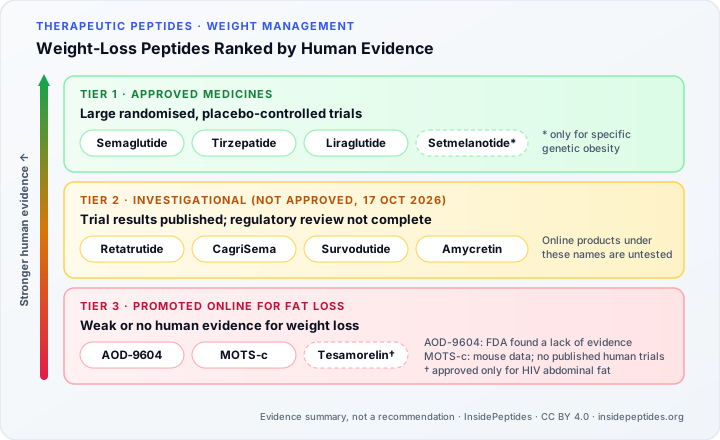
Diagram: an evidence ladder for weight-loss peptides. Top tier, approved medicines with large randomised trials: semaglutide, tirzepatide, liraglutide, and setmelanotide for rare genetic obesity. Middle tier, late-stage investigational peptides: retatrutide, CagriSema, survodutide and amycretin. Bottom tier, peptides promoted online with weak or no human evidence: AOD-9604, MOTS-c, and tesamorelin outside its HIV indication.
The weight-loss peptide evidence ladder: approved medicines backed by large randomised trials, investigational peptides with trial results but no approval (status 17 October 2026), and peptides promoted online without convincing human evidence. Diagram by InsidePeptides, CC BY 4.0: free to reuse with a credit and link. Download SVG

What “peptides for weight loss” actually covers

“Peptides for weight loss” is a label that lumps together very different things: approved prescription medicines tested in tens of thousands of people, investigational drugs still in late-stage trials, and compounds promoted online with little or no human evidence. A peptide is simply a short chain of amino acids (see What Are Peptides?), so the word on its own says nothing about whether a product works or is safe.

The clearest way to answer the question is by evidence, not by popularity. This guide sorts weight-loss peptides into three tiers:

  • Tier 1, approved medicines: peptides such as semaglutide, tirzepatide and liraglutide, each supported by large randomised controlled trials and approved by the U.S. Food and Drug Administration (FDA) for chronic weight management, plus setmelanotide for specific rare genetic forms of obesity.
  • Tier 2, late-stage investigational peptides: molecules such as retatrutide, CagriSema (cagrilintide with semaglutide), survodutide and amycretin, which have phase 3 or earlier trial results but no approval yet.
  • Tier 3, peptides promoted online: compounds such as AOD-9604 and MOTS-c, whose weight-loss claims rest mainly on animal studies or unpublished, unsuccessful human trials, and tesamorelin, an approved medicine whose approval covers a narrow indication rather than general weight loss.

When people ask for the “best peptides for weight loss”, the honest answer is that only Tier 1 has the evidence needed to judge benefit and harm. Ranking a Tier 3 compound alongside an approved medicine mixes two entirely different kinds of evidence. This guide describes research and regulatory status only. It gives no doses or instructions and is not medical advice.

How weight-loss peptides work

Most peptides with strong weight-loss evidence copy or extend gut and brain hormones that regulate appetite. The central example is GLP-1 (glucagon-like peptide-1), which the gut releases after eating. At the levels reached with medicines, GLP-1 receptor agonists reduce appetite and food intake, mainly through actions in the brain, and slow stomach emptying. The body's own GLP-1 is inactivated within minutes, so medicines such as semaglutide are modified to last far longer; the chemistry is explained in Peptide Half-Life, and the hormone background in The Incretin Effect.

Newer molecules add further hormone targets in a single peptide or combination:

  • GIP plus GLP-1: tirzepatide activates both receptors.
  • Glucagon plus GLP-1: survodutide is designed to add the energy-use and liver effects of glucagon receptor activity.
  • GIP, GLP-1 and glucagon: retatrutide acts on all three.
  • Amylin plus GLP-1: CagriSema combines an amylin analogue with semaglutide; amycretin puts both activities in one molecule.

Why combining receptors might add benefit is covered in Multi-Receptor Agonists. A different route is the melanocortin-4 (MC4) receptor in the hypothalamus, part of the brain's long-term weight-control circuit. Setmelanotide activates this receptor and is designed for people whose obesity results from specific genetic breaks in that pathway (see Melanocortin Receptors).

Compounds in Tier 3 are usually described with very different mechanisms, such as directly “burning fat” or mimicking exercise. Those descriptions mostly come from cell and animal work, and a plausible mechanism is not the same as evidence of weight loss in people (see Human vs Preclinical Research).

Tier 1: approved medicines with large trials

Three peptide medicines are approved in the United States for chronic weight management in adults with obesity, or overweight with at least one weight-related condition, alongside diet and physical activity. Each approval rests on randomised, double-blind, placebo-controlled trials.

  • Liraglutide (Saxenda) was approved for weight management in December 2014 [1]. In the 56-week SCALE trial of 3,731 adults without diabetes, 63.2% of people on liraglutide lost at least 5% of their body weight, compared with 27.1% on placebo; average loss was about 8.4 kg versus 2.8 kg [2].
  • Semaglutide (Wegovy) was approved for weight management in June 2021 [3]. In STEP 1, average body weight fell by 14.9% over 68 weeks with semaglutide versus 2.4% with placebo. Gastrointestinal side effects such as nausea and diarrhoea were the most common, and 4.5% stopped treatment because of them, versus 0.8% on placebo [4]. A tablet form was approved for weight management in December 2025; see Oral vs Injected Peptides.
  • Tirzepatide (Zepbound) was approved for weight management in November 2023 [5]. In SURMOUNT-1, average weight change over 72 weeks ranged from −15.0% to −20.9% across the tested doses, versus −3.1% with placebo [6].

For semaglutide there is also outcome evidence beyond the scales. The SELECT trial enrolled 17,604 adults with established cardiovascular disease and overweight or obesity but no diabetes. Over a mean follow-up of more than three years, the combined rate of cardiovascular death, heart attack or stroke was 6.5% with semaglutide versus 8.0% with placebo, a hazard ratio of 0.80. Stopping the study drug because of adverse events was also more common with semaglutide (16.6% versus 8.2%) [7].

Setmelanotide (Imcivree) is a different case. It is approved to reduce excess body weight in people with obesity caused by specific genetic conditions, including POMC, PCSK1 or LEPR deficiency confirmed by genetic testing and Bardet-Biedl syndrome, and more recently acquired hypothalamic obesity. Its label states that it is not expected to work in other types of obesity [8]. In its pivotal single-arm trials, 8 of 10 participants with POMC deficiency and 5 of 11 with LEPR deficiency lost at least 10% of their weight at about one year [9]. These trials were small because the conditions are rare.

Tier 2: late-stage investigational peptides

The following peptides have published trial results but were not approved by the FDA for any use as of 17 October 2026, the date this status was checked. Results come from different trials with different populations, durations and analysis methods, so the numbers should not be lined up as a ranking.

  • Retatrutide (Eli Lilly; GIP, GLP-1 and glucagon receptors). In the phase 3 TRIUMPH-1 trial of 2,339 adults with obesity and without diabetes, average weight change over 80 weeks was −17.6% to −25.0% across dose groups, versus −3.9% with placebo; the most common adverse events were gastrointestinal [10].
  • CagriSema (Novo Nordisk; cagrilintide plus semaglutide). In REDEFINE 1, 3,417 adults without diabetes were randomised; average weight change over 68 weeks was −20.4% versus −3.0% with placebo, and gastrointestinal adverse events affected 79.6% versus 39.9% [11]. The company submitted CagriSema to the FDA in December 2025 and said a decision was anticipated by late 2026. The same announcement reported that REDEFINE 4, a head-to-head trial, did not show CagriSema to be non-inferior to tirzepatide [12]. No FDA decision had been announced when this guide was checked.
  • Survodutide (Boehringer Ingelheim; glucagon and GLP-1 receptors). In the phase 3 SYNCHRONIZE-1 trial of 725 adults without diabetes, average weight change at 76 weeks was −12.2% and −13.0% in the two dose groups, versus −5.4% with placebo. Gastrointestinal symptoms occurred in 80.9% and 89.7% of the survodutide groups, versus 47.9% with placebo [13].
  • Amycretin (Novo Nordisk; GLP-1 and amylin receptors in one molecule). A phase 1b/2a study randomised 125 people; in the highest-dose group, average weight change at 36 weeks was −24.3% versus −1.1% with placebo, but group sizes were small and many participants withdrew [14]. A phase 3 trial, AMAZE 1, began in February 2026 and is recruiting [15].

Investigational means exactly that: approval is not guaranteed, and regulators weigh side effects and tolerability as well as weight loss. Products marketed online under these names have not been tested in these trials. For a dated, regularly updated status summary, see Orforglipron, Retatrutide and CagriSema: Where the Next Weight-Loss Drugs Stand.

Tier 3: peptides promoted online with weak or no human evidence

Several peptides are widely promoted for fat loss without approval and without convincing human trials. What the evidence actually shows differs for each one.

  • AOD-9604 is a modified fragment of human growth hormone. Its developer ran human obesity trials in the 2000s, mostly with an oral form, but they were never published in full. In a 2024 briefing document, the FDA reviewed the available summaries and concluded that “there is a lack of evidence to support the effectiveness” of AOD-9604 for obesity “for any” route of administration. In most of the studies it identified, AOD-9604 failed to show a benefit over placebo, and it found no human exposure data for the injected or skin routes [16].
  • MOTS-c is a peptide encoded in mitochondrial DNA. In the 2015 study that described it, treatment in mice prevented diet-induced obesity and insulin resistance [17]. There are no published randomised trials of MOTS-c for weight loss in people. A small phase 2a trial registered in 2026 is recruiting adults with prediabetes and overweight or obesity; its main outcome is insulin sensitivity, not weight, and no results are available [18].
  • Tesamorelin is an approved medicine, but not a general weight-loss drug. It stimulates the body's release of growth hormone and was approved in 2010 to reduce excess abdominal fat in adults with HIV-associated lipodystrophy. In a 26-week trial in that population, visceral (deep abdominal) fat fell by 15.2% with tesamorelin and rose by 5.0% with placebo [19]. Its current label states that it “is not indicated for weight loss management as it has a weight neutral effect” [20].

The gap between these compounds and Tier 1 is not a matter of degree. Approved medicines have large, published, placebo-controlled trials with defined products. Tier 3 claims usually rely on animal studies, mechanism stories, unpublished data or results from a different population. Products labelled “research use only” are not made or tested to medicine standards; see what “research use only” means and approved versus unapproved peptides.

Side by side: approval status and strongest human evidence

The table summarises each compound's U.S. status on 17 October 2026 and the strongest human evidence found for weight loss. It is a summary of evidence, not a recommendation.

CompoundU.S. approval statusStrongest human evidence for weight loss
SemaglutideApproved for chronic weight management (2021) [3]Phase 3 RCTs (STEP 1) and a cardiovascular outcomes trial (SELECT) [4][7]
TirzepatideApproved for chronic weight management (2023) [5]Phase 3 RCT (SURMOUNT-1) [6]
LiraglutideApproved for chronic weight management (2014) [1]Phase 3 RCT (SCALE) [2]
SetmelanotideApproved only for specific genetic and hypothalamic obesity [8]Small single-arm phase 3 trials in rare genetic obesity [9]
RetatrutideInvestigationalPhase 3 RCT (TRIUMPH-1) [10]
CagriSemaInvestigational; under FDA review [12]Phase 3 RCT (REDEFINE 1) [11]
SurvodutideInvestigationalPhase 3 RCT (SYNCHRONIZE-1) [13]
AmycretinInvestigational; phase 3 under way [15]Phase 1b/2a RCT [14]
TesamorelinApproved only for excess abdominal fat in HIV lipodystrophy [20]RCTs show less visceral fat in that population; label says weight neutral [19][20]
AOD-9604Not approvedUnpublished oral and intravenous trials; FDA found a lack of evidence of effectiveness [16]
MOTS-cNot approvedNone published; mouse studies only, first phase 2a trial recruiting [17][18]

“RCT” means randomised controlled trial, the study design that best isolates a medicine's effect (see Randomized Controlled Trials).

Are peptides safe for weight loss?

Safety depends on the specific product, and evidence about safety comes from the same trials as evidence about benefit. For approved medicines, side effects are measured in thousands of trial participants, listed in the label and tracked after approval. For Tier 1 incretin medicines, the most common problems in trials were gastrointestinal: nausea, vomiting, diarrhoea and constipation [4][6]. More serious risks, such as gallbladder and pancreas problems, and a boxed warning about thyroid C-cell tumours seen in rodents, are set out in the prescribing information [21]. Whether a given medicine is suitable for a given person is a decision for a licensed clinician.

For Tier 2 peptides, safety is still being characterised, which is one reason they are not yet approved. For Tier 3, the safety question is largely unanswered: there are few or no controlled human data, and products marketed outside the medicine supply chain may differ from what their label says in identity, purity or sterility (see peptide impurities).

Two further points apply across the board. First, weight usually returns when effective medicines are stopped; the evidence is reviewed in Stopping Semaglutide or Tirzepatide. Second, a larger average weight loss in one trial does not make a medicine “better” for everyone; tolerability, other health conditions and the way results were analysed all matter.

Frequently asked questions

What are the best peptides for weight loss?

Ranked by strength of evidence rather than recommendation, the peptides with the strongest human evidence are the approved medicines semaglutide, tirzepatide and liraglutide, each tested in large randomised trials [4][2][6]. Retatrutide, CagriSema, survodutide and amycretin have trial results but remain investigational. Peptides such as AOD-9604 and MOTS-c lack convincing human evidence [16][18]. Which medicine, if any, suits an individual is a question for a clinician.

How do peptides work for weight loss?

The best-studied ones mimic gut hormones such as GLP-1, GIP and amylin, which reduce appetite and food intake through actions in the brain and slow stomach emptying. Setmelanotide instead activates the MC4 receptor in a brain pathway that is broken in certain genetic forms of obesity [9].

Are peptides safe for weight loss?

Approved peptide medicines have known, labelled side effects, most commonly gastrointestinal ones, measured in large trials [4][6]. Unapproved peptides have little or no controlled safety data, and their product quality is not assured.

Is semaglutide (Ozempic or Wegovy) a peptide?

Yes. Semaglutide is a modified version of the human GLP-1 peptide. Ozempic is the brand approved for type 2 diabetes, and Wegovy is the brand approved for weight management [3]. So “peptides vs Ozempic” is not a contest between two categories: Ozempic is itself a peptide medicine. The real contrast is between approved peptide medicines and unapproved peptides with little evidence.

Do weight-loss peptides work without injections?

Some do. A semaglutide tablet is approved, but taking peptides by mouth is difficult, and most unapproved “oral” products have no supporting trials. See Oral vs Injected Peptides.

Core Scientific Definitions

Precise biomedical definitions for terms used throughout this guide.

Chronic weight management
The regulatory term for the approved use of weight-loss medicines: long-term treatment, alongside diet and physical activity, for adults with obesity or with overweight plus at least one weight-related condition.
GLP-1 receptor agonist
A medicine that activates the receptor for glucagon-like peptide-1, a gut hormone; in weight management these medicines reduce appetite and food intake and slow stomach emptying.
Investigational drug
A medicine being tested in clinical trials that has not been approved by a regulator for the use being studied; its benefits and risks are not yet fully established.
Placebo-controlled trial
A study in which some participants receive an inactive comparison treatment, so that the effect of the medicine can be separated from lifestyle advice, natural weight change and expectation.
Visceral fat
Fat stored deep in the abdomen around the internal organs, as opposed to fat under the skin; some medicines, such as tesamorelin, are studied for their effect on this fat specifically.

Peer-Reviewed References & Primary Sources

This educational guide is built strictly upon peer-reviewed literature, official regulatory guidance, and authoritative biochemical repositories.

  1. Saxenda (liraglutide) injection: NDA 206321 approval letter U.S. Food and Drug Administration. Saxenda (liraglutide) injection NDA 206321 approval letter, 23 December 2014. U.S. Food and Drug Administration (Drugs@FDA) · 2014
  2. A Randomized, Controlled Trial of 3.0 mg of Liraglutide in Weight Management Pi-Sunyer X et al. N Engl J Med 2015;373:11-22. N Engl J Med · 2015
  3. Wegovy (semaglutide) injection: NDA 215256 approval letter U.S. Food and Drug Administration. Wegovy (semaglutide) injection NDA 215256 approval letter, 4 June 2021. U.S. Food and Drug Administration (Drugs@FDA) · 2021
  4. Once-Weekly Semaglutide in Adults with Overweight or Obesity Wilding JPH et al. N Engl J Med 2021;384:989-1002. N Engl J Med · 2021
  5. Zepbound (tirzepatide) injection: NDA 217806 approval letter U.S. Food and Drug Administration. Zepbound (tirzepatide) injection NDA 217806 approval letter, 8 November 2023. U.S. Food and Drug Administration (Drugs@FDA) · 2023
  6. Tirzepatide Once Weekly for the Treatment of Obesity Jastreboff AM et al. N Engl J Med 2022;387:205-16. N Engl J Med · 2022
  7. Semaglutide and Cardiovascular Outcomes in Obesity without Diabetes Lincoff AM et al. N Engl J Med 2023;389:2221-32. N Engl J Med · 2023
  8. IMCIVREE (setmelanotide) prescribing information Rhythm Pharmaceuticals. Imcivree (setmelanotide) injection prescribing information, DailyMed, accessed 17 October 2026. DailyMed, U.S. National Library of Medicine · 2026
  9. Efficacy and safety of setmelanotide, an MC4R agonist, in individuals with severe obesity due to LEPR or POMC deficiency: single-arm, open-label, multicentre, phase 3 trials Clément K et al. Lancet Diabetes Endocrinol 2020;8:960-70. Lancet Diabetes Endocrinol · 2020
  10. Retatrutide, a Triple Hormone Receptor Agonist, for Treatment of Obesity Jastreboff AM et al. N Engl J Med 2026 (published online 29 September 2026). N Engl J Med · 2026
  11. Coadministered Cagrilintide and Semaglutide in Adults with Overweight or Obesity Garvey WT et al. N Engl J Med 2025;393:635-47. N Engl J Med · 2025
  12. CagriSema demonstrated 23% weight loss in an open-label head-to-head REDEFINE 4 trial in people with obesity, the primary endpoint was not achieved Novo Nordisk A/S. Company announcement, 23 February 2026. Novo Nordisk company announcement (via Investegate) · 2026
  13. Survodutide Once Weekly for the Treatment of Adults with Obesity le Roux CW et al. N Engl J Med 2026;395:776-87. N Engl J Med · 2026
  14. Amycretin, a novel, unimolecular GLP-1 and amylin receptor agonist administered subcutaneously: results from a phase 1b/2a randomised controlled study Dahl K et al. Lancet 2025;406:149-62. Lancet · 2025
  15. AMAZE 1: A Research Study Investigating How Well the Medicine NNC0487-0111 Helps People With Excess Body Weight Lose Weight ClinicalTrials.gov NCT07339423 (AMAZE 1). Sponsor: Novo Nordisk A/S. Phase 3; recruiting; start 24 February 2026. ClinicalTrials.gov · 2026
  16. FDA Briefing Document, Pharmacy Compounding Advisory Committee Meeting, December 4, 2024: AOD-9604 (free base) and AOD-9604 acetate U.S. Food and Drug Administration. Pharmacy Compounding Advisory Committee briefing document, 4 December 2024. U.S. Food and Drug Administration · 2024
  17. The mitochondrial-derived peptide MOTS-c promotes metabolic homeostasis and reduces obesity and insulin resistance Lee C et al. Cell Metab 2015;21:443-54. Cell Metab · 2015
  18. MOTS-c for Improving Insulin Sensitivity in Adults With Prediabetes and Overweight/Obesity ClinicalTrials.gov NCT07505745 (MOTS-MET). Phase 2a; recruiting; start 2 February 2026. ClinicalTrials.gov · 2026
  19. Metabolic effects of a growth hormone-releasing factor in patients with HIV Falutz J et al. N Engl J Med 2007;357:2359-70. N Engl J Med · 2007
  20. EGRIFTA WR (tesamorelin) prescribing information Theratechnologies Inc. Egrifta WR (tesamorelin for injection) prescribing information, DailyMed, published 3 August 2026. DailyMed, U.S. National Library of Medicine · 2026
  21. WEGOVY (semaglutide) prescribing information Novo Nordisk. Wegovy (semaglutide) injection and tablets prescribing information, DailyMed, published 30 June 2026. DailyMed, U.S. National Library of Medicine · 2026
Written By InsidePeptides Editorial Team
Review Status Scientific review pending
Last Updated
Last Evidence Review Pending verification

Educational Disclaimer: This guide is for education only and is not medical advice, diagnosis or treatment. Many peptides discussed here are not approved for human use. Talk to a licensed clinician before making any health decision.