
Stopping Semaglutide or Tirzepatide: Weight Regain and What the Evidence Says About Tapering
What happens when you stop semaglutide or tirzepatide: trial data on weight regain, health markers, real-world patterns, and what is known about tapering.

Key takeaways
- In randomised trials, people switched from semaglutide or tirzepatide to placebo regained most of their weight loss within a year.
- Blood pressure, blood sugar and cholesterol improvements faded back towards baseline within about one to one and a half years.
- Staying on a lower dose beat placebo in one trial, but no trial has yet compared tapering off with stopping abruptly.
In this article
When people stop semaglutide or tirzepatide, most of the lost weight usually comes back. In randomised trials, people switched to placebo regained about two-thirds of their weight loss within a year, and blood pressure, blood sugar and cholesterol improvements faded with it. Tapering is often suggested as a gentler way to stop, but no trial has yet tested a taper against stopping outright.1234
Coming off a GLP-1 medicine is now one of the most common questions people ask about these drugs. Cost, insurance problems, side effects and shortages mean many people stop within a year.89 This guide sets out what the trials show, what happens in everyday practice, what is and is not known about tapering, and the questions worth asking a prescriber. It gives no dosing or tapering instructions and is not medical advice: decisions about stopping or changing a medicine should be made with the person who prescribes it.
The short version
- Regain is the rule in trials. One year after stopping semaglutide, STEP 1 participants had regained two-thirds of their weight loss. In SURMOUNT-4, people switched from tirzepatide to placebo regained an average of 14% of body weight over a year.13
- Pooled data agree. A 2026 analysis of six trials estimated that 60% of lost weight returns within a year of stopping, and predicted that regain levels off at about 75%. A separate 2026 review in the BMJ found regain after weight-loss medicines was faster than after diet and exercise programmes.45
- Health gains fade too. Blood pressure, blood sugar and cholesterol drift back towards where they started; one review projected all of them back to baseline within about a year and a half.15
- A lower dose did better than stopping, in one trial. In SURMOUNT-MAINTAIN, a quarter of people moved to a lower dose regained at least half their weight loss, compared with two-thirds of those switched to placebo. Staying on the full dose did best.6
- No taper schedule has been proven. No published trial has compared tapering with stopping abruptly. Randomised tapering trials are registered but had not started recruiting by 17 October 2026.12131718
Why so many people stop
Most people who start a GLP-1 medicine for weight do not stay on it. In a study of more than 125,000 US adults, 64.8% of those without type 2 diabetes stopped within a year. Those with diabetes stopped less often (46.5%).8
The reasons are mostly practical. When researchers checked the medical records of 288 people who stopped semaglutide or tirzepatide within a year, the most common reasons were:
| Reason for stopping | Share of people |
|---|---|
| Cost or insurance problems | 47.6% |
| Side effects they could not tolerate | 14.6% |
| Could not get the medicine because of shortages | 11.8% |
| Switched to a compounded version | 2.4% |
| Not enough weight loss | 1.7% |
| Other or not recorded | 21.9% |
Source: Gasoyan et al., Obesity, 2025, one US health system.9
Only 1.7% stopped because the drug was not working. For most, stopping was not a medical decision but a financial or practical one. If compounded versions are part of the story, see our explainer on FDA's plan to end bulk compounding of semaglutide and tirzepatide.
What the trials show when the drug stops
The strongest evidence comes from "randomised withdrawal" trials. Everyone first takes the drug and loses weight; then some are randomly switched to placebo while the rest carry on. Because the switch is random, any difference afterwards is due to stopping.
STEP 1 extension: semaglutide
STEP 1 gave adults semaglutide or placebo for 68 weeks, then stopped both the drug and the lifestyle programme. A subset of 327 people was followed for another year. People on semaglutide had lost 17.3% of body weight on average. By a year after stopping, they had regained 11.6 percentage points of it, leaving them 5.6% below their starting weight. The authors concluded that participants "regained two-thirds of their prior weight loss, with similar changes in cardiometabolic variables."1
STEP 4: semaglutide
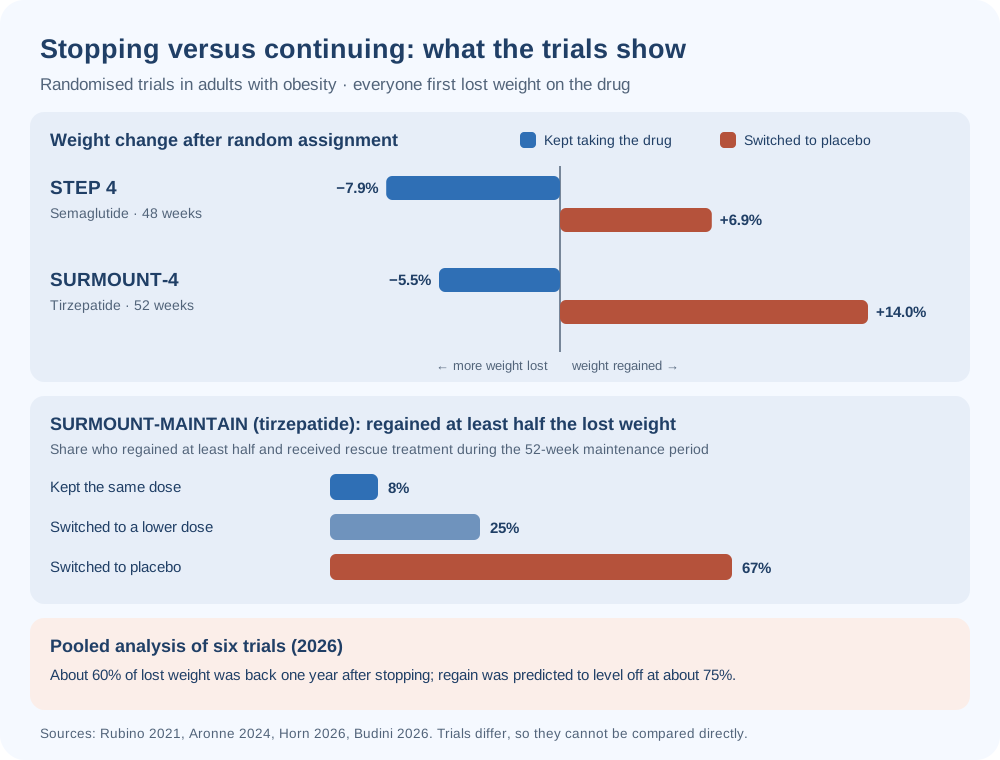
In STEP 4, 803 adults who had lost an average of 10.6% in a 20-week run-in were randomised. Over the next 48 weeks, those who kept taking semaglutide lost a further 7.9%, while those switched to placebo gained 6.9%. Waist size, blood pressure and physical functioning were also better in the group that continued.2
SURMOUNT-4: tirzepatide
In SURMOUNT-4, 670 adults lost an average of 20.9% in a 36-week run-in. Over the following year, people who stayed on tirzepatide lost a further 5.5%, while those switched to placebo regained 14.0% of body weight. At the end, 89.5% of those who continued had kept at least 80% of their weight loss, compared with 16.6% of those on placebo.3
What all the trials have in common
Pooling six randomised trials with 3,236 participants, Cambridge researchers found that "weight consistently rebounded after cessation." They estimated that 60% of lost weight was back after a year, and that regain slows over time and is predicted to plateau at about 75% of the weight lost, "suggesting that partial weight-loss benefit may persist long-term but is substantially attenuated." Most included studies had a moderate risk of bias.4
A wider 2026 review in the BMJ, covering 37 studies of weight-loss medicines, found an average regain of 0.4 kg a month after stopping. Regain was faster than after stopping diet and exercise programmes, "independent of initial weight loss."5
What happens to blood pressure, blood sugar and cholesterol
Weight is not the only thing that reverses. In the STEP 1 extension, the improvements in cardiometabolic measures "reverted towards baseline at week 120 for most variables."1 The BMJ review projected that "all cardiometabolic markers" would return to baseline within 1.4 years of stopping a weight-loss medicine.5 A 2026 narrative review put it this way: glucose, blood pressure and cholesterol return to baseline within about 12 months, while HbA1c, a three-month average of blood sugar, normalises within 12 to 18 months.12
That review also reported that stopping within a year was associated with higher risks of coronary artery disease and heart failure than continuing.12 Associations like this come from studies that observe patients rather than randomise them, so they cannot prove that stopping caused the difference: people who stop may differ in other ways.
For what GLP-1 medicines have and have not been shown to do beyond weight loss, see our GLP-1 evidence scorecard.
Real life looks less dramatic than the trials, on average
Trials measure people who stop abruptly and receive no other treatment. Everyday practice is messier, and the average picture is gentler:
- Many people restart or switch. In one US health system, 19.6% of people who stopped semaglutide or tirzepatide restarted it within a year, and 35.2% received another obesity treatment, such as a different medicine or a lifestyle programme.11 In the larger national study, 36.3% of people without diabetes who stopped had restarted within a year.8
- Average regain was small, but individuals varied widely. Among people treated for obesity who stopped after 3 to 12 months, average weight one year after stopping was only 0.5% higher than at the time they stopped, but the authors stressed "considerable individual-level variability."11
- Stopping early meant less loss in the first place. People who stopped within three months lost 3.6% at one year; those who did not stop lost 11.9%.10
These figures do not contradict the trials. People in real life often stopped earlier, lost less weight, used lower doses, and frequently restarted or switched treatment, all of which shrink the average regain.1011
Is tapering better than stopping outright?
Tapering means coming off gradually, by lowering the dose or spacing injections out, rather than stopping in one go. It is widely discussed online and in clinics. Here is what the evidence actually covers.
What has been tested
| Approach | Best evidence so far | What it showed |
|---|---|---|
| Keep taking the full dose | Randomised trials (STEP 4, SURMOUNT-4, SURMOUNT-MAINTAIN) | Weight maintained or reduced further236 |
| Move to a lower dose and stay on it | One randomised trial (SURMOUNT-MAINTAIN, tirzepatide) | Better than placebo, worse than the full dose6 |
| Space injections further apart | A case series of 30 patients, no comparison group | Weight held steady; cannot show cause and effect14 |
| Stop, with structured support (an app or medically tailored meals) | A pilot randomised trial of 39 people over 4 months | Less early regain than usual care; too small to be sure7 |
| Taper gradually, then stop | No published trial | Unknown |
SURMOUNT-MAINTAIN is the most important new study. After 60 weeks on tirzepatide, 378 adults were randomly assigned to stay on their full dose, switch to a lower dose, or switch to placebo for a year. Compared with their starting weight, the full-dose group was 21.9% lighter at the end, the lower-dose group 16.6% lighter and the placebo group 9.9% lighter. The share who regained at least half their weight loss and needed rescue treatment was 8%, 25% and 67% respectively. The authors said the lower dose "might provide a valuable alternative to discontinuation, although individuals' treatment response might vary." The trial was funded by Eli Lilly, which makes tirzepatide.6
This was a trial of staying on a lower dose, not of tapering off completely.
The October 2026 pilot trial randomised 39 adults at the moment they stopped a GLP-1 medicine to usual care, a digital wellness app or medically tailored meals. After four months, both support groups had gained about 7 percentage points less than the usual-care group. Weight was an exploratory outcome and the trial was very small, so the authors called for "larger, more diverse trials with longer follow-up."7
What is not known
- Whether a gradual taper beats stopping abruptly. No published trial has compared the two. A 2026 review concluded that "whether structured tapering strategies can successfully facilitate treatment discontinuation remains unknown and requires prospective evaluation."13
- Which schedule, if any, works. A second 2026 review noted "the absence of validated tapering strategies."12
- Who will keep weight off. Real-world studies show wide differences between individuals after stopping, and reviewers call for prospective studies to find out who does well.1113
Trials that will start to answer the question
We searched ClinicalTrials.gov on 17 October 2026 and found three relevant randomised trials, none of which had started recruiting:
- Taper versus abrupt stop, semaglutide (Egypt, about 100 people after weight-loss surgery, double-blind). Primary results are expected around April 2028.17
- Dose-tapering versus staying on the treatment dose, semaglutide (China, about 72 people). Primary results are expected around December 2027.18
- "OFF-RAMP" pilot (US, about 60 people), comparing full-strength treatment, a lower dose given less often, and switching to a non-GLP-1 medicine.19
Until results like these are published, any specific taper schedule found online is based on opinion or experience, not trial evidence.
What guidelines and regulators say
There is no single international rule on how long to take these medicines.
- England (NICE): semaglutide for weight management is recommended "for a maximum of 2 years" within a specialist weight management service, and stopping should be considered if less than 5% of starting weight has been lost after six months.15 For tirzepatide, NICE sets no maximum duration; if less than 5% has been lost after six months, the prescriber should "decide whether to continue treatment."16
- Trial authors and reviewers increasingly describe obesity as a chronic, relapsing condition, and say the withdrawal results "suggest ongoing treatment is required to maintain improvements in weight and health."16
Long-term treatment has its own costs, side effects and unanswered questions. Whether to continue is a decision for each person and their prescriber, not something a trial average can settle.
Questions to ask your prescriber before stopping
These questions are meant to help a conversation, not replace one:
- Why am I stopping? If the reason is cost, supply or side effects, are there other options, such as a different medicine, a different dose or support programmes?
- What should I expect to happen to my weight, and how quickly? Ask how often your weight, blood pressure and blood sugar should be checked afterwards.
- Should my other medicines be reviewed? If you reduced medicines for blood pressure or diabetes while losing weight, ask whether they need checking once you stop.
- Is a lower or less frequent dose an option instead of stopping? Ask what evidence supports it for your medicine.
- What support is available? Ask about dietitians, physical activity programmes or structured follow-up, which early evidence suggests may soften regain.712
- What is the plan if weight comes back? Agree in advance what would prompt a review.
Never change the dose of a prescription medicine on your own, and avoid unregulated or "research use only" versions sold online; see what the "research use only" label really means.
Frequently asked questions
Will I regain all the weight if I stop semaglutide or tirzepatide?
Not necessarily all of it, but in trials most people regained most of it. STEP 1 participants regained about two-thirds of their weight loss within a year, and a 2026 analysis predicted that regain levels off at about 75% of the weight lost.14
How fast does weight come back after stopping a GLP-1?
Fastest in the first months. The Cambridge analysis estimated that 60% of lost weight returns within a year, with regain slowing over time. The BMJ review found an average of 0.4 kg a month after stopping weight-loss medicines.45
Is it better to taper off a GLP-1 than to stop suddenly?
Nobody knows yet. No published trial has compared the two. One trial found that staying on a lower dose of tirzepatide held weight better than placebo, but that is not the same as tapering off. Randomised taper trials are registered but have not started.6131718
Do blood sugar and blood pressure go back up after stopping?
Generally yes. In trials and reviews, improvements in blood pressure, blood sugar and cholesterol drifted back towards baseline within about one to one and a half years of stopping.1512
How long should I stay on a GLP-1 medicine?
There is no agreed answer. NICE limits NHS semaglutide for weight management to two years but sets no maximum for tirzepatide, and trial authors increasingly describe ongoing treatment as necessary to keep the benefits. This is a decision to make with your prescriber.11516
How we reviewed this article
Sources
InsidePeptides relies on primary sources: peer-reviewed studies, trial registries and regulators’ own documents. Read our editorial policy.
- Wilding JPH et al. 2022. Weight regain and cardiometabolic effects after withdrawal of semaglutide: the STEP 1 trial extension. Diabetes, Obesity and Metabolism 24(8):1553–1564. PMID: 35441470. DOI: 10.1111/dom.14725. Trial: NCT03548935.
- Rubino D et al. 2021. Effect of continued weekly subcutaneous semaglutide vs placebo on weight loss maintenance in adults with overweight or obesity: the STEP 4 randomized clinical trial. JAMA 325(14):1414–1425. PMID: 33755728. DOI: 10.1001/jama.2021.3224. Trial: NCT03548987.
- Aronne LJ et al. 2024. Continued treatment with tirzepatide for maintenance of weight reduction in adults with obesity: the SURMOUNT-4 randomized clinical trial. JAMA 331(1):38–48. PMID: 38078870. DOI: 10.1001/jama.2023.24945. Trial: NCT04660643.
- Budini B et al. 2026. Trajectory of weight regain after cessation of GLP-1 receptor agonists: a systematic review and nonlinear meta-regression. eClinicalMedicine 93:103796. PMID: 41938838. DOI: 10.1016/j.eclinm.2026.103796.
- West S et al. 2026. Weight regain after cessation of medication for weight management: systematic review and meta-analysis. BMJ 392:e085304. PMID: 41500720. DOI: 10.1136/bmj-2025-085304.
- Horn DB et al. 2026. Tirzepatide for maintenance of bodyweight reduction in people with obesity in the USA (SURMOUNT-MAINTAIN): a multicentre, double-blind, randomised, placebo-controlled trial00656-2). The Lancet 407(10545):2305–2318. PMID: 42119587. DOI: 10.1016/S0140-6736(26)00656-2. Trial: NCT06047548. Funded by Eli Lilly.
- Hollis-Hansen K et al. 2026. Preventing weight regain after glucagon-like peptide-1 therapy discontinuation: a pilot randomized controlled trial. Obesity Science & Practice 12(5):e70194. PMID: 42846130. DOI: 10.1002/osp4.70194.
- Rodriguez PJ et al. 2025. Discontinuation and reinitiation of dual-labeled GLP-1 receptor agonists among US adults with overweight or obesity. JAMA Network Open 8(1):e2457349. PMID: 39888616. DOI: 10.1001/jamanetworkopen.2024.57349.
- Gasoyan H et al. 2025. Reasons for discontinuation of obesity pharmacotherapy with semaglutide or tirzepatide in clinical practice. Obesity 33(12):2296–2303. PMID: 41039650. DOI: 10.1002/oby.70058.
- Gasoyan H et al. 2025. Changes in weight and glycemic control following obesity treatment with semaglutide or tirzepatide by discontinuation status. Obesity 33(9):1657–1667. PMID: 40491239. DOI: 10.1002/oby.24331.
- Gasoyan H et al. 2026. Obesity treatments and weight changes in clinical practice after discontinuation of semaglutide or tirzepatide. Diabetes, Obesity and Metabolism 28(6):4795–4805. PMID: 41816857. DOI: 10.1111/dom.70660.
- Shah E et al. 2026. Clinical management of weight regain and cardiometabolic consequences after discontinuation of GLP-1 receptor agonists. Diabetes, Obesity and Metabolism 28(6):4546–4558. PMID: 41889156. DOI: 10.1111/dom.70713.
- Damhof MA et al. 2026. Early weight regain after GLP-1 receptor agonist discontinuation: mechanisms and implications for treatment de-escalation strategies. Diabetes, Obesity and Metabolism 28(10):8769–8776. PMID: 42396734. DOI: 10.1111/dom.71075.
- Wong M et al. 2026. Reduced-frequency GLP1 therapy maintains weight, body composition, and metabolic syndrome improvements: a case series. Obesity 34(Suppl 1):112–120. PMID: 41732031. DOI: 10.1002/oby.70137.
- NICE. Semaglutide for managing overweight and obesity (TA875): recommendations. National Institute for Health and Care Excellence. Checked 17 October 2026.
- NICE. Tirzepatide for managing overweight and obesity (TA1026): recommendations. National Institute for Health and Care Excellence. Checked 17 October 2026.
- ClinicalTrials.gov. NCT07859176: Tapered versus abrupt discontinuation of semaglutide after treatment of recurrent weight gain or suboptimal response following metabolic and bariatric surgery. Not yet recruiting; checked 17 October 2026.
- ClinicalTrials.gov. NCT07783854: Evaluation of a semaglutide dose-tapering regimen for weight-loss maintenance in adults with overweight or obesity. Not yet recruiting; checked 17 October 2026.
- ClinicalTrials.gov. NCT07832084: OFF-RAMP feasibility, a pilot trial comparing different off-ramping strategies for maintaining weight loss among adults using incretin-based therapies for obesity. Not yet recruiting; checked 17 October 2026.
History
Each entry records a dated change to this article’s content. Link and formatting changes are not listed.
Current version
Written by InsidePeptides Editorial Team
Scientific review pending
Last updated
Published


