
1. What the incretin effect is
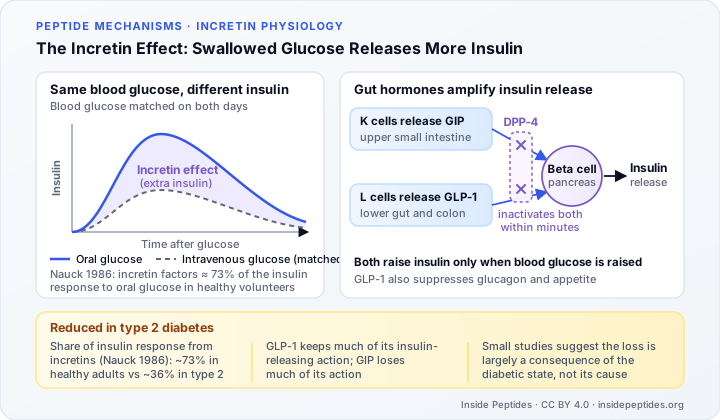
The incretin effect is the extra insulin the pancreas releases when glucose arrives through the gut rather than directly into the bloodstream. Insulin is the hormone that lets tissues take up glucose and lowers blood sugar. If glucose itself were the only signal to the pancreas, a given rise in blood glucose should produce the same insulin response however the glucose got there. It does not.
In 1964, Elrick and colleagues gave glucose to volunteers by mouth and by intravenous infusion and found that oral glucose produced a larger insulin response, even though the intravenous route raised blood glucose at least as much [1]. Something released from the gut during absorption was amplifying the pancreas's response. The term incretin, from intestinal secretion of insulin, had been coined decades earlier for this kind of hypothetical gut factor.
Modern studies measure the effect more precisely with an isoglycaemic intravenous glucose infusion: on one day participants drink glucose; on another, glucose is infused into a vein at a rate adjusted to reproduce the same blood glucose curve. Any extra insulin on the oral day is attributed to the gut. Researchers often measure C-peptide as well as insulin, because C-peptide is released in equal amounts with insulin but is not removed by the liver, so it tracks secretion more faithfully. Using this design, Nauck and colleagues estimated in 1986 that incretin factors accounted for about 73% of the insulin response to oral glucose in eight healthy control volunteers [2].
2. The two incretin hormones: GLP-1 and GIP
Two peptide hormones explain most of the incretin effect in humans [3]:
- GIP (glucose-dependent insulinotropic polypeptide) is a 42-amino-acid peptide released by K cells, which are concentrated in the duodenum and upper jejunum, the first parts of the small intestine. It was originally named gastric inhibitory polypeptide.
- GLP-1 (glucagon-like peptide-1) is released by L cells, which are most numerous in the lower small intestine and colon. Its active circulating form is a 30-amino-acid peptide cut from the same precursor protein, proglucagon, that gives rise to glucagon in the pancreas.
Both hormones act on their own receptors on the insulin-producing beta cells of the pancreas, and both increase insulin release only when blood glucose is raised. This glucose dependence is the defining feature of an incretin: the hormone amplifies the response to a meal rather than forcing insulin out regardless of blood sugar.
The two hormones are not interchangeable. GLP-1 also suppresses glucagon (a pancreatic hormone that raises blood glucose), slows stomach emptying and reduces appetite and food intake [3]. In a hyperglycaemic clamp study, GLP-1 lowered glucagon concentrations but GIP did not [4]. These extra actions help explain why GLP-1 became the main focus of drug development. For a side-by-side comparison of the two hormones, see GLP-1 vs GIP.
3. DPP-4: why incretin signals last only minutes
Incretin hormones are short-lived signals. Both GLP-1 and GIP carry an alanine as the second amino acid in their sequence, which makes them targets for dipeptidyl peptidase-4 (DPP-4), an enzyme present in blood plasma and on the surface of many cells. DPP-4 snips off the first two amino acids, and the shortened peptides have little or no ability to stimulate insulin release. Laboratory work in 1993 showed that DPP-4 cleaves GIP and GLP-1 and is responsible for their breakdown in human serum [5].
The speed of this inactivation in people was shown in 1995. When GLP-1 was infused intravenously, the intact hormone accounted for only about 20% of the measured GLP-1 increase in healthy volunteers and about 25% in people with type 2 diabetes; the rest was the shortened, inactive metabolite. After injection under the skin, GLP-1 was likewise rapidly degraded [6].
Rapid breakdown matters for two reasons. Physiologically, it keeps the incretin signal tied to the meal that triggered it. Pharmacologically, it means natural GLP-1 cannot work as a practical medicine, because its activity disappears within minutes. The general problem of short-lived peptides is covered in Peptide Half-Life and Peptide Degradation.
4. The reduced incretin effect in type 2 diabetes
In the same 1986 study that measured the effect in healthy volunteers, incretin factors accounted for about 36% of the insulin response to oral glucose in 14 people with type 2 diabetes, compared with about 73% in matched controls. GIP blood levels after oral glucose did not differ between the groups, which pointed to a weaker response to the hormones rather than a simple shortage of them [2].
A 1993 study then tested each hormone directly. Nine people with mild type 2 diabetes and nine matched controls received GIP, GLP-1 or placebo infusions while their blood glucose was held at a raised level. With GIP, the maximum insulin-secretion response in the diabetes group was 54% lower than in controls. With GLP-1, the diabetes group reached 71% of the controls' response, a difference that was not statistically significant. The authors concluded that GLP-1, in contrast to GIP, retains much of its insulin-releasing activity in type 2 diabetes [4].
Whether the loss is a cause or a result of diabetes has been tested in two ways. A 2007 study compared people whose diabetes resulted from chronic pancreatitis (a disease that damages the pancreas) with people who had pancreatitis but normal glucose tolerance. The incretin effect was about 31% in the pancreatitis-diabetes group, 68% in the pancreatitis group with normal glucose tolerance and 60% in healthy controls, and about 36% in a type 2 diabetes group; the authors concluded that the reduced effect is a consequence of the diabetic state rather than a primary event [7]. In a 2009 study, four weeks of near-normal blood glucose achieved with insulin improved the late insulin-secretion response to both GLP-1 and GIP by a factor of three to four in eight people with type 2 diabetes [8].
These studies were small, often with eight or fourteen participants per group, so their percentages are best read as illustrations of the direction and approximate size of the effect, not as fixed population values.
5. From physiology to medicines
The findings above suggested a treatment strategy: if the beta cells of people with type 2 diabetes still respond to GLP-1, raising GLP-1 activity should improve blood glucose. In 1993, an intravenous GLP-1 infusion brought fasting blood glucose down to normal within four hours in ten people with poorly controlled type 2 diabetes; once glucose was normal, insulin fell back towards baseline even though the infusion continued, as glucose dependence predicts [9]. The obstacle was DPP-4, which inactivates natural GLP-1 within minutes.
Two classes of medicine emerged to get around it [3]:
- GLP-1 receptor agonists (sometimes called incretin mimetics) are injected or oral molecules that activate the GLP-1 receptor but resist DPP-4. The first, exenatide, is a synthetic version of exendin-4, a peptide isolated from the venom of the Gila monster [10]. Exenatide was approved in the United States in April 2005 for type 2 diabetes [11]. Later agents such as liraglutide and semaglutide are modified human GLP-1 that lasts much longer in the body.
- DPP-4 inhibitors (incretin enhancers), such as sitagliptin and vildagliptin, are tablets that block the enzyme, so the body's own GLP-1 and GIP stay active for longer.
The two classes differ in strength. A 2006 review of early trials reported that GLP-1 receptor agonists lowered HbA1c (a measure of average blood glucose over about three months) by roughly 1 to 2 percentage points with modest weight loss, while DPP-4 inhibitors lowered it by roughly 0.5 to 1.0 points without weight gain [3]. The usual explanation is that DPP-4 inhibitors can only preserve the body's own, relatively low hormone levels, whereas receptor agonists produce much stronger and more sustained receptor activation. Those figures describe early trials and specific comparators; later drugs and trials have reported different results.
6. What the incretin concept does not explain
The incretin story is one of the clearest examples of physiology leading directly to medicines, but it is easy to stretch too far.
- The effect is not a fixed number. Estimates depend on the amount of glucose given, the measurement used (insulin or C-peptide) and the population. Type 2 diabetes also involves the alpha cells: in the 1993 clamp study, raised glucose lowered glucagon in healthy volunteers but not in people with diabetes [4].
- Weight loss is a separate story. The large weight reductions seen with modern GLP-1 receptor agonists are thought to come mainly from actions on appetite and the brain at drug concentrations far above natural levels, not from the incretin effect on insulin.
- GIP was not abandoned. Although GIP loses much of its insulin-releasing action in type 2 diabetes, drug developers later combined GIP and GLP-1 receptor activity in a single molecule, tirzepatide. Why adding GIP receptor activity appears to help, given the earlier findings, is still debated [12]. One partial answer is that responsiveness to GIP may recover when blood glucose is better controlled [8].
For how these hormones act at the cellular level, see Peptide Receptors and Peptide Signaling.
Core Scientific Definitions
Precise biomedical definitions for terms used throughout this guide.
- Incretin effect
- The amplification of insulin secretion that occurs when glucose is taken by mouth compared with an intravenous glucose infusion that produces the same blood glucose levels, attributed mainly to the gut hormones GLP-1 and GIP.
- Incretin hormone
- A hormone released from the gut in response to eating that increases insulin secretion from pancreatic beta cells in a glucose-dependent way; in humans the two established incretins are GLP-1 and GIP.
- Glucose-dependent insulin secretion
- Insulin release that a hormone enhances only when blood glucose is raised, so the stimulus fades as glucose returns towards normal.
- Dipeptidyl peptidase-4 (DPP-4)
- An enzyme found in blood and on cell surfaces that removes the first two amino acids from GLP-1 and GIP, converting them into forms with little or no insulin-releasing activity.
- Isoglycaemic intravenous glucose infusion
- An experimental technique in which glucose is infused into a vein at a rate adjusted to copy the blood glucose curve seen after an oral glucose load, so that the two insulin responses can be compared fairly.
Peer-Reviewed References & Primary Sources
This educational guide is built strictly upon peer-reviewed literature, official regulatory guidance, and authoritative biochemical repositories.
-
Plasma insulin response to oral and intravenous glucose administration J Clin Endocrinol Metab · 1964
-
Reduced incretin effect in type 2 (non-insulin-dependent) diabetes Diabetologia · 1986
-
The incretin system: glucagon-like peptide-1 receptor agonists and dipeptidyl peptidase-4 inhibitors in type 2 diabetes Lancet · 2006
-
Preserved incretin activity of glucagon-like peptide 1 [7-36 amide] but not of synthetic human gastric inhibitory polypeptide in patients with type-2 diabetes mellitus J Clin Invest · 1993
-
Dipeptidyl-peptidase IV hydrolyses gastric inhibitory polypeptide, glucagon-like peptide-1(7-36)amide, peptide histidine methionine and is responsible for their degradation in human serum Eur J Biochem · 1993
-
Both subcutaneously and intravenously administered glucagon-like peptide I are rapidly degraded from the NH2-terminus in type II diabetic patients and in healthy subjects Diabetes · 1995
-
Reduced incretin effect in type 2 diabetes: cause or consequence of the diabetic state? Diabetes · 2007
-
Four weeks of near-normalisation of blood glucose improves the insulin response to glucagon-like peptide-1 and glucose-dependent insulinotropic polypeptide in patients with type 2 diabetes Diabetologia · 2009
-
Normalization of fasting hyperglycaemia by exogenous glucagon-like peptide 1 (7-36 amide) in type 2 (non-insulin-dependent) diabetic patients Diabetologia · 1993
-
Isolation and characterization of exendin-4, an exendin-3 analogue, from Heloderma suspectum venom. Further evidence for an exendin receptor on dispersed acini from guinea pig pancreas J Biol Chem · 1992
-
Byetta (exenatide) injection: NDA 021773 approval letter U.S. Food and Drug Administration (Drugs@FDA) · 2005
-
GIPR/GLP-1R dual agonist therapies for diabetes and weight loss-chemistry, physiology, and clinical applications Cell Metab · 2023
Educational Disclaimer: This guide is produced strictly for biomedical educational purposes and does not constitute medical advice, diagnosis, or treatment recommendations. Experimental peptides discussed herein may lack regulatory authorization for human clinical use. Consult a licensed medical practitioner before considering any therapeutic intervention.