
Therapeutic Peptides Beginner

Oral GLP-1 Pills: Rybelsus, Wegovy Tablets and Orforglipron Explained

Is oral semaglutide available? What Rybelsus, Wegovy tablets and orforglipron (Foundayo) are, what their trials showed and how pills compare with injections.

10 min read Updated 17 sources InsidePeptides Editorial Team

A loose pile of plain round white tablets on a clean white surface
Photo: Christian Schnettelker from Essen, Deutschland, CC BY 2.0, via Wikimedia Commons.

Plain-English Summary

Three GLP-1 tablets were approved in the United States as of 17 October 2026. Rybelsus contains oral semaglutide, a peptide, and is approved for type 2 diabetes; Wegovy tablets contain the same peptide and were approved for weight management in December 2025. Foundayo contains orforglipron, a small molecule that is not a peptide, and was approved for weight management in April 2026. Oral semaglutide needs an absorption enhancer and has specific instructions on how it is taken; orforglipron does not. No large trial has compared the pills directly with injections for weight loss.

Key Takeaways

  • Oral semaglutide is available by prescription in the United States: as Rybelsus (and Ozempic tablets) for type 2 diabetes since 2019, and as Wegovy tablets for weight management since 22 December 2025.
  • Oral semaglutide is a peptide; its tablet contains the absorption enhancer SNAC, and its label sets specific instructions on how it is taken relative to food and drink.
  • Orforglipron (Foundayo), approved on 1 April 2026 for chronic weight management, is a small molecule, not a peptide, and can be taken with or without food.
  • In OASIS 4, Wegovy tablets produced −13.6% average weight change versus −2.2% with placebo at 64 weeks; in ATTAIN-1, orforglipron produced −7.5% to −11.2% versus −2.1% at 72 weeks.
  • These trials were separate, so their numbers cannot be ranked; the only direct pill-versus-pill trial, ACHIEVE-3, was in type 2 diabetes.
  • No head-to-head trial has compared oral and injected semaglutide for weight loss; a manufacturer-funded indirect comparison suggested similar efficacy.
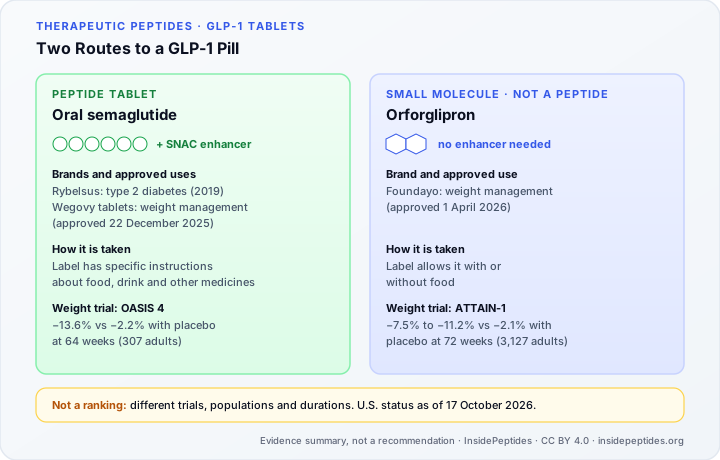
Diagram comparing the two kinds of oral GLP-1 pill approved in the United States as of 17 October 2026. Left: oral semaglutide, a peptide tablet with the absorption enhancer SNAC, sold as Rybelsus for type 2 diabetes (approved 2019) and Wegovy tablets for weight management (approved December 2025); its label has specific instructions about food and drink; OASIS 4 found −13.6% versus −2.2% average weight change at 64 weeks. Right: orforglipron, a small molecule that is not a peptide, sold as Foundayo for weight management (approved April 2026); can be taken with or without food; ATTAIN-1 found −7.5% to −11.2% versus −2.1% at 72 weeks. A note warns that results come from different trials and cannot be ranked.
Two routes to a GLP-1 pill: a peptide made absorbable with SNAC, and a small molecule designed to be swallowed. U.S. status as of 17 October 2026. Diagram by InsidePeptides, CC BY 4.0: free to reuse with a credit and link. Download SVG

What are oral GLP-1 pills?

Oral GLP-1 pills are tablets that activate the GLP-1 receptor, the same target as injectable medicines such as Ozempic, Wegovy and Zepbound. In the United States as of 17 October 2026, three tablet products of this kind were approved, built on two very different molecules:

  • Oral semaglutide, a peptide, sold as Rybelsus (and as Ozempic tablets) for type 2 diabetes [1][2], and as Wegovy tablets for weight management [6][7].
  • Orforglipron, sold as Foundayo for weight management. It is a small molecule, not a peptide [11][12].

The difference matters. Semaglutide is a modified copy of the gut hormone GLP-1, a chain of amino acids that the digestive system would normally break down, so the tablet needs special technology to work. Orforglipron is a conventional drug-sized molecule designed to switch on the same receptor; it is absorbed like most pills. Why one is a peptide and the other is not is explained in Is GLP-1 a Peptide?, and the general challenge of giving peptides by mouth in Oral vs Injected Peptides.

This guide covers what each pill is, what the main trials found and how the pills compare with injections. It describes research and regulatory status only. It gives no doses and is not medical advice; whether any of these medicines suits a particular person is a decision for a licensed clinician.

Is oral semaglutide available?

Yes. Oral semaglutide is an approved prescription medicine in the United States, in two forms with different approved uses.

  • Rybelsus was approved by the U.S. Food and Drug Administration (FDA) on 20 September 2019 for type 2 diabetes [1]. Its current label covers improving blood glucose control in adults with type 2 diabetes and reducing the risk of major cardiovascular events in adults with type 2 diabetes at high risk of them. The same label also covers oral semaglutide tablets sold under the Ozempic name [2].
  • Wegovy tablets were approved on 22 December 2025 [6]. They are indicated, alongside a reduced-calorie diet and increased physical activity, to reduce excess body weight and maintain weight reduction long term in adults with obesity, or with overweight and at least one weight-related condition, and to reduce the risk of major cardiovascular events in adults with established cardiovascular disease and obesity or overweight [7].

All of these are prescription-only medicines. Approval in the United States does not mean approval everywhere; availability, approved uses and brand names differ between countries. Products sold online as “oral semaglutide” drops, sprays or capsules outside licensed pharmacies are not these medicines and have not been shown to work; see approved versus unapproved peptides and compounded peptides.

What oral semaglutide is and how the tablet works

Oral semaglutide contains the same active peptide as Ozempic and Wegovy injections. What makes the tablet possible is an added ingredient, SNAC (salcaprozate sodium). Studies in people and dogs showed that the peptide is absorbed in the stomach, close to the dissolving tablet. SNAC buffers stomach acid locally, protecting the peptide from digestive enzymes, and briefly helps it cross the stomach lining [3].

Even so, only a small fraction of the semaglutide in each tablet reaches the bloodstream, and the label gives separate instructions for anyone switching between injected and oral forms [2]. This guide does not repeat the detailed absorption science, which is covered in Oral vs Injected Peptides and Peptide Bioavailability.

Because food, drinks and other medicines in the stomach reduce absorption, the prescribing information for both Rybelsus and Wegovy tablets sets out specific instructions on how the tablet is taken in relation to food, drink and other oral medicines [2][7]. Those instructions are part of what makes the medicine work, and they are explained by the prescriber, the pharmacist and the label. This guide does not reproduce them.

Once absorbed, oral semaglutide acts like injected semaglutide: it activates GLP-1 receptors, reducing appetite and food intake and, in diabetes, increasing insulin release when glucose is high. The mechanism is described in How GLP-1 Drugs Work.

What the trials show for oral semaglutide

Type 2 diabetes. Rybelsus was approved after the PIONEER trial programme. In PIONEER 4, 711 adults with type 2 diabetes were randomised to oral semaglutide, injected liraglutide or placebo. At 26 weeks, oral semaglutide was non-inferior to liraglutide for lowering HbA1c (a measure of average blood glucose) and produced more weight loss: −4.4 kg versus −3.1 kg with liraglutide and −0.5 kg with placebo [4]. Adverse events were more frequent with oral semaglutide (80%) and liraglutide (74%) than with placebo [4].

Cardiovascular outcomes. The SOUL trial randomised 9,650 people with type 2 diabetes and atherosclerotic cardiovascular disease, chronic kidney disease or both. Over a mean follow-up of about four years, major cardiovascular events (cardiovascular death, heart attack or stroke) occurred in 12.0% with oral semaglutide versus 13.8% with placebo, a hazard ratio of 0.86 [5]. This trial is the basis for the cardiovascular indication on the Rybelsus label [2].

Weight management. Wegovy tablets were approved on the basis of the OASIS 4 trial, which randomised 307 adults with obesity, or overweight with at least one weight-related condition, and without diabetes. Average weight change over 64 weeks was −13.6% with oral semaglutide versus −2.2% with placebo, an estimated difference of −11.4 percentage points. Gastrointestinal adverse events affected 74.0% versus 42.2% [8]. An earlier trial, OASIS 1, tested a different, higher-strength formulation that is not the approved product.

OASIS 4 was relatively small and lasted just over a year. Like all trials of weight-loss medicines, it shows average results for the people who took part, not what any individual can expect.

Orforglipron (Foundayo): the non-peptide GLP-1 pill

Orforglipron is a small-molecule GLP-1 receptor agonist developed by Eli Lilly. It is not a peptide and does not need an absorption enhancer. The FDA approved it as Foundayo on 1 April 2026, through its National Priority Voucher pilot programme; the agency described it as the fastest approval of a new molecular entity since 2002 [11]. It appears on the FDA's list of novel drug approvals for 2026 with that date.

Indication. Foundayo is indicated, in combination with a reduced-calorie diet and increased physical activity, to reduce excess body weight and maintain weight reduction long term in adults with obesity, or with overweight and at least one weight-related condition. Its label states that it can be taken with or without food, and, like other medicines in the class, it carries a boxed warning about thyroid C-cell tumours seen in rodents [12]. As of 17 October 2026, the label listed weight management as its only approved use.

Key trial results.

  • ATTAIN-1 randomised 3,127 adults with obesity and without diabetes. Average weight change over 72 weeks was −7.5%, −8.4% and −11.2% across the three tested doses, versus −2.1% with placebo. At the highest dose, 54.6% lost at least 10% of their body weight, versus 12.9% with placebo. Stopping treatment because of adverse events occurred in 5.3% to 10.3% of orforglipron groups versus 2.7% with placebo; the most common adverse events were gastrointestinal [13].
  • ATTAIN-2, in 1,613 adults with obesity and type 2 diabetes, found −5.1% to −9.6% versus −2.5% with placebo at 72 weeks [14].
  • ATTAIN-MAINTAIN enrolled people who had already lost weight on injected tirzepatide or semaglutide and switched them to orforglipron or placebo. Those switched to orforglipron kept more of the weight off than those switched to placebo. The trial had no group that stayed on injections, so it cannot show whether switching is as good as continuing [15].

For a dated summary of other new weight-loss medicines, see Orforglipron, Retatrutide and CagriSema: Where the Next Weight-Loss Drugs Stand.

Oral vs injectable semaglutide, and pill vs pill

Oral vs injectable semaglutide. No large randomised trial has directly compared Wegovy tablets with Wegovy injections for weight loss. The numbers that exist come from separate placebo-controlled trials: −13.6% versus −2.2% over 64 weeks for the tablet in OASIS 4 [8], and −14.9% versus −2.4% over 68 weeks for the injection in STEP 1 [9]. Because the trials differ in duration, populations and timing, these figures cannot simply be set side by side.

One analysis combined the two trials statistically in an indirect treatment comparison. It found small, uncertain differences and concluded that the two forms had comparable weight-loss efficacy [10]. The analysis was carried out by, or for, the manufacturer, and indirect comparisons are weaker evidence than a head-to-head randomised trial (see Understanding Evidence Levels). In type 2 diabetes, PIONEER 4 is a useful reference point: oral semaglutide was compared directly with an injected GLP-1 medicine, liraglutide, and was at least as effective for glucose control [4].

Orforglipron vs oral semaglutide. The only direct comparison of the two pills so far is in type 2 diabetes, not obesity. In the open-label ACHIEVE-3 trial, 1,698 adults with type 2 diabetes were randomised to one of two orforglipron doses or one of two oral semaglutide doses for 52 weeks. Both orforglipron doses lowered HbA1c more than both semaglutide doses. Gastrointestinal adverse events (58% to 59% versus 37% to 45%) and stopping treatment because of adverse events (9% to 10% versus 4% to 5%) were more common with orforglipron [16]. Whether those results apply to weight management is not known.

Practical differences also exist: semaglutide tablets come with specific administration instructions relating to food and drink [2][7], whereas orforglipron's label allows it with or without food [12]. Which form suits a particular person depends on their health, other medicines and preferences, and is a decision for a clinician.

Oral GLP-1 pills side by side

The table summarises U.S. status as of 17 October 2026 and the main published trials. Weight-loss figures come from different trials and are not a ranking.

ProductMoleculeU.S. approved use (17 October 2026)Key published trials
Rybelsus / Ozempic tabletsSemaglutide (peptide) with SNACType 2 diabetes; cardiovascular risk reduction in high-risk type 2 diabetes. First approved 2019 [1][2]PIONEER 4 [4]; SOUL [5]
Wegovy tabletsSemaglutide (peptide) with SNACChronic weight management; cardiovascular risk reduction. Approved 22 December 2025 [6][7]OASIS 4: −13.6% vs −2.2% at 64 weeks [8]
FoundayoOrforglipron (small molecule, not a peptide)Chronic weight management. Approved 1 April 2026 [11][12]ATTAIN-1: −7.5% to −11.2% vs −2.1% at 72 weeks [13]; ATTAIN-2 [14]
Wegovy injection (for comparison)Semaglutide (peptide)Chronic weight management and other uses [7]STEP 1: −14.9% vs −2.4% at 68 weeks [9]

For how to read percentages like these, including the difference between analysis methods, see How to Read a Clinical Trial Results Table.

Side effects and safety

The side effects of GLP-1 pills are broadly those of the class. In the trials above, the most common were gastrointestinal: nausea, vomiting, diarrhoea and constipation, usually mild to moderate, and in ATTAIN-2 mostly occurring while the dose was being increased [8][13][14]. The labels describe more serious but less common risks, including pancreatitis and gallbladder problems, and carry a boxed warning about thyroid C-cell tumours seen in rodents [2][7][12]. Full safety information is in each product's prescribing information.

A tablet is not automatically gentler than an injection. In OASIS 4, gastrointestinal adverse events affected 74.0% of people taking oral semaglutide versus 42.2% on placebo [8], and in ACHIEVE-3 they were more frequent with orforglipron than with oral semaglutide [16].

Unapproved “GLP-1” capsules, drops and sublingual products sold online have not been tested in these trials, and their contents are not verified. The FDA has warned about unapproved and compounded GLP-1 products marketed for weight loss [17]. See Compounded Semaglutide and Tirzepatide for the regulatory background.

Frequently asked questions

Is oral semaglutide available?

Yes. In the United States, oral semaglutide is approved as Rybelsus (and Ozempic tablets) for type 2 diabetes and as Wegovy tablets, approved on 22 December 2025, for weight management. All are prescription-only [1][2][6].

What is oral semaglutide?

It is the same GLP-1 peptide as in Ozempic and Wegovy injections, formulated as a tablet with an absorption enhancer called SNAC that lets a small fraction of the peptide cross the stomach lining [3].

Is there a GLP-1 pill for weight loss?

Yes, two as of 17 October 2026: Wegovy tablets (oral semaglutide) and Foundayo (orforglipron), both approved for chronic weight management in adults with obesity, or overweight with a weight-related condition [7][12].

What is orforglipron?

Orforglipron (Foundayo) is a small-molecule, non-peptide drug that activates the GLP-1 receptor. The FDA approved it on 1 April 2026 for chronic weight management; in ATTAIN-1, average weight change at 72 weeks was −7.5% to −11.2% versus −2.1% with placebo [11][13].

Is oral semaglutide as effective as the injection?

There is no head-to-head trial in weight management. Separate trials found similar-sized average weight loss, and a manufacturer-funded indirect comparison concluded the two were comparable, but that is weaker evidence than a direct trial [8][9][10].

Is a GLP-1 pill better than an injection?

Not in any general sense. Pills avoid injections but come with their own administration instructions and side effects [2][12]. The choice between forms is one for a prescriber, based on the individual's health and the label.

Core Scientific Definitions

Precise biomedical definitions for terms used throughout this guide.

Oral semaglutide
Semaglutide, a GLP-1 peptide, formulated as a tablet with the absorption enhancer SNAC; sold as Rybelsus and Ozempic tablets for type 2 diabetes and as Wegovy tablets for weight management.
SNAC (salcaprozate sodium)
An absorption enhancer in oral semaglutide tablets that locally protects the peptide from stomach enzymes and briefly helps it cross the stomach lining.
Small-molecule GLP-1 receptor agonist
A drug that is not a peptide but is designed to activate the GLP-1 receptor; orforglipron is the first approved example.
Indirect treatment comparison
A statistical method for comparing two treatments that were each tested against placebo in separate trials; it is weaker evidence than a head-to-head randomised trial.
Chronic weight management
The regulatory term for the approved use of weight-loss medicines: long-term treatment, alongside diet and physical activity, for adults with obesity or with overweight plus at least one weight-related condition.

Peer-Reviewed References & Primary Sources

This educational guide is built strictly upon peer-reviewed literature, official regulatory guidance, and authoritative biochemical repositories.

  1. Rybelsus (semaglutide) tablets: NDA 213051 approval letter U.S. Food and Drug Administration. Rybelsus (semaglutide) tablets NDA 213051 approval letter, 20 September 2019. U.S. Food and Drug Administration (Drugs@FDA) · 2019
  2. RYBELSUS and OZEMPIC (oral semaglutide) tablets prescribing information Novo Nordisk. Rybelsus and Ozempic (semaglutide) tablets prescribing information, DailyMed, published 19 August 2026. DailyMed, U.S. National Library of Medicine · 2026
  3. Transcellular stomach absorption of a derivatized glucagon-like peptide-1 receptor agonist Buckley ST et al. Sci Transl Med 2018;10:eaar7047. Sci Transl Med · 2018
  4. Oral semaglutide versus subcutaneous liraglutide and placebo in type 2 diabetes (PIONEER 4): a randomised, double-blind, phase 3a trial Pratley R et al. Lancet 2019;394:39-50. Lancet · 2019
  5. Oral Semaglutide and Cardiovascular Outcomes in High-Risk Type 2 Diabetes McGuire DK et al. N Engl J Med 2025;392:2001-12. N Engl J Med · 2025
  6. Wegovy (semaglutide) tablets: NDA 218316 approval letter U.S. Food and Drug Administration. Wegovy (semaglutide) tablets NDA 218316 approval letter, 22 December 2025. U.S. Food and Drug Administration (Drugs@FDA) · 2025
  7. WEGOVY (semaglutide) prescribing information Novo Nordisk. Wegovy (semaglutide) injection and tablets prescribing information, DailyMed, published 30 June 2026. DailyMed, U.S. National Library of Medicine · 2026
  8. Oral Semaglutide at a Dose of 25 mg in Adults with Overweight or Obesity Wharton S et al. N Engl J Med 2025;393:1077-87. N Engl J Med · 2025
  9. Once-Weekly Semaglutide in Adults with Overweight or Obesity Wilding JPH et al. N Engl J Med 2021;384:989-1002. N Engl J Med · 2021
  10. Semaglutide 25 mg Oral Versus Semaglutide 2.4 mg Injectable: An Indirect Treatment Comparison of Weight Loss Outcomes Plotkin M et al. Diabetes Obes Metab 2026;28:7237-46. Diabetes Obes Metab · 2026
  11. FDA approves first new molecular entity under National Priority Voucher program U.S. Food and Drug Administration. FDA approves first new molecular entity under National Priority Voucher program. Press announcement, 1 April 2026. U.S. Food and Drug Administration · 2026
  12. FOUNDAYO (orforglipron) tablets prescribing information Eli Lilly and Company. Foundayo (orforglipron) tablets prescribing information, DailyMed, published 13 August 2026. DailyMed, U.S. National Library of Medicine · 2026
  13. Orforglipron, an Oral Small-Molecule GLP-1 Receptor Agonist for Obesity Treatment Wharton S et al. N Engl J Med 2025;393:1796-806. N Engl J Med · 2025
  14. Orforglipron, an oral small-molecule GLP-1 receptor agonist, for the treatment of obesity in people with type 2 diabetes (ATTAIN-2): a phase 3, double-blind, randomised, multicentre, placebo-controlled trial Horn DB et al. Lancet 406:2927-44 (PubMed issue date 2026). Lancet · 2026
  15. Orforglipron for maintenance of body weight reduction: the double-blind, randomized phase 3b ATTAIN-MAINTAIN trial Aronne LJ et al. Nat Med 2026;32:2679-87. Nat Med · 2026
  16. Efficacy and safety of once-daily oral orforglipron compared with oral semaglutide in adults with type 2 diabetes (ACHIEVE-3): a multinational, multicentre, non-inferiority, open-label, randomised, phase 3 trial Rosenstock J et al. Lancet 2026;407:1147-60. Lancet · 2026
  17. FDA’s concerns with unapproved GLP-1 drugs used for weight loss U.S. Food and Drug Administration. FDA’s concerns with unapproved GLP-1 drugs used for weight loss. Content current as of 1 October 2026. U.S. Food and Drug Administration · 2026
Written By InsidePeptides Editorial Team
Review Status Scientific review pending
Last Updated
Last Evidence Review Pending verification

Educational Disclaimer: This guide is for education only and is not medical advice, diagnosis or treatment. Many peptides discussed here are not approved for human use. Talk to a licensed clinician before making any health decision.