

Mechanisms Intermediate

Amylin and Amylin Drugs: Pramlintide, Cagrilintide and What Comes Next

What amylin does, how pramlintide, cagrilintide, CagriSema, amycretin, eloralintide and petrelintide work, what trials show and their status in October 2026.

11 min read Updated 20 sources InsidePeptides Editorial Team

Close-up of the objective lenses on a white laboratory microscope with a softly blurred background
Photo: Shixart1985, CC BY 2.0, via Wikimedia Commons.

Plain-English Summary

Amylin is a hormone released by the pancreas together with insulin after meals; it helps people feel full sooner, slows stomach emptying and lowers glucagon. Pramlintide, a short-acting amylin medicine, was approved in 2005 only as an add-on to insulin in diabetes. Longer-acting amylin drugs, including cagrilintide (alone and with semaglutide as CagriSema), amycretin (now zenagamtide), eloralintide and petrelintide, have produced weight loss in trials, but none of them was approved as of 17 October 2026.

Key Takeaways

  • Amylin is a pancreatic peptide hormone co-secreted with insulin; it promotes satiation, slows stomach emptying and suppresses glucagon after meals.
  • Pramlintide (Symlin), approved in 2005, is the only amylin medicine ever approved, and only as an add-on to mealtime insulin in diabetes; Drugs@FDA now lists it as discontinued.
  • CagriSema (cagrilintide with semaglutide) produced −20.4% average weight change versus −3.0% with placebo in REDEFINE 1, and was under FDA review with no decision announced as of 17 October 2026.
  • In the head-to-head REDEFINE 4 trial, CagriSema did not meet its goal of non-inferiority to tirzepatide, according to the company.
  • Amycretin (zenagamtide) is one molecule acting on GLP-1 and amylin receptors; eloralintide and petrelintide are amylin analogues tested alone. All three entered phase 3 in 2026.
  • Amylin is a major 2026 trend because it offers a different mechanism from GLP-1, but claims of better tolerability are not yet established in large trials.
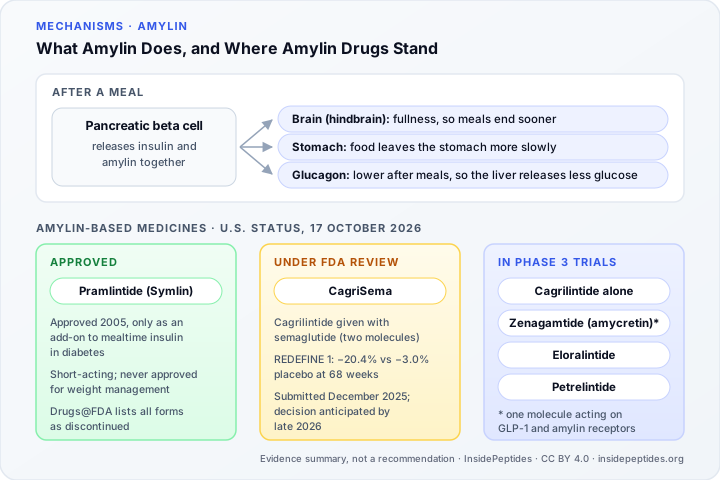
Diagram of amylin and amylin-based medicines. Top: after a meal, pancreatic beta cells release insulin and amylin together; amylin acts on the hindbrain to promote fullness, slows stomach emptying and lowers glucagon. Bottom: status of amylin drugs as of 17 October 2026. Approved: pramlintide (2005, diabetes only, now listed as discontinued). Under FDA review: CagriSema, cagrilintide plus semaglutide. In phase 3 trials: cagrilintide alone, zenagamtide (amycretin), eloralintide and petrelintide.
What amylin does, and where amylin-based medicines stand in the United States as of 17 October 2026. Diagram by InsidePeptides, CC BY 4.0: free to reuse with a credit and link. Download SVG

What amylin is and what it does

Amylin is a 37-amino-acid peptide hormone made by the beta cells of the pancreas, the same cells that make insulin. It is stored alongside insulin and released together with it when people eat, so blood levels of both rise after a meal and fall between meals [1][3]. People with type 1 diabetes, and many with advanced type 2 diabetes, make too little of both hormones [3]. Amylin is also called islet amyloid polypeptide (IAPP); human amylin tends to clump into fibrils, which is one reason it has never been used as a medicine in its natural form [1].

Amylin's main actions, described in the prescribing information for the first amylin medicine and in reviews of the physiology, are:

  • Satiation. Amylin helps end a meal sooner. This effect is fast, and studies in animals point to direct action on the brain, especially the area postrema, a part of the hindbrain that can sense hormones in the blood [2].
  • Slower stomach emptying. Amylin slows the rate at which food passes from the stomach into the small intestine, without changing how much of it is eventually absorbed [3].
  • Lower glucagon after meals. Amylin suppresses the post-meal rise in glucagon, a hormone that tells the liver to release glucose [3].

Together these effects smooth the rise in blood glucose after eating and reduce how much is eaten. Amylin works through receptors built from the calcitonin receptor paired with a helper protein called RAMP; some newer drugs act on amylin receptors selectively, while others also activate the calcitonin receptor itself [1][20]. That pharmacology is why amylin sits naturally next to GLP-1 in the gut-brain system that regulates appetite, and why researchers have combined the two. For the wider family of meal-related hormones, see The Incretin Effect and Peptide Signaling.

This guide describes research and regulatory status only. It gives no doses or instructions and is not medical advice.

Pramlintide: the first amylin medicine (2005)

Because natural human amylin clumps and breaks down quickly, the first medicine was an engineered version. Pramlintide differs from human amylin at three positions, borrowed from rat amylin, which does not form fibrils [1]. The U.S. Food and Drug Administration (FDA) approved it as Symlin on 16 March 2005 [4].

Its approved use is narrow: an add-on for people with type 1 or type 2 diabetes who use mealtime insulin and have not reached their glucose targets despite optimal insulin therapy [3]. It was never approved for weight management. In a one-year randomised trial in people with type 2 diabetes using insulin, pramlintide lowered HbA1c (a measure of average blood glucose) more than placebo, and body weight fell slightly with pramlintide while it rose slightly with placebo; the most common side effect was transient nausea [5].

Pramlintide also showed the limits of the first approach:

  • Short action. It is short-acting, and reviews cite the burden of frequent injections, separate from insulin, as one reason it was little used [20].
  • Hypoglycaemia risk. Used with insulin, it increases the risk of severe low blood glucose, particularly in type 1 diabetes, and the label carries a boxed warning about this [3].
  • Modest weight effect. The weight changes in diabetes trials were small [5].

When this guide was checked on 17 October 2026, Drugs@FDA listed every Symlin presentation as discontinued, although the approval itself is still on record [4]. Pramlintide's main legacy is scientific: it showed that amylin signalling could be used safely in people, and it set the template that newer, longer-acting analogues improve on. Direct comparisons are covered in Insulin vs Pramlintide and Semaglutide vs Pramlintide.

Cagrilintide and CagriSema

Cagrilintide is a long-acting amylin analogue developed by Novo Nordisk. It is chemically modified to last far longer in the body than pramlintide [6]; the general chemistry of long-acting peptides is explained in Peptide Half-Life.

Cagrilintide alone. In a 26-week phase 2 dose-finding trial of 706 adults with overweight or obesity, average weight reductions with cagrilintide ranged from 6.0% to 10.8%, compared with 3.0% with placebo, using an analysis that assumes people took the treatment as planned. The most frequent side effects were gastrointestinal and injection-site reactions [6]. A phase 3 programme of cagrilintide on its own (RENEW 1) began in November 2025 [12].

CagriSema is cagrilintide given together with semaglutide. It is a combination of two separate molecules, not one engineered molecule. Its main phase 3 trials are known as REDEFINE:

  • REDEFINE 1 randomised 3,417 adults with obesity, or overweight with a related condition, and without diabetes. Over 68 weeks, average weight change was −20.4% with the combination versus −3.0% with placebo. Gastrointestinal adverse events affected 79.6% of the combination group and 39.9% of the placebo group [7].
  • REDEFINE 2, in 1,206 adults with obesity and type 2 diabetes, found −13.7% versus −3.4% at 68 weeks; gastrointestinal adverse events affected 72.5% versus 34.4% [8].
  • REDEFINE 5, in 331 adults in Japan and Taiwan, compared the combination with semaglutide alone: −18.4% versus −11.9% at 68 weeks [9].
  • REDEFINE 4, an open-label head-to-head trial of 809 people, compared CagriSema with tirzepatide over 84 weeks. Novo Nordisk reported that it did not meet its primary goal of showing CagriSema was non-inferior to tirzepatide: −20.2% versus −23.6% under the treatment-regimen analysis. These results come from a company announcement, not yet a peer-reviewed paper [10].

The weight-loss figures belong to the combination. REDEFINE 1 also had a smaller cagrilintide-only arm, and the combination result must not be attributed to cagrilintide alone [7]. The published trials and their limits are discussed in more detail in Cagrilintide: Published Trials and Regulatory Status.

Regulatory status as of 17 October 2026. Novo Nordisk submitted CagriSema to the FDA in December 2025, on the basis of REDEFINE 1 and 2, and said a decision was anticipated by late 2026 [10]. No FDA decision had been announced when this guide was checked, and the combination did not appear on the FDA's 2026 list of novel approvals. The FDA states that cagrilintide is not a component of any FDA-approved drug, has not been found safe and effective for any condition, and cannot be used in compounding under federal law [11]. The individual components are compared in Cagrilintide vs Semaglutide and Cagrilintide vs Pramlintide.

Amycretin (zenagamtide): amylin and GLP-1 in one molecule

Amycretin, which now carries the international non-proprietary name zenagamtide, takes a different route. Instead of pairing two drugs, it is a single peptide engineered to activate both GLP-1 and amylin receptors [13][14]. This makes it a unimolecular co-agonist, the same design idea behind dual and triple agonists such as tirzepatide and retatrutide (see Multi-Receptor Agonists).

  • Injected form, obesity. A phase 1b/2a trial randomised 125 people with overweight or obesity. In the highest-dose group, average weight change at 36 weeks was −24.3% versus −1.1% with placebo. Group sizes were small, gastrointestinal events were frequent, and many participants withdrew, mostly for reasons the authors judged unrelated to adverse events [13].
  • Tablet form, type 2 diabetes. A 36-week phase 2 dose-finding trial of an oral version in 186 adults with type 2 diabetes found larger HbA1c reductions than placebo at all three strengths. Gastrointestinal adverse events affected 26% to 47% of the zenagamtide groups versus 23% with placebo [14].

Phase 3 trials in obesity began in 2026; the first, AMAZE 1, started in February 2026 and is recruiting [15]. Zenagamtide is not approved anywhere as of 17 October 2026, and early-phase results from small groups are not a reliable guide to what phase 3 trials will show (see How Clinical Trials Work).

The next wave: eloralintide and petrelintide

Two other long-acting amylin analogues have published randomised phase 2 results and phase 3 programmes under way. Both are being tested on their own, not only in combination with GLP-1 drugs.

Eloralintide (Eli Lilly) is described by its developer as a selective amylin receptor agonist, designed to act preferentially on amylin receptors [16]. In a 48-week phase 2 trial, 263 adults with obesity or overweight and without type 2 diabetes were randomised to one of several eloralintide regimens or placebo. Average weight change ranged from about −9% to −20% across eloralintide groups, versus −0.4% with placebo, using the efficacy estimand (an analysis that assumes people stayed on treatment). Nausea and fatigue were the most common adverse events, and their frequency varied widely between dose groups [16]. The phase 3 ENLIGHTEN programme is under way; ENLIGHTEN-1, in adults without type 2 diabetes, started in February 2026 and is recruiting [17].

Petrelintide (Zealand Pharma, with phase 3 trials sponsored by Roche) is a long-acting analogue based on human amylin. In the phase 2 ZUPREME 1 trial, 493 adults with obesity or overweight were randomised. At 28 weeks, average weight change was −7.9% to −9.8% across five petrelintide groups versus −1.7% with placebo (efficacy estimand), with further loss to week 42. Nausea affected 20% of petrelintide-treated participants versus 6% with placebo, and vomiting was uncommon (3% versus 6%) [18]. Phase 3 trials sponsored by Roche, including ZUPREME-3, started recruiting on 30 September 2026 [19].

These numbers come from different trials with different durations, populations and analyses, so they should not be read as a ranking. Phase 2 trials are designed to choose doses and look for safety signals; phase 3 trials are needed to confirm benefit and characterise harms in larger groups. Neither eloralintide nor petrelintide is approved anywhere as of 17 October 2026. Reviews of the field also list other amylin-based candidates at earlier stages of development [20]; this guide includes only those with published randomised results that could be checked.

Why amylin became a major 2026 trend

Amylin drugs moved from a niche diabetes add-on to one of the most active areas of obesity research. Several developments came together in 2025 and 2026:

  • A different mechanism from GLP-1. GLP-1 receptor agonists are effective, but reviewers argue that obesity is too varied for a single pathway to suit everyone. Amylin acts through separate receptors and brain pathways, so it offers both a possible alternative and a partner for GLP-1 drugs [2][20].
  • Phase 3 evidence and a regulatory filing. REDEFINE 1 and 2 were published in 2025, and CagriSema was submitted to the FDA for weight management in December 2025 [7][8][10].
  • A wave of phase 3 starts. Phase 3 programmes for cagrilintide alone, zenagamtide, eloralintide and petrelintide all started between late 2025 and September 2026 [12][15][17][19]. Novo Nordisk, Eli Lilly and Roche each now sponsor phase 3 trials of amylin-based drugs.
  • The tolerability question. Much of the interest rests on the hope that amylin analogues may cause fewer gastrointestinal problems for a given amount of weight loss. Early data are mixed. Petrelintide had low vomiting rates in ZUPREME 1 [18], but nausea was common at some eloralintide doses [16], and CagriSema had high rates of gastrointestinal events in REDEFINE 1 [7]. Reviews describe better tolerability as a promise still to be tested in larger trials, not an established fact [20].

Interest is not the same as proof. Only pramlintide has ever been approved, and only for diabetes. Long-term safety, effects on muscle and bone, and outcomes such as heart attacks and strokes have not been established for any of the newer amylin drugs. A cardiovascular outcomes trial of CagriSema, REDEFINE 3, was still under way at the last registry check reported on this site (see Cagrilintide: Published Trials and Regulatory Status).

Amylin drugs side by side

The table summarises each amylin-based medicine's U.S. status as of 17 October 2026 and its strongest published human evidence. It is a summary of evidence, not a recommendation.

MedicineWhat it isU.S. status (17 October 2026)Strongest published human evidence
Pramlintide (Symlin)Short-acting amylin analogueApproved 2005 as an add-on to mealtime insulin in diabetes; all presentations listed as discontinued [4]Phase 3 RCTs in type 1 and type 2 diabetes [3][5]
CagrilintideLong-acting amylin analogueInvestigational; phase 3 alone under way [11][12]Phase 2 RCT [6]
CagriSemaCagrilintide given with semaglutideUnder FDA review; decision anticipated by late 2026 [10]Phase 3 RCTs (REDEFINE 1, 2, 5) [7][8][9]
Zenagamtide (amycretin)One peptide acting on GLP-1 and amylin receptorsInvestigational; phase 3 under way [15]Phase 1b/2a and phase 2 RCTs [13][14]
EloralintideSelective amylin receptor agonistInvestigational; phase 3 under way [17]Phase 2 RCT [16]
PetrelintideLong-acting human amylin analogueInvestigational; phase 3 under way [19]Phase 2 RCT [18]

“RCT” means randomised controlled trial (see Randomized Controlled Trials). What “investigational” means is explained in Investigational vs Experimental. Products sold online under these names, often labelled “research use only”, are not the products tested in these trials; see approved versus unapproved peptides.

Frequently asked questions

What is amylin?

Amylin is a peptide hormone released by the pancreas together with insulin after meals. It helps end meals sooner, slows stomach emptying and lowers glucagon after eating [1][3].

Is cagrilintide FDA-approved?

No. As of 17 October 2026, neither cagrilintide alone nor CagriSema was FDA-approved. CagriSema was submitted to the FDA in December 2025, with a decision anticipated by late 2026 [10][11].

What is the difference between pramlintide and cagrilintide?

Both are amylin analogues. Pramlintide is short-acting and was approved in 2005 only as an add-on to insulin in diabetes [3][4]. Cagrilintide is engineered to last much longer and is being studied for weight management, alone and with semaglutide [6][7].

Is amycretin the same as CagriSema?

No. CagriSema is two separate peptides, cagrilintide and semaglutide, given together. Amycretin, now called zenagamtide, is one molecule that activates both GLP-1 and amylin receptors [13]. Both are investigational.

Do amylin drugs cause fewer side effects than GLP-1 drugs?

That is not yet known. Some phase 2 results suggest lower vomiting rates, but nausea was common in other trials, and only large phase 3 trials can settle the question [16][18][20].

Are petrelintide and eloralintide available?

No. Both are investigational drugs in phase 3 trials and are not approved anywhere as of 17 October 2026 [17][19]. Whether any weight-management medicine is suitable for a particular person is a decision for a licensed clinician.

Core Scientific Definitions

Precise biomedical definitions for terms used throughout this guide.

Amylin
A 37-amino-acid peptide hormone released by pancreatic beta cells together with insulin after meals; it promotes satiation, slows stomach emptying and suppresses glucagon.
Amylin analogue
A modified version of amylin designed to avoid clumping and to last longer in the body, such as pramlintide, cagrilintide or petrelintide.
Unimolecular co-agonist
A single molecule engineered to activate two or more hormone receptors, such as amycretin (zenagamtide), which acts on GLP-1 and amylin receptors.
Area postrema
A small region of the hindbrain that can sense hormones in the blood; it is a key site for amylin's effect on ending meals.
Efficacy estimand
A way of analysing trial results that estimates the effect if everyone had taken the treatment as planned; it usually gives larger numbers than the treatment-policy (treatment-regimen) analysis, which counts everyone randomised.

Peer-Reviewed References & Primary Sources

This educational guide is built strictly upon peer-reviewed literature, official regulatory guidance, and authoritative biochemical repositories.

  1. Amylin: Pharmacology, Physiology, and Clinical Potential Hay DL, Chen S, Lutz TA, Parkes DG, Roth JD. Pharmacol Rev 2015;67:564-600. Pharmacol Rev · 2015
  2. Role of amylin in feeding and satiation Lutz TA. Neuropharmacology 2025;278:110587. Neuropharmacology · 2025
  3. SYMLINPEN (pramlintide acetate) injection prescribing information AstraZeneca. SymlinPen (pramlintide acetate) injection prescribing information, DailyMed, published 20 August 2024. DailyMed, U.S. National Library of Medicine · 2024
  4. Drugs@FDA: Symlin (pramlintide acetate), NDA 021332 U.S. Food and Drug Administration. Drugs@FDA: Symlin (pramlintide acetate), NDA 021332; original approval 16 March 2005; marketing status checked 17 October 2026. U.S. Food and Drug Administration (Drugs@FDA) · 2005
  5. Pramlintide as an adjunct to insulin therapy improves long-term glycemic and weight control in patients with type 2 diabetes: a 1-year randomized controlled trial Hollander PA et al. Diabetes Care 2003;26:784-90. Diabetes Care · 2003
  6. Once-weekly cagrilintide for weight management in people with overweight and obesity: a multicentre, randomised, double-blind, placebo-controlled and active-controlled, dose-finding phase 2 trial Lau DCW et al. Lancet 2021;398:2160-72. Lancet · 2021
  7. Coadministered Cagrilintide and Semaglutide in Adults with Overweight or Obesity Garvey WT et al. N Engl J Med 2025;393:635-47. N Engl J Med · 2025
  8. Cagrilintide-Semaglutide in Adults with Overweight or Obesity and Type 2 Diabetes Davies MJ et al. N Engl J Med 2025;393:648-59. N Engl J Med · 2025
  9. Efficacy and safety of co-administered cagrilintide and semaglutide versus semaglutide alone in adults with overweight or obesity with or without type 2 diabetes in Japan and Taiwan (REDEFINE 5): a multicentre, randomised, active-controlled, phase 3a trial Yamauchi T et al. Lancet Diabetes Endocrinol 2026;14:450-62. Lancet Diabetes Endocrinol · 2026
  10. CagriSema demonstrated 23% weight loss in an open-label head-to-head REDEFINE 4 trial in people with obesity, the primary endpoint was not achieved Novo Nordisk A/S. Company announcement, 23 February 2026. Novo Nordisk company announcement (via Investegate) · 2026
  11. FDA’s concerns with unapproved GLP-1 drugs used for weight loss U.S. Food and Drug Administration. FDA’s concerns with unapproved GLP-1 drugs used for weight loss. Content current as of 1 October 2026. U.S. Food and Drug Administration · 2026
  12. Weight Loss in People Living With Overweight or Obesity Following Treatment With Cagrilintide ClinicalTrials.gov NCT07220642 (RENEW 1). Sponsor: Novo Nordisk A/S. Phase 3; active, not recruiting; start 5 November 2025. ClinicalTrials.gov · 2025
  13. Amycretin, a novel, unimolecular GLP-1 and amylin receptor agonist administered subcutaneously: results from a phase 1b/2a randomised controlled study Dahl K et al. Lancet 2025;406:149-62. Lancet · 2025
  14. Efficacy and safety of once-daily oral zenagamtide, a novel unimolecular GLP-1 and amylin receptor agonist, in adults with type 2 diabetes: a multicentre, randomised, parallel, double-blind, placebo-controlled, dose-finding, phase 2 trial Mora P et al. Lancet 2026;408:607-20. Lancet · 2026
  15. AMAZE 1: A Research Study Investigating How Well the Medicine NNC0487-0111 Helps People With Excess Body Weight Lose Weight ClinicalTrials.gov NCT07339423 (AMAZE 1). Sponsor: Novo Nordisk A/S. Phase 3; recruiting; start 24 February 2026. ClinicalTrials.gov · 2026
  16. Eloralintide, a selective amylin receptor agonist for the treatment of obesity: a 48-week phase 2, multicentre, double-blind, randomised, placebo-controlled trial Billings LK et al. Lancet 2025;406:2631-43. Lancet · 2025
  17. A Study of Eloralintide (LY3841136) in Participants With Obesity, or Overweight Without Type 2 Diabetes ClinicalTrials.gov NCT07321886 (ENLIGHTEN-1). Sponsor: Eli Lilly and Company. Phase 3; recruiting; start 6 February 2026. ClinicalTrials.gov · 2026
  18. Petrelintide, a human amylin analogue for the treatment of obesity (ZUPREME 1): a randomised, double-blind, placebo-controlled, phase 2 trial Garvey WT et al. Lancet Diabetes Endocrinol 2026;14:914-26. Lancet Diabetes Endocrinol · 2026
  19. A Phase III Study to Evaluate the Efficacy and Safety of Petrelintide in Participants With Overweight or Obesity ClinicalTrials.gov NCT07843498 (ZUPREME-3). Sponsor: Hoffmann-La Roche. Phase 3; recruiting; start 30 September 2026. ClinicalTrials.gov · 2026
  20. Amylin Analogs: The Next Major Class of Weight Loss Therapy: A Review of Experimental Data and Early-Phase Clinical Trials Alhazmi A, le Roux CW. Diabetes Obes Metab 2026;28 Suppl 5:42-50. Diabetes Obes Metab · 2026
Written By InsidePeptides Editorial Team
Review Status Scientific review pending
Last Updated
Last Evidence Review Pending verification

Educational Disclaimer: This guide is for education only and is not medical advice, diagnosis or treatment. Many peptides discussed here are not approved for human use. Talk to a licensed clinician before making any health decision.