
Not Losing Weight on a GLP-1? What the Trials Say Is Normal
How weight loss on semaglutide, tirzepatide and retatrutide varied in trials: who lost under 5%, when it plateaued, slow starters and what to ask a doctor.

Key takeaways
- In the main trials, weight loss on semaglutide and tirzepatide varied widely: at the highest dose, about 1 in 7 and 1 in 11 people lost less than 5%, while a third and more than half lost 20% or more.
- Weight loss slowed and levelled off over time, with semaglutide plateauing around week 60, and people with type 2 diabetes lost less on average.
- A slow start did not always mean no response, but persistent hunger or little weight loss is something to raise with the prescriber rather than a reason to change doses.
In this article
If you are a few months into semaglutide, tirzepatide or retatrutide and the scale has barely moved, or you are still hungry, you are not unusual. In the main trials, weight came off over more than a year, slowed to a plateau and varied widely between people. At the highest dose tested, about 1 in 7 people on semaglutide and about 1 in 11 on tirzepatide lost less than 5% of their starting weight, while about a third and more than half respectively lost 20% or more.1234 People with type 2 diabetes lost less, and many slow starters caught up, though not all of the way.56
This article sets out that spread and what can explain a smaller result, so you can have a better-informed conversation with your prescriber. It gives no dosing information, recommends no products and is not medical advice.
How results were spread in the trials
Headlines report the average. The table shows the spread behind it, at the highest dose tested in each trial against placebo. Figures come from the published papers, the FDA-approved Zepbound label and results posted on ClinicalTrials.gov, checked on 22 October 2026.1273485910
| Trial (drug, length, who took part) | Group | Average weight change | Lost at least 5% | At least 10% | At least 15% | At least 20% |
|---|---|---|---|---|---|---|
| STEP 1 (semaglutide, 68 weeks, no diabetes) | Highest dose tested | −14.9% | 86.4% | 69.1% | 50.5% | 32.0% |
| Placebo | −2.4% | 31.5% | 12.0% | 4.9% | 1.7% | |
| SURMOUNT-1 (tirzepatide, 72 weeks, no diabetes) | Highest dose tested | −20.9% | 90.9% | 83.5% | 70.6% | 56.7% |
| Placebo | −3.1% | 34.5% | 18.8% | 8.8% | 3.1% | |
| Retatrutide phase 2 (48 weeks, no diabetes)* | Highest dose tested | −24.2% | 100% | 93% | 83% | Not published in abstract or registry |
| Placebo | −2.1% | 27% | 9% | 2% | Not published in abstract or registry | |
| STEP 2 (semaglutide, 68 weeks, type 2 diabetes) | Highest dose tested | −9.6% | 68.8% | 45.6% | 25.8% | 13.1% |
| Placebo | −3.4% | 28.5% | 8.2% | 3.2% | 1.6% | |
| SURMOUNT-2 (tirzepatide, 72 weeks, type 2 diabetes) | Highest dose tested | −14.7% | 82.8% | 64.8% | 48.0% | 30.8% |
| Placebo | −3.2% | 32.5% | 9.5% | 2.7% | 1.0% |
*The retatrutide phase 2 figures leave out data collected after people stopped the drug, which tends to make results look better than an analysis that counts everyone, and the highest-dose group had only 62 people.78 The 80-week phase 3 trial, TRIUMPH-1, reported an average loss of 25.0%, but we could not find its full spread of results in an accessible source.11 The trials differ in length, populations and methods, so the rows are not a ranking. Our guides to reading a trial results table and to semaglutide vs tirzepatide explain why.
Read across a row and the average stops looking like a target. In STEP 1, about half the semaglutide group lost 15% or more and half lost less, and 13.6% lost under 5%. In SURMOUNT-1, 9.1% on tirzepatide lost under 5%.134 A 2026 review put "non-response", commonly defined as less than 5% weight loss, at "approximately 10% of participants in controlled trials", with real-world data suggesting it is more common in routine practice.12 The placebo rows are a reminder that the drug is not the only influence: 12.0% of the STEP 1 placebo group and 18.8% in SURMOUNT-1 lost 10% or more, and in STEP 1 both groups also received a lifestyle intervention.14
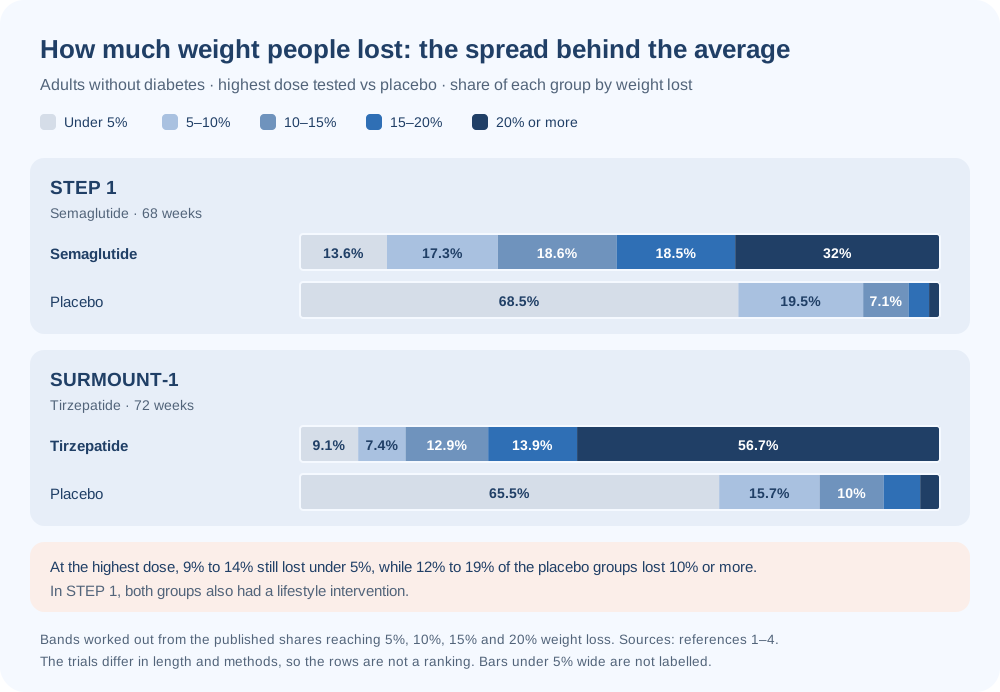
How the average is calculated matters too. STEP 1's main analysis counted everyone, including people who stopped treatment, and gave −14.9%. An analysis that assumed everyone kept taking the drug gave −16.9%.13 Both are correct; they answer different questions, as our explainer on statistical vs clinical significance sets out.
Outside trials, results are usually smaller. In a US health system study of 7,881 adults without diabetes who started semaglutide or tirzepatide, average weight loss at one year was 8.7%. Most (80.8%) were on what the authors called low maintenance dosages, and people who stopped within three months lost 3.6% on average, against 11.9% for those who kept going. The authors said the lower average was "likely because of higher rates of discontinuation and lower maintenance dosages."14
Is it too early to judge?
Often, yes. In the trials the dose was raised in steps over the first weeks or months, so nobody started on the full trial dose, and the results above were measured after 48 to 72 weeks.127 Loss was fastest early, then slowed and levelled off. In the two-year STEP 5 trial, semaglutide weight curves "plateaued after approximately week 60".15 In a tirzepatide analysis limited to people who stayed on the drug and lost at least 5%, the median time to plateau was 24 to 36 weeks, depending on starting weight.16 A plateau while still on treatment is what the trials predict, not a sign the drug has stopped working. Our retatrutide questions answered post covers plateaus on that drug, and the guide to stopping semaglutide or tirzepatide covers what happens when treatment ends.
A slow first few months predicts a smaller result on average, but not necessarily no result. In a SURMOUNT-1 analysis of 1,545 people who took at least three-quarters of their scheduled doses, 18% had lost less than 5% by week 12. Of these "late responders", 70% reached 5% by week 24 and 90% by week 72. Their average loss at week 72 was 11.0%, against 22.5% for early responders, and they were more likely to be men and to have higher starting weights.6 A second analysis of SURMOUNT-1 and SURMOUNT-2, using an 8-week cut-off, also found that slower starters still achieved "clinically meaningful weight reduction", though less than early responders. Several authors of both analyses work for Eli Lilly, and neither tested what late responders should do differently.617 The pattern is older than these drugs: with liraglutide, losing at least 4% by week 16 best predicted reaching 5% at a year, and people who had not reached that mark and completed the year lost about 3% on average.18
Health services use similar checkpoints. In England, NICE says to "consider stopping semaglutide if less than 5% of the initial weight has been lost after 6 months of treatment". For tirzepatide, it says that if less than 5% has been lost after six months on the highest tolerated dose, the prescriber should "decide whether to continue treatment".1920 These are decisions for a prescriber with the full picture, not self-checks.
What can make the result smaller
No single factor predicts how one person will respond, and early genetic findings are "hypothesis-generating rather than a basis for individual-level genotyping."12 The trials and reviews do point to a few things worth checking:
- Type 2 diabetes. Average loss was about 5 to 6 percentage points lower than in similar trials without diabetes: −9.6% vs −14.9% for semaglutide, −14.7% vs −20.9% for tirzepatide. Roughly 3 in 10 people with diabetes on semaglutide's highest tested dose, and 1 in 6 on tirzepatide's, did not reach 5%.1245910
- The dose reached. In SURMOUNT-1, the lowest dose tested gave −15.0% and the highest −20.9%.2 In the US health system study, most patients were on low maintenance doses.14
- Sex and starting weight. In the tirzepatide early-response analysis, slower responders were more often men and heavier at the start.6
- Other medicines and conditions. The US National Institute of Diabetes and Digestive and Kidney Diseases (NIDDK) lists medicines that "may contribute to weight gain", including some used for epilepsy, depression or psychotic disorders, corticosteroids (steroids), insulin and sulfonylureas, some blood-pressure medicines such as beta-blockers, and some antihistamines. It also lists conditions such as hypothyroidism, Cushing's syndrome and polycystic ovary syndrome.21 Never stop a prescribed medicine on your own; ask the prescriber whether any of these apply.
Where the medicine came from is a separate question. Every figure above comes from approved or trial-grade medicine. Products sold online as "research" retatrutide, semaglutide or tirzepatide are different: what is in the vial is unknown. In Australian lab tests of three vials sold as retatrutide, the measured content ranged from 51% to 190% of the label, and sterility and endotoxin were not tested.22 In a 2026 preprint using US health records, people using retatrutide obtained outside a trial lost 7.2% at 6 to 12 months, compared with 15.5% for trial volunteers seen in routine care. The authors could not check what the products contained, the doses used or whether people kept taking them, and the study has not been peer-reviewed.23 FDA says retatrutide is not a component of any FDA-approved drug and has "not been found safe and effective for any condition."24 Our report on gray-market retatrutide covers this in detail, and what "research use only" means explains the label.
Why am I still hungry?
Reduced appetite is thought to be the main way these drugs work; our guide to how GLP-1 drugs work explains the brain pathways. In a 20-week trial of 72 adults, people on semaglutide ate 35% less at a self-chosen lunch than people on placebo, and reported less hunger, more fullness and fewer, weaker cravings.25 That is an average across a small group; the trial did not report how much individuals varied.
We found no trial that measured how many people stay hungry on these drugs, or why. Response varies between people for reasons that are not yet well understood.12 For retatrutide bought online, persistent hunger is consistent with a vial containing less drug than its label says, but it cannot prove it.2322 Either way, ongoing hunger with little weight loss is worth raising with whoever prescribes the medicine. If you are tempted to adjust doses yourself, our explainer on GLP-1 microdosing shows why self-measured dose changes carry their own risks.
What to raise with your prescriber
A short list makes the appointment more useful:
- How long you have been on treatment, how your weight has changed, any missed or delayed doses and any side effects.
- Every medicine and supplement you take, including steroids, antidepressants, antipsychotics, insulin or other diabetes medicines, and whether any could be working against weight loss.21
- Whether a medical cause should be checked, such as an underactive thyroid.21
- What result to expect for someone like you, and when the plan will be reviewed. NICE uses six months as a review point in England.1920
What not to do is just as clear: don't change the dose, double up or switch products on your own, and don't turn to unapproved online versions.2322
Get medical help promptly for persistent or severe stomach pain, which can be a sign of pancreatitis, or for vomiting or diarrhoea that leaves you dehydrated; the Zepbound label warns about both.4 If you think a medicine or product caused a side effect, report it to FDA's MedWatch programme or your national regulator.26 Side effects of the newest drug are covered in our post on retatrutide side effects, and the changes people notice as weight falls in our guides to muscle loss and hair loss.
How we reviewed this article
Sources
InsidePeptides relies on primary sources: peer-reviewed studies, trial registries and regulators’ own documents. Read our editorial policy.
- Wilding JPH et al. 2021. Once-Weekly Semaglutide in Adults with Overweight or Obesity. New England Journal of Medicine 384(11):989–1002. PMID: 33567185. DOI: 10.1056/NEJMoa2032183. STEP 1; NCT03548935. Funded by Novo Nordisk.
- Jastreboff AM et al. 2022. Tirzepatide Once Weekly for the Treatment of Obesity. New England Journal of Medicine 387(3):205–216. PMID: 35658024. DOI: 10.1056/NEJMoa2206038. SURMOUNT-1; NCT04184622. Supported by Eli Lilly.
- ClinicalTrials.gov. NCT03548935: STEP 1 results. Posted results: participants achieving at least 5%, 10%, 15% and 20% body weight reduction at week 68 (for example, 388 of 1,212 vs 10 of 577 for at least 20%). Checked 22 October 2026.
- U.S. National Library of Medicine, DailyMed. 2026. Zepbound (tirzepatide) injection: prescribing information. Eli Lilly and Company; label effective 28 August 2026. Table 2, Studies 1 (SURMOUNT-1) and 2 (SURMOUNT-2), intention-to-treat population. Accessed 22 October 2026.
- Davies M et al. 2021. Semaglutide 2·4 mg once a week in adults with overweight or obesity, and type 2 diabetes (STEP 2): a randomised, double-blind, double-dummy, placebo-controlled, phase 3 trial. The Lancet 397(10278):971–984. PMID: 33667417. DOI: 10.1016/S0140-6736(21)00213-0. Funded by Novo Nordisk.
- Ard J et al. 2025. Weight reduction over time in tirzepatide-treated participants by early weight loss response: Post hoc analysis in SURMOUNT-1. Diabetes, Obesity and Metabolism 27(9):5064–5071. PMID: 40677091. DOI: 10.1111/dom.16554. Several authors are Eli Lilly employees and shareholders.
- Jastreboff AM et al. 2023. Triple-Hormone-Receptor Agonist Retatrutide for Obesity - A Phase 2 Trial. New England Journal of Medicine 389(6):514–526. PMID: 37366315. DOI: 10.1056/NEJMoa2301972. NCT04881760. Funded by Eli Lilly.
- ClinicalTrials.gov. NCT04881760: A Phase 2 Study of Once-Weekly LY3437943 Compared With Placebo in Participants Who Have Obesity or Are Overweight With Weight-Related Comorbidities. Posted results at weeks 24 and 48; analysis excludes data after stopping study drug. Checked 22 October 2026.
- ClinicalTrials.gov. NCT03552757: STEP 2 results. Posted results: participants achieving at least 10%, 15% and 20% body weight reduction at week 68 (177, 100 and 51 of 388 vs 31, 12 and 6 of 376). Checked 22 October 2026.
- Garvey WT et al. 2023. Tirzepatide once weekly for the treatment of obesity in people with type 2 diabetes (SURMOUNT-2): a double-blind, randomised, multicentre, placebo-controlled, phase 3 trial. The Lancet 402(10402):613–626. PMID: 37385275. DOI: 10.1016/S0140-6736(23)01200-X. Funded by Eli Lilly; several authors are Lilly employees.
- Jastreboff AM et al. 2026. Retatrutide, a Triple Hormone Receptor Agonist, for Treatment of Obesity. New England Journal of Medicine, published online 29 September 2026. PMID: 42814954. DOI: 10.1056/NEJMoa2604169. TRIUMPH-1; NCT05929066. Funded by Eli Lilly.
- Kuryłowicz A, Czupryniak L. 2026. Responders Vs. Non-Responders or How to Predict the Response to GLP-1 or GLP-1/GIP Receptor Agonist Therapy. Diabetes, Obesity and Metabolism, published online 23 August 2026. PMID: 42634284. DOI: 10.1111/dom.71226. Narrative review.
- Wilding JPH et al. 2021. Efficacy and Safety of Once-Weekly Subcutaneous Semaglutide 2.4 MG in Adults With Overweight or Obesity (STEP 1). Journal of the Endocrine Society 5(Suppl 1):A10. DOI: 10.1210/jendso/bvab048.018. ENDO 2021 conference abstract.
- Gasoyan H et al. 2025. Changes in weight and glycemic control following obesity treatment with semaglutide or tirzepatide by discontinuation status. Obesity 33(9):1657–1667. PMID: 40491239. DOI: 10.1002/oby.24331. Retrospective cohort study.
- Garvey WT et al. 2022. Two-year effects of semaglutide in adults with overweight or obesity: the STEP 5 trial. Nature Medicine 28(10):2083–2091. PMID: 36216945. DOI: 10.1038/s41591-022-02026-4.
- Horn DB et al. 2025. Time to weight plateau with tirzepatide treatment in the SURMOUNT-1 and SURMOUNT-4 clinical trials. Clinical Obesity 15(3):e12734. PMID: 39800653. DOI: 10.1111/cob.12734. Post hoc analysis; several authors are Eli Lilly employees.
- Kokkinos A et al. 2026. Tirzepatide Efficacy and Tolerability According to Early Weight Response: A Post Hoc Analysis of the SURMOUNT-1 and SURMOUNT-2 Trials. Diabetes, Obesity and Metabolism 28(9):8367–8377. PMID: 42348366. DOI: 10.1111/dom.71009. Several authors are Eli Lilly employees.
- Fujioka K et al. 2016. Early Weight Loss with Liraglutide 3.0 mg Predicts 1-Year Weight Loss and is Associated with Improvements in Clinical Markers. Obesity 24(11):2278–2288. PMID: 27804269. DOI: 10.1002/oby.21629.
- NICE. Semaglutide for managing overweight and obesity (TA875): recommendations. National Institute for Health and Care Excellence. Accessed 22 October 2026.
- NICE. Tirzepatide for managing overweight and obesity (TA1026): recommendations. National Institute for Health and Care Excellence. Accessed 22 October 2026.
- National Institute of Diabetes and Digestive and Kidney Diseases. 2023. Factors Affecting Weight & Health. Last reviewed May 2023; accessed 22 October 2026.
- Piatkowski T et al. 2026. Composition and Labelling Accuracy of Products Sold as Retatrutide in Australia. Drug and Alcohol Review 45(6):e70231. PMID: 42559975. DOI: 10.1111/dar.70231.
- Murugadoss K, Venkatakrishnan AJ, Soundararajan V. 2026. Accelerating Use of Unapproved Retatrutide Is Associated with Weaker Weight Loss and Increased Cardiovascular Symptoms. Preprints.org, posted 18 August 2026. DOI: 10.20944/preprints202608.1193.v1. Preprint; not peer-reviewed.
- U.S. Food and Drug Administration. FDA's concerns with unapproved GLP-1 drugs used for weight loss. Accessed 22 October 2026.
- Friedrichsen M et al. 2021. The effect of semaglutide 2.4 mg once weekly on energy intake, appetite, control of eating, and gastric emptying in adults with obesity. Diabetes, Obesity and Metabolism 23(3):754–762. PMID: 33269530. DOI: 10.1111/dom.14280.
- U.S. Food and Drug Administration. MedWatch: The FDA Safety Information and Adverse Event Reporting Program. Accessed 22 October 2026.
History
Each entry records a dated change to this article’s content. Link and formatting changes are not listed.
Current version
Written by InsidePeptides Editorial Team
Scientific review pending
Last updated
Published


