
What the melanocortin receptors are
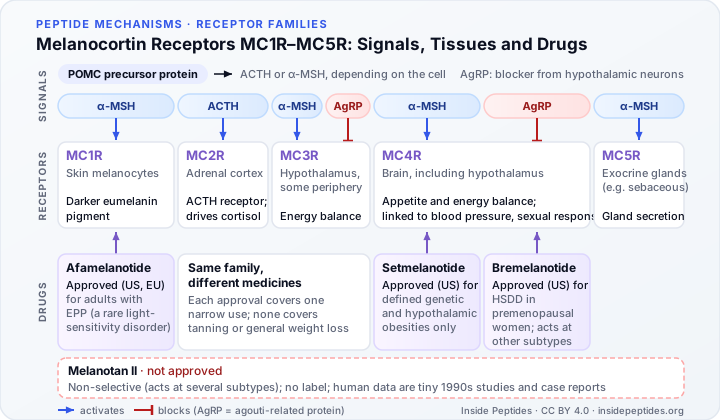
The melanocortin receptors are a family of five related receptors, MC1R to MC5R, that respond to hormones made from a shared precursor and control functions as different as skin color, stress-hormone production, appetite and sexual responses. All five are G protein-coupled receptors, the same broad receptor class used by many peptide hormones (see peptide receptors).
A useful feature of this system is that both the receptors and their natural activators are made in a limited number of places. Each receptor tends to serve a fairly specific function in the tissue where it is found [1]. A drug's effects therefore depend largely on two things: which of the five receptors it activates, and whether it reaches the tissues, including the brain, where those receptors sit.
The five receptors and what each does
| Receptor | Main locations | Best-known role |
|---|---|---|
| MC1R | Melanocytes (pigment cells) in skin and hair | Shifts pigment production toward darker eumelanin |
| MC2R | Adrenal cortex | The ACTH receptor; drives cortisol production |
| MC3R | Brain (hypothalamus) and some peripheral tissues | Contributes to energy balance |
| MC4R | Brain, including the hypothalamus | Appetite and energy balance; also linked to blood pressure and sexual responses |
| MC5R | Exocrine glands, such as sebaceous glands | Gland secretion |
These roles are described in reviews of the system's physiology, which list pigmentation, adrenal steroid production, energy balance, sodium handling, erectile responses and exocrine secretion among its functions [1].
Human genetics confirms the importance of MC4R. People with loss-of-function variants in the MC4R gene develop obesity. In one study, they also had a lower prevalence of high blood pressure than equally overweight controls (24% vs 53%), which helped show that this receptor influences blood pressure in people as well as appetite [2].
Natural switches and brakes: α-MSH, ACTH and agouti-related protein
The body's activators of these receptors are cut from one precursor protein, pro-opiomelanocortin (POMC). Depending on the cell, POMC is processed into adrenocorticotropic hormone (ACTH), which acts on the adrenal MC2R, or into melanocyte-stimulating hormones such as α-MSH, which act on MC1R, MC3R, MC4R and MC5R [1].
Unusually for a hormone system, melanocortin signaling also has natural antagonists, proteins that block the receptors. Agouti protein acts mainly at MC1R in the skin, and agouti-related protein (AgRP), made by appetite-regulating neurons in the hypothalamus, blocks MC3R and MC4R. In the brain, α-MSH released by POMC neurons tends to reduce hunger, while AgRP tends to increase it [1].
This balance explains why some rare genetic forms of obesity respond to an MC4R-activating drug. If a person cannot make POMC, or cannot respond to leptin (a fat-derived hormone that switches on POMC neurons), the MC4R receptor itself may still work but receive too little α-MSH signal [3].
Four drugs, four receptor profiles
Afamelanotide (MC1R). A synthetic analogue of α-MSH that mainly acts on MC1R to increase eumelanin in skin. In two randomized, placebo-controlled trials in people with erythropoietic protoporphyria (EPP), a rare condition that causes severe pain after light exposure, afamelanotide increased the time patients could spend in direct sunlight without pain (median 69.4 vs 40.8 hours in the U.S. study) and improved quality of life [4]. As the Scenesse implant, it is FDA-approved to increase pain-free light exposure in adults with a history of phototoxic reactions from EPP [5]. The European Commission authorized it in 2014 under "exceptional circumstances", a pathway used when complete data cannot be obtained, in part because the disease is rare [6].
Setmelanotide (MC4R). A cyclic peptide that activates MC4R in the brain. Its U.S. label limits use to specific causes of obesity: Bardet-Biedl syndrome; POMC, PCSK1 or LEPR deficiency confirmed by genetic testing; and acquired hypothalamic obesity. The label states it is not indicated for other types of obesity [7]. In single-arm phase 3 trials, 8 of 10 participants with POMC deficiency and 5 of 11 with LEPR deficiency lost at least 10% of body weight at about one year [3]. These were small, open-label studies in very rare conditions.
Bremelanotide (MC4R-mediated). A cyclic peptide that activates several melanocortin receptors, with its intended effect attributed mainly to MC4R in the brain. As Vyleesi, it is FDA-approved for premenopausal women with acquired, generalized hypoactive sexual desire disorder (HSDD) not explained by another medical or psychiatric condition, relationship problems or medication [8]. In two phase 3 trials of 1,267 women, bremelanotide produced statistically significant but modest improvements in desire and related distress scores compared with placebo [9].
Melanotan II (non-selective, unapproved). A cyclic α-MSH analogue that was never developed into a medicine. In a 1996 pilot study in three male volunteers, it darkened skin and also caused nausea and spontaneous erections, effects that point to activity at more than one melanocortin receptor [10]. No approved medicine contains it. For a side-by-side view, see the table below, and melanotan II vs bremelanotide and melanotan II vs afamelanotide.
| Drug | Main receptor of interest | U.S. status | Main human evidence |
|---|---|---|---|
| Afamelanotide | MC1R (skin) | Approved for adults with EPP | Two randomized, placebo-controlled trials |
| Setmelanotide | MC4R (brain) | Approved for defined genetic and hypothalamic obesities | Small phase 3 trials in rare conditions |
| Bremelanotide | MC4R (brain), with activity at other subtypes | Approved for acquired, generalized HSDD in premenopausal women | Two randomized, placebo-controlled phase 3 trials |
| Melanotan II | Several subtypes | Not approved | Tiny 1990s studies and case reports |
Known safety signals and where they come from
Many melanocortin side effects make sense once you know where the receptors are. A drug intended for the brain can still reach MC1R in skin; a drug intended for skin may still affect the brain.
- Skin darkening and moles. The setmelanotide label warns of skin hyperpigmentation, darkening of existing moles (nevi) and new melanocytic lesions, and advises skin examinations [7]. In its POMC trial, hyperpigmentation was reported in all ten participants [3]. The afamelanotide label recommends a full-body skin examination twice yearly to monitor existing and new pigmented lesions [5]. With bremelanotide, focal hyperpigmentation (including the face, gums and breasts) was reported in 1% of patients in phase 3 trials; the label notes that resolution was not confirmed in some patients [8].
- Nausea. Nausea was reported by 40% of patients using bremelanotide in the phase 3 program and led 8% to stop treatment [8]. Nausea also occurred in the setmelanotide trials and the melanotan II pilot study [3][10].
- Blood pressure. Bremelanotide transiently raises blood pressure and lowers heart rate after each dose, usually resolving within 12 hours; its label advises against use in people at high cardiovascular risk [8]. An earlier experimental MC4R agonist raised blood pressure in a 7-day study in volunteers [2]. The current setmelanotide label does not list blood pressure among its warnings [7].
- Other central effects. The setmelanotide label also warns of sexual adverse reactions, such as spontaneous erections, and of depression and suicidal ideation [7].
Melanotan II. Because it is unapproved, there is no label and no controlled long-term safety data. A 2017 review described increasing case reports of changes in existing moles, new (sometimes dysplastic) moles and four reports of melanoma arising during or shortly after melanotan use, while noting that conclusive evidence of a causal link is lacking [11]. FDA lists melanotan II among bulk drug substances that may present significant safety risks in compounding, citing possible immunogenicity and impurities and case reports of melanoma, posterior reversible encephalopathy syndrome, sympathomimetic toxidrome and priapism [12]. Products sold online may also not contain what their labels state.
Reading melanocortin claims carefully
Several questions help when a news story or product claim mentions a melanocortin peptide:
- Which receptor? An MC1R effect on skin color, an MC4R effect on appetite and an MC4R effect on sexual desire are different claims, even if the drugs are chemically related.
- Which population? Setmelanotide's results come from people with specific gene defects or hypothalamic injury; they do not show an effect in common obesity [7]. Afamelanotide's results come from people with EPP, not from people seeking a tan [4].
- What kind of evidence? Randomized trials support the approved uses. Melanotan II's human data consist of tiny 1990s studies and later case reports [10][11].
- What is the size of the effect? A statistically significant change, such as bremelanotide's improvement in desire scores, may still be modest for an individual (see statistical vs clinical significance).
Be cautious with the word "melanotan" itself. Products sold online under that name are not regulated medicines, may vary in content and purity, and are not the same thing as the approved drugs above, even when marketing borrows their science [12]. For how regulators define approved uses, see what FDA approval means.
Core Scientific Definitions
Precise biomedical definitions for terms used throughout this guide.
- Melanocortin receptors
- A family of five G protein-coupled receptors (MC1R–MC5R) activated by peptides derived from pro-opiomelanocortin, which regulate functions including pigmentation, adrenal steroid production, energy balance and sexual responses.
- Pro-opiomelanocortin (POMC)
- A precursor protein that cells cut into several active peptides, including adrenocorticotropic hormone (ACTH) and α-, β- and γ-melanocyte-stimulating hormones (MSH).
- Agouti-related protein (AgRP)
- A peptide made by appetite-regulating neurons in the hypothalamus that blocks the MC3 and MC4 receptors, opposing the appetite-suppressing signal of α-MSH.
- Erythropoietic protoporphyria (EPP)
- A rare inherited disorder in which a light-sensitive molecule, protoporphyrin, builds up in the body and causes severe pain in skin exposed to visible light.
- Receptor selectivity
- The degree to which a drug activates one receptor subtype more than related subtypes at the concentrations reached in the body.
Peer-Reviewed References & Primary Sources
This educational guide is built strictly upon peer-reviewed literature, official regulatory guidance, and authoritative biochemical repositories.
-
Studies on the physiological functions of the melanocortin system Endocrine Reviews · 2006
-
Modulation of blood pressure by central melanocortinergic pathways New England Journal of Medicine · 2009
-
Efficacy and safety of setmelanotide, an MC4R agonist, in individuals with severe obesity due to LEPR or POMC deficiency: single-arm, open-label, multicentre, phase 3 trials Lancet Diabetes & Endocrinology · 2020
-
Afamelanotide for Erythropoietic Protoporphyria New England Journal of Medicine · 2015
-
SCENESSE (afamelanotide) implant: prescribing information DailyMed, U.S. National Library of Medicine · Accessed 2026
-
Scenesse: EPAR (European public assessment report) European Medicines Agency · Accessed 2026
-
IMCIVREE (setmelanotide) injection: prescribing information DailyMed, U.S. National Library of Medicine · Accessed 2026
-
VYLEESI (bremelanotide) injection: prescribing information DailyMed, U.S. National Library of Medicine · Accessed 2026
-
Bremelanotide for the Treatment of Hypoactive Sexual Desire Disorder: Two Randomized Phase 3 Trials Obstetrics & Gynecology · 2019
-
Evaluation of melanotan-II, a superpotent cyclic melanotropic peptide in a pilot phase-I clinical study Life Sciences · 1996
-
Risks of unregulated use of alpha-melanocyte-stimulating hormone analogues: a review International Journal of Dermatology · 2017
-
Certain Bulk Drug Substances for Use in Compounding that May Present Significant Safety Risks U.S. Food and Drug Administration · Accessed 2026
Educational Disclaimer: This guide is produced strictly for biomedical educational purposes and does not constitute medical advice, diagnosis, or treatment recommendations. Experimental peptides discussed herein may lack regulatory authorization for human clinical use. Consult a licensed medical practitioner before considering any therapeutic intervention.