
1. Defining Half-Life: Alpha vs Beta Phases
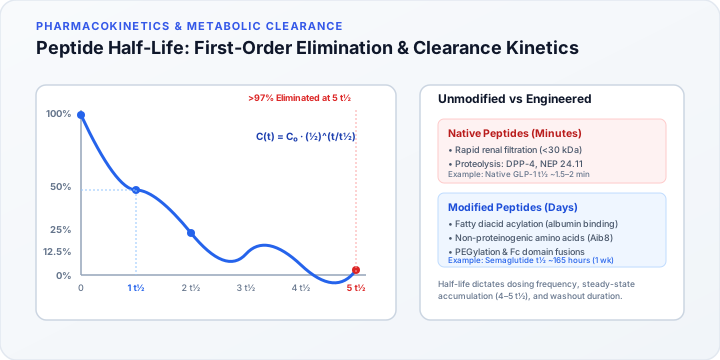
In quantitative pharmacokinetics, half-life (t1/2) is the duration required for the plasma concentration of a substance to decline by 50% [1]. Following intravenous administration, peptides exhibit multi-compartmental pharmacokinetic decay:
- Alpha Phase (Distribution Half-Life): The rapid initial drop as the peptide diffuses out of the central vascular compartment into interstitial tissues and capillary beds (typically seconds to minutes).
- Beta Phase (Terminal Elimination Half-Life): The true elimination phase governed by metabolic proteolysis and irreversible renal or biliary excretion [1].
2. Why Natural Peptides Vanish in Minutes
Endogenous peptide hormones evolved to serve as transient, acute regulatory signals. Prolonged receptor stimulation leads to receptor downregulation, desensitization, or pathological overactivation (such as fatal hypoglycemia from sustained insulin signaling) [2].
Natural peptide half-lives are exceptionally brief because the human body employs two aggressive clearance systems in parallel:
- Renal Glomerular Filtration: Small peptides (< 30–50 kDa) pass freely across glomerular podocyte slit diaphragms into the nephron, where the proximal tubule degrades them: small linear peptides are hydrolysed by brush-border enzymes, while larger or disulfide-bridged peptides such as insulin are taken up by endocytosis and degraded in lysosomes [3].
- Ubiquitous Peptidases: Soluble aminopeptidases, carboxypeptidases, and cell-surface endopeptidases (neprilysin, DPP-4) rapidly cleave unhindered peptide bonds [2].
3. Molecular Half-Life Extension Strategies
To develop viable therapeutic peptide drugs, pharmaceutical chemists employ several half-life extension platforms:
- Sequence Stabilization: Substituting cleavage-prone residues with unnatural amino acids (e.g., aminoisobutyric acid [Aib] or D-amino acids) and capping N- and C-termini.
- Hydrodynamic Size Expansion: Conjugating large hydrophilic PEG polymers (PEGylation) expands the effective molecular diameter beyond the 50 kDa glomerular pore limit.
- Fc-Fusion & Transferrin Fusion: Fusing the peptide to an immunoglobulin IgG-Fc domain increases size and recruits the neonatal Fc receptor (FcRn), which recycles the molecule out of endosomes back into circulation.
- Lipidation / Acylation: Attaching fatty acid tails (or fatty-acid-bearing peptide ligands) to allow reversible binding to circulating human serum albumin, an approach shown in animal studies to prolong the elimination half-life of cyclic peptides several-fold [4].
4. Acylation and Albumin Binding
Reversible albumin binding underpins approved acylated GLP-1 analogues such as liraglutide and semaglutide [5]. Human serum albumin (HSA) is the most abundant protein in blood (35–50 g/L) and boasts an extraordinary human half-life of approximately 19 to 21 days due to FcRn recycling.
By conjugating a synthetic fatty acid spacer (such as palmitic acid in liraglutide, or a C18/C20 diacid in semaglutide and tirzepatide) to an engineered lysine side chain, the peptide reversibly 'hitchhikes' on albumin. Because most of the circulating peptide is bound to albumin, it is protected from renal filtration and shielded from peptidases, while the small unbound fraction remains available to bind target receptors. In the semaglutide discovery program, combining Aib8 substitution (for protection against DPP-4 degradation) with a fatty-acid side chain on lysine 26 increased albumin affinity and gave a plasma half-life of 46.1 hours in mini-pigs after intravenous administration [5].
5. Clinical Importance for Dosing Schedules
Half-life dictates clinical dosing intervals and steady-state kinetics. A drug requires approximately 4 to 5 half-lives to reach therapeutic steady-state concentrations upon initiation, and the same duration to fully clear the body upon discontinuation [1].
Terminal half-life directly dictates clinical safety management: agents with multi-day half-lives maintain continuous receptor engagement with infrequent administration, but require multiple weeks to wash out if adverse drug reactions develop.
Core Scientific Definitions
Precise biomedical definitions for terms used throughout this guide.
- Elimination Half-Life (t1/2β)
- The time required for the plasma concentration of a drug to decrease by 50% during the terminal elimination phase.
- Acylation
- The chemical attachment of an acyl (fatty acid) chain to a peptide residue to facilitate reversible non-covalent binding to serum albumin.
- PEGylation
- The covalent conjugation of polyethylene glycol (PEG) polymer chains to increase hydrodynamic radius above the renal filtration cutoff.
Peer-Reviewed References & Primary Sources
This educational guide is built strictly upon peer-reviewed literature, official regulatory guidance, and authoritative biochemical repositories.
-
Acylated heptapeptide binds albumin with high affinity and application as tag furnishes long-acting peptides Nat Commun · 2017
-
Discovery of the once-weekly glucagon-like peptide-1 (GLP-1) analogue semaglutide J Med Chem · 2015
Educational Disclaimer: This guide is produced strictly for biomedical educational purposes and does not constitute medical advice, diagnosis, or treatment recommendations. Experimental peptides discussed herein may lack regulatory authorization for human clinical use. Consult a licensed medical practitioner before considering any therapeutic intervention.