
Peptide Biology Beginner

Can Peptides Be Taken Orally? Oral vs Injected Peptides Explained

Why most peptides are injected, how oral semaglutide, desmopressin and linaclotide work by mouth, and what the evidence says about peptide pills, sprays and creams.

10 min read Updated 18 sources InsidePeptides Editorial Team

A loose pile of plain round white tablets on a clean white surface
Photo: Christian Schnettelker from Essen, Deutschland, CC BY 2.0, via Wikimedia Commons.

Plain-English Summary

Most peptides cannot simply be swallowed, because stomach acid, digestive enzymes and the gut wall break them down or keep them out of the blood, which is why most peptide medicines are injected. A few approved peptide medicines do work by mouth: oral semaglutide uses an absorption enhancer, desmopressin and the cyclic peptide cyclosporine are robust enough to work despite limited absorption, and linaclotide acts inside the gut without being absorbed. Oral, nasal or cream versions of unapproved peptides generally have no evidence that they reach the body in useful amounts.

Key Takeaways

  • Stomach acid, digestive enzymes and the gut wall destroy or block most peptides, so most peptide medicines are given by injection.
  • Oral semaglutide works because its tablet contains the absorption enhancer SNAC, yet only about 0.4% to 1% of the peptide reaches the blood.
  • Desmopressin tablets work despite oral bioavailability of roughly 0.1%, and cyclosporine's ring-shaped structure helps it survive digestion.
  • Linaclotide is designed to act on the gut lining and is barely absorbed at all.
  • Nasal sprays absorb some small peptides better than tablets but still far less than injections; cosmetic peptide creams are designed to act on the skin.
  • Orforglipron (Foundayo) is an oral GLP-1 medicine but a small molecule, not a peptide.
  • There is generally no human evidence that oral or nasal versions of unapproved “research” peptides reach the blood in useful amounts.
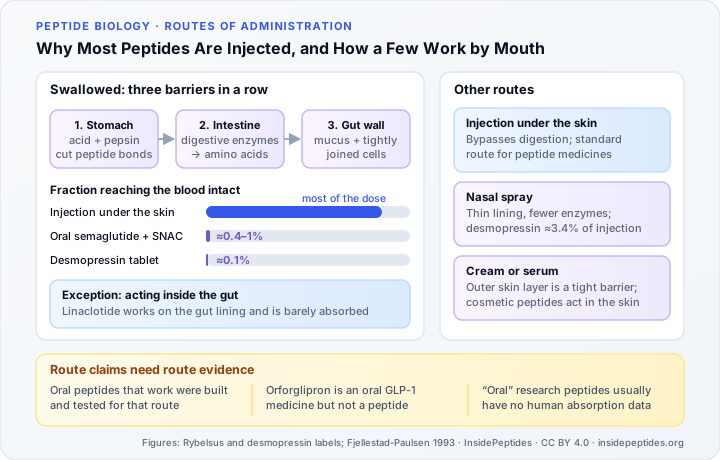
Diagram comparing routes for peptides. A swallowed peptide meets stomach acid and pepsin, intestinal enzymes and the gut wall, so only a small fraction reaches the blood: about 0.4 to 1 percent for oral semaglutide with SNAC and about 0.1 percent for desmopressin tablets. Linaclotide acts on the gut lining without being absorbed. An injection under the skin delivers most of the dose to the blood. A nasal spray delivers about 3.4 percent for desmopressin, and cosmetic creams act mainly in the skin.
Why route matters for peptides: digestion and the gut wall leave only a small fraction of a swallowed peptide in the blood unless a product is specially engineered, whereas injection under the skin delivers most of the dose. Figures from Rybelsus and desmopressin labels and Fjellestad-Paulsen 1993. Diagram by InsidePeptides, CC BY 4.0: free to reuse with a credit and link. Download SVG

Can peptides be taken orally?

Some can, but most cannot, at least not without special technology. The digestive system is built to break proteins and peptides into amino acids, and the gut wall is built to keep large molecules out of the blood. That is why nearly all peptide medicines, from insulin to the GLP-1 medicines used for diabetes and weight management, are given by injection [1].

A small number of peptide medicines do work by mouth. They fall into three groups:

  • Peptides formulated with an absorption enhancer, such as oral semaglutide, where a carefully designed tablet gets a small fraction of the drug into the blood.
  • Unusually robust peptides, such as the ring-shaped (cyclic) peptide cyclosporine, or desmopressin, which work despite low absorption.
  • Peptides meant to act inside the gut, such as linaclotide, which do their job without being absorbed at all.

Each of these products was developed and tested specifically for oral use. A peptide that works when injected does not automatically work when swallowed, sprayed into the nose or rubbed on the skin. This guide explains why, gives real examples of each route, and sets out what the evidence says about “oral” versions of unapproved peptides. It describes science and regulation only and gives no dosing or medical advice.

Why most peptides are injected

A swallowed peptide faces three barriers in sequence [1]:

  1. Stomach acid and pepsin. The stomach is strongly acidic and contains pepsin, an enzyme that cuts peptide bonds.
  2. Digestive enzymes in the intestine. Enzymes from the pancreas and the intestinal lining continue cutting peptides into smaller fragments and single amino acids, which is exactly what they do to the protein in food.
  3. The gut wall. Any intact peptide that survives must cross a layer of mucus and a sheet of tightly joined cells. Most peptides are too large and carry too many charged or water-loving groups to pass through cell membranes, and the gaps between cells are too small for them.

Even then, absorbed material passes through the liver before reaching the rest of the body. The result is that oral bioavailability, the fraction of a dose that reaches the bloodstream intact, is usually tiny for peptides. These barriers are covered in detail in Peptide Bioavailability and Peptide Degradation.

An injection under the skin avoids all three barriers. The peptide is absorbed from the tissue into the blood, mostly intact, which is why injection remains the standard route. Engineering can then make injections less frequent, for example by attaching a fatty acid that binds to albumin in the blood (see Peptide Half-Life) or by using long-acting depots (see Peptide Drug Delivery).

Oral peptide medicines that do work

A handful of approved medicines show how oral peptides can succeed, and how much effort it takes.

Oral semaglutide (Rybelsus and the Wegovy pill). Semaglutide is a modified GLP-1 peptide. Its tablet contains an absorption enhancer called SNAC (salcaprozate sodium). Studies in people and dogs showed that absorption happens in the stomach, close to the dissolving tablet, and requires SNAC, which locally buffers acid to protect the peptide from enzymes and briefly helps it cross the stomach lining [2]. Even so, the label estimates absolute bioavailability at only about 0.4% to 1% for Rybelsus, so most of each tablet's peptide never reaches the blood [3]. The FDA approved Rybelsus for type 2 diabetes on 20 September 2019 [4] and approved Wegovy tablets for weight management and cardiovascular risk reduction on 22 December 2025 [5]. In the OASIS 4 trial, average weight change over 64 weeks was −13.6% with the oral tablet versus −2.2% with placebo [6]. Because absorption is so delicate, these tablets come with strict instructions about taking them on an empty stomach, set out in the prescribing information.

Oral octreotide (Mycapssa). Octreotide, a somatostatin-like peptide normally injected, was approved as a delayed-release capsule in June 2020 for long-term maintenance treatment of acromegaly in people already controlled on injections [7]. The capsule includes absorption-enhancing ingredients that temporarily and reversibly loosen the junctions between gut cells; a much larger amount must be swallowed to produce blood levels similar to a small injection [8].

Desmopressin tablets. Desmopressin is a modified version of the hormone vasopressin used for central diabetes insipidus. In healthy volunteers, oral bioavailability was about 0.1% of that after injection under the skin [9]; the label gives about 0.16% relative to intravenous administration [10]. It works orally because the molecule is potent and resistant enough that this small fraction is still active.

Cyclosporine. This immune-suppressing medicine is a cyclic peptide of 11 amino acids made by a fungus [11]. Its ring structure removes the free ends that many enzymes attack, and it is unusually able to cross cell membranes. A review identified 125 cyclic peptides absorbed orally in mammals and noted that cyclisation reduces breakdown in the gut [12]. Absorption still varies widely: the label estimates absolute bioavailability of the original formulation at less than 10% in some patient groups and up to 89% in others [11].

Peptides that work without being absorbed

Some oral peptides are not meant to reach the blood at all. Linaclotide (Linzess) is a 14-amino-acid peptide that activates a receptor called guanylate cyclase-C on the inner surface of the intestine, increasing fluid secretion and speeding transit. It is used for chronic constipation and for irritable bowel syndrome with constipation [13]. According to its label, linaclotide is “minimally absorbed with negligible systemic availability”; blood levels after oral use are too low to measure [14].

This is the main exception to the general rule. When the target is in the gut itself, poor absorption becomes an advantage: the peptide acts where it is swallowed and largely avoids effects elsewhere in the body. The same logic does not apply to peptides whose targets are in the brain, muscle, fat tissue or joints, which need to reach the bloodstream in active form.

Nasal sprays, creams and other routes

Nasal sprays. The lining of the nose is thinner and has fewer digestive enzymes than the gut, so some small peptides are partly absorbed there. Desmopressin is available as a nasal spray; in the same volunteer study, nasal bioavailability was about 3.4% of the injected value, higher than oral but still a small fraction [9]. Salmon calcitonin was for many years used as a nasal spray for osteoporosis. Its use declined after regulators reviewed a possible link with cancer in 2013; a later review and meta-analysis judged a causal link unlikely but could not completely exclude an association [15]. Oral forms of insulin, calcitonin and parathyroid hormone have also been taken into clinical trials, a history that makes the eventual approval of oral semaglutide stand out [1].

Creams and skin products. The outer layer of the skin is an even tighter barrier. Cosmetic peptides in creams are designed to act in or near the skin, and evidence about how far they penetrate is limited; see Can Peptides Get Through the Skin? for the full picture. A cosmetic peptide product is not a way of getting a drug-like amount of a peptide into the bloodstream.

Under the tongue. In the desmopressin study, no desmopressin was detected in the blood after the sublingual or rectal routes, although small amounts appeared in urine [9]. Placing a peptide under the tongue does not reliably bypass digestion.

Other non-injected routes, such as inhaled insulin, are discussed in Peptide Drug Delivery.

Routes compared

The table summarises how each route behaves for peptides, with approved examples. Bioavailability figures are taken from the cited studies and labels and are given only to show the scale of loss.

RouteMain barrierExamplesWhat reaches the blood
Injection under the skinFew; absorbed from tissueMost peptide medicines, including semaglutide and tirzepatide injectionsMost of the dose; the usual reference point [1]
Tablet with absorption enhancerAcid, enzymes, gut wallOral semaglutide; oral octreotideA small fraction; about 0.4% to 1% for Rybelsus [3][8]
Tablet, robust peptideEnzymes, gut wallDesmopressin; cyclosporine (cyclic)About 0.1% to 0.16% for desmopressin; highly variable for cyclosporine [9][10][11]
Oral, acting in the gutNot intended to be absorbedLinaclotideNegligible; acts on the gut lining [14]
Nasal sprayNasal lining, mucus clearanceDesmopressin; formerly salmon calcitoninAbout 3.4% for desmopressin [9]
Cream or serumOuter skin layerCosmetic peptidesDesigned to act locally; little evidence of meaningful entry into the blood

“Oral” research peptides and GLP-1 pills that are not peptides

Not every GLP-1 pill is a peptide. Orforglipron (Foundayo), approved by the FDA in April 2026 for chronic weight management, is a small-molecule, non-peptide drug that activates the GLP-1 receptor [16]. Because it is not a peptide, it does not need an absorption enhancer, and its label allows it to be taken with or without food [17]. Its success says nothing about whether peptide drugs can be swallowed; it shows that a different kind of molecule can reach the same receptor.

Unapproved peptides sold as capsules, drops or nasal sprays. Many peptides marketed online with “research use only” labels are offered in oral or nasal forms. For these products the barriers above apply in full, and there is usually no published human study showing how much, if any, reaches the blood. AOD-9604 is a clear example. Its developer did test an oral form in human obesity trials, and in a 2024 review the FDA concluded there was a lack of evidence of effectiveness for obesity by any route, adding that it found no human exposure data at all for the injected or skin routes [18].

Oral semaglutide shows what it takes for a peptide pill to work: a purpose-built enhancer, measured bioavailability, and large trials of that exact tablet [2][6]. Without that evidence, there is no basis for assuming an oral version of an unapproved peptide works at all. Product quality is a separate concern; see what “research use only” means and approved versus unapproved peptides.

Frequently asked questions

Do oral peptides work?

Some approved oral peptide medicines do, because they were designed and tested for that route: oral semaglutide, oral octreotide, desmopressin tablets, cyclosporine and linaclotide [3][7][10][11][14]. For most other peptides, swallowing them leads to breakdown in the gut, and there is no evidence that meaningful amounts reach the blood.

Why are most peptides injected?

Stomach acid, digestive enzymes and the gut wall break down or block most peptides before they can be absorbed. Injection under the skin avoids those barriers [1].

Peptide injections vs oral: which is better?

There is no general answer, because “oral” and “injected” are only comparable for the same molecule in tested products. For semaglutide, both injected and tablet forms are approved for weight management, but the tablet needs far more peptide to deliver a small fraction to the blood and comes with strict administration rules [3][5]. Choices between approved products are for a clinician.

Do peptide pills, nasal sprays or creams work as well as injections?

Only where a specific product has been tested. Nasal desmopressin reaches the blood better than oral desmopressin but far less than an injection [9]. Cosmetic peptide creams are designed to act on the skin, not to deliver a peptide into the body.

Is the GLP-1 pill a peptide?

It depends which pill. Rybelsus and the Wegovy pill contain semaglutide, a peptide [3]. Foundayo contains orforglipron, a small molecule that is not a peptide [16].

Core Scientific Definitions

Precise biomedical definitions for terms used throughout this guide.

Oral bioavailability
The fraction of a swallowed dose that reaches the general circulation unchanged, usually compared with an intravenous dose, which by definition is 100% bioavailable.
Absorption (permeation) enhancer
An ingredient added to a tablet or capsule to help a drug cross the gut lining, for example SNAC in oral semaglutide or the enhancers in oral octreotide.
Cyclic peptide
A peptide whose chain is joined into a ring; removing the free ends makes it harder for many digestive enzymes to break down.
Subcutaneous injection
An injection into the fatty tissue just under the skin, from which a peptide is absorbed into the blood without passing through the digestive system.
Small molecule
A drug with a much lower molecular weight than a peptide, typically made by chemical synthesis; many small molecules are absorbed well from the gut.

Peer-Reviewed References & Primary Sources

This educational guide is built strictly upon peer-reviewed literature, official regulatory guidance, and authoritative biochemical repositories.

  1. Advances in oral peptide therapeutics Drucker DJ. Nat Rev Drug Discov 2020;19:277-89. Nat Rev Drug Discov · 2020
  2. Transcellular stomach absorption of a derivatized glucagon-like peptide-1 receptor agonist Buckley ST et al. Sci Transl Med 2018;10:eaar7047. Sci Transl Med · 2018
  3. RYBELSUS and OZEMPIC (oral semaglutide) tablets prescribing information Novo Nordisk. Rybelsus and Ozempic (semaglutide) tablets prescribing information, DailyMed, published 19 August 2026. DailyMed, U.S. National Library of Medicine · 2026
  4. Rybelsus (semaglutide) tablets: NDA 213051 approval letter U.S. Food and Drug Administration. Rybelsus (semaglutide) tablets NDA 213051 approval letter, 20 September 2019. U.S. Food and Drug Administration (Drugs@FDA) · 2019
  5. Wegovy (semaglutide) tablets: NDA 218316 approval letter U.S. Food and Drug Administration. Wegovy (semaglutide) tablets NDA 218316 approval letter, 22 December 2025. U.S. Food and Drug Administration (Drugs@FDA) · 2025
  6. Oral Semaglutide at a Dose of 25 mg in Adults with Overweight or Obesity Wharton S et al. N Engl J Med 2025;393:1077-87. N Engl J Med · 2025
  7. Mycapssa (octreotide) delayed-release capsules: NDA 208232 approval letter U.S. Food and Drug Administration. Mycapssa (octreotide) delayed-release capsules NDA 208232 approval letter, 26 June 2020. U.S. Food and Drug Administration (Drugs@FDA) · 2020
  8. MYCAPSSA (octreotide) prescribing information Chiesi USA. Mycapssa (octreotide) delayed-release capsules prescribing information, DailyMed, published 28 July 2025. DailyMed, U.S. National Library of Medicine · 2025
  9. Pharmacokinetics of 1-deamino-8-D-arginine vasopressin after various routes of administration in healthy volunteers Fjellestad-Paulsen A, Höglund P, Lundin S, Paulsen O. Clin Endocrinol (Oxf) 1993;38:177-82. Clin Endocrinol (Oxf) · 1993
  10. DESMOPRESSIN ACETATE tablets prescribing information Apotex Corp. Desmopressin acetate tablets prescribing information, DailyMed, published 14 September 2026. DailyMed, U.S. National Library of Medicine · 2026
  11. NEORAL (cyclosporine) prescribing information Novartis. Neoral (cyclosporine) capsules and oral solution prescribing information, DailyMed, published 11 August 2026. DailyMed, U.S. National Library of Medicine · 2026
  12. Orally Absorbed Cyclic Peptides Nielsen DS et al. Chem Rev 2017;117:8094-128. Chem Rev · 2017
  13. Review article: Linaclotide for the management of irritable bowel syndrome with constipation Layer P, Stanghellini V. Aliment Pharmacol Ther 2014;39:371-84. Aliment Pharmacol Ther · 2014
  14. LINZESS (linaclotide) prescribing information Allergan. Linzess (linaclotide) capsules prescribing information, DailyMed, published 1 June 2026. DailyMed, U.S. National Library of Medicine · 2026
  15. Does salmon calcitonin cause cancer? A review and meta-analysis Wells G, Chernoff J, Gilligan JP, Krause DS. Osteoporos Int 2016;27:13-9. Osteoporos Int · 2016
  16. Orforglipron, an Oral Small-Molecule GLP-1 Receptor Agonist for Obesity Treatment Wharton S et al. N Engl J Med 2025;393:1796-806. N Engl J Med · 2025
  17. FOUNDAYO (orforglipron) tablets prescribing information Eli Lilly and Company. Foundayo (orforglipron) tablets prescribing information, NDA 220934, revised 2026. U.S. Food and Drug Administration (Drugs@FDA) · 2026
  18. FDA Briefing Document, Pharmacy Compounding Advisory Committee Meeting, December 4, 2024: AOD-9604 (free base) and AOD-9604 acetate U.S. Food and Drug Administration. Pharmacy Compounding Advisory Committee briefing document, 4 December 2024. U.S. Food and Drug Administration · 2024
Written By InsidePeptides Editorial Team
Review Status Scientific review pending
Last Updated
Last Evidence Review Pending verification

Educational Disclaimer: This guide is for education only and is not medical advice, diagnosis or treatment. Many peptides discussed here are not approved for human use. Talk to a licensed clinician before making any health decision.