

Peptide Mechanisms Intermediate

How GLP-1 Drugs Work: Appetite, the Stomach, the Brain and Side Effects

How semaglutide and tirzepatide reduce appetite, why they cause nausea, diarrhoea and hair loss, what the thyroid cancer warning means and what happens when they stop.

12 min read Updated 19 sources InsidePeptides Editorial Team

A colourful bowl of rice, tempeh, avocado, edamame, radish and vegetables on a wooden table
Photo: PizzaMan, CC BY-SA 4.0, via Wikimedia Commons.

Plain-English Summary

GLP-1 drugs such as semaglutide and tirzepatide are long-lasting medicines that switch on the receptor for GLP-1, a hormone the gut releases after eating. They act mainly on appetite centres in the brain, so people feel less hungry and fuller sooner; they slow stomach emptying, most noticeably early in treatment; and they help the pancreas release insulin when blood glucose is high. The same actions explain the most common side effects, such as nausea and diarrhoea. Thyroid tumours seen in rodents led to a boxed warning on U.S. labels, but whether this applies to people has not been determined, and human studies have reached different conclusions.

Key Takeaways

  • GLP-1 drugs activate the same receptor as the gut hormone GLP-1 but are engineered to last for days rather than minutes, mainly by binding to the blood protein albumin and resisting the enzyme DPP-4.
  • Most of their effect on weight is thought to come from the brain: less hunger, earlier fullness and fewer food cravings, so people eat less.
  • Slower stomach emptying adds to fullness and nausea, but this effect is strongest early in treatment and lessens over time.
  • Nausea, diarrhoea, vomiting and constipation are the most common side effects; in the main obesity trials they were mostly mild to moderate and clustered in the early, step-up phase of treatment.
  • Hair loss is reported more often than with placebo and appears to be linked to weight reduction, most often as a temporary shedding pattern called telogen effluvium.
  • Thyroid C-cell tumours in rodents led to a boxed warning; their relevance to humans has not been determined, and large human studies have given mixed results.
  • In trials where treatment was stopped, most participants regained a large part of the weight they had lost.
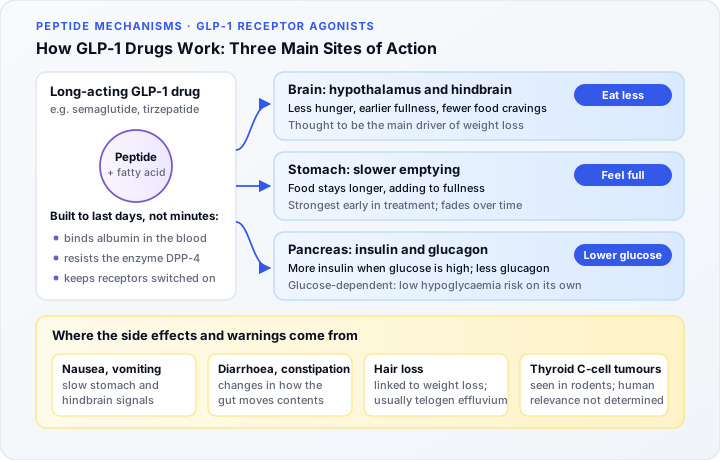
Diagram: a long-acting GLP-1 drug acts on three main sites. In the brain it reduces hunger and brings on fullness; in the stomach it slows emptying, most strongly at first; in the pancreas it raises insulin when glucose is high and lowers glucagon. A lower panel links nausea, diarrhoea, hair loss and the rodent thyroid finding to their likely causes.
How GLP-1 receptor agonists act on the brain, stomach and pancreas, and where the common side effects and the thyroid warning come from. Most mapping of brain sites comes from animal studies. Diagram by InsidePeptides, CC BY 4.0: free to reuse with a credit and link. Download SVG

What GLP-1 drugs are and why they last

GLP-1 drugs are medicines that switch on the receptor for glucagon-like peptide-1 (GLP-1), a hormone released by the gut after eating. The best known are semaglutide (sold as Ozempic, Wegovy and Rybelsus) and tirzepatide (Mounjaro and Zepbound), which also activates the receptor for a second gut hormone, GIP. Older members of the class include liraglutide, dulaglutide and exenatide. They are approved in the United States for type 2 diabetes, weight management or both, depending on the product.

GLP-1 receptors are found in the pancreas, the gut, the heart, the kidneys and several parts of the brain, which is why one drug can affect blood glucose, appetite and digestion at the same time [1]. The body's own GLP-1 and its role in insulin release, known as the incretin effect, are covered in The Incretin Effect; this guide focuses on what happens when a long-acting drug keeps the receptor switched on.

Natural GLP-1 lasts only minutes in the blood before the enzyme DPP-4 inactivates it. Drug designers solved this in two main ways. Semaglutide differs from human GLP-1 at two positions: one change protects it from DPP-4, and a fatty-acid side chain lets it bind reversibly to albumin, the most abundant protein in blood. Bound drug is protected from breakdown and released slowly back into the circulation [2]. Tirzepatide uses a similar fatty-acid attachment to bind albumin [3]. The result is a half-life of about a week for semaglutide [4], compared with minutes for the natural hormone. The general chemistry is explained in Peptide Half-Life.

That long exposure is the key difference from the body's own hormone. Natural GLP-1 rises and falls with each meal; a long-acting drug keeps receptors stimulated around the clock, at levels well above those reached naturally [1].

The brain: hunger, fullness and cravings

Most of the weight loss produced by GLP-1 drugs is thought to come from their effects on the brain. The U.S. labels for semaglutide and tirzepatide describe GLP-1 as a physiological regulator of appetite and calorie intake and note that its receptors are present in brain areas involved in appetite regulation [4][3].

These drugs are large molecules and do not cross the blood-brain barrier in any meaningful amount. Animal studies suggest they reach the brain at points where that barrier is naturally leaky:

  • The hypothalamus. In rats and mice, labelled liraglutide reached the arcuate nucleus, a hypothalamic area that controls hunger. There it activated nerve cells that promote fullness (POMC/CART neurons) and indirectly dampened nerve cells that drive hunger (NPY/AgRP neurons) [5].
  • The hindbrain. In rats, semaglutide directly reached the area postrema and nearby hindbrain regions, which sense hormones in the blood and help end a meal. Activity then spread to connected areas, including the lateral parabrachial nucleus, a relay linked to meal termination, without the drug reaching them directly [6].

The same rodent study found that semaglutide changed food preferences and reduced food intake without reducing energy expenditure [6]. In people, the clearest evidence comes from controlled feeding studies. In a 20-week trial of 72 adults with obesity, participants taking semaglutide ate about 35% less energy at a self-chosen lunch than those taking placebo, reported less hunger and more fullness, and described better control of eating and fewer and weaker food cravings [7]. In other words, people on these drugs tend to eat less because they want less food, not because they are forcing themselves to stop.

How these drugs act on the brain without crossing the barrier is discussed further in Can Peptides Reach the Brain?

The stomach: slower emptying, mostly at first

GLP-1 slows the rate at which food leaves the stomach, partly through signals carried by the vagus nerve [8]. Food that stays in the stomach longer stretches it for longer, which adds to the sense of fullness after a meal and blunts the rise in blood glucose that follows eating [1]. Both the semaglutide and tirzepatide labels list delayed gastric emptying among the drugs' effects [4][3].

This effect fades with continuous exposure, a process called tachyphylaxis. In a study of nine healthy volunteers given a continuous GLP-1 infusion, the slowing of stomach emptying was significantly greater after the first meal than after a second meal four hours later [8]. The tirzepatide label states that the delay in gastric emptying is largest after the first dose and diminishes over time [3]. In the 20-week semaglutide feeding study, an indirect measure of stomach emptying showed no evidence of a meaningful delay by the end of the trial, even though appetite remained clearly reduced [7].

This pattern helps explain two observations. First, nausea and fullness are most common early in treatment, the period when the stomach effect is strongest. Second, the continued weight loss over many months is unlikely to be explained by a slow stomach alone, which points back to the brain.

The pancreas: insulin, glucagon and blood glucose

The original purpose of GLP-1 drugs was to treat type 2 diabetes. In the pancreas, they increase insulin release and reduce release of glucagon, a hormone that raises blood glucose, and both effects depend on glucose: they are strong when blood glucose is high and fade as it returns towards normal [4][3]. That glucose dependence is why GLP-1 drugs used on their own carry a relatively low risk of hypoglycaemia (low blood glucose), although the risk rises when they are combined with insulin or with drugs that force insulin release regardless of glucose [1].

The tirzepatide label also reports improved insulin sensitivity in people with type 2 diabetes [3], and weight loss itself improves how the body handles glucose. The physiology of the hormones behind these effects, and how DPP-4 limits them, is explained in The Incretin Effect; the reasons for adding GIP or other hormone signals are covered in Multi-Receptor Agonists.

Why side effects happen: nausea, diarrhoea and hair loss

Nausea, vomiting, diarrhoea and constipation

The most common side effects of GLP-1 drugs come from the same systems that produce their benefits. Slower stomach emptying and activation of hindbrain areas involved in nausea can both cause queasiness and vomiting, while GLP-1 receptors along the gut affect how quickly contents move through the intestines, which can lead to either diarrhoea or constipation [1].

In a pooled analysis of the STEP 1 to 3 trials of semaglutide for weight management, nausea was reported by 43.9% of participants on semaglutide compared with 16.1% on placebo, diarrhoea by 29.7% compared with 15.9%, vomiting by 24.5% compared with 6.3% and constipation by 24.2% compared with 11.1%. Almost all of these events were mild to moderate, most were temporary and occurred during or shortly after the step-up phase at the start of treatment, and 4.3% of participants on semaglutide stopped treatment permanently because of them [9]. In SURMOUNT-1, the tirzepatide obesity trial, gastrointestinal events were likewise the most common, mostly mild to moderate and mainly during the step-up phase [10]. The labels also describe less common but serious problems, including severe gastrointestinal reactions, acute pancreatitis and gallbladder disease [4][3].

Hair loss

Hair loss is listed as an adverse reaction on both labels. In pooled semaglutide weight-management trials, it was reported by 3.3% of participants on the drug and 1% on placebo, more often in women than in men, and the label states that hair loss was associated with weight reduction [4]. Hair loss was also reported more often with tirzepatide than with placebo in its obesity trials [3].

There is no strong evidence that GLP-1 drugs damage hair follicles directly. Reviews of the available reports suggest the most common pattern is telogen effluvium, a temporary increase in shedding that follows a physical stress, and that the size and speed of weight loss appear to matter more than the drug itself [11]. The same pattern is well recognised after bariatric surgery, where rapid weight loss, low calorie and protein intake and nutrient deficiencies have all been implicated [12]. Most of this evidence is observational, so the exact contribution of the drug, the weight loss and diet is not settled.

Do GLP-1 drugs cause cancer? Thyroid findings and wider safety

The cancer question centres on the thyroid gland, and specifically on C-cells, the cells that make the hormone calcitonin. In long-term rodent studies, semaglutide and tirzepatide caused thyroid C-cell tumours at exposures relevant to human use. U.S. labels therefore carry a boxed warning stating that it is unknown whether the drugs cause these tumours, including medullary thyroid carcinoma, in humans, because the human relevance of the rodent findings has not been determined. The drugs are contraindicated in people with a personal or family history of medullary thyroid carcinoma or with the inherited syndrome MEN 2 [4][3].

Laboratory work offers a reason to think rodents may be especially sensitive. Rat and mouse C-cells carry GLP-1 receptors and respond to GLP-1 drugs by releasing calcitonin and multiplying. Human and monkey C-cells had low receptor levels, the drugs did not trigger calcitonin release in primates, and 20 months of high-exposure liraglutide did not cause C-cell overgrowth in monkeys. The authors noted that the long-term consequences in the human thyroid remain unknown [13].

Human studies have reached different conclusions. A French nested case-control study of people with type 2 diabetes found that one to three years of GLP-1 drug use was associated with a higher risk of thyroid cancer overall and of medullary thyroid cancer [14]. A larger Scandinavian cohort study comparing new users of GLP-1 drugs with new users of DPP-4 inhibitors found no substantially increased risk of thyroid cancer over an average follow-up of 3.9 years [15]. Observational studies like these can be affected by differences in who receives which drug and by increased thyroid testing in people under closer medical follow-up, and medullary thyroid cancer is rare, so estimates for it are imprecise. Longer follow-up is still needed.

Wider safety evidence comes from large randomised trials. In SELECT, 17,604 adults with cardiovascular disease and overweight or obesity but without diabetes were assigned to semaglutide or placebo; heart attack, stroke or cardiovascular death occurred in 6.5% of the semaglutide group and 8.0% of the placebo group. More participants on semaglutide stopped treatment because of adverse events (16.6% compared with 8.2%) [16]. Whether a GLP-1 drug is safe for a particular person therefore depends on their health and history, which is a question for their clinician. For broader context on side-effect evidence, see Peptide Side Effects: What Users Report and What the Evidence Shows and GLP-1 Drugs Beyond Weight Loss.

How long they take to work, and what happens when they stop

Some effects begin quickly and others build slowly. In trials, these medicines were started low and increased in steps over several weeks to months to limit gastrointestinal side effects [9], so the full effect is not reached at once, and weight changes gradually rather than all at once. In STEP 1, a 68-week trial of 1,961 adults, average weight fell by 14.9% with semaglutide compared with 2.4% with placebo [17]. In SURMOUNT-1, a 72-week trial of 2,539 adults, average weight fell by 15.0% to 20.9% across the tirzepatide groups compared with 3.1% with placebo [10]. In both trials, the reported results describe change at the end of more than a year of treatment, and individual responses varied widely. These figures come from different trials with different populations and should not be compared directly.

The effects depend on continued receptor stimulation. In the STEP 1 extension, 327 participants were followed for a year after semaglutide and the trial's lifestyle programme ended; on average they regained about two-thirds of the weight they had lost, and improvements in blood pressure, blood fats and other risk factors largely returned towards baseline [18]. In the SURMOUNT-4 randomised withdrawal trial, participants who switched from tirzepatide to placebo regained 14.0% of their body weight over the next year, while those who continued lost a further 5.5% [19]. The evidence on tapering and stopping is reviewed in Stopping Semaglutide or Tirzepatide.

Frequently asked questions

How does GLP-1 work for weight loss?

GLP-1 drugs act mainly on appetite centres in the hypothalamus and hindbrain, reducing hunger and cravings and bringing on fullness sooner, so people eat less. Slower stomach emptying adds to this, mostly early in treatment [7][6].

How do semaglutide and tirzepatide work differently?

Both activate the GLP-1 receptor and both are engineered to last for days rather than minutes. Tirzepatide also activates the GIP receptor; how much that second action adds in people is still being studied. See Semaglutide vs Tirzepatide and Multi-Receptor Agonists.

Why do GLP-1 drugs cause nausea and diarrhoea?

Because the same receptors that reduce appetite also act on the stomach, the gut and hindbrain areas involved in nausea. In trials these effects were usually mild to moderate and most common in the early, step-up phase of treatment [9].

Do GLP-1 drugs cause hair loss?

Hair loss was reported more often than with placebo, and the semaglutide label links it to weight reduction. The usual pattern appears to be temporary shedding after rapid weight loss rather than direct damage to hair follicles [4][11].

Do GLP-1 drugs cause cancer?

They caused thyroid C-cell tumours in rodents, which is the reason for the boxed warning. Whether this happens in humans has not been determined; one large study found a higher thyroid cancer risk and another did not [14][15].

What happens when you stop a GLP-1 drug?

Appetite tends to return, and in trials most participants regained much of the weight they had lost within a year [18][19].

Core Scientific Definitions

Precise biomedical definitions for terms used throughout this guide.

GLP-1 receptor agonist
A medicine that binds to and switches on the receptor for the gut hormone glucagon-like peptide-1 (GLP-1). Semaglutide and liraglutide are examples; tirzepatide also activates the receptor for a second gut hormone, GIP.
Gastric emptying
The rate at which food leaves the stomach and passes into the small intestine. Slower emptying keeps food in the stomach longer, which can increase fullness and nausea.
Circumventricular organs
Small areas of the brain, such as the area postrema in the hindbrain, where the usual blood-brain barrier is leaky, allowing hormones and some drugs in the blood to reach nerve cells directly.
Telogen effluvium
A temporary increase in hair shedding that usually begins a few months after a physical stress, such as illness, surgery or rapid weight loss, pushes more hair follicles into their resting phase at the same time.
Boxed warning
The most prominent safety warning the U.S. Food and Drug Administration (FDA) can require on a prescription medicine's label, placed in a box at the top of the prescribing information.

Peer-Reviewed References & Primary Sources

This educational guide is built strictly upon peer-reviewed literature, official regulatory guidance, and authoritative biochemical repositories.

  1. Mechanisms of action and therapeutic application of glucagon-like peptide-1 Drucker DJ. Cell Metab 2018;27:740-56. Cell Metab · 2018
  2. Discovery of the once-weekly glucagon-like peptide-1 (GLP-1) analogue semaglutide Lau J, Bloch P, Schäffer L, et al. J Med Chem 2015;58:7370-80. J Med Chem · 2015
  3. Zepbound (tirzepatide) injection, for subcutaneous use: full prescribing information Eli Lilly and Company. Zepbound (tirzepatide) injection: prescribing information. DailyMed, label version published September 2026. U.S. National Library of Medicine (DailyMed) · 2026
  4. Wegovy (semaglutide) injection and Wegovy (semaglutide) tablets: full prescribing information Novo Nordisk. Wegovy (semaglutide) injection and tablets: prescribing information. DailyMed, label version published June 2026. U.S. National Library of Medicine (DailyMed) · 2026
  5. The arcuate nucleus mediates GLP-1 receptor agonist liraglutide-dependent weight loss Secher A, Jelsing J, Baquero AF, et al. J Clin Invest 2014;124:4473-88. J Clin Invest · 2014
  6. Semaglutide lowers body weight in rodents via distributed neural pathways Gabery S, Salinas CG, Paulsen SJ, et al. JCI Insight 2020;5:e133429. JCI Insight · 2020
  7. The effect of semaglutide 2.4 mg once weekly on energy intake, appetite, control of eating, and gastric emptying in adults with obesity Friedrichsen M, Breitschaft A, Tadayon S, Wizert A, Skovgaard D. Diabetes Obes Metab 2021;23:754-62. Diabetes Obes Metab · 2021
  8. Rapid tachyphylaxis of the glucagon-like peptide 1-induced deceleration of gastric emptying in humans Nauck MA, Kemmeries G, Holst JJ, Meier JJ. Diabetes 2011;60:1561-5. Diabetes · 2011
  9. Gastrointestinal tolerability of once-weekly semaglutide 2.4 mg in adults with overweight or obesity, and the relationship between gastrointestinal adverse events and weight loss Wharton S, Calanna S, Davies M, et al. Diabetes Obes Metab 2022;24:94-105. Diabetes Obes Metab · 2022
  10. Tirzepatide once weekly for the treatment of obesity Jastreboff AM, Aronne LJ, Ahmad NN, et al.; SURMOUNT-1 Investigators. N Engl J Med 2022;387:205-16. NCT04184622. N Engl J Med · 2022
  11. GLP-1 receptor agonists and hair loss: adverse effect, epiphenomenon, or therapeutic paradox? Leite Júnior AC, Ribeiro Junior HL. Acta Diabetol 2026 (online ahead of print). Acta Diabetol · 2026
  12. Association of obesity and bariatric surgery on hair health Smolarczyk K, Meczekalski B, Rudnicka E, Suchta K, Szeliga A. Medicina (Kaunas) 2024;60:325. Medicina (Kaunas) · 2024
  13. Glucagon-like peptide-1 receptor agonists activate rodent thyroid C-cells causing calcitonin release and C-cell proliferation Bjerre Knudsen L, Madsen LW, Andersen S, et al. Endocrinology 2010;151:1473-86. Endocrinology · 2010
  14. GLP-1 receptor agonists and the risk of thyroid cancer Bezin J, Gouverneur A, Pénichon M, et al. Diabetes Care 2023;46:384-90. Diabetes Care · 2023
  15. Glucagon-like peptide 1 receptor agonist use and risk of thyroid cancer: Scandinavian cohort study Pasternak B, Wintzell V, Hviid A, et al. BMJ 2024;385:e078225. BMJ · 2024
  16. Semaglutide and cardiovascular outcomes in obesity without diabetes Lincoff AM, Brown-Frandsen K, Colhoun HM, et al.; SELECT Trial Investigators. N Engl J Med 2023;389:2221-32. NCT03574597. N Engl J Med · 2023
  17. Once-weekly semaglutide in adults with overweight or obesity Wilding JPH, Batterham RL, Calanna S, et al.; STEP 1 Study Group. N Engl J Med 2021;384:989-1002. NCT03548935. N Engl J Med · 2021
  18. Weight regain and cardiometabolic effects after withdrawal of semaglutide: the STEP 1 trial extension Wilding JPH, Batterham RL, Davies M, et al.; STEP 1 Study Group. Diabetes Obes Metab 2022;24:1553-64. Diabetes Obes Metab · 2022
  19. Continued treatment with tirzepatide for maintenance of weight reduction in adults with obesity: the SURMOUNT-4 randomized clinical trial Aronne LJ, Sattar N, Horn DB, et al.; SURMOUNT-4 Investigators. JAMA 2024;331:38-48. NCT04660643. JAMA · 2024
Written By InsidePeptides Editorial Team
Review Status Scientific review pending
Last Updated
Last Evidence Review Pending verification

Educational Disclaimer: This guide is for education only and is not medical advice, diagnosis or treatment. Many peptides discussed here are not approved for human use. Talk to a licensed clinician before making any health decision.