
GLP-1: the basics
What is it?
A gut hormone released after eating. It helps signal insulin release, influences appetite and slows stomach emptying.
Research paper 1 ↗Research paper 2 ↗What do people claim it helps with?
Blood-sugar control and appetite reduction. These physiological effects helped inspire medicines, but native GLP-1 is not interchangeable with them.
What has research actually shown?
Human infusion studies demonstrate effects on blood sugar and food intake. Native GLP-1 breaks down quickly; longer-acting medicines were engineered to work differently.
Research paper 1 ↗Research paper 2 ↗Has this been demonstrated in people?
Human physiology and small human administration studies, alongside laboratory and animal research. These studies do not establish a routine treatment for the claims listed here.
Research paper 1 ↗Research paper 2 ↗What side effects, risks and unknowns should I understand?
Administered GLP-1 can cause nausea and alter stomach emptying and glucose regulation. Results from short studies do not establish safety for routine self-use.
Research paper 1 ↗Research paper 2 ↗Is it an approved medicine?
The native hormone described here is not an FDA-approved standalone medicine. Medicines that act on similar pathways are different products with their own approvals.
Research paper 1 ↗Research paper 2 ↗Approval here means U.S. FDA approval and applies to a particular product, formulation and use. This is a starting overview, not a complete side-effect list. Sources checked 10 October 2026; independent scientific review pending.
How is it used or studied?
Native GLP-1 is mainly studied in research infusions; approved GLP-1 receptor medicines use distinct drug formulations.
Different routes and formulations can have different effects. A study of one product does not validate every product with the same peptide name.
A common misunderstanding
GLP-1 is a hormone name and a medicine-class shorthand. Semaglutide is not native GLP-1.
What should I ask a clinician?
- What diagnosis or goal are we trying to address, and what established options are available?
- Was the expected benefit shown in people like me, using this exact product?
- How could my medicines, health conditions or pregnancy plans affect the risks?
- What monitoring is needed, and what would tell us the treatment is helping or should be stopped?
What do the research words mean?
- Peptide
- A short chain of amino acids, the building blocks of proteins.
- Preclinical
- Research in cells, tissues or animals before dependable treatment evidence in people.
- Controlled trial
- A study comparing a treatment with another treatment or a placebo to help separate its effects from other explanations.
- Biomarker
- A measurement, such as a hormone level. A change does not necessarily mean someone feels better or lives longer.
GLP-1 Evidence & Clinical Profile
Human Study Limits
GLP-1 has been investigated in clinical contexts. Patient outcomes must be evaluated against study size, design, and control cohorts.
Laboratory & In Vivo Assays
Cellular and animal disease models examine receptor binding affinities and signaling cascades, which require human confirmation.
What is GLP-1?
Glucagon-Like Peptide-1 (Endogenous 7-36 Amide) is An endogenous 30-amino-acid incretin peptide hormone secreted by intestinal enteroendocrine L-cells in response to nutrient ingestion. Coordinates glucose-dependent insulin secretion, glucagon suppression, and gastric emptying, serving as the biological blueprint for modern GLP-1 receptor agonist medicines. Aliases include: GLP-1(7-36)amide, Incretin hormone, Proglucagon fragment 78-107.
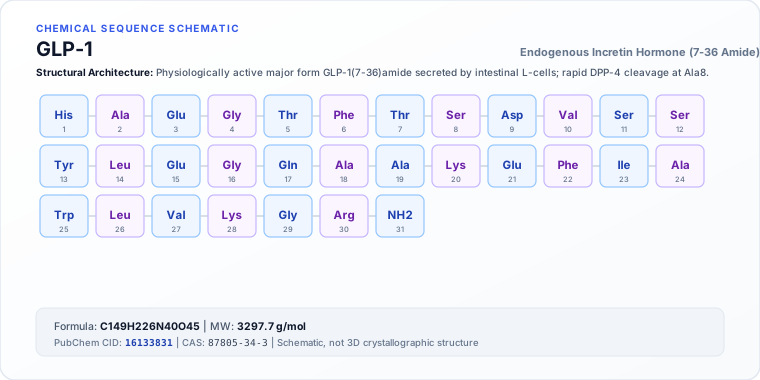
- Sequence (one-letter)
- HAEGTFTSDVSSYLEGQAAKEFIAWLVKGR-NH2
- Molecular formula
- C149H226N40O45
- Molecular weight
- 3297.7 g/mol
- CAS Number
- 107444-51-9
- UNII Code
- 0JS9125PIZ
- PubChem CID
- 16133831
Identifiers are for GLP-1(7-36) amide, the main active circulating form.
Identifiers checked against PubChem and FDA's Global Substance Registration System on 13 October 2026. FDA substance record ↗ · PubChem record ↗ See all names and codes in the peptide name index.
Clinical Trials & Human Cohorts
Human research can examine tolerability, symptoms or patient outcomes. The design and comparator determine what each result can establish.
Normalization of Fasting Hyperglycaemia by Exogenous Glucagon-Like Peptide 1 (7-36 Amide) in Type 2 Diabetic Patients [1]
What was reported
Intravenous GLP-1 raised insulin and C-peptide, lowered glucagon and brought plasma glucose to normal fasting concentrations within 4 hours, which did not occur with placebo; insulin returned toward basal once glucose normalized.
What limits the conclusion
Single acute infusion in the fasting state; long-term glycemic control was not assessed.
Effect of 6-week course of glucagon-like peptide 1 on glycaemic control, insulin sensitivity, and beta-cell function in type 2 diabetes: a parallel-group study [2]
What was reported
With continuous subcutaneous GLP-1, HbA1c fell by 1.3%, fasting plasma glucose by 4.3 mmol/L and body weight by 1.9 kg; insulin sensitivity and beta-cell function improved.
What limits the conclusion
Small 6-week pilot with alternate rather than random assignment and continuous pump infusion; the authors call for longer-term study.
How the compound may work
Mechanisms describe how GLP-1 may affect biological processes. Laboratory findings and patient outcomes answer different questions.
Glucose-Lowering Incretin Actions
GLP-1 stimulates insulin and suppresses glucagon secretion, inhibits gastric emptying, and reduces appetite and food intake. [3]
Rapid Dipeptidyl Peptidase-4 (DPP-4) Inactivation
GLP-1 is extremely rapidly metabolized and inactivated by DPP-4, even before the hormone leaves the gut, which led to degradation-resistant agonists and DPP-4 inhibitors. [5]
Areas Being Studied
These research topics reflect active areas of scientific exploration, distinct from unverified commercial marketing claims.
Incretin Physiology & Glucose Homeostasis
GLP-1 stimulates insulin secretion and inhibits glucagon secretion, limiting postprandial glucose excursions, and acts as part of the ileal brake. [5]
Satiety & Body Weight
GLP-1 promotes satiety, and sustained GLP-1 receptor activation is associated with weight loss. [4]
Compare the study designs.
| Study | Design / sample | Outcome type | Key limitation |
|---|---|---|---|
| Landmark Nauck Infusion · 1993 [1] | Placebo-controlled intravenous infusion study n = 10 |
Clinical endpoint evaluation | Single acute infusion in the fasting state; long-term glycemic control was not assessed. |
| Subcutaneous Continuous Infusion · 2002 [2] | Parallel-group pilot study (alternate assignment to GLP-1 or saline) n = 20 |
Clinical endpoint evaluation | Small 6-week pilot with alternate rather than random assignment and continuous pump infusion; the authors call for longer-term study. |
Regulatory Status & Clinical Safety
Regulatory Classification
Endogenous biological molecule. Synthetic analogues are FDA-approved; native peptide is used in clinical research.
Safety Realities & Impurities
Safety depends on the molecule, formulation, route and evidence. A laboratory purity measurement alone cannot establish safety for human use.
Clinical Trials Registry Records
Official registry records from ClinicalTrials.gov. Study registration does not imply government endorsement or guaranteed efficacy.
WADA & Anti-Doping Regulations
WADA Anti-Doping Status
GLP-1 is not prohibited under current World Anti-Doping Agency (WADA) regulations. However, athletes must ensure unregulated preparations or unverified vendor products do not violate Section S0 (Non-approved substances). Last verified: October 2026.
Research Timeline
-
1993
Nauck Landmark
Nauck et al. report normalization of fasting glucose in poorly controlled type 2 diabetes with GLP-1 infusion. [1]
-
2002
Six-Week Infusion Pilot
Continuous subcutaneous GLP-1 for 6 weeks lowers HbA1c and body weight. [2]
-
2005
First Analogue
FDA approves Byetta (exenatide), the first GLP-1 receptor agonist medicine. [6]
What Researchers Still Don't Know
Long-term safety profiles
Multi-year observational data in broader heterogeneous cohorts remains uncharacterized.
Optimal dose-response thresholds
Comparative trials optimizing minimal effective exposure versus adverse event rates.
Formulation bioavailability
Differences between oral, subcutaneous, and modified peptide delivery vehicles.
References
Primary sources verified against PubMed / NLM and regulatory databases.
- Landmark Physiological RCT
- Clinical Infusion Study
- Physiology Review
- Physiology Review
-
Physiology Review
The physiology of glucagon-like peptide 1 ↗ (external website)
-
Regulatory
Drugs@FDA: Byetta (Exenatide) NDA 021773 ↗ (external website)