
1. What the blood–brain barrier is
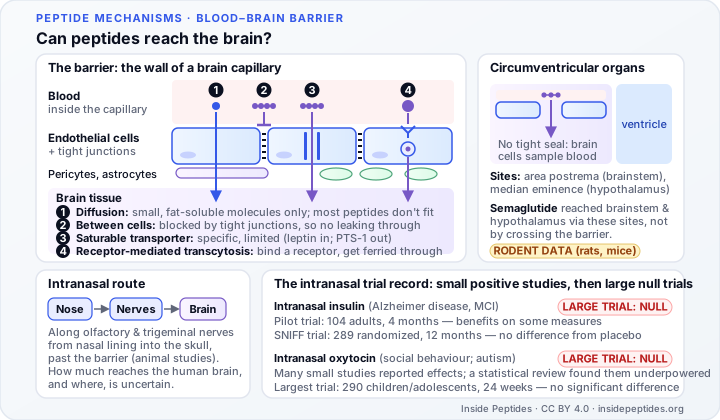
The brain is supplied by a dense network of tiny blood vessels, but its tissue is shielded from much of what circulates in the blood. The blood–brain barrier is formed mainly by the endothelial cells that line brain capillaries. Unlike capillaries in most of the body, these cells are sealed together by tight junctions, protein seals that close the gaps between neighbouring cells, so substances cannot simply leak through [1]. Supporting cells called pericytes and astrocytes help maintain these properties.
To enter the brain, a molecule therefore has to pass through the endothelial cells rather than between them. The barrier also carries pumps that push some substances back into the blood. A separate barrier, the blood–cerebrospinal fluid barrier at the choroid plexus, controls exchange between blood and the fluid that bathes the brain [1]. Measuring a substance in cerebrospinal fluid is not the same as showing it reached brain tissue.
2. Why most peptides cross poorly
A molecule can pass through the barrier cells unaided by dissolving in their fatty membranes. Pardridge, a leading researcher on the barrier, estimates that this kind of free diffusion generally requires a molecular weight under about 400 daltons and the ability to form fewer than eight hydrogen bonds (weak chemical attractions to water). Most small-molecule drugs lack these properties, and large-molecule drugs lack them entirely [1].
Peptides are a poor fit. Even short ones are usually larger than this, and their backbone and many of their amino acids form hydrogen bonds and carry electrical charges. They are also broken down by enzymes in the blood and at the barrier itself, so the amount available to cross may be small to begin with (see peptide degradation).
This is not an absolute rule. Banks, reviewing decades of work begun by the endocrinologist Abba Kastin, describes animal studies in which some small peptides entered the brain by diffusion through the barrier cells, with uptake tracking their fat-solubility [2].
3. The routes peptides can use
Because the brain needs signals from the body, the barrier has dedicated transport systems. Peptides that cross in meaningful amounts usually use one of them [1] [2]:
- Saturable peptide transport systems. Kastin and Banks described a series of peptide transport systems at the barrier. The first, peptide transport system-1, actually moves small peptides out of the brain into the blood. Others carry peptides inward; in the mid-1990s, Kastin's laboratory showed that leptin, a hormone made by fat tissue, enters the brain by its own transporter [2]. "Saturable" means the transporter has limited capacity: raising blood levels beyond a point does not push more across.
- Receptor-mediated transcytosis. Some large molecules bind a receptor on the barrier cells, such as the receptors for transferrin or insulin, and are ferried through the cell. Drug developers attach medicines to antibodies against these receptors, an approach sometimes called a "molecular Trojan horse", to carry them into the brain [1].
- Carrier-mediated transport. Nutrient carriers, for example for glucose and amino acids, can be exploited by small drugs built to resemble their natural cargo [1].
These routes are specific. A transporter that carries one peptide does not carry unrelated peptides, so evidence that one peptide crosses says nothing about another.
4. Circumventricular organs: how GLP-1 drugs reach the brain
A few small brain areas, known as circumventricular organs, sit next to the fluid-filled ventricles and have leaky capillaries without the usual tight seal. They include the area postrema in the brainstem, which helps detect toxins and trigger nausea, and the median eminence at the base of the hypothalamus. They let the brain sample hormones in the blood directly.
GLP-1 receptor agonists such as semaglutide are large, albumin-bound peptides, yet they reduce appetite through the brain. Rodent studies help explain how. In a study by Novo Nordisk scientists and collaborators, labelled semaglutide given to rats and mice reached the brainstem, septal nucleus and hypothalamus, but did not cross the blood–brain barrier; it accessed the brain through the circumventricular organs and a few select sites next to the ventricles. It switched on activity in brain areas it touched directly and in connected areas it did not reach, including a region involved in ending meals [3].
These are animal findings, and the exact sites in people are harder to study. The broader point is well supported: a peptide can have strong effects on the brain without crossing the barrier in any quantity.
5. The intranasal route: what trials have shown
The nose offers a possible shortcut. Nerves for smell and facial sensation (the olfactory and trigeminal nerves) run from the nasal lining into the skull, and animal studies suggest that some substances sprayed into the nose can travel along or beside these nerves into the brain, bypassing the barrier [4]. How much reaches the brain in people, and where, remains uncertain.
Intranasal insulin. Insulin affects brain processes relevant to Alzheimer disease. A pilot randomized trial in 104 adults with mild cognitive impairment or Alzheimer disease, lasting four months, reported benefits on some memory and function measures [5]. The larger SNIFF trial (Study of Nasal Insulin to Fight Forgetfulness) randomized 289 participants for 12 months. After problems with the first delivery device, the main analysis covered 240 participants and found no difference from placebo on the primary cognitive outcome, or on other clinical or cerebrospinal fluid outcomes [6].
Intranasal oxytocin. Many small studies reported that a nasal dose of oxytocin changed trust, social perception or other behaviour. A statistical review concluded that these studies were generally underpowered and that there was a high probability that most published findings did not represent true effects [7]. Neuroendocrinologists Leng and Ludwig noted that very little intranasal oxytocin appears to reach cerebrospinal fluid, while blood levels rise well above normal, so effects elsewhere in the body cannot be ruled out [8]. In the largest trial in autism, 290 children and adolescents were randomized to oxytocin or placebo for 24 weeks; there was no significant difference in social or cognitive measures [9].
Neither result means intranasal delivery can never work. They show that a plausible route plus encouraging small studies did not translate into proven benefit when tested rigorously.
6. Semax, Selank and "nootropic" peptide claims
Semax and Selank are synthetic peptides developed in Russia; the Semax studies below used nasal administration. Both are on the Russian state register of medicines but are not approved by FDA or the European Medicines Agency. Inside Peptides rates their evidence as early human.
- Semax. A Russian study followed 110 patients after ischaemic stroke, comparing subgroups who did and did not receive Semax; the abstract does not describe randomization or a placebo. It reported higher blood levels of BDNF (brain-derived neurotrophic factor, a protein that supports nerve cells) and better functional recovery in those given Semax [10]. A brain-imaging study in 24 healthy volunteers reported changes in resting brain network activity minutes after intranasal Semax compared with placebo [11]. Neither shows improved thinking in healthy people.
- Selank. A study of 62 patients with generalized anxiety disorder or neurasthenia compared Selank with medazepam, a benzodiazepine, and reported similar reductions in anxiety; it had no placebo group [12].
Most of this research comes from a small number of groups, often including the peptides' developers, and has not been independently replicated in large, placebo-controlled trials. Other peptides marketed for cognition have even less human evidence: dihexa, for example, has been studied only in animals and cells.
"Nootropic peptide" claims typically combine three separate steps: the peptide reaches the brain, it acts on a relevant target, and that action improves thinking in people. Each step needs its own evidence. For most of these peptides, the first step has not been measured directly in humans, and the last has not been shown in rigorous trials. Intranasal insulin and oxytocin had stronger early evidence and still did not confirm benefit in large trials, so claims that these peptides enhance cognition run well ahead of the data.
Core Scientific Definitions
Precise biomedical definitions for terms used throughout this guide.
- Blood–brain barrier (BBB)
- The barrier formed by the cells lining the brain's capillaries, joined by tight junctions, that controls which substances pass from the blood into brain tissue.
- Receptor-mediated transcytosis
- A process in which a molecule binds a receptor on one side of a barrier cell, is carried through the cell inside a small membrane bubble, and is released on the other side.
- Circumventricular organs
- Small brain regions next to the fluid-filled ventricles, such as the area postrema and median eminence, where capillaries are leaky so that brain cells can sample substances in the blood.
- Intranasal delivery
- Giving a substance as a nasal spray or drops, with the aim that some of it travels from the nasal lining to the brain along nerve pathways, bypassing the blood–brain barrier.
Peer-Reviewed References & Primary Sources
This educational guide is built strictly upon peer-reviewed literature, official regulatory guidance, and authoritative biochemical repositories.
-
Semaglutide lowers body weight in rodents via distributed neural pathways JCI Insight · 2020
-
Intranasal delivery of biologics to the central nervous system Adv Drug Deliv Rev · 2012
-
Intranasal insulin therapy for Alzheimer disease and amnestic mild cognitive impairment: a pilot clinical trial Arch Neurol · 2012
-
Safety, Efficacy, and Feasibility of Intranasal Insulin for the Treatment of Mild Cognitive Impairment and Alzheimer Disease Dementia: A Randomized Clinical Trial JAMA Neurol · 2020
-
Statistical and Methodological Considerations for the Interpretation of Intranasal Oxytocin Studies Biol Psychiatry · 2016
-
Intranasal Oxytocin in Children and Adolescents with Autism Spectrum Disorder N Engl J Med · 2021
-
The efficacy of semax in the tretament of patients at different stages of ischemic stroke Zh Nevrol Psikhiatr Im S S Korsakova · 2018
-
Efficacy and possible mechanisms of action of a new peptide anxiolytic selank in the therapy of generalized anxiety disorders and neurasthenia Zh Nevrol Psikhiatr Im S S Korsakova · 2008
Educational Disclaimer: This guide is produced strictly for biomedical educational purposes and does not constitute medical advice, diagnosis, or treatment recommendations. Experimental peptides discussed herein may lack regulatory authorization for human clinical use. Consult a licensed medical practitioner before considering any therapeutic intervention.