
Peptide Biology Beginner

How Long Do Peptides Stay in Your System?

How long peptides last in the body depends on half-life, not the word “peptide”. Native GLP-1, octreotide, tirzepatide and semaglutide compared, plus drug testing.

10 min read Updated 17 sources InsidePeptides Editorial Team

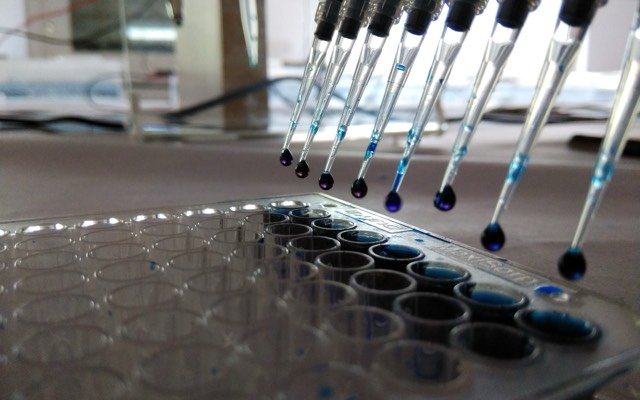
A multichannel pipette releasing drops of blue liquid into the wells of a clear plate
Photo: ACHUTH P JAYARAJ, CC BY 4.0, via Wikimedia Commons.

Plain-English Summary

There is no single answer to how long peptides stay in the body, because each peptide is cleared at its own rate. The body's own GLP-1 is broken down within minutes, the medicine octreotide lasts hours, and engineered medicines such as tirzepatide and semaglutide have half-lives of several days to about a week, so they stay in the blood for weeks after the last injection. Three different questions are often mixed up: how quickly the molecule is cleared (half-life), how long its effects last, and how long a laboratory could still detect it. Effects can outlast the molecule, and they can also fade long before the body has fully adjusted. Standard workplace drug tests do not look for peptides, but anti-doping laboratories use specialised methods that are designed to find them.

Key Takeaways

  • How long a peptide stays in the body depends on the specific molecule; the word “peptide” on its own says nothing about it.
  • Half-life, duration of effect and detection window are three different things and are often confused.
  • The body's own GLP-1 is inactivated within minutes, while the semaglutide label states a half-life of about one week and says the drug stays in circulation for about five to seven weeks after the last dose.
  • As a rule of thumb, a drug is largely cleared after about five half-lives, which is why a long-acting peptide lingers for weeks.
  • Effects can outlast the molecule, and the body's response to stopping, such as weight regain after GLP-1 medicines, plays out over months.
  • Standard U.S. workplace drug tests screen for drugs such as cannabis, cocaine, opioids and amphetamines, not peptides; anti-doping laboratories use mass spectrometry methods that are designed to detect prohibited peptides.
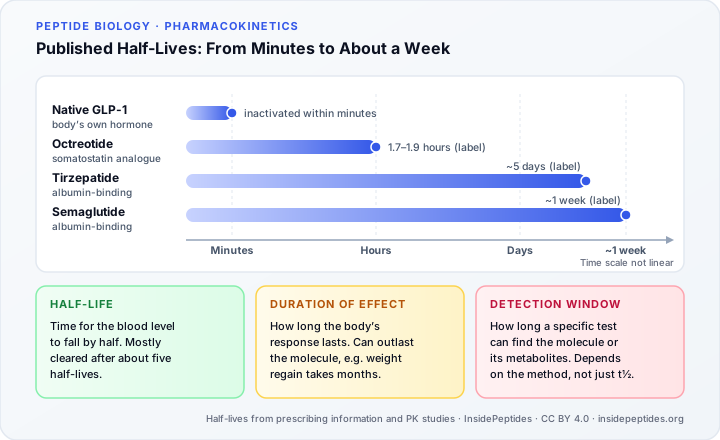
Diagram: published half-lives of four peptides on a time scale running from minutes to weeks. Native GLP-1 is inactivated within minutes; octreotide has a half-life of under two hours; tirzepatide about five days; semaglutide about one week. A lower panel separates three ideas: half-life, how fast the level in blood halves; duration of effect, how long the body's response lasts; and detection window, how long a laboratory method could still find the molecule or its breakdown products.
Peptide half-lives span minutes to about a week, depending on how the molecule is built. Half-life, duration of effect and detection window are separate questions. Half-lives from the cited labels and studies. Diagram by InsidePeptides, CC BY 4.0: free to reuse with a credit and link. Download SVG

The short answer: it depends on the peptide

There is no single answer to how long peptides stay in your system. Each peptide is cleared at its own rate, and published half-lives range from a few minutes for natural hormones to about a week for engineered medicines. A peptide is simply a short chain of amino acids (see What Are Peptides?), and the body has many enzymes designed to break such chains down. Natural peptide hormones are built to act briefly and then disappear, which is how the body keeps tight control over signals such as appetite and blood sugar.

Medicines change that. Drug developers alter a peptide's structure so that it resists enzymes, avoids rapid filtering by the kidneys, or binds to proteins in the blood. The result can be a molecule that lasts more than a thousand times longer than the hormone it imitates. That is why “peptides” as a group cannot have one duration: the body's own GLP-1 and the GLP-1 medicine semaglutide act on the same receptor but stay in the blood for very different lengths of time.

For any approved peptide medicine, the most reliable figures are in the prescribing information (the label), which reports the half-life measured in clinical studies. For peptides sold online without approval, there is usually no human data at all on how long they last. This guide explains the concepts and gives published examples. It gives no doses or instructions and is not medical advice; questions about a specific medicine belong with the prescriber or pharmacist.

Half-life, duration of effect and detection window

People asking “how long do peptides stay in your system?” are usually asking one of three separate questions. Keeping them apart avoids most of the confusion.

  • Half-life is how long it takes for the amount of drug in the blood to fall by half. It is a property of the molecule in a typical person, measured in pharmacokinetic studies and reported on the label. After one half-life, half remains; after two, a quarter; after about five, only a few per cent. That is why the time for a drug to be largely gone is roughly five times its half-life, not equal to it. The underlying chemistry is explained in Peptide Half-Life.
  • Duration of effect is how long the body's response lasts. A drug can keep working after most of it has left the blood, or it can stop working while some is still present, depending on how it acts on its receptor and what happens downstream.
  • Detection window is how long a specific laboratory test could still find the substance or its breakdown products. It depends on how sensitive the method is, whether it looks in blood or urine, and whether it targets the original molecule or a metabolite. A more sensitive test has a longer window for the same drug.

These three can differ widely for the same peptide. Octreotide, a medicine that copies the hormone somatostatin, illustrates the point: its label reports a plasma half-life of under two hours, yet states that its duration of action extends up to about half a day, depending on the type of tumour being treated [7]. Half-life tells you about the molecule; it does not, on its own, tell you about the effect or about any test.

Published half-lives: from minutes to a week

The examples below come from drug labels and pharmacokinetic studies. They show how design, not the label “peptide”, determines how long a molecule lasts.

Native GLP-1: minutes

GLP-1 is a gut hormone released after eating. In the bloodstream, an enzyme called dipeptidyl peptidase-4 (DPP-4) quickly cuts two amino acids from its front end, which inactivates it [17]. In a study in healthy volunteers and people with type 2 diabetes, GLP-1 given by injection under the skin or into a vein was rapidly degraded; most of what circulated was already the inactive fragment [1]. A major review of GLP-1 physiology describes the hormone as “extremely rapidly” inactivated, much of it even before it has left the gut, so the intact hormone lasts only minutes [2]. Kidney filtering removes what is left; the routes of breakdown are covered in Peptide Metabolism and Peptide Degradation.

Octreotide: hours

Natural somatostatin lasts only a few minutes in the blood. Octreotide is a shorter, ring-shaped version designed to resist enzymes. Its U.S. label reports an elimination half-life of 1.7 to 1.9 hours, compared with 1 to 3 minutes for the natural hormone [7], consistent with an earlier pharmacokinetic review that described a plasma half-life of about 100 minutes [8]. Long-acting versions exist that release octreotide slowly from an injected depot, which shows that the formulation, not just the molecule, can set how long a medicine lasts (see Peptide Drug Delivery and Octreotide vs Lanreotide).

Tirzepatide: about five days

Tirzepatide activates both the GIP and GLP-1 receptors. It carries a fatty side chain that binds albumin, which its developers designed to extend its half-life [6]. The current Zepbound label gives an elimination half-life of approximately five to six days in people with overweight or obesity [5].

Semaglutide: about one week

Semaglutide was engineered from GLP-1 with three key changes: a substitution that blocks DPP-4, and a spacer and fatty acid that bind tightly to albumin [3]. The Wegovy label states that it is more than 99% bound to albumin, has an elimination half-life of approximately one week, and “will be present in the circulation for about 5 to 7 weeks after the last” dose [4]. The same label advises stopping the medicine at least two months before a planned pregnancy “because of the long half-life of semaglutide” [4].

Put together, the four examples span from minutes to about a week, a difference of several thousandfold, even though three of them act on closely related hormone systems. Half-life also varies between people: the octreotide label notes that it can be longer in older people and in severe kidney or liver disease [7].

Why the effect can outlast the molecule

A peptide works by binding to a receptor on a cell and switching on a signal (see How Peptides Work and Peptide Signaling). That signal can set off a chain of further events: other hormones are released or suppressed, genes are switched on or off, and tissues gradually change. Those downstream changes follow their own timetable, which is why the effect and the molecule do not disappear together.

  • Hormone changes take time to unwind. Octreotide suppresses the release of hormones such as growth hormone; its effect on those hormones lasts longer than its plasma half-life would suggest [7][8]. When a peptide pushes a hormone system in one direction, the body's own feedback loops then need time to readjust once it is gone.
  • Body changes persist after the drug clears. Weight lost on a GLP-1 medicine does not reappear the day the drug falls below an active level. Regain happens gradually over months, as appetite and energy balance return towards their previous state [9].
  • Long half-life smooths the curve. For a medicine that lasts about a week, levels rise and fall slowly, so effects such as reduced appetite also fade gradually rather than switching off.

The reverse can also happen. A drug can still be measurable in blood at a level too low to have any meaningful effect. So “still in your system” and “still working” are not the same statement. How long benefits and side effects last is measured in clinical trials, not inferred from half-life alone.

What happens when you stop taking peptides

What happens after stopping depends on the medicine and on why it was being used. The best human evidence comes from trials of approved GLP-1-based medicines that deliberately stopped treatment in some participants.

  • Semaglutide. In the STEP 1 trial extension, people who had lost weight on semaglutide stopped treatment and were followed for another year. They regained about two-thirds of the weight they had lost, and improvements in blood pressure, blood sugar and other cardiometabolic measures largely reverted towards where they started [9].
  • Tirzepatide. In SURMOUNT-4, participants who had lost weight on tirzepatide were randomly assigned either to continue or to switch to placebo. Those switched to placebo regained a substantial amount of weight, while those who continued maintained and extended their weight loss [10].

These findings reflect the effect, not the molecule: the drug itself is cleared within weeks, but the body's return to its previous state takes months. The evidence on stopping, slowing down and tapering is reviewed in more detail in Stopping Semaglutide or Tirzepatide: Weight Regain and What the Evidence Says About Tapering.

For medicines that treat a hormone-producing tumour or a hormone excess, such as octreotide, stopping generally means the underlying condition is no longer controlled. For unapproved peptides sold online, there are no controlled human studies of what happens on stopping, so claims about lasting benefits or “resetting” the body are not based on evidence (see Human vs Preclinical Research). Decisions about starting, continuing or stopping any medicine belong with a licensed clinician.

Do peptides show up on a drug test?

The answer depends on which test. Two very different kinds of drug testing exist, and they look for different things.

Standard workplace drug tests

Routine employment drug tests screen for a defined list of drugs. U.S. federal rules for Department of Transportation testing, for example, set cut-offs for cannabis metabolites, cocaine, opioids such as codeine, morphine, hydrocodone and oxycodone, phencyclidine, amphetamines and MDMA [11]. Peptides are not on that list, and standard panels are not designed to detect them. Employers can request extra tests, so a specific programme may differ, but peptide hormones are not part of the standard panels.

Anti-doping tests in sport

Sport is different. The World Anti-Doping Agency (WADA) Prohibited List bans many peptides at all times, including growth hormone secretagogues such as ipamorelin and GHRP-6, thymosin-β4 derivatives such as TB-500, and, under its non-approved substances class, BPC-157 [12]. The rules are explained in WADA Peptide Rules.

WADA-accredited laboratories use specialised methods, mainly liquid chromatography combined with mass spectrometry (LC-MS), which can identify a peptide by its exact mass and fragments rather than relying on an immunoassay [13]. Published examples include a urine method for BPC-157 that also targets a stable breakdown product [15], and a validated plasma method for the mitochondrial peptide MOTS-c [16]. Researchers including Mario Thevis and colleagues at the German Sport University Cologne publish an annual review of new detection approaches, which in its latest edition covers new drug candidates, metabolism studies and expanding testing options [14].

This guide deliberately does not give detection windows for prohibited substances. Methods are improving, laboratories study the breakdown products as well as the parent molecule, and an athlete is responsible for any prohibited substance found in their sample. The health and sporting risks are covered in Peptides and Athletes.

Frequently asked questions

How long do peptides stay in your system?

It depends entirely on the peptide. Natural hormones such as GLP-1 are inactivated within minutes [1], octreotide has a half-life of under two hours [7], and long-acting medicines such as tirzepatide and semaglutide have half-lives of about five days and about one week [5][4]. Most of a drug is gone after about five half-lives.

How long does it take for semaglutide to leave your system?

The Wegovy label states that semaglutide, with a half-life of about one week, will be present in the circulation for about five to seven weeks after the last dose [4]. Its effects on weight fade over a longer period [9].

How long are peptides detectable?

Detection depends on the testing method and sample as well as the peptide, so there is no general figure. Standard workplace drug tests do not look for peptides [11]. Anti-doping laboratories use mass spectrometry methods designed to find prohibited peptides and their metabolites, and these methods continue to improve [14].

Do peptides show up on a drug test?

Not on a standard workplace panel, which screens for drugs such as cannabis, cocaine, opioids and amphetamines [11]. In sport, many peptides are prohibited and WADA-accredited laboratories test for them [12][13].

What happens when you stop taking peptides?

For approved GLP-1-based medicines, trials show that much of the lost weight returns over the following year after stopping [9][10]. For unapproved peptides there are no controlled human data on stopping. Any change to a prescribed medicine should be discussed with the prescriber.

How long does BPC-157 stay in your system?

There are no published human pharmacokinetic studies of BPC-157, so how long it lasts in people is not known. It is prohibited in sport under WADA's non-approved substances class [12]. See the BPC-157 profile for the evidence that does exist.

Core Scientific Definitions

Precise biomedical definitions for terms used throughout this guide.

Half-life
The time it takes for the concentration of a drug in the blood to fall by half once absorption is complete. After about five half-lives, most of the drug has been cleared.
Duration of effect
How long a drug's effect on the body lasts. It can be longer or shorter than the time the molecule itself is present, because the body's response follows its own timetable.
Detection window
The period during which a particular laboratory method can still find a substance or its breakdown products in a sample. It depends on the method, the sample type and the substance, not only on half-life.
Albumin binding
Attachment of a drug to albumin, the most abundant protein in blood. Medicines such as semaglutide and tirzepatide carry a fatty side chain that binds albumin, which protects them from breakdown and from removal by the kidneys.
LC-MS (liquid chromatography–mass spectrometry)
A laboratory technique that separates the components of a sample and identifies them by their mass. Anti-doping laboratories use it to identify specific peptides and their metabolites.

Peer-Reviewed References & Primary Sources

This educational guide is built strictly upon peer-reviewed literature, official regulatory guidance, and authoritative biochemical repositories.

  1. Both subcutaneously and intravenously administered glucagon-like peptide I are rapidly degraded from the NH2-terminus in type II diabetic patients and in healthy subjects Deacon CF et al. Diabetes 1995;44:1126-31. PMID: 7657039. Diabetes · 1995
  2. The physiology of glucagon-like peptide 1 Holst JJ. Physiol Rev 2007;87:1409-39. PMID: 17928588. Physiol Rev · 2007
  3. Discovery of the Once-Weekly Glucagon-Like Peptide-1 (GLP-1) Analogue Semaglutide Lau J et al. J Med Chem 2015;58:7370-80. PMID: 26308095. J Med Chem · 2015
  4. WEGOVY (semaglutide) prescribing information Novo Nordisk. Wegovy (semaglutide) injection and tablets prescribing information, DailyMed, revised June 2026, accessed 17 October 2026. DailyMed, U.S. National Library of Medicine · 2026
  5. ZEPBOUND (tirzepatide) prescribing information Eli Lilly and Company. Zepbound (tirzepatide) injection prescribing information, DailyMed, revised August 2026, accessed 17 October 2026. DailyMed, U.S. National Library of Medicine · 2026
  6. LY3298176, a novel dual GIP and GLP-1 receptor agonist for the treatment of type 2 diabetes mellitus: From discovery to clinical proof of concept Coskun T et al. Mol Metab 2018;18:3-14. PMID: 30473097. Mol Metab · 2018
  7. SANDOSTATIN (octreotide acetate) injection prescribing information Novartis Pharmaceuticals. Sandostatin (octreotide acetate) injection prescribing information, DailyMed, accessed 17 October 2026. DailyMed, U.S. National Library of Medicine · 2026
  8. Clinical pharmacokinetics of octreotide. Therapeutic applications in patients with pituitary tumours Chanson P, Timsit J, Harris AG. Clin Pharmacokinet 1993;25:375-91. PMID: 8287633. Clin Pharmacokinet · 1993
  9. Weight regain and cardiometabolic effects after withdrawal of semaglutide: The STEP 1 trial extension Wilding JPH et al. Diabetes Obes Metab 2022;24:1553-64. PMID: 35441470. Diabetes Obes Metab · 2022
  10. Continued Treatment With Tirzepatide for Maintenance of Weight Reduction in Adults With Obesity: The SURMOUNT-4 Randomized Clinical Trial Aronne LJ et al. JAMA 2024;331:38-48. PMID: 38078870. JAMA · 2024
  11. 49 CFR 40.85: What are the cutoff concentrations for urine drug tests? U.S. Department of Transportation. 49 CFR § 40.85, What are the cutoff concentrations for urine drug tests? Electronic Code of Federal Regulations, accessed 17 October 2026. Electronic Code of Federal Regulations (eCFR) · 2026
  12. The Prohibited List World Anti-Doping Agency. The 2026 Prohibited List, accessed 17 October 2026. World Anti-Doping Agency · 2026
  13. Analytical challenges in the detection of peptide hormones for anti-doping purposes Barroso O, Handelsman DJ, Strasburger C, Thevis M. Bioanalysis 2012;4:1577-90. PMID: 22831474. Bioanalysis · 2012
  14. Annual Banned-Substance Review 18th Edition-Analytical Approaches in Human Sports Drug Testing 2024/2025 Thevis M, Kuuranne T, Geyer H. Drug Test Anal 2026;18:458-82. PMID: 41702393. Drug Test Anal · 2026
  15. Detection and in vitro metabolism of the confiscated peptides BPC 157 and MGF R23H Cox HD, Miller GD, Eichner D. Drug Test Anal 2017;9:1490-8. PMID: 28035768. Drug Test Anal · 2017
  16. Development of a mass spectrometry based detection method for the mitochondrion-derived peptide MOTS-c in plasma samples for doping control purposes Knoop A, Thomas A, Thevis M. Rapid Commun Mass Spectrom 2019;33:371-80. PMID: 30394592. Rapid Commun Mass Spectrom · 2019
  17. Dipeptidyl-peptidase IV (CD26)--role in the inactivation of regulatory peptides Mentlein R. Regul Pept 1999;85:9-24. PMID: 10588446. Regul Pept · 1999
Written By InsidePeptides Editorial Team
Review Status Scientific review pending
Last Updated
Last Evidence Review Pending verification

Educational Disclaimer: This guide is for education only and is not medical advice, diagnosis or treatment. Many peptides discussed here are not approved for human use. Talk to a licensed clinician before making any health decision.