
What a growth hormone secretagogue is
A growth hormone secretagogue is a substance that makes the pituitary gland release more of the body's own growth hormone, rather than supplying growth hormone directly. "Secretagogue" simply means something that causes secretion.
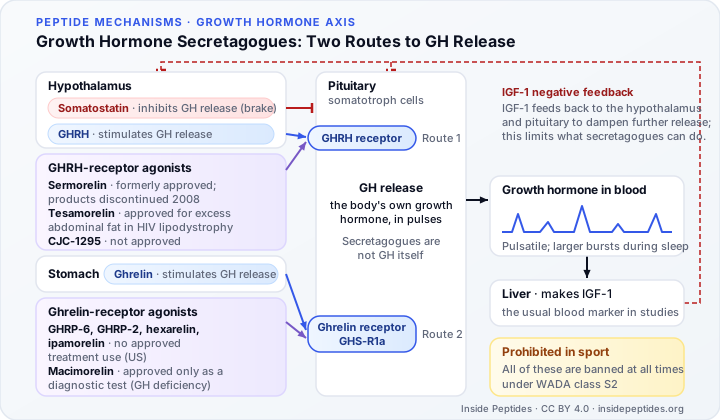
Growth hormone (GH) is made by somatotroph cells in the pituitary, a small gland at the base of the brain. Its release is controlled by signals from the hypothalamus and from the stomach. Secretagogues copy one of two of those signals. Because the body's own control systems remain partly in place, the hormone pattern produced by a secretagogue differs from that produced by injecting growth hormone. This feature is often cited in marketing, but it does not by itself show any health benefit.
The term covers a mixed group: peptide analogues of hypothalamic GHRH, synthetic growth hormone-releasing peptides (GHRPs), and small molecules that act on the ghrelin receptor. They differ in chemistry, in which receptor they use and, importantly, in the evidence behind them.
Two routes: the GHRH receptor and the ghrelin receptor
Route 1: the GHRH receptor. Growth hormone-releasing hormone (GHRH) is a hypothalamic peptide that acts on pituitary somatotrophs to stimulate the synthesis and pulsatile release of growth hormone [1]. Drugs on this route are modified versions of GHRH:
- Sermorelin, the first 29 amino acids of human GHRH.
- Tesamorelin, a stabilized GHRH analogue that binds human GHRH receptors with potency similar to the natural hormone in laboratory tests [1].
- CJC-1295, a GHRH analogue designed to last longer in the body. In healthy adults, its long-acting form raised GH and IGF-1 for days after a single injection, with an estimated half-life of 5.8 to 8.1 days [2].
Route 2: the ghrelin receptor. In the 1980s, chemists made small synthetic peptides, including GHRP-6, that released growth hormone through a receptor distinct from the GHRH receptor. That receptor, GHS-R1a, was cloned in 1996, and its natural activator was identified in 1999 as ghrelin, a 28-amino-acid peptide from the stomach that needs a fatty-acid side chain to work [3]. Drugs on this route include GHRP-6, GHRP-2 (pralmorelin), hexarelin and ipamorelin, plus orally active compounds such as macimorelin and anamorelin [4][5].
The two routes are complementary. In healthy young men, ghrelin and GHRH given together released more growth hormone than either alone, a synergistic effect [6]. Ghrelin-receptor agonists also act beyond growth hormone: ghrelin itself stimulates appetite, which is the basis for anamorelin's use in cancer-related weight loss [5].
Brakes and rhythm: somatostatin, IGF-1 and pulsatility
Growth hormone is not released at a steady rate. It comes in pulses, with larger bursts during sleep. This rhythm results from a push-pull between GHRH, which stimulates release, and somatostatin, a hypothalamic peptide that inhibits it.
Growth hormone acts partly by prompting the liver to make IGF-1 (insulin-like growth factor 1). IGF-1 carries many of growth hormone's effects on tissues and also feeds back to the hypothalamus and pituitary to dampen further release. This negative feedback is one reason secretagogue effects are limited by the body's own controls, and why IGF-1 is the usual blood marker in studies of these substances.
Secretagogues mostly amplify the existing pattern. In one small study, repeated hexarelin injections increased the size of growth hormone pulses but not how often they occurred; a later test injection produced a blunted response, consistent with some loss of responsiveness after repeated exposure [7]. Long-acting CJC-1295, by contrast, raised IGF-1 for well over a week after dosing [2], showing that pharmacology can change the rhythm in ways that differ from normal physiology.
Which ones are approved, and for what
| Substance | Receptor | Regulatory status |
|---|---|---|
| Tesamorelin | GHRH | FDA-approved (2010) to reduce excess abdominal fat in adults with HIV and lipodystrophy [1] |
| Sermorelin | GHRH | Formerly FDA-approved; products discontinued in 2008. No currently marketed approved U.S. product |
| CJC-1295 | GHRH | Not approved |
| Macimorelin | Ghrelin | FDA-approved (2017) as an oral test to diagnose adult growth hormone deficiency, not as a treatment [4] |
| Anamorelin | Ghrelin | Approved in Japan for cancer cachexia; not approved in the U.S. [5] |
| GHRP-2 (pralmorelin) | Ghrelin | Diagnostic agent in Japan; not FDA-approved |
| GHRP-6, hexarelin, ipamorelin | Ghrelin | Not approved |
Statuses match our individual profiles, which give regulatory sources for each compound. FDA has placed GHRP-2, GHRP-6 and ipamorelin in a category of bulk substances that may present significant safety risks when compounded, and has noted safety concerns for CJC-1295 [8]. For what an approval does and does not cover, see what FDA approval means.
What human studies show, and what they don't
Tesamorelin has the strongest treatment evidence. In a 26-week randomized trial in people with HIV and excess abdominal fat, visceral (deep belly) fat fell by 15.2% with tesamorelin and rose by 5.0% with placebo; IGF-1 rose by 81% [9]. The label notes that long-term cardiovascular safety has not been established and that it is not indicated for weight loss [1].
Macimorelin was approved on diagnostic accuracy, not on treatment benefit: a single oral dose is used to see whether the pituitary can release growth hormone [4].
Anamorelin illustrates the gap between a body-composition change and a functional benefit. In two phase 3 trials in 979 people with advanced lung cancer and cachexia, it increased lean body mass over 12 weeks but did not improve handgrip strength [10].
A similar pattern appeared with an oral ghrelin mimetic, ibutamoren (MK-677; not a peptide), in a two-year trial in 65 healthy older adults. It raised GH and IGF-1 into the young-adult range and increased fat-free mass, but did not change strength or function [11].
For CJC-1295, GHRP-6, GHRP-2, hexarelin and ipamorelin, human data consist mainly of short studies that measure hormone responses, diagnostic testing and small trials in specific illnesses [7][2]. Claims about muscle building, fat loss, recovery, sleep or slowing ageing in healthy people are not supported by controlled trials measuring those outcomes. See why animal studies don't always predict human results.
When reading a claim about any secretagogue, it helps to ask four questions. Was the study in people, and in which people: healthy volunteers, older adults, or patients with a specific disease? Was the outcome a hormone level, a body-composition scan, or something a person would notice, such as strength, function or quality of life? Was there a placebo group, and how long did the study last? And was the substance tested the same compound and formulation as the one being described? Results for one long-acting GHRH analogue, for example, cannot simply be transferred to a differently made product sold under a similar name.
Safety questions
- IGF-1 elevation. The tesamorelin label states that the effects of prolonged IGF-1 elevation are unknown and advises monitoring; among patients treated for 26 weeks, 47% had IGF-1 above 2 standard deviation scores [1]. Because IGF-1 promotes cell growth, the label also asks prescribers to consider cancer risk carefully.
- Blood sugar. Growth hormone opposes insulin. Tesamorelin can cause glucose intolerance, with elevated HbA1c in 5% of treated patients vs 1% on placebo at 26 weeks [1]. In the ibutamoren trial, fasting glucose rose and insulin sensitivity fell [11]. FDA notes blood-glucose increases among its concerns about GHRP-6 [8].
- Cortisol and prolactin. Ghrelin and hexarelin raised prolactin, ACTH and cortisol, as well as growth hormone, in healthy volunteers [6]. FDA lists possible effects on cortisol among its concerns about GHRP-6 [8].
- Fluid retention and heart rhythm. Fluid retention is listed for tesamorelin [1], and macimorelin's label warns that it can prolong the QT interval on an ECG [4].
- Unregulated products. For compounded or online versions, FDA cites risks of immune reactions and impurities. It also notes reports of serious adverse events, including death when ipamorelin was given intravenously in a study of gut motility [8].
Long-term safety, including cancer incidence, has not been studied for most of these compounds.
Rules in sport
The World Anti-Doping Agency (WADA) Prohibited List places growth hormone-releasing factors in class S2 (peptide hormones, growth factors and related substances), prohibited at all times. The class covers GHRH and its analogues, growth hormone secretagogues and their mimetics, and growth hormone-releasing peptides, and names compounds including CJC-1295, sermorelin, tesamorelin, ipamorelin, anamorelin, macimorelin, ibutamoren (MK-677), examorelin (hexarelin), GHRP-2 and GHRP-6 [12]. Athletes with a genuine medical need must follow the therapeutic use exemption process. See our guide to WADA peptide rules.
Core Scientific Definitions
Precise biomedical definitions for terms used throughout this guide.
- Growth hormone secretagogue
- A substance that stimulates the pituitary gland to release the body's own growth hormone, acting through either the GHRH receptor or the ghrelin receptor (GHS-R1a).
- GHRH (growth hormone-releasing hormone)
- A hypothalamic peptide hormone that acts on pituitary somatotroph cells to stimulate the synthesis and pulsatile release of growth hormone.
- Ghrelin receptor (GHS-R1a)
- The growth hormone secretagogue receptor type 1a, a G protein-coupled receptor in the pituitary and hypothalamus that responds to the stomach hormone ghrelin and to synthetic growth hormone-releasing peptides.
- IGF-1 (insulin-like growth factor 1)
- A hormone made mainly in the liver in response to growth hormone, which carries many of growth hormone's effects and feeds back to reduce further growth hormone release.
- Somatostatin
- A hypothalamic peptide that inhibits growth hormone release from the pituitary and, with GHRH, shapes growth hormone secretion into pulses.
Peer-Reviewed References & Primary Sources
This educational guide is built strictly upon peer-reviewed literature, official regulatory guidance, and authoritative biochemical repositories.
-
EGRIFTA WR (tesamorelin) for injection: prescribing information DailyMed, U.S. National Library of Medicine · Accessed 2026
-
Prolonged stimulation of growth hormone (GH) and insulin-like growth factor I secretion by CJC-1295, a long-acting analog of GH-releasing hormone, in healthy adults Journal of Clinical Endocrinology & Metabolism · 2006
-
Ghrelin is a growth-hormone-releasing acylated peptide from stomach Nature · 1999
-
MACRILEN (macimorelin acetate) for oral solution: prescribing information DailyMed, U.S. National Library of Medicine · Accessed 2026
-
[Pharmacological profile and clinical efficacy of anamorelin HCl (ADLUMIZ(®)Tablets), the first orally available drug for cancer cachexia with ghrelin-like action in Japan] Nihon Yakurigaku Zasshi (Folia Pharmacologica Japonica) · 2021
-
Endocrine activities of ghrelin, a natural growth hormone secretagogue (GHS), in humans: comparison and interactions with hexarelin, a nonnatural peptidyl GHS, and GH-releasing hormone Journal of Clinical Endocrinology & Metabolism · 2001
-
Impact of two or three daily subcutaneous injections of hexarelin, a synthetic growth hormone (GH) secretagogue, on 24-h GH, prolactin, adrenocorticotropin and cortisol secretion in humans European Journal of Endocrinology · 2002
-
Certain Bulk Drug Substances for Use in Compounding that May Present Significant Safety Risks U.S. Food and Drug Administration · Accessed 2026
-
Metabolic effects of a growth hormone-releasing factor in patients with HIV New England Journal of Medicine · 2007
-
Anamorelin in patients with non-small-cell lung cancer and cachexia (ROMANA 1 and ROMANA 2): results from two randomised, double-blind, phase 3 trials Lancet Oncology · 2016
-
Effects of an oral ghrelin mimetic on body composition and clinical outcomes in healthy older adults: a randomized trial Annals of Internal Medicine · 2008
-
World Anti-Doping Code International Standard: Prohibited List 2026 World Anti-Doping Agency · 2026
Educational Disclaimer: This guide is produced strictly for biomedical educational purposes and does not constitute medical advice, diagnosis, or treatment recommendations. Experimental peptides discussed herein may lack regulatory authorization for human clinical use. Consult a licensed medical practitioner before considering any therapeutic intervention.