

Therapeutic Peptides Beginner

Peptides for Anti-Aging and Longevity: What the Evidence Shows

Epitalon, MOTS-c, SS-31 (elamipretide), GHK-Cu and more: what human, animal and cell evidence shows about peptides for anti-ageing and longevity.

10 min read Updated 20 sources InsidePeptides Editorial Team

Overhead view of a hand with a dab of white cream on a pale yellow background
Photo: Moose Photos (https://www.pexels.com/@moose-photos-170195/), CC0, via Wikimedia Commons.

Plain-English Summary

No peptide has been shown in human trials to slow ageing or extend lifespan, and none is approved for that purpose. Epitalon and MOTS-c, the peptides most often promoted for longevity, rest mainly on cell and mouse studies, and most epitalon research comes from a single research group. Elamipretide (SS-31) is approved only for the rare disease Barth syndrome. Growth hormone approaches have shown small body changes with more side effects in older adults, and GLP-1 medicines reduce some specific diseases rather than ageing itself.

Key Takeaways

  • No peptide is approved to slow ageing or extend life, and no human trial has shown that any peptide does so (status 17 October 2026).
  • Lifespan trials in people would take decades, so studies rely on surrogate measures such as telomere length or epigenetic clocks, which have not been shown to predict longer healthy life.
  • Epitalon’s telomere and lifespan claims come mostly from cell and mouse studies by one Russian research group, with few independent replications.
  • MOTS-c improved metabolism and physical performance in mice; the first phase 2 human treatment trial is recruiting and tests insulin sensitivity, not ageing.
  • Elamipretide (SS-31) received FDA accelerated approval in September 2025 as Forzinity for Barth syndrome only; a phase 3 trial in mitochondrial myopathy was negative.
  • Growth hormone given to healthy older adults produced small body-composition changes and more side effects, and is not recommended for anti-ageing.
  • GLP-1 medicines have outcome trials for specific diseases, which is different from evidence that they slow ageing.
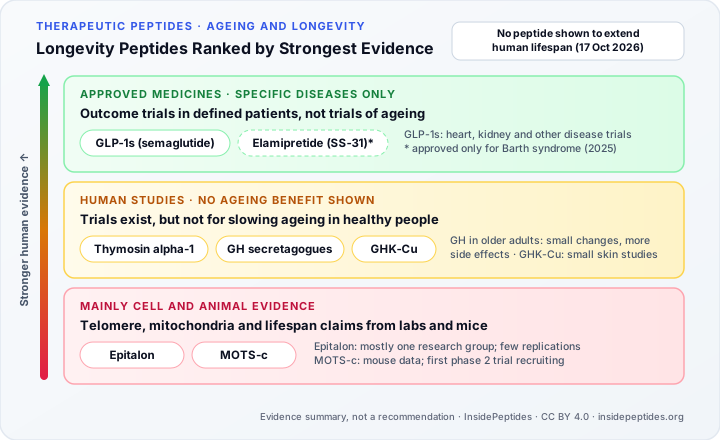
Diagram: an evidence ladder for peptides promoted for anti-ageing and longevity. Top rung, approved medicines with outcome trials for specific diseases but not for ageing: GLP-1 medicines such as semaglutide, and elamipretide (Forzinity) for Barth syndrome only. Middle rung, human trials but no ageing benefit shown: thymosin alpha-1, growth hormone and secretagogues, and GHK-Cu in small topical skin studies. Bottom rung, mainly cell and animal evidence: epitalon and MOTS-c. A side note says that no peptide has been shown to extend human lifespan.
Peptides promoted for longevity, sorted by the strongest evidence behind them. No peptide has been shown in human trials to slow ageing or extend lifespan (status 17 October 2026). Diagram by InsidePeptides, CC BY 4.0: free to reuse with a credit and link. Download SVG

What “anti-ageing peptides” actually means

No peptide has been shown in human trials to slow ageing or extend lifespan, and none is approved by the U.S. Food and Drug Administration (FDA) for that purpose as of 17 October 2026. The peptides marketed for “longevity” fall into three very different groups: compounds whose ageing claims rest mainly on cell and animal research, approved medicines whose approval covers a specific disease rather than ageing, and cosmetic ingredients aimed at the appearance of skin.

Ageing biology is usually described through a set of “hallmarks”, such as damage to DNA, shortening of telomeres (the protective ends of chromosomes), failing mitochondria (the energy-producing parts of cells), build-up of senescent (“zombie”) cells and long-running inflammation [1]. Most longevity peptides are promoted because they affect one of these hallmarks in a dish or in mice. That is a reasonable starting point for research, but it is not evidence that people who take the peptide live longer or stay healthier for longer (see Human vs Preclinical Research).

This guide sorts the peptides people search for most, epitalon, MOTS-c, elamipretide (SS-31), GHK-Cu, thymosin alpha-1 and growth hormone secretagogues, by the kind of evidence behind them. The wider research field is summarised on the Longevity Peptides research page. This guide describes research and regulatory status only. It gives no doses or instructions and is not medical advice.

Why longevity cannot yet be shown in human trials

The most direct test of an anti-ageing treatment would be a randomised trial showing that people who receive it live longer than people who receive a placebo. In humans, such a trial would need thousands of participants followed for decades. None has been done for any peptide, and none is likely soon.

Researchers therefore rely on surrogate endpoints: measurements that are easier and quicker to collect, such as telomere length, “epigenetic clock” scores, blood biomarkers, muscle strength or the activity of an enzyme. A surrogate is only useful if changing it reliably changes the outcome people care about, and for ageing that link has not been established for any of these measures. A peptide that lengthens telomeres in cultured cells, or lowers an epigenetic age score, has changed a number; it has not been shown to add healthy years.

Small human studies of “age reversal” show why caution is needed. In one widely reported study, a combination of growth hormone, DHEA and metformin was given to a small group of men to try to regenerate the thymus, and average epigenetic age scores fell over a year [2]. There was no randomised control group, several authors held commercial interests, and the study measured clocks and markers rather than illness or survival.

One proposed way forward is the TAME-style trial. The Targeting Aging with Metformin (TAME) concept, described in 2016, was to test whether a well-understood medicine delays a combination of age-related diseases, such as heart disease, cancer and dementia, plus death, rather than ageing itself, which regulators do not treat as a disease indication [3]. Even this design needs years and thousands of people. No peptide has been put through a trial of this kind. How trial design shapes what can be concluded is explained in How Clinical Trials Work and Understanding Evidence Levels.

Epitalon: one research group, few independent replications

What is epitalon? Epitalon (also spelled epithalon) is a synthetic peptide of four amino acids, Ala-Glu-Asp-Gly, designed on the basis of Epithalamin, an extract of cattle pineal gland [4]. Almost all of its research comes from the St Petersburg group led by Vladimir Khavinson and close collaborators.

  • Cell studies: a 2003 report from the group found that adding epitalon to cultured human fetal fibroblasts switched on telomerase, the enzyme that rebuilds telomeres, and lengthened telomeres [5]. This is the source of most “telomere” claims online.
  • Mouse studies: in a lifespan study in female mice, epitalon did not change average lifespan; it modestly increased the lifespan of the longest-lived animals and reduced leukaemia, while total tumour incidence was unchanged [6].
  • Human data: the most cited human report followed 266 older people over 6 to 8 years and described lower death rates with Epithalamin and a thymus extract [7]. It tested the extract rather than the synthetic peptide, was not a modern placebo-controlled trial, and has not been independently repeated.

A 2025 review from an independent group in Poland summarised 25 years of epitalon research and noted that its mechanisms remain uncertain and that basic chemical and structural studies are limited [4]. In the United States, epitalon is not an approved medicine. The FDA lists it among bulk substances that may present significant safety risks in compounding, citing possible immune reactions and impurities and a lack of safety information [8]. For the compound-level summary, see the epitalon profile and the comparisons Semax vs Epitalon and Selank vs Epitalon.

MOTS-c: mouse data and one recruiting human trial

MOTS-c is a short peptide encoded in mitochondrial DNA rather than in the cell nucleus. In the 2015 study that described it, giving MOTS-c to mice prevented diet-induced obesity and insulin resistance [9]. A 2021 study reported that MOTS-c improved physical performance in young, middle-aged and old mice, and that treatment started late in life improved physical capacity in old mice [10].

The human part of that 2021 paper was different: it measured the body’s own MOTS-c, which rose in muscle and blood after exercise. It did not give MOTS-c to people [10]. Two senior authors declared that they were consultants and shareholders of a company developing mitochondrial peptide drugs.

As of 17 October 2026, there are no published randomised trials of MOTS-c treatment in people. A phase 2 trial registered in 2026 is recruiting adults with prediabetes and overweight or obesity; its main outcome is insulin sensitivity, not ageing or lifespan, and no results are available [11]. MOTS-c is not an approved medicine, and it appears on the World Anti-Doping Agency prohibited list (see WADA peptide rules). More detail is on the MOTS-c profile and in MOTS-c vs BPC-157.

Elamipretide (SS-31): approved for one rare disease, not for ageing

Elamipretide, long known in research as SS-31, is a four-amino-acid peptide that binds cardiolipin, a fat found in the inner membrane of mitochondria. On 19 September 2025 the FDA granted accelerated approval to Forzinity (elamipretide) as the first treatment for Barth syndrome, a rare inherited mitochondrial disease [12].

The basis for that approval was narrow. Accelerated approval relies on a measure judged “reasonably likely” to predict benefit; here it was improved strength of the knee-extending muscle, and the FDA requires a randomised, placebo-controlled confirmatory trial [12]. The supporting Barth syndrome trial, TAZPOWER, was very small: 10 patients entered its open-label extension and 8 reached the final visit; walking distance and other measures improved over time, without a placebo comparison in that phase [13].

Elsewhere, results have been disappointing. In MMPOWER-3, a phase 3 randomised trial of 218 adults with primary mitochondrial myopathy, elamipretide did not improve walking distance or fatigue compared with placebo [14]. Animal studies of ageing tissues are the main source of anti-ageing claims; no trial has tested elamipretide as an anti-ageing treatment in healthy people. “SS-31” sold online is not the FDA-approved product. See the elamipretide profile and What FDA Approval Means.

GHK-Cu, thymosin alpha-1 and growth hormone secretagogues

GHK-Cu is a three-amino-acid peptide bound to copper that occurs naturally in the body. Laboratory and gene-expression studies suggest effects on tissue repair, and reviews of this work, largely from the scientist who first described the peptide, propose wider anti-ageing roles [15]. Human evidence is limited to small studies of topical skin and wound products. Applying a peptide to skin is very different from injecting it, and the FDA lists injectable GHK-Cu among compounding substances that may present significant safety risks [8]. Skin products are covered in Topical Peptides and the Skin Barrier; see also the GHK-Cu profile.

Thymosin alpha-1 is a peptide first found in the thymus, the immune organ that shrinks with age. A synthetic version (thymalfasin) is approved in some countries outside the United States, but no FDA-approved product contains it. Its largest and best-controlled trial, TESTS, randomised 1,106 adults with sepsis and found no difference in 28-day death rates compared with placebo [16]. That trial does not address ageing at all, and claims that it “rejuvenates” the immune system are not backed by trials in healthy older people. The FDA also lists it among compounding substances that may present significant safety risks [8]. See the thymosin alpha-1 profile.

Growth hormone secretagogues, such as sermorelin, ipamorelin, CJC-1295 and tesamorelin, raise the body’s own growth hormone (see Growth Hormone Secretagogues). The anti-ageing idea is that restoring youthful growth hormone levels will restore youthful bodies. A systematic review of randomised trials of growth hormone itself in healthy older people found small changes in body composition, no change in weight or bone density, and more side effects, including swelling, joint pain, carpal tunnel syndrome and a tendency towards diabetes; the authors concluded that it could not be recommended as an anti-ageing therapy [17]. A two-year trial of MK-677 (ibutamoren), an oral non-peptide ghrelin mimetic, raised growth hormone and lean mass in healthy older adults, but strength and function did not improve and blood glucose rose [18]. The FDA cites a heart-failure safety signal for ibutamoren and identifies safety concerns for several peptide secretagogues in compounding [8]. Tesamorelin is approved, but only to reduce excess abdominal fat in people with HIV-associated lipodystrophy.

Where GLP-1 medicines fit

GLP-1 medicines such as semaglutide and tirzepatide are peptides, and they are often discussed in longevity circles. They are the clearest example of how age-related disease, rather than ageing, gets tested. In the SELECT trial, 17,604 adults with cardiovascular disease and overweight or obesity were randomised; semaglutide reduced the combined rate of cardiovascular death, heart attack or stroke compared with placebo [19]. That is a hard outcome in a defined group of patients, not proof of slower ageing in healthy people.

The limits are just as instructive. In the evoke and evoke+ phase 3 trials, oral semaglutide did not slow progression of early Alzheimer’s disease compared with placebo [20]. A medicine can reduce some age-related diseases without affecting others. The full scorecard is in GLP-1 Drugs Beyond Weight Loss, and the drug class is explained in How GLP-1 Drugs Work.

Side by side: strongest evidence for each peptide

The table gives each compound’s U.S. status on 17 October 2026 and the strongest evidence found for an ageing-related claim. It summarises evidence; it is not a recommendation.

CompoundU.S. statusStrongest evidence for ageing claims
EpitalonNot approved; on FDA compounding safety-risk list [8]Cell and mouse studies, mostly from one group; an older uncontrolled human study used the parent extract [5][6][7]
MOTS-cNot approvedMouse studies; first phase 2 trial recruiting, testing insulin sensitivity [10][11]
Elamipretide (SS-31)Accelerated approval for Barth syndrome only (2025) [12]No ageing trials; phase 3 trial in mitochondrial myopathy negative [14]
GHK-CuNot approved as a medicine; used in cosmeticsLaboratory studies and small topical human studies [15]
Thymosin alpha-1Not FDA-approved; approved in some other countriesNo ageing trials; large sepsis RCT found no survival benefit [16]
GH secretagoguesTesamorelin approved for HIV lipodystrophy only; others not approvedGrowth hormone RCTs in older adults: small body-composition changes, more side effects [17][18]
SemaglutideApproved for diabetes, weight management and cardiovascular risk reduction in specified adultsOutcome RCTs for specific diseases; no trial of ageing itself [19][20]

“RCT” means randomised controlled trial (see Randomized Controlled Trials).

Safety and what remains unknown

Long-term safety is the biggest gap. An anti-ageing treatment would, by definition, be taken by healthy people for many years, yet the unapproved peptides in this guide have little or no controlled human safety data. Some proposed mechanisms carry their own theoretical concerns; for example, switching on telomerase or raising growth hormone and IGF-1 are pathways also linked to cell growth, and whether that matters for cancer risk in people is unknown.

Product quality is a separate problem. Peptides sold as “research use only” are not made or tested to medicine standards, and their identity, purity and sterility can differ from the label (see what “research use only” means, peptide impurities and approved versus unapproved peptides). Combining several peptides adds further unknowns, as discussed in Peptide Stacks. Whether any treatment is appropriate for a particular person is a decision for a licensed clinician.

Frequently asked questions

Which peptides are best for anti-ageing?

Judged by evidence, none has been shown to slow ageing or extend life in people. Epitalon and MOTS-c rest mainly on cell and animal studies [6][10]. Elamipretide is approved only for Barth syndrome [12]. GLP-1 medicines have outcome trials for specific diseases, not for ageing itself [19].

Are peptides good for anti-ageing?

Some peptides act on processes linked to ageing in laboratory studies, and some approved peptide medicines reduce specific age-related diseases. That is different from showing that a peptide slows ageing in healthy people, which no trial has done.

What is epitalon peptide?

Epitalon is a synthetic four-amino-acid peptide based on a cattle pineal extract. Its telomere and lifespan claims come mostly from cell and mouse studies by one Russian research group, with few independent replications [5][4]. It is not an approved medicine.

What does MOTS-c do?

In mice, MOTS-c improved insulin sensitivity and physical performance [9][10]. In people, studies have only measured the body’s own MOTS-c, which rises with exercise. A first phase 2 treatment trial is recruiting [11].

Is SS-31 the same as elamipretide, and is it approved?

SS-31 is the research name for elamipretide. The FDA-approved product, Forzinity, has accelerated approval only for Barth syndrome, pending a confirmatory trial [12]. Products sold online as “SS-31” are not that product, and the approval says nothing about ageing.

What dose of anti-ageing peptides is used?

There is no established human dose for any peptide as an anti-ageing treatment, because no trial has shown that one works or is safe for that purpose. Questions about approved medicines belong with the prescriber and the product label.

Core Scientific Definitions

Precise biomedical definitions for terms used throughout this guide.

Surrogate endpoint
A measurement, such as a blood marker or telomere length, used in place of an outcome that matters directly to people, such as illness or survival. It is only meaningful if changing it reliably changes that outcome.
Telomere
A protective cap of repeated DNA at the end of each chromosome that tends to shorten as cells divide; telomerase is the enzyme that can rebuild it.
Epigenetic clock
A score that estimates biological age from chemical tags on DNA. It is a research tool, and a lower score has not been shown to mean a longer or healthier life.
Mitochondria
The structures inside cells that produce most of their energy; declining mitochondrial function is one of the recognised hallmarks of ageing.
Accelerated approval
An FDA pathway that allows earlier approval for serious conditions based on a measure considered reasonably likely to predict benefit, on condition that further trials confirm the benefit.

Peer-Reviewed References & Primary Sources

This educational guide is built strictly upon peer-reviewed literature, official regulatory guidance, and authoritative biochemical repositories.

  1. Hallmarks of aging: An expanding universe López-Otín C et al. Cell 2023;186:243-78. Cell · 2023
  2. Reversal of epigenetic aging and immunosenescent trends in humans Fahy GM et al. Aging Cell 2019;18:e13028. Aging Cell · 2019
  3. Metformin as a Tool to Target Aging Barzilai N et al. Cell Metab 2016;23:1060-5. Cell Metab · 2016
  4. Overview of Epitalon-Highly Bioactive Pineal Tetrapeptide with Promising Properties Araj SK et al. Int J Mol Sci 2025;26:2691. Int J Mol Sci · 2025
  5. Epithalon peptide induces telomerase activity and telomere elongation in human somatic cells Khavinson VKh et al. Bull Exp Biol Med 2003;135:590-2. Bull Exp Biol Med · 2003
  6. Effect of Epitalon on biomarkers of aging, life span and spontaneous tumor incidence in female Swiss-derived SHR mice Anisimov VN et al. Biogerontology 2003;4:193-202. Biogerontology · 2003
  7. Peptides of pineal gland and thymus prolong human life Khavinson VKh, Morozov VG. Neuro Endocrinol Lett 2003;24:233-40. PMID: 14523363. Neuro Endocrinol Lett · 2003
  8. Certain Bulk Drug Substances for Use in Compounding that May Present Significant Safety Risks U.S. Food and Drug Administration. Certain bulk drug substances for use in compounding that may present significant safety risks (content current as of 22 April 2026; accessed 17 October 2026). U.S. Food and Drug Administration · 2026
  9. The mitochondrial-derived peptide MOTS-c promotes metabolic homeostasis and reduces obesity and insulin resistance Lee C et al. Cell Metab 2015;21:443-54. Cell Metab · 2015
  10. MOTS-c is an exercise-induced mitochondrial-encoded regulator of age-dependent physical decline and muscle homeostasis Reynolds JC et al. Nat Commun 2021;12:470. Nat Commun · 2021
  11. MOTS-c for Improving Insulin Sensitivity in Adults With Prediabetes and Overweight/Obesity ClinicalTrials.gov NCT07505745 (MOTS-MET). Phase 2; recruiting; start 2 February 2026; accessed 17 October 2026. ClinicalTrials.gov · 2026
  12. FDA Grants Accelerated Approval to First Treatment for Barth Syndrome U.S. Food and Drug Administration. News release, 19 September 2025. U.S. Food and Drug Administration · 2025
  13. Long-term efficacy and safety of elamipretide in patients with Barth syndrome: 168-week open-label extension results of TAZPOWER Thompson WR et al. Genet Med 2024;26:101138. Genet Med · 2024
  14. Efficacy and Safety of Elamipretide in Individuals With Primary Mitochondrial Myopathy: The MMPOWER-3 Randomized Clinical Trial Karaa A et al. Neurology 2023;101:e238-52. Neurology · 2023
  15. Regenerative and Protective Actions of the GHK-Cu Peptide in the Light of the New Gene Data Pickart L, Margolina A. Int J Mol Sci 2018;19:1987. Int J Mol Sci · 2018
  16. The efficacy and safety of thymosin α1 for sepsis (TESTS): multicentre, double blinded, randomised, placebo controlled, phase 3 trial Wu J et al. BMJ 2025;388:e082583. BMJ · 2025
  17. Systematic review: the safety and efficacy of growth hormone in the healthy elderly Liu H et al. Ann Intern Med 2007;146:104-15. Ann Intern Med · 2007
  18. Effects of an oral ghrelin mimetic on body composition and clinical outcomes in healthy older adults: a randomized trial Nass R et al. Ann Intern Med 2008;149:601-11. Ann Intern Med · 2008
  19. Semaglutide and Cardiovascular Outcomes in Obesity without Diabetes Lincoff AM et al. N Engl J Med 2023;389:2221-32. N Engl J Med · 2023
  20. Efficacy and safety of oral semaglutide 14 mg (flexible dose) in early-stage symptomatic Alzheimer’s disease (evoke and evoke+): two phase 3, randomised, placebo-controlled trials Cummings JL et al. Lancet 2026;407:2167-79. Lancet · 2026
Written By InsidePeptides Editorial Team
Review Status Scientific review pending
Last Updated
Last Evidence Review Pending verification

Educational Disclaimer: This guide is for education only and is not medical advice, diagnosis or treatment. Many peptides discussed here are not approved for human use. Talk to a licensed clinician before making any health decision.