

Field Summary & Status
Preclinical Evidence / Insufficient Human DataHallmarks of Aging & The Mitochondrial Genome
Aging is characterized by nine interconnected biological hallmarks, including genomic instability, telomere attrition, epigenetic alterations, loss of proteostasis, deregulated nutrient-sensing, and mitochondrial dysfunction. Research into longevity peptides seeks molecules that enhance metabolic resilience and stress resistance at the cellular level.
A major breakthrough in the past decade was the discovery that mitochondrial DNA, historically thought to encode only 13 proteins and RNA components, contains short open reading frames (sORFs) that encode bioactive signaling peptides. These Mitochondrial-Derived Peptides (MDPs), such as humanin and MOTS-c, act as retrograde signaling factors that coordinate nuclear gene expression during metabolic stress.
Despite sensationalized anti-aging claims in the biohacking industry, no peptide has been demonstrated in peer-reviewed clinical trials to extend human lifespan or reverse biological aging metrics. The evidence base remains predominantly confined to short-lived rodent models.
Biological Systems & Signaling Mechanisms
Longevity peptide research centers on stress-response signaling, mitochondrial biogenesis, and telomeric regulation.
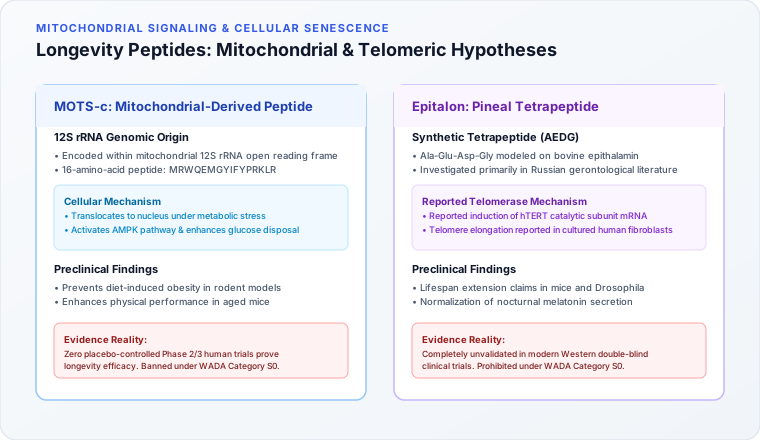
Mitochondrial Retrograde Signaling & AMPK
MOTS-c inhibits folate one-carbon metabolism, leading to AICAR accumulation and downstream AMP-activated protein kinase (AMPK) activation.
Cellular Metabolism
Nuclear Translocation Under Metabolic Stress
MDPs translocate directly into the nucleus to interact with ARE (antioxidant response element) transcription factors during heat shock and nutrient depletion.
Nuclear Signaling
Putative Telomerase Upregulation
Pineal peptides (Epitalon) are reported in Russian literature to stimulate telomerase reverse transcriptase (TERT) expression in human fibroblasts.
Preclinical / Russian Studies
Peptide Classes & Molecular Targets
Candidate longevity peptides divide into mitochondrial-derived peptides and synthetic pineal extracts.
Mitochondrial-Derived Peptides (MDPs)
Target: MOTS-c, Humanin, SHLP peptidesPeptides encoded within mitochondrial ribosomal RNA that modulate insulin sensitivity and cytoprotection.
Pineal Peptide Bioregulators
Target: Epitalon (AEDG), EpithalaminShort tetrapeptides derived from bovine pineal gland extracts investigated in Russia for telomere elongation.
FoxO4-D-Retro-Inverso Senolytics
Target: FoxO4-DRIPeptides engineered to disrupt the FoxO4-p53 interaction to selectively induce apoptosis in senescent cells.
Human Clinical Trials & Observational Data
Controlled human trials for longevity peptides are virtually non-existent; research relies on observational biomarker measurements.
| Trial / Study | Identifier / Compound | Phase & Cohort | Status / Duration | Primary Findings |
|---|---|---|---|---|
| Exercise-Induced MOTS-c in Humans (Reynolds et al.) |
Exercise-Induced MOTS-c in Humans (Reynolds et al.)
NatCommun-2021
|
Human exercise sub-study within a mainly mouse study
Healthy human volunteers
|
Completed |
Exercise induced endogenous MOTS-c expression in skeletal muscle and in circulation; the healthspan findings in the same paper come from mice.
Published 2021
|
| Epithalamin Longitudinal Gerontological Cohort |
Epithalamin Longitudinal Gerontological Cohort
StPetersburg-2003
|
Non-Blinded Longitudinal
266 elderly persons observed for 6-8 years
|
Published |
Reported lower mortality with thymic (Thymalin) and pineal (Epithalamin) peptide preparations vs control; non-blinded design and limited methodological reporting.
Published 2003
|
Approved Medicines vs. Investigational Compounds
Clear distinction between regulatory-approved prescription medicines and experimental candidates undergoing laboratory or early clinical testing.
| Compound | Target / Mechanism | Regulatory Status | Indications / Focus | Sponsor / Developer |
|---|---|---|---|---|
| None | Approved Biological Target | FDA/EMA Approved (N/A) | No peptide is approved by FDA or EMA for anti-aging or lifespan extension | N/A |
| MOTS-c | AMPK activation & metabolic homeostasis | Preclinical / Early Translational | Preclinical / Investigational | Academic / Biotech |
| Epitalon | Putative TERT stimulation & pineal modulation | Russian Gerontological Use / Western Unapproved | Preclinical / Investigational | St. Petersburg Institute |
Safety Realities & Uncharacterized Hazards
Unregulated use of compounds claiming to alter telomerase or cellular senescence carries theoretical oncological hazards.
Theoretical Neoplasia / Carcinogenesis Risk
Theoretical / SevereReactivating telomerase or bypassing cellular senescence checkpoints carries theoretical concerns for enabling malignant transformed cells to avoid apoptosis.
Purity Failures in Gray-Market Anti-Aging Vials
Moderate to HighVendors selling unapproved 'longevity peptides' routinely distribute sub-potent or uncharacterized peptide mixtures.
WADA Prohibition
Regulatory DisqualificationMOTS-c is named on the WADA Prohibited List under S4.4.1 (metabolic modulators, AMPK activators) and is banned in sport at all times.
Unresolved Scientific Questions
Key mechanistic and translational questions currently under active scientific investigation.
Can rodent lifespan extension findings translate to long-lived humans?
Mice live 2 to 3 years and frequently die of specific lymphomas; interventions that extend mouse lifespan rarely translate to heterogeneous human biology.
Does exogenously administered MOTS-c cross human cellular membranes?
MOTS-c is a 16-amino-acid polar peptide; mechanisms of systemic cellular entry without transporter assistance remain scientifically debated.
Evolution of Research & Milestones
Historical scientific breakthroughs, isolation events, structural discoveries, and regulatory milestones.
Humanin Discovered
Nishimoto identifies humanin as a neuroprotective peptide encoded in mitochondrial 16S rRNA.
Khavinson Epitalon Research
St. Petersburg Institute publishes reports on Epitalon and telomerase activity.
MOTS-c Described in Cell Metabolism
Lee and colleagues report that MOTS-c promotes metabolic homeostasis and prevents obesity in mice.
Scientific References
Primary scientific publications, randomized controlled trials, and clinical consensus papers referenced in this field overview.
-
The mitochondrial-derived peptide MOTS-c promotes metabolic homeostasis and reduces obesity and insulin resistance Cell Metab · 2015
-
The Mitochondrial-Encoded Peptide MOTS-c Translocates to the Nucleus to Regulate Nuclear Gene Expression in Response to Metabolic Stress Cell Metab · 2018
-
Epithalon peptide induces telomerase activity and telomere elongation in human somatic cells Bull Exp Biol Med · 2003
-
MOTS-c is an exercise-induced mitochondrial-encoded regulator of age-dependent physical decline and muscle homeostasis Nat Commun · 2021
Scientific & Educational Disclaimer
InsidePeptides.org provides scientific and educational analysis of peer-reviewed research for informational purposes only. This overview does not constitute medical advice, diagnosis, treatment, prescription, or clinical guidance. Incretin and metabolic peptide medicines require physician oversight, prescription authorization, and regular clinical monitoring. Never adjust, initiate, or discontinue prescribed treatments without direct consultation with a qualified medical specialist.