
Epitalon: the basics
What is it?
A synthetic four-amino-acid peptide also called epithalon, investigated in aging-related biology.
Research paper ↗What do people claim it helps with?
Longer life, younger cells, better sleep and slower aging. Human longevity benefits have not been demonstrated.
What has research actually shown?
Laboratory studies report effects on telomeres, the protective ends of chromosomes. Changing a cell measurement does not show that people live longer or stay healthier.
Research paper ↗Has this been demonstrated in people?
Primarily laboratory and animal research. Human cell lines grown in a dish are not human clinical trials.
Research paper ↗What side effects, risks and unknowns should I understand?
Long-term effects, including the implications of altering cell-growth pathways, remain uncertain. FDA identifies limited safety information.
FDA safety information ↗Is it an approved medicine?
No FDA-approved medicine contains this peptide. Availability online or through a clinic does not mean it has been approved.
FDA safety information ↗Approval here means U.S. FDA approval and applies to a particular product, formulation and use. This is a starting overview, not a complete side-effect list. Sources checked 10 October 2026; independent scientific review pending.
How is it used or studied?
Studied using specific research preparations. There is no FDA-approved treatment formulation; an online vial, capsule or spray is not necessarily the product used in a study.
Different routes and formulations can have different effects. A study of one product does not validate every product with the same peptide name.
A common misunderstanding
Epithalamin, an extract used in some older reports, is not the same as the defined synthetic peptide epitalon.
What should I ask a clinician?
- What diagnosis or goal are we trying to address, and what established options are available?
- Was the expected benefit shown in people like me, using this exact product?
- How could my medicines, health conditions or pregnancy plans affect the risks?
- What monitoring is needed, and what would tell us the treatment is helping or should be stopped?
What do the research words mean?
- Peptide
- A short chain of amino acids, the building blocks of proteins.
- Preclinical
- Research in cells, tissues or animals before dependable treatment evidence in people.
- Controlled trial
- A study comparing a treatment with another treatment or a placebo to help separate its effects from other explanations.
- Biomarker
- A measurement, such as a hormone level. A change does not necessarily mean someone feels better or lives longer.
Epitalon Evidence & Clinical Profile
Human Study Limits
Epitalon has been investigated in clinical contexts. Patient outcomes must be evaluated against study size, design, and control cohorts.
Laboratory & In Vivo Assays
Cellular and animal disease models examine receptor binding affinities and signaling cascades, which require human confirmation.
What is Epitalon?
Epithalon Synthetic Tetrapeptide (AGAG) is A synthetic tetrapeptide (Ala-Glu-Asp-Gly) modeled on the pineal gland peptide extract epithalamin. Reported in Russian laboratory and mouse studies to induce telomerase activity in cultured cells, but unvalidated by modern placebo-controlled human trials. Aliases include: Epithalon, Ala-Glu-Asp-Gly, Pineal Tetrapeptide.
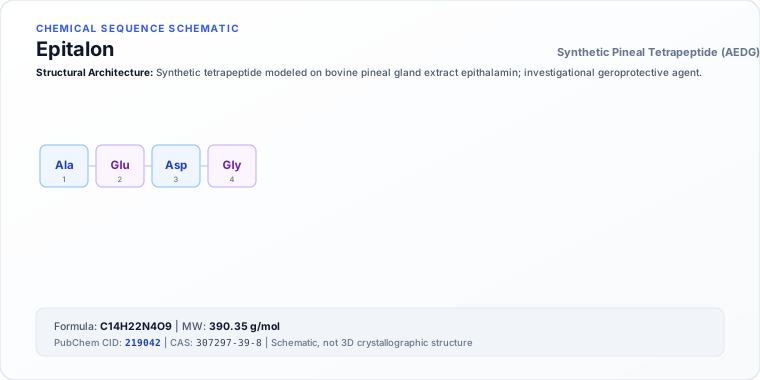
- Sequence (one-letter)
- AEDG
- Molecular formula
- C14H22N4O9
- Molecular weight
- 390.3 g/mol
- CAS Number
- 307297-39-8
- UNII Code
- O65P17785G
- PubChem CID
- 219042
Identifiers checked against PubChem and FDA's Global Substance Registration System on 13 October 2026. FDA substance record ↗ · PubChem record ↗ See all names and codes in the peptide name index.
Clinical Trials & Human Cohorts
Human research can examine tolerability, symptoms or patient outcomes. The design and comparator determine what each result can establish.
Peptides of pineal gland and thymus prolong human life [1]
What was reported
Authors reported lower incidence of acute respiratory disease and several age-related conditions, and lower mortality than controls (1.6–1.8-fold lower in the Epithalamin group).
What limits the conclusion
Studied the Epithalamin extract rather than the synthetic tetrapeptide; the abstract does not describe randomization or blinding.
Epithalon peptide induces telomerase activity and telomere elongation in human somatic cells [2]
What was reported
Reported induction of the telomerase catalytic subunit, telomerase enzymatic activity and telomere elongation.
What limits the conclusion
In vitro cellular assay; does not show systemic anti-aging effects or in vivo safety in humans.
How the compound may work
Mechanisms describe how Epitalon may affect biological processes. Laboratory findings and patient outcomes answer different questions.
Telomerase Induction in Cultured Cells
Added to telomerase-negative fibroblasts, Epitalon induced expression of the telomerase catalytic subunit, enzyme activity and telomere elongation; the authors suggest reactivation of the telomerase gene. [2]
Aging Biomarkers in Mice
Long-term treatment slowed age-related switching-off of estrous function and reduced chromosome aberrations in bone marrow cells. [3]
Areas Being Studied
These research topics reflect active areas of scientific exploration, distinct from unverified commercial marketing claims.
Telomere Biology & Cellular Senescence
Telomerase activity and telomere length in cultured human fibroblasts. [2]
Rodent Lifespan Dynamics
Did not change mean life span in female mice but increased the life span of the longest-lived survivors and inhibited leukemia; total tumor incidence was unchanged. [3]
Compare the study designs.
| Study | Design / sample | Outcome type | Key limitation |
|---|---|---|---|
| Elderly Bioregulator Cohort · 2003 [1] | Clinical observational comparison with a control group n = 266 |
Clinical endpoint evaluation | Studied the Epithalamin extract rather than the synthetic tetrapeptide; the abstract does not describe randomization or blinding. |
| Fibroblast Telomerase Assay · 2003 [2] | In vitro human cell culture n = not applicable (cell culture) |
Clinical endpoint evaluation | In vitro cellular assay; does not show systemic anti-aging effects or in vivo safety in humans. |
Regulatory Status & Clinical Safety
Regulatory Classification
Unapproved research chemical; not recognized as an approved therapeutic by FDA or EMA.
Safety Realities & Impurities
Safety depends on the molecule, formulation, route and evidence. A laboratory purity measurement alone cannot establish safety for human use.
Clinical Trials Registry Records
Official registry records from ClinicalTrials.gov. Study registration does not imply government endorsement or guaranteed efficacy.
WADA & Anti-Doping Regulations
WADA Section S0: Prohibited Substance
The World Anti-Doping Agency (WADA) classifies Epitalon under Section S0 of the Prohibited List. Prohibited at all times (in- and out-of-competition). Last verified: October 2026.
Research Timeline
-
2003
In Vitro Telomerase Claim
Paper reports telomerase activation in human fetal fibroblasts. [2]
-
2003
Mouse Lifespan Study
Lifelong treatment in female SHR mice reported; mean life span unchanged. [3]
-
2026
Evidence Appraisal
Classification remains Preclinical due to absence of rigorous Western RCTs. [4]
What Researchers Still Don't Know
Long-term safety profiles
Multi-year observational data in broader heterogeneous cohorts remains uncharacterized.
Optimal dose-response thresholds
Comparative trials optimizing minimal effective exposure versus adverse event rates.
Formulation bioavailability
Differences between oral, subcutaneous, and modified peptide delivery vehicles.
References
Primary sources verified against PubMed / NLM and regulatory databases.
-
Observational Cohort
Peptides of pineal gland and thymus prolong human life ↗ (external website)
- Cell Culture
- Preclinical Longevity
-
Regulatory
Inside Peptides Longevity Evidence: Epitalon ↗ (external website)