
Therapeutic Peptides Beginner

Peptides vs Retinol in Skincare: What the Evidence Shows

Peptides vs retinol compared by evidence: tretinoin and retinol trials, Matrixyl, Argireline and GHK-Cu studies, skin penetration, irritation and pregnancy cautions.

12 min read Updated 18 sources InsidePeptides Editorial Team

Overhead view of a hand with a dab of white cream on a pale yellow background
Photo: Moose Photos (https://www.pexels.com/@moose-photos-170195/), CC0, via Wikimedia Commons.

Plain-English Summary

Retinoids, the vitamin A family that includes prescription tretinoin and cosmetic retinol, have much stronger evidence for improving sun-damaged and ageing skin than cosmetic peptides. Tretinoin has been tested in randomised controlled trials and biopsy studies for decades, and retinol has smaller independent trials. Peptides such as Matrixyl, Argireline and GHK-Cu are supported mainly by laboratory work and small, short, often industry-funded human studies, and many penetrate skin poorly. Retinoids cause more irritation and carry a pregnancy warning on prescription labels; peptides are better tolerated but less proven.

Key Takeaways

  • Prescription tretinoin has the strongest evidence of any topical anti-ageing ingredient, including randomised trials and collagen measured in skin biopsies.
  • Retinol, the cosmetic form, is converted to retinoic acid in skin and has smaller trials showing similar but generally weaker effects.
  • Cosmetic peptides fall into four classes: signal, carrier, neurotransmitter-inhibitor and enzyme-inhibitor; most mechanisms come from laboratory studies.
  • Human peptide studies, such as those of Matrixyl and Argireline, are small, short and frequently run or funded by ingredient makers.
  • “Copper peptides” usually means GHK-Cu, a carrier peptide with broad laboratory research but thin controlled human evidence for skin.
  • Retinoids commonly cause redness, peeling and sun sensitivity, and the tretinoin label says it should not be used during pregnancy.
  • There is little independent evidence that combining peptides with a retinoid works better than the retinoid alone.
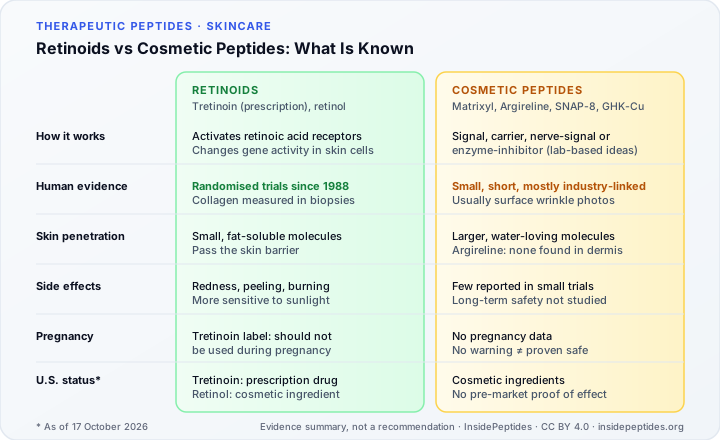
Diagram comparing retinoids and cosmetic peptides. Left, retinoids: small fat-soluble molecules that activate retinoic acid receptors; evidence from randomised trials and biopsy studies; side effects include irritation and sun sensitivity; prescription tretinoin is labelled not for use in pregnancy. Right, cosmetic peptides: larger molecules in four classes, signal, carrier, neurotransmitter-inhibitor and enzyme-inhibitor; evidence from small, mostly industry-linked studies; limited skin penetration; generally well tolerated.
Retinoids and cosmetic peptides compared by mechanism, strength of human evidence, skin penetration and side effects. Regulatory status as of 17 October 2026. Diagram by InsidePeptides, CC BY 4.0: free to reuse with a credit and link. Download SVG

Peptides vs retinol: the short answer

Retinoids, the vitamin A family that includes prescription tretinoin and cosmetic retinol, have far stronger evidence for improving sun-damaged and ageing skin than cosmetic peptides do. Tretinoin has been tested in randomised, vehicle-controlled trials since the 1980s and is an approved prescription medicine for fine facial wrinkles in the United States. Retinol, which skin converts into the active form, has smaller but independent trials. Cosmetic peptides such as Matrixyl, Argireline and GHK-Cu rest mostly on laboratory work and a handful of small human studies, many of them run or funded by the companies that make or sell the ingredient.

That does not mean peptides do nothing; the two groups simply sit at very different points on the evidence ladder. Retinoids also bring well-documented downsides, mainly irritation, sun sensitivity and a pregnancy warning on prescription labels. Peptides are generally better tolerated, but their benefits are less certain.

This guide compares the two by evidence, mechanism, side effects and regulation. It does not recommend products, concentrations or routines, and it is not medical advice. How peptides cross the skin barrier, and why many cannot, is covered separately in Can Peptides Get Through the Skin?

How retinoids work, and the evidence behind them

Retinoids are compounds related to vitamin A. Inside skin cells, the active form, all-trans retinoic acid (tretinoin), binds to nuclear retinoic acid receptors and changes which genes are switched on. In skin this affects how quickly surface cells turn over and how much collagen the deeper dermis produces. Retinol and retinaldehyde, the forms common in cosmetics, must first be converted in the skin to retinoic acid, which is one reason they act more slowly and more weakly [5][6].

The human evidence for tretinoin is the deepest of any topical anti-ageing ingredient:

  • The first controlled trial. In a 16-week randomised, double-blind, vehicle-controlled study published in 1988, 14 of 15 people who applied tretinoin to the face showed improvement in photoageing, compared with none of those who applied the inactive cream. Irritation was the main side effect [1].
  • Collagen in biopsies. A 1993 study found that tretinoin restored the formation of type I collagen in photodamaged skin, measured directly in skin samples, rather than relying only on photographs [2].
  • Regulatory approval. One tretinoin cream, Renova, is approved as an add-on treatment for the “mitigation (palliation) of fine facial wrinkles” in people who also use sun avoidance and skin care. The label is careful: it states that the product does not eliminate wrinkles, repair sun-damaged skin or restore younger skin, and that many people in the inactive-cream groups of its trials also improved with sunscreen and moisturiser alone [3].

Retinol, the over-the-counter form, has a smaller evidence base. In a randomised, double-blind trial at a university centre, 36 older adults had retinol lotion applied to one arm and an inactive lotion to the other for 24 weeks. Fine wrinkling improved significantly on the retinol side, and biopsies from a subgroup showed more procollagen and glycosaminoglycans [4]. A company-run comparison found that retinol produced the same kinds of changes as retinoic acid in skin samples, but generally of smaller size [5]. A review of retinoids in skin ageing reached a similar conclusion: tretinoin has the strongest data, and the cosmetic forms are milder and less well studied [6].

How peptides work in skincare

A peptide is a short chain of amino acids (see What Are Peptides?). In skincare, peptides are added to creams and serums on the theory that they can send signals to skin cells, carry useful metals or block particular processes. A widely cited review sorted them into four classes [7]:

  • Signal peptides, such as Matrixyl (palmitoyl pentapeptide-4), are meant to tell fibroblasts to make more collagen. Matrixyl's core sequence comes from a fragment of type I procollagen that increased collagen and fibronectin production in cultured cells [8].
  • Carrier peptides, chiefly GHK-Cu, deliver copper, a trace metal that some collagen-processing enzymes need.
  • Neurotransmitter-inhibitor peptides, such as Argireline (acetyl hexapeptide-8) and its longer relative SNAP-8, were designed to dampen the nerve signals that make facial muscles contract, loosely imitating botulinum toxin [10].
  • Enzyme-inhibitor peptides, often derived from soy, rice or other plant proteins, are intended to slow the enzymes that break down collagen.

The key difference from retinoids is what is known about mechanism in people. Retinoic acid's receptor pathway is well characterised, and its effects on collagen have been measured in human biopsies [2]. For most cosmetic peptides, the proposed mechanism comes from cell cultures or biochemical tests, and whether enough peptide reaches the right cells in living skin is often unknown. The categories describe what each peptide was designed to do, not what has been shown in human skin. More on these classes, and on the barrier they face, is in the topical peptides guide; the general biology of peptide signalling is in How Peptides Work.

What the peptide studies show, and their limits

Human studies of cosmetic peptides do exist, but they are small, short and frequently connected to industry. The main examples:

  • Matrixyl (palmitoyl pentapeptide-4). In a 12-week, double-blind, split-face study of 93 women, the moisturiser containing the peptide reduced the appearance of fine lines and wrinkles more than the same moisturiser without it. The authors worked for Procter & Gamble, a cosmetics manufacturer [9].
  • Argireline (acetyl hexapeptide-8). The 2002 paper that introduced it reported reduced wrinkle depth in a small group of volunteers after 30 days, alongside laboratory tests of nerve-signal inhibition [10]. A 2013 randomised, placebo-controlled study of 60 people in China found improvement around the eyes after 4 weeks in about half of the argireline group and none of the placebo group; three people received argireline for every one on placebo, and the trial was short [11].
  • GHK-Cu. Much of the literature is laboratory and animal work, summarised in reviews written by the researcher who first described the peptide [12]. In a small randomised study after laser skin resurfacing, only 13 patients completed; blinded assessment found no difference in redness, wrinkles or overall skin quality between the GHK-Cu and comparison regimens, although patients using GHK-Cu reported higher satisfaction [13].
  • SNAP-8. Published evidence consists largely of supplier data. No independent randomised trial was found for this guide.

The pattern matters more than any single study. Most peptide trials enrol dozens rather than hundreds of people, last weeks rather than months, measure surface wrinkle appearance rather than collagen in tissue, and are designed, funded or run by an ingredient supplier or brand. Industry funding does not make a result wrong, but it is a known source of bias, and small positive studies are more likely to be published than small negative ones (see Understanding Study Limitations and Understanding Sample Size).

For direct comparisons between individual peptides, see Matrixyl vs Argireline, Argireline vs SNAP-8 and Matrixyl vs GHK-Cu.

Copper peptides vs other peptides

“Copper peptides” almost always means GHK-Cu: the three-amino-acid peptide glycyl-histidyl-lysine bound to a copper ion. It belongs to the carrier class, so it differs from signal peptides such as Matrixyl and neurotransmitter-inhibitor peptides such as Argireline in its intended role. GHK occurs naturally in human blood plasma, and laboratory studies link it to wound repair, collagen and glycosaminoglycan production, and changes in the activity of many genes [12].

The human evidence does not match the breadth of those laboratory claims. The controlled human data for GHK-Cu skin products are limited, and the most rigorous small trial found no objective benefit after laser resurfacing [13]. Injectable “research” GHK-Cu is a separate, unapproved use. See the GHK-Cu profile and comparisons such as BPC-157 vs GHK-Cu and TB-500 vs GHK-Cu.

Getting into the skin: why size matters

Any topical ingredient first has to pass the stratum corneum, the skin's outer barrier. A long-standing rule of thumb holds that compounds that pass through skin well are usually below about 500 daltons in molecular weight [14]. Tretinoin and retinol are small, fat-soluble molecules that fall well under that threshold. Most cosmetic peptides are larger and water-loving, which makes the barrier harder to cross.

When FDA scientists measured Argireline from a cosmetic emulsion on human and guinea pig skin in the laboratory, most of the applied peptide washed off the surface. What remained sat mostly in the outer barrier layer, a very small fraction reached the epidermis, and none was detected in the dermis [15]. That finding is hard to square with a mechanism that depends on reaching nerve endings at muscles below the dermis. Attaching a fatty acid (the “palmitoyl” in palmitoyl pentapeptide) is meant to improve uptake, but evidence of active amounts reaching target cells is limited. The detailed science is in Can Peptides Get Through the Skin? and Peptide Bioavailability.

Irritation, sun sensitivity and pregnancy cautions

Retinoids carry well-documented downsides. Irritation was the main side effect in the first tretinoin trial [1], and the Renova label warns that topical use may cause redness, itching, burning, stinging and peeling at the application site, that treated skin can become more sensitive to sunlight, and that sunscreen and protective clothing should be used [3]. Retinol is generally milder than tretinoin, but it can still cause dryness and irritation [6].

Pregnancy. Oral retinoids are known to cause birth defects. The Renova prescribing information states that the cream “should not be used during pregnancy”, noting that there are no adequate and well-controlled studies in pregnant women [3]. A study following 106 women inadvertently exposed to topical tretinoin in early pregnancy found no increase in miscarriage, major birth defects or the minor malformations typical of retinoid exposure, compared with unexposed women; its authors described this as reassurance after accidental exposure, not as evidence that use in pregnancy is safe [17]. Cosmetic retinol products have no prescribing information and their safety in pregnancy has not been tested in controlled studies.

Cosmetic peptides are usually described as well tolerated; the Matrixyl study reported good skin tolerance [9]. But “few reported problems” in small, short trials is not the same as demonstrated safety, and there are essentially no pregnancy data for cosmetic peptides. Absence of a warning is not evidence of safety. Questions about using any skin product during pregnancy or breastfeeding belong with a clinician, and for prescription products, the label.

Side by side: retinoids and cosmetic peptides compared

The table summarises the evidence and regulatory position for each group as of 17 October 2026. It is a summary of evidence, not a recommendation.

FeatureTretinoin (prescription retinoid)Retinol (cosmetic retinoid)Cosmetic peptides
How it is meant to workActivates retinoic acid receptors, changing gene activity in skin cellsConverted in skin to retinoic acid [5]Varies by class: cell signalling, copper delivery, nerve-signal or enzyme inhibition [7]
Strongest human evidenceRandomised, vehicle-controlled trials and biopsy studies [1][2]Small randomised trial with biopsies [4]Small, short trials, mostly industry-linked [9][11]
Collagen change measured in human skinYes [2]Yes, in small subgroups [4][5]Rarely; most studies measure surface appearance
Skin penetrationSmall, fat-soluble moleculeSmall, fat-soluble moleculeLarger, water-loving; limited penetration [15]
Common side effectsRedness, peeling, burning, sun sensitivity [3]Similar but usually milder [6]Few reported in small trials
PregnancyLabel: should not be used during pregnancy [3]Not studied in controlled trialsNo data
U.S. regulatory statusPrescription drug; one product approved for fine facial wrinkles [3]Sold as a cosmetic ingredientSold as cosmetic ingredients [18]

“Vehicle-controlled” means the comparison group used the same cream without the active ingredient, which separates the ingredient's effect from the benefits of moisturising (see Randomized Controlled Trials).

Can you use peptides with retinol?

There is no known chemical reason that peptides and retinoids cannot be present in the same routine, and many commercial products already combine them. What is missing is good evidence that adding a peptide improves results beyond what the retinoid achieves alone.

The most cited comparison is an 8-week randomised study of 196 women with wrinkles around the eyes. One group used a cosmetic regimen containing niacinamide, peptides and retinyl propionate, a mild retinoid ester; the other used prescription tretinoin with sunscreen. The cosmetic regimen improved wrinkle appearance more at 8 weeks, results were similar at 24 weeks in smaller follow-up groups, and the cosmetic regimen was better tolerated [16]. Three caveats limit what it shows. The study was run by the company that made the cosmetic products. The cosmetic regimen itself contained a retinoid, so the result cannot be credited to peptides. And tretinoin tends to cause irritation in the first weeks, which may have affected the short-term comparison.

Whether combining ingredients suits a particular person, especially someone with sensitive skin, a skin condition or a prescription retinoid, is a question for a dermatologist or the prescriber.

The regulatory line

In the United States, a product's legal category depends on its intended use. A product intended to affect the structure or function of the body is a drug, while one intended to cleanse or beautify is a cosmetic [18]. As of 17 October 2026, tretinoin is regulated as a prescription drug, while retinol and peptide skincare are sold as cosmetics, which do not need FDA approval or proof of effectiveness before sale. Words such as “clinically proven” on a cosmetic do not mean a regulator has reviewed the evidence. More on this distinction is in What FDA Approval Means.

Frequently asked questions

Are peptides better than retinol?

Not on current evidence. Retinoids, especially prescription tretinoin, have stronger and longer-running trial evidence for photoaged skin [1][4]. Cosmetic peptides are generally better tolerated, but their supporting studies are small and mostly industry-linked [7][9].

How do peptides work in skincare?

Depending on the class, they are designed to signal skin cells to make collagen, deliver copper, reduce nerve signals to facial muscles or slow enzymes that break down collagen [7]. Most of these mechanisms were shown in laboratory tests, and many peptides penetrate skin poorly [15].

Are copper peptides better than other peptides?

No direct comparison shows that. GHK-Cu has a broad body of laboratory research, but the controlled human evidence for skin is thin, and one small randomised trial found no objective benefit [13].

Can you use peptides with retinol?

Many products combine them, and no harmful interaction is known, but there is little independent evidence that the combination works better than a retinoid alone [16]. People using a prescription retinoid should check with the prescriber.

Are peptides good for anti-ageing?

Some small studies report modest improvements in the appearance of fine lines [9][11]. Larger, independent and longer trials would be needed to confirm a meaningful effect. In the tretinoin trials, many people who used only sunscreen and moisturiser also improved [3], a reminder that basic skin care is part of any comparison.

Is retinol safe during pregnancy?

Prescription tretinoin is labelled as not for use during pregnancy [3], and cosmetic retinol has not been tested in controlled pregnancy studies. Anyone who is pregnant or planning pregnancy should ask a clinician before using retinoid products.

Core Scientific Definitions

Precise biomedical definitions for terms used throughout this guide.

Retinoid
A compound related to vitamin A. Tretinoin (retinoic acid) is the active form in skin; retinol and retinaldehyde are converted into it.
Photoageing
Skin changes caused mainly by long-term sun exposure, such as fine and coarse wrinkles, uneven pigment and loss of elasticity, as distinct from ageing due to time alone.
Vehicle-controlled trial
A study in which the comparison group applies the same cream or lotion without the active ingredient, so that the ingredient’s effect can be separated from moisturising alone.
Cosmetic peptide
A short amino acid chain added to skincare products. Cosmetic peptides are sold as cosmetic ingredients rather than approved drugs, so effectiveness does not have to be proven before sale.
Split-face study
A trial in which each participant applies one product to one side of the face and a comparison product to the other, so that each person acts as their own control.

Peer-Reviewed References & Primary Sources

This educational guide is built strictly upon peer-reviewed literature, official regulatory guidance, and authoritative biochemical repositories.

  1. Topical tretinoin improves photoaged skin. A double-blind vehicle-controlled study. Weiss JS, Ellis CN, Headington JT, et al. JAMA 1988;259(4):527-32. JAMA · 1988
  2. Restoration of collagen formation in photodamaged human skin by tretinoin (retinoic acid). Griffiths CE, Russman AN, Majmudar G, et al. N Engl J Med 1993;329(8):530-5. N Engl J Med · 1993
  3. RENOVA (tretinoin) cream prescribing information Bausch Health US. Renova (tretinoin cream) prescribing information, DailyMed, published 26 February 2026, accessed 17 October 2026. DailyMed, U.S. National Library of Medicine · 2026
  4. Improvement of naturally aged skin with vitamin A (retinol). Kafi R, Kwak HS, Schumacher WE, et al. Arch Dermatol 2007;143(5):606-12. Arch Dermatol · 2007
  5. A comparative study of the effects of retinol and retinoic acid on histological, molecular, and clinical properties of human skin. Kong R, Cui Y, Fisher GJ, et al. J Cosmet Dermatol 2016;15(1):49-57. J Cosmet Dermatol · 2016
  6. Retinoids in the treatment of skin aging: an overview of clinical efficacy and safety. Mukherjee S, Date A, Patravale V, et al. Clin Interv Aging 2006;1(4):327-48. Clin Interv Aging · 2006
  7. Role of topical peptides in preventing or treating aged skin. Gorouhi F, Maibach HI. Int J Cosmet Sci 2009;31(5):327-45. Int J Cosmet Sci · 2009
  8. A pentapeptide from type I procollagen promotes extracellular matrix production. Katayama K, Armendariz-Borunda J, Raghow R, et al. J Biol Chem 1993;268(14):9941-4. J Biol Chem · 1993
  9. Topical palmitoyl pentapeptide provides improvement in photoaged human facial skin. Robinson LR, Fitzgerald NC, Doughty DG, et al. Int J Cosmet Sci 2005;27(3):155-60. Int J Cosmet Sci · 2005
  10. A synthetic hexapeptide (Argireline) with antiwrinkle activity. Blanes-Mira C, Clemente J, Jodas G, et al. Int J Cosmet Sci 2002;24(5):303-10. Int J Cosmet Sci · 2002
  11. The anti-wrinkle efficacy of argireline, a synthetic hexapeptide, in Chinese subjects: a randomized, placebo-controlled study. Wang Y, Wang M, Xiao S, et al. Am J Clin Dermatol 2013;14(2):147-53. Am J Clin Dermatol · 2013
  12. Regenerative and Protective Actions of the GHK-Cu Peptide in the Light of the New Gene Data. Pickart L, Margolina A. Int J Mol Sci 2018;19(7):1987. Int J Mol Sci · 2018
  13. Effects of topical copper tripeptide complex on CO2 laser-resurfaced skin. Miller TR, Wagner JD, Baack BR, Eisbach KJ. Arch Facial Plast Surg 2006;8(4):252-9. Arch Facial Plast Surg · 2006
  14. The 500 Dalton rule for the skin penetration of chemical compounds and drugs. Bos JD, Meinardi MM. Exp Dermatol 2000;9(3):165-9. Exp Dermatol · 2000
  15. In vitro skin penetration of acetyl hexapeptide-8 from a cosmetic formulation. Kraeling ME, Zhou W, Wang P, Ogunsola OA. Cutan Ocul Toxicol 2015;34(1):46-52. Cutan Ocul Toxicol · 2015
  16. A randomized, controlled comparative study of the wrinkle reduction benefits of a cosmetic niacinamide/peptide/retinyl propionate product regimen vs. a prescription 0.02% tretinoin product regimen. Fu JJ, Hillebrand GG, Raleigh P, et al. Br J Dermatol 2010;162(3):647-54. Br J Dermatol · 2010
  17. Minor malformations characteristic of the retinoic acid embryopathy and other birth outcomes in children of women exposed to topical tretinoin during early pregnancy. Loureiro KD, Kao KK, Jones KL, et al. Am J Med Genet A 2005;136(2):117-21. Am J Med Genet A · 2005
  18. Is It a Cosmetic, a Drug, or Both? (Or Is It Soap?) U.S. Food and Drug Administration. Cosmetics laws and regulations, accessed 17 October 2026. U.S. Food and Drug Administration · 2026
Written By InsidePeptides Editorial Team
Review Status Scientific review pending
Last Updated
Last Evidence Review Pending verification

Educational Disclaimer: This guide is for education only and is not medical advice, diagnosis or treatment. Many peptides discussed here are not approved for human use. Talk to a licensed clinician before making any health decision.