
Evidence-Based Summary
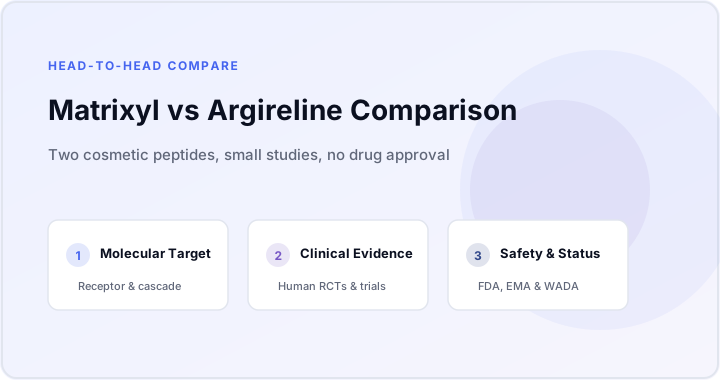
Matrixyl (palmitoyl pentapeptide-4, Pal-KTTKS) and Argireline (acetyl hexapeptide-8, also listed as acetyl hexapeptide-3) are cosmetic ingredients, not FDA-approved drugs; FDA does not pre-approve cosmetic ingredients. Their proposed mechanisms differ: Matrixyl is a fatty-acid-linked collagen fragment that stimulated matrix production in cell culture, while Argireline mimics part of SNAP-25 and interfered with nerve-signal machinery in laboratory tests. Each has a few small human studies reporting modest wrinkle improvements; the largest Matrixyl trial (93 women) was run entirely by Procter & Gamble. The only direct comparison we found is an 8-week trial of 21 Indonesian women split into three groups, where the Matrixyl cream appeared to do better than Argireline and placebo. That is too small to settle which works better, and lab work shows very little Argireline gets past the skin surface.
Quick Comparison: Matrixyl vs Argireline
A high-level comparison of molecule class, molecular receptor targets, FDA regulatory approvals, and verified clinical programs.
| Feature | Matrixyl | Argireline |
|---|---|---|
| Class | Palmitoylated pentapeptide (Pal-Lys-Thr-Thr-Lys-Ser) | Acetylated hexapeptide amide (Ac-Glu-Glu-Met-Gln-Arg-Arg-NH2) |
| Proposed target | Skin fibroblasts: collagen and matrix production (cell studies) | SNARE complex at nerve endings: mimics part of SNAP-25 (lab studies) |
| How it is used | Applied to the skin in creams and serums, usually daily | Applied to the skin in creams and serums, usually daily; not an approved injectable |
| U.S. regulatory status | Cosmetic ingredient; no FDA drug approval exists | Cosmetic ingredient; no FDA drug approval exists |
| Strongest human evidence | 93-woman split-face trial, 12 weeks, manufacturer-run | 60-person placebo-controlled study, 4 weeks; 24-person NIH blepharospasm pilot (not significant) |
| Direct comparison | 21-woman, three-arm trial: appeared better than Argireline | Same trial: appeared less effective than Matrixyl |
| Main safety concerns | Well tolerated in trials; few independent safety data | Considered safe at low cosmetic concentrations by an industry-funded panel; infection reported after off-label facial injection |
| WADA status (2026) | Not named on the 2026 Prohibited List | Not named on the 2026 Prohibited List |
Collagen Signalling vs Nerve-Signal Interference
Both mechanisms come mainly from cell and laboratory experiments. Whether enough of either peptide reaches the right skin layer to work this way in people is uncertain.
Matrixyl (palmitoyl pentapeptide-4)
Primary Target: No defined receptor; acts on fibroblasts in culture
Affinity Profile: Collagen-fragment signal (KTTKS from type I procollagen)
KTTKS stimulated collagen and fibronectin production in cultured cells (1993). The palmitoyl group was added to improve stability and skin uptake; in mouse skin it reached outer layers but did not pass fully through.
Argireline (acetyl hexapeptide-8)
Primary Targets: SNARE complex (competes with SNAP-25)
Affinity Profile: Far weaker than botulinum toxin in lab assays
Designed as a non-toxic mimic of botulinum toxin's effect. In lab tests it interfered with SNARE complex formation needed for nerve-signal release. FDA scientists found most applied peptide stayed on or in the outer skin layer, with none detected in the dermis.
Cosmetic Ingredients, Not Approved Drugs
Checked 11 October 2026. FDA does not pre-approve cosmetic products or ingredients (except certain color additives), so there is no FDA approval to look up for either peptide.
Matrixyl Status & Formulations
Sold as a cosmetic ingredient. Companies, not FDA, are responsible for product safety and labeling. Matrixyl 3000 is a different blend (palmitoyl tripeptide-1 plus palmitoyl tetrapeptide-7), so evidence for one should not be applied to the other.
Argireline Status & Formulations
Sold as a cosmetic ingredient. The Cosmetic Ingredient Review panel, which is industry-funded, concluded in 2025 that it is safe as used at low cosmetic concentrations, with insufficient data for higher concentrations. It is not an FDA-approved alternative to botulinum toxin.
Critical Regulatory Distinction
A product that claims to relax muscles, treat disease or change the structure or function of the body can be regulated as a drug. 'Clinically tested' on a cosmetic label does not mean FDA reviewed the evidence.
Small, Short and Often Industry-Funded
Cosmetic studies usually measure appearance over weeks, using photos, skin replicas or expert grading. Results apply to the specific formulation tested. Comparing separate studies cannot show which ingredient is better; the one direct trial is very small.
Matrixyl: Matrixyl studies
Robinson and colleagues (2005) ran a 12-week, double-blind, split-face trial in 93 Caucasian women; the moisturizer with pal-KTTKS improved measured wrinkles and fine lines versus the same moisturizer without it. All authors worked for Procter & Gamble. Two further P&G split-face studies (2009) tested multi-ingredient eye products, so pal-KTTKS's own effect cannot be separated. A 2011 review noted few clinical studies and little skin-penetration data.
Argireline: Argireline studies
A 4-week randomized placebo-controlled study in 60 Chinese adults (2013) reported improvement in about half of the Argireline group versus none on placebo, with unequal group sizes. An NIH pilot in 24 people with blepharospasm (2013) found only a non-significant trend, and a follow-up trial was terminated. In the direct 2023 trial in 21 Indonesian women (Matrixyl cream vs Argireline cream vs placebo, about 7 per group), the Matrixyl cream appeared to perform better; the authors called it an initial study needing larger samples.
Generally Well Tolerated on Skin, Few Independent Data
Topical use was well tolerated in the published studies, but those studies were small and short. Neither ingredient has long-term independent safety data.
Do not inject cosmetic peptides
A woman developed a Mycobacterium abscessus skin infection after Argireline was injected into her face. Neither Argireline nor Matrixyl is an approved injectable product, and cosmetic-grade material is not made for injection.
| Safety Consideration | Matrixyl | Argireline |
|---|---|---|
| Tolerability in studies | Well tolerated in the 93-woman trial | No significant adverse events in the NIH pilot |
| Formal safety review | Industry bioinformatic screen found no toxin or allergen flags (no new clinical data) | Cosmetic Ingredient Review (industry-funded): safe at low cosmetic concentrations |
| Skin penetration | Reached outer skin layers in mouse skin; not fully through | Mostly stayed on or in outer layer in human cadaver and guinea pig skin |
| Misuse risk | Not studied for injection | Infection case after facial injection |
What Matrixyl and Argireline Have in Common
Where the two compounds overlap in biology, evidence or regulatory context.
Cosmetic, not drug
Both are sold as cosmetic ingredients with no FDA drug approval; FDA does not pre-approve cosmetic ingredients.
Small human evidence base
Each has a handful of short studies with modest appearance results; none is large or long-term.
Skin penetration is a question
Lab studies suggest both stay mostly in the outer skin layers, which limits how far lab mechanisms translate.
Key Scientific & Clinical Differences
Meaningful distinctions in mechanism, strength of evidence, safety and regulatory status.
Mechanism
Matrixyl is a collagen-fragment signal for skin cells; Argireline targets nerve-signal release machinery.
Funding of key trials
Matrixyl's main trial was run by a manufacturer; Argireline's include university and NIH studies, with a manufacturer-affiliated author on the NIH pilot.
Botox comparisons
Argireline is often marketed as 'Botox in a jar'; lab data show it is far weaker than botulinum toxin, and no trial supports that claim.
Scientific Comparison vs Clinical Recommendations
Inside Peptides compares scientific evidence, receptor pharmacology, and official regulatory documents to advance public and professional understanding. We do not determine which compound is appropriate for an individual patient, rank medications with arbitrary scores, or recommend initiating or switching treatments.
Decisions about any medicine require a licensed healthcare professional who can weigh personal medical history, contraindications, interactions and monitoring needs. Unapproved peptides have no established safe use, and products sold as “research chemicals” are not the preparations studied in clinical research.
Approved Uses vs Online Claims
A critical scientific distinction between verified, FDA-approved clinical uses and unverified claims circulating on social media and vendor platforms.
Argireline works like Botox without needles
Not supportedArgireline is a cosmetic ingredient, not an approved alternative to botulinum toxin.
In lab assays it was far less effective than botulinum toxin, and FDA scientists found little reaches below the outer skin layer. Small studies show modest wrinkle changes, not muscle paralysis.
Matrixyl rebuilds collagen and reverses aging
Partly supportedA claim to change skin structure could make a product a drug under FDA rules.
Cell studies show collagen stimulation, and a manufacturer-run trial showed modest wrinkle improvement over 12 weeks. No study shows lasting structural reversal of skin aging.
Matrixyl is proven better than Argireline
UnprovenNeither ingredient has an FDA-reviewed efficacy claim.
One 21-person trial favored Matrixyl, with about seven women per group. That is a signal for larger studies, not proof.
Evidence Strength Across Clinical Domains
Inside Peptides evaluates scientific certainty at the claim level. Because clinical evidence varies significantly depending on the therapeutic endpoint evaluated, each domain is assessed independently.
Facial wrinkles (topical)
Small, short studies for both; Matrixyl's largest trial was manufacturer-run.
Direct comparison
A single 21-person, three-arm trial; too small to rank the two.
Mechanism in living skin
Mechanisms come from cell, lab and animal-skin experiments.
Medical uses
Argireline's blepharospasm pilot was not significant; Matrixyl has no medical-use trials.
What Research Still Doesn’t Tell Us
Identifying open scientific questions, pending active-comparator trials, and areas where long-term clinical data remain incomplete.
Independent, larger trials
Neither ingredient has a large, independent, long-term randomized trial.
A proper head-to-head
Only one tiny direct comparison exists; an adequately powered trial is needed.
Delivery to target
It is unclear how much of either peptide reaches fibroblasts or nerve endings from a cream.
Formulation dependence
Results apply to the tested product; concentrations and other ingredients vary widely between commercial products.
Related Compound Profiles
Individual profiles provide full molecular datasheets, CAS numbers, preclinical histories, and compound monographs.
Related Educational Resources
Scientific & Regulatory References
Every pharmacological mechanism, clinical trial result, and regulatory approval cited on this page is traceable to official FDA prescribing documentation, ClinicalTrials.gov registries, or peer-reviewed medical publications.
-
Randomized split-face trial (manufacturer-run)
Topical palmitoyl pentapeptide provides improvement in photoaged human facial skin.All authors were Procter & Gamble employees; 93 women, 12 weeks.
-
Small randomized three-arm trial (direct comparison)
Double-blind, Randomized Trial on the Effectiveness of Acetylhexapeptide-3 Cream and Palmitoyl Pentapeptide-4 Cream for Crow's Feet.21 women in three groups, 8 weeks; university authors reported no relevant conflicts of interest.
-
Randomized split-face studies (multi-ingredient, manufacturer-run)
Efficacy of anti-aging products for periorbital wrinkles as measured by 3-D imaging.
-
Cell research
A pentapeptide from type I procollagen promotes extracellular matrix production.
-
Laboratory skin study (mouse)
Dermal Stability and In Vitro Skin Permeation of Collagen Pentapeptides (KTTKS and palmitoyl-KTTKS).
-
Review
Topically applied KTTKS: a review.
-
Original design and laboratory study
A synthetic hexapeptide (Argireline) with antiwrinkle activity.
-
Randomized placebo-controlled study
The anti-wrinkle efficacy of argireline, a synthetic hexapeptide, in Chinese subjects: a randomized, placebo-controlled study.60 adults, 4 weeks, 3:1 allocation.
-
Randomized pilot trial
Pilot study of topical acetyl hexapeptide-8 in the treatment for blepharospasm in patients receiving botulinum toxin therapy.NIH-led; one author affiliation is a peptide manufacturer (BCN Peptides).
-
Laboratory skin penetration study (FDA scientists)
In vitro skin penetration of acetyl hexapeptide-8 from a cosmetic formulation.
-
Cosmetic Ingredient Review safety assessment
Safety Assessment of Acetyl Hexapeptide-8 Amide as Used in Cosmetics.The Cosmetic Ingredient Review is funded by the cosmetics industry.
-
Review
Acetyl Hexapeptide-8 in Cosmeceuticals-A Review of Skin Permeability and Efficacy.
-
Case report
Mycobacterium abscessus infection after facial injection of argireline: A case report.
-
Human skin permeation study
Permeation behaviour of cosmetic actives into the human stratum corneum.Relevant to Matrixyl 3000, a different peptide blend.
-
Industry safety framework (no new clinical data)
A framework for the safety evaluation of peptides in cosmetics.Authors work for a company that makes products containing these peptides.
-
Registry Record
Acetyl Hexapeptide-8 for BlepharospasmNINDS Phase 2 follow-up trial; terminated with 8 participants (registry checked 11 October 2026).
-
Organization information
About the Cosmetic Ingredient ReviewStates that CIR was established by the industry trade association and is funded by the Personal Care Products Council.
-
FDA regulatory explanation
Cosmetics & U.S. LawExplains that FDA does not pre-approve cosmetic products or ingredients, other than certain color additives.
-
FDA regulatory explanation
Is It a Cosmetic, a Drug, or Both? (Or Is It Soap?)Intended use, including claims to treat disease or change body structure or function, can make a product a drug.