
1. Defining Absolute Bioavailability
Bioavailability (F) represents the rate and extent to which an active pharmaceutical ingredient is absorbed and becomes available at the site of physiological action [1]. Intravenous (IV) injection delivers 100% of the dose directly into circulation (F = 1.0).
For any extravascular route (oral, subcutaneous, nasal, transdermal), bioavailability is calculated by comparing the area under the plasma concentration-time curve (AUC) to the IV baseline:
F = (AUC_extravascular / AUC_IV) × (Dose_IV / Dose_extravascular)
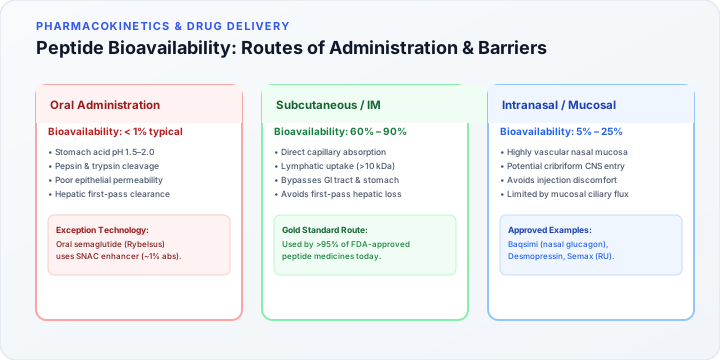
For most unformulated peptides, oral bioavailability is very low because the gastrointestinal tract presents substantial structural and enzymatic barriers [2]. Even the more clinically advanced oral peptide technologies have generally reported oral bioavailability of only about 1–2% [3].
2. Gastrointestinal Barriers to Oral Delivery
The mammalian digestive tract is biologically optimized to rapidly break down dietary peptides and proteins into individual amino acids for nutrient absorption. An oral peptide pill faces three hostile sequential barriers [2]:
- Gastric Acid Denaturation: The stomach lumen maintains an acidic pH (1.5–2.0) that protonates ionizable side chains, destabilizing tertiary structure and unfolding the peptide.
- Luminal Endopeptidases: Gastric pepsin and pancreatic enzymes (trypsin, chymotrypsin, elastase) cleave peptide backbones at specific aromatic and basic residues.
- Brush-Border Peptidases: The microvillar membrane of intestinal enterocytes is heavily coated with aminopeptidases, carboxypeptidases, and dipeptidases (e.g., aminopeptidase N, neprilysin) that finish off surviving fragments [2].
3. The Intestinal Epithelium & Tight Junctions
Even if an intact peptide survives the enzymatic gauntlet of the gut lumen, it encounters the physical barrier of the intestinal epithelium [2]. Transport across this monolayer can occur via two routes:
- Transcellular Route: Crossing directly through the enterocyte membrane. Because peptides are hydrophilic and polar, they cannot partition into the hydrophobic lipid core of the plasma membrane without carrier transport.
- Paracellular Route: Slipping between adjacent enterocytes. Enterocytes are hermetically sealed by apical tight junction complexes (claudins, occludins, ZO-1) that restrict the passage of large hydrophilic molecules such as most peptides.
4. Parenteral Absorption: Subcutaneous vs Intramuscular vs IV
Because oral delivery is so inefficient, parenteral administration remains the primary route for therapeutic peptides [1]:
- Subcutaneous (SC) Injection: Deposited in interstitial adipose tissue. Small peptides (< 16 kDa) diffuse directly across vascular capillaries into blood, achieving 60% to 90% bioavailability. Large or acylated peptides diffuse primarily into initial lymphatic capillaries before entering the thoracic duct.
- Intramuscular (IM) Injection: Higher vascularity yields faster time-to-peak (Tmax) but greater injection discomfort.
- Intranasal Delivery: Bypasses first-pass hepatic metabolism and is used for some small, potent peptides such as desmopressin, calcitonin, and oxytocin, although systemic bioavailability is generally much lower than by injection. The nasal route is also being studied as a way to deliver drugs directly to the brain along olfactory and trigeminal nerve pathways, bypassing the blood-brain barrier [4].
5. Permeation Enhancers & Oral Rybelsus Technology
In 2019, the FDA approved the first oral GLP-1 receptor agonist tablet, oral semaglutide (Rybelsus). This breakthrough relied on co-formulation with SNAC (sodium N-[8-(2-hydroxybenzoyl)amino]caprylate).
In clinical studies and preclinical dog studies, absorption of oral semaglutide took place in the stomach, was confined to an area close to the tablet surface, and required co-formulation with SNAC. SNAC protected semaglutide against enzymatic degradation through local buffering and only transiently enhanced absorption; the absorption mechanism was transcellular, with no evidence of an effect on tight junctions [5].
Core Scientific Definitions
Precise biomedical definitions for terms used throughout this guide.
- Bioavailability (F)
- The fraction of an administered dose of unchanged drug that reaches the systemic circulation, calculated as (AUC_route / AUC_IV) * (Dose_IV / Dose_route).
- Paracellular Transport
- Passive transport between adjacent epithelial cells through tight junctions; highly restricted for molecules > 500-600 Daltons.
- SNAC (Sodium N-(8-[2-hydroxybenzoyl]amino)caprylate)
- A synthetic fatty acid-derived absorption enhancer that transiently binds peptides to promote transcellular gastric mucosal absorption.
Peer-Reviewed References & Primary Sources
This educational guide is built strictly upon peer-reviewed literature, official regulatory guidance, and authoritative biochemical repositories.
-
Current status of selected oral peptide technologies in advanced preclinical development and in clinical trials Adv Drug Deliv Rev · 2016
-
Direct nose to brain drug delivery via integrated nerve pathways bypassing the blood-brain barrier: an excellent platform for brain targeting Expert Opin Drug Deliv · 2013
-
Transcellular stomach absorption of a derivatized glucagon-like peptide-1 receptor agonist Sci Transl Med · 2018
Educational Disclaimer: This guide is produced strictly for biomedical educational purposes and does not constitute medical advice, diagnosis, or treatment recommendations. Experimental peptides discussed herein may lack regulatory authorization for human clinical use. Consult a licensed medical practitioner before considering any therapeutic intervention.