
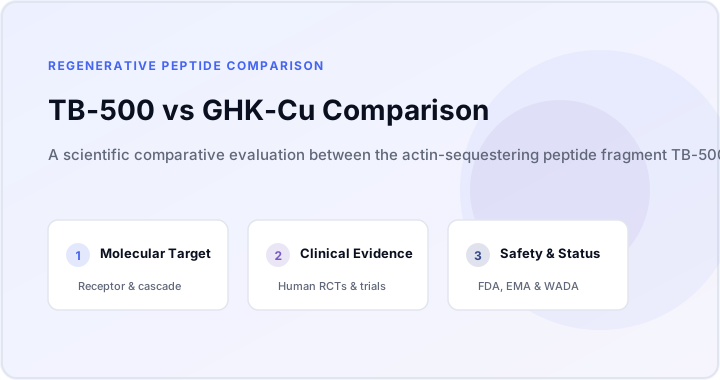
Evidence-Based Summary
TB-500 and GHK-Cu represent two complementary facets of tissue repair biology: intracellular motility versus extracellular architecture. TB-500 is a synthetic peptide containing the acetylated active fragment (Ac-LKKTETQ) of Thymosin Beta-4 (Tβ4), a 43-amino-acid intracellular protein. Its primary biological mechanism is the sequestration of globular actin (G-actin) monomers. By preventing actin monomers from premature polymerization into filamentous F-actin while maintaining an available pool for extending cellular lamellipodia, TB-500 accelerates the physical migration of endothelial cells, dermal fibroblasts, and keratinocytes into wound margins. In contrast, GHK-Cu (Gly-His-Lys:Cu2+) is an endogenous human plasma tripeptide that acts extracellularly and genomically. By delivering divalent copper to cellular enzymes such as lysyl oxidase, GHK-Cu stimulates the direct synthesis of collagen types I and III, upregulates decorin to prevent aberrant fibrosis, and modulates matrix metalloproteinases (MMPs) to clean up damaged matrix. While GHK-Cu is an endogenous physiological biomolecule validated in human topical clinical trials and permitted by anti-doping authorities, TB-500 is an unapproved synthetic research chemical explicitly banned by the World Anti-Doping Agency (WADA Section S2) and restricted from compounding pharmacies.
Quick Comparison: TB-500 vs GHK-Cu
A high-level comparison of molecule class, molecular receptor targets, FDA regulatory approvals, and verified clinical programs.
| Feature | TB-500 | GHK-Cu |
|---|---|---|
| Primary biological role | Actin monomer sequestration & cell migration | Extracellular matrix remodeling & copper delivery |
| Molecular structure | 7-amino-acid fragment: Ac-LKKTETQ (889 Da) | 3-amino-acid complex: Gly-His-Lys:Cu (403.9 Da) |
| Biological origin | Synthetic derivative of Thymosin Beta-4 (Tβ4) | Endogenous human plasma tripeptide complex |
| Key molecular target | G-actin monomer binding (LKKTET sequence motif) | Lysyl oxidase activation, collagen I/III, TGF-beta |
| Human clinical evidence | Zero approved systemic RCTs for TB-500 fragment | Multiple peer-reviewed human trials in topical wound healing |
| FDA status | Unapproved research substance (on FDA compounding risk list) | Cosmetic clearance; investigational for systemic use |
| WADA anti-doping status | Prohibited at all times (Section S2: Growth factors) | Not prohibited by WADA |
Actin Polymerization Dynamics vs Matrix Synthesis
Cell migration into injured tissue requires actin dynamics (TB-500), while structural rebuilding requires collagen matrix synthesis (GHK-Cu).
TB-500: G-Actin Sequestration & Lamellipodial Motility
Primary Target: Direct binding to globular monomeric actin (G-actin)
Affinity Profile: High micromolar affinity (Kd ~1-2 μM)
TB-500 carries the central LKKTET actin-binding loop of Tβ4. By binding G-actin in a 1:1 complex, it acts as a cellular buffer, preventing random polymerization into F-actin while rapidly transporting actin monomers to extending cellular lamellipodia. This enables rapid crawling and migration of keratinocytes and endothelial cells into injured tissue planes.
GHK-Cu: Collagen Fibrillogenesis & MMP Balancing
Primary Targets: Copper transport; integrin and proteoglycan interactions
Affinity Profile: Extremely high affinity for Cu(II) (log K = 16.4)
GHK-Cu delivers bioavailable copper directly to dermal fibroblasts, upregulating mRNA for procollagen alpha-1(I) and alpha-1(III). It stimulates the cross-linking enzyme lysyl oxidase to ensure structural tensile strength, while concurrently upregulating anti-fibrotic decorin to prevent hypertrophic scar formation.
Compounding Prohibitions vs Cosmetic Commercialization
The legal and regulatory frameworks governing both compounds.
TB-500 Status & Formulations
Not approved by the FDA or EMA for human clinical use.
GHK-Cu Status & Formulations
Not approved by the FDA or EMA for human clinical use.
Critical Regulatory Distinction
FDA lists TB-500 among bulk substances that may present significant safety risks in compounding (now “nominated but withdrawn”, which is not a clearance), and it is prohibited by WADA. GHK-Cu is non-prohibited and compliant for topical dermatological applications.
Full-Length Tβ4 Clinical Trials vs GHK-Cu Research
Distinguishing parent protein research from isolated peptide fragments.
TB-500: Thymosin Beta-4 Trials (Parent Protein)
Full-length 43-AA Thymosin Beta-4 (RGN-259) reached Phase 3 clinical trials as eye drops for neurotrophic keratopathy and dry eye, and Phase 2 trials for dermal wounds. However, the isolated synthetic fragment TB-500 (Ac-LKKTETQ) has never completed systemic human clinical trials.
GHK-Cu: GHK-Cu Clinical Trials
Topical GHK-Cu wound gel was evaluated in randomized controlled trials in patients with diabetic neuropathic ulcers, demonstrating significantly accelerated wound closure and higher healing rates compared to conventional wound care protocols.
Known Tolerability & Quality Assurance
Safety evaluation between an unregulated peptide fragment and an endogenous copper complex.
| Safety Consideration | TB-500 | GHK-Cu |
|---|---|---|
| Systemic human toxicity data | Lacking; unapproved injectable research compound | Well characterized; endogenous to human blood |
| Topical dermatological safety | Not established in clinical dermatology | Extensive safety record; non-irritating in human trials |
| Anti-doping sanction risk | Immediate athletic suspension (WADA Category S2) | Zero anti-doping violation risk |
What TB-500 and GHK-Cu Have in Common
Where the two compounds overlap in biology, evidence or regulatory context.
Regenerative Context
Both peptides are investigated for their roles in tissue repair, wound healing, and cellular recovery.
Key Scientific & Clinical Differences
Meaningful distinctions in mechanism, strength of evidence, safety and regulatory status.
Functional Role
TB-500 coordinates actin dynamics and cell motility; GHK-Cu coordinates collagen synthesis and matrix remodeling.
Regulatory Status
TB-500 is an unapproved, WADA-banned research chemical; GHK-Cu is an endogenous copper complex with approved topical applications.
Target Location
TB-500 acts on the intracellular actin cytoskeleton; GHK-Cu acts primarily on extracellular matrix synthesis and gene expression.
Scientific Comparison vs Clinical Recommendations
Inside Peptides compares scientific evidence, receptor pharmacology, and official regulatory documents to advance public and professional understanding. We do not determine which compound is appropriate for an individual patient, rank medications with arbitrary scores, or recommend initiating or switching treatments.
Decisions about any medicine require a licensed healthcare professional who can weigh personal medical history, contraindications, interactions and monitoring needs. Unapproved peptides have no established safe use, and products sold as “research chemicals” are not the preparations studied in clinical research.
Approved Uses vs Online Claims
A critical scientific distinction between verified, FDA-approved clinical uses and unverified claims circulating on social media and vendor platforms.
TB-500 builds muscle and tendon fibers faster than GHK-Cu
insufficientUnverified vendor claim; TB-500 has zero human clinical trials for muscle or tendon building.
TB-500 primarily influences actin-mediated cell motility, not structural collagen synthesis. GHK-Cu actually has stronger scientific data for stimulating collagen and extracellular matrix remodeling.
Evidence Strength Across Clinical Domains
Inside Peptides evaluates scientific certainty at the claim level. Because clinical evidence varies significantly depending on the therapeutic endpoint evaluated, each domain is assessed independently.
Actin-Mediated Cell Motility
TB-500's LKKTET motif validated in cellular motility assays.
Human Wound & Dermal Remodeling
GHK-Cu validated in human topical clinical trials; TB-500 lacks human systemic trial proof.
What Research Still Doesn’t Tell Us
Identifying open scientific questions, pending active-comparator trials, and areas where long-term clinical data remain incomplete.
Bioavailability of Synthetic TB-500 Fragment
Characterizing whether systemic subcutaneous injections of short 7-AA TB-500 reach target musculoskeletal tissues intact before enzymatic degradation.
Related Compound Profiles
Individual profiles provide full molecular datasheets, CAS numbers, preclinical histories, and compound monographs.
Related Educational Resources
Scientific & Regulatory References
Every pharmacological mechanism, clinical trial result, and regulatory approval cited on this page is traceable to official FDA prescribing documentation, ClinicalTrials.gov registries, or peer-reviewed medical publications.
-
Peer-Reviewed Review
Thymosin beta4: actin-sequestering protein and more
-
Peer-Reviewed Article
GHK peptide as a natural modulator of multiple cellular pathways in skin regeneration