

Field Summary & Status
Early Human for Topical; Insufficient for Systemic InjectionsExtracellular Matrix Remodeling & Cutaneous Biology
The skin is the largest organ of the human body, providing an impermeable physical and biological barrier against environmental insults. Chronological aging and photo-damage (extrinsic aging from ultraviolet radiation) cause progressive degradation of dermal extracellular matrix (ECM) architecture, marked by fragmentation of Type I collagen fibers, loss of elastin, and reduced glycosaminoglycan ground substance.
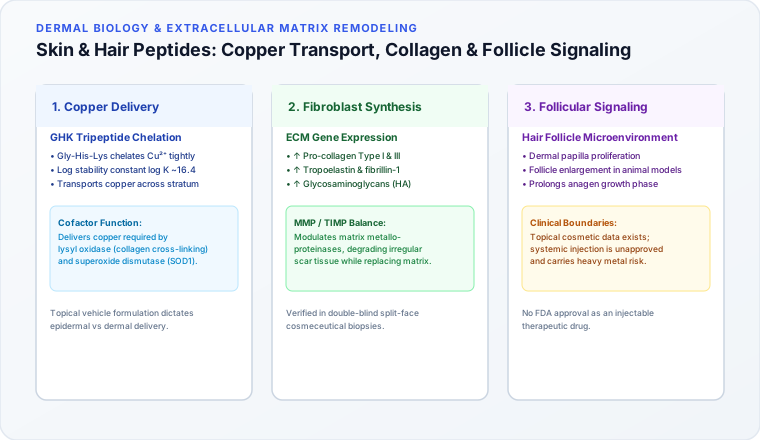
Dermal peptide research investigates short amino acid sequences that act as 'matrikines', peptides derived from fragmented matrix proteins that signal surviving fibroblasts to initiate repair synthesis. The field encompasses carrier peptides (GHK-Cu delivering catalytic copper), signal peptides (stimulating procollagen mRNA), and neurotransmitter-inhibiting peptides.
While topical formulations show modest cosmetic benefits in split-face profilometry trials, marketing claims promoting systemic injection of cosmetic peptides for full-body rejuvenation lack clinical verification and carry regulatory risks.
Biological Systems & Signaling Mechanisms
Dermal peptides regulate cellular matrix deposition, enzymatic remodeling, and follicular proliferation.
Procollagen mRNA Upregulation
Signal matrikines bind fibroblast surface receptors to stimulate transcription of COL1A1 and COL3A1 procollagen chains.
Cell Culture Assay
MMP & TIMP Balance Regulation
Copper peptides modulate the ratio between matrix metalloproteinases (MMPs) and tissue inhibitors (TIMPs), removing damaged collagen without excessive breakdown.
Biochemical Assay
Wnt / beta-Catenin Follicle Cycling
Activation of Wnt signaling in dermal papilla cells promotes hair follicle transition from telogen (resting) into anagen (growth).
Preclinical Model
Peptide Classes & Molecular Targets
Dermal peptides are categorized by functional mechanism into carrier, signal, and neurotransmitter-modulating peptides.
Copper Carrier Peptides
Target: GHK-Cu, Copper Tripeptide-1Tripeptides with femtomolar copper binding affinity (GHK-Cu) that deliver copper cofactors to lysyl oxidase.
Signal Matrikine Peptides
Target: Palmitoyl Pentapeptide-4 (Matrixyl), Pal-GHKSequences modeled on fragmented procollagen chains that stimulate fibroblast extracellular matrix synthesis.
Neurotransmitter-Modulating Peptides
Target: Acetyl Hexapeptide-8 (Argireline)Hexapeptides modeled on SNAP-25 that competitively inhibit SNARE complex assembly to reduce facial expression contractions.
Human Clinical Trials & Observational Data
Clinical evaluation of cosmetic peptides relies largely on split-face designs with image-based wrinkle analysis; controlled human trials of topical GHK-Cu are scarce.
| Trial / Study | Identifier / Compound | Phase & Cohort | Status / Duration | Primary Findings |
|---|---|---|---|---|
| Topical Palmitoyl Pentapeptide-4 in Photoaging |
Topical Palmitoyl Pentapeptide-4 in Photoaging
IntJCosSci-2005
|
Double-Blind Placebo-Controlled Split-Face
93 Caucasian women aged 35-55 over 12 weeks
|
Completed |
Significant quantitative reduction in fine lines and wrinkle depth compared to placebo vehicle.
Published 2005
|
Approved Medicines vs. Investigational Compounds
Clear distinction between regulatory-approved prescription medicines and experimental candidates undergoing laboratory or early clinical testing.
| Compound | Target / Mechanism | Regulatory Status | Indications / Focus | Sponsor / Developer |
|---|---|---|---|---|
| Copper Tripeptide-1 (Topical) | Approved Biological Target | FDA/EMA Approved (2000s) | Cosmetic Dermal Conditioning (INCI) | Global Cosmetic Manufacturers |
| Becaplermin (Regranex) | Approved Biological Target | FDA/EMA Approved (1997) | Diabetic Foot Ulcer Healing | Smith & Nephew |
| Injectable GHK-Cu | Systemic matrix remodeling & gene modulation | Unapproved as Systemic Drug | Preclinical / Investigational | Academic / Gray-Market |
| Bimatoprost / Peptide Hair Hybrids | Wnt / dermal papilla follicular stimulation | Preclinical / Early Formulation | Preclinical / Investigational | Dermatology Startups |
Safety Realities & Unapproved Systemic Use
Topical cosmetic peptides exhibit excellent local tolerability; unverified systemic injection presents serious safety hazards.
Topical Contact Dermatitis
MildMild erythema and allergic contact dermatitis can occur, typically linked to cosmetic preservatives or fragrance excipients.
Risks of Injectable Gray-Market Cosmetic Peptides
SevereInjecting non-sterile GHK-Cu solutions risks copper dyshomeostasis, sterile abscess formation, and systemic endotoxin contamination.
Unresolved Scientific Questions
Key mechanistic and translational questions currently under active scientific investigation.
How deeply do topical peptides penetrate the human stratum corneum?
Because peptides are hydrophilic, lipophilic conjugation (palmitoylation) is required; actual transdermal bioavailability remains low without microneedling.
Does systemic GHK-Cu provide systemic anti-aging benefits in humans?
Loren Pickart's broad gene-expression hypotheses are derived from computational broad-panel analyses, lacking human interventional trial proof.
Evolution of Research & Milestones
Historical scientific breakthroughs, isolation events, structural discoveries, and regulatory milestones.
GHK Isolated
Pickart isolates GHK from human plasma as a growth factor for liver cells.
Wound Healing Described
Maquart reports GHK-Cu accelerates collagen synthesis in rat wound chambers.
Matrixyl Introduced
KTTKS signal peptide synthesized as palmitoyl derivative for cosmetic formulations.
Scientific References
Primary scientific publications, randomized controlled trials, and clinical consensus papers referenced in this field overview.
-
GHK peptide as a natural modulator of multiple cellular pathways in skin regeneration BioMed Res Int · 2015
-
Topical palmitoyl pentapeptide provides improvement in photoaged human facial skin Int J Cosmet Sci · 2005
Scientific & Educational Disclaimer
InsidePeptides.org provides scientific and educational analysis of peer-reviewed research for informational purposes only. This overview does not constitute medical advice, diagnosis, treatment, prescription, or clinical guidance. Incretin and metabolic peptide medicines require physician oversight, prescription authorization, and regular clinical monitoring. Never adjust, initiate, or discontinue prescribed treatments without direct consultation with a qualified medical specialist.