
GLP-1 Microdosing: What the Evidence Shows and What It Doesn’t
Microdosing semaglutide or tirzepatide is popular, but no trial has tested it. What the evidence shows, what experts say and the known dosing risks.

Key takeaways
- “Microdosing” has no agreed definition; online it means any smaller-than-approved amount of a GLP-1 drug.
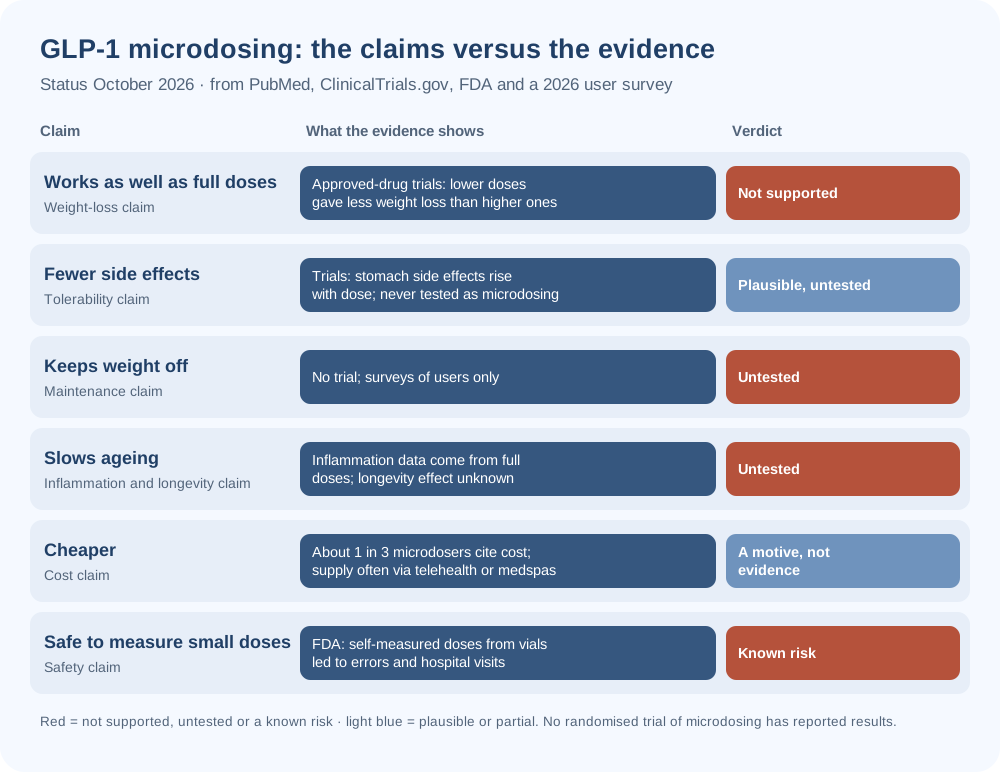
- No randomised trial of microdosing has reported results; approved-drug trials show smaller doses gave less weight loss.
- FDA has linked self-measured compounded GLP-1 doses to serious dosing errors and hospital visits.
In this article
"Microdosing" GLP-1 drugs means taking smaller amounts of medicines such as semaglutide or tirzepatide than the doses tested and approved, usually in the hope of keeping some benefit with fewer side effects or lower cost. A 2026 survey suggests about one in seven people using injectable GLP-1s have tried it. But no randomised trial of microdosing has reported results, and a 2026 review found that studies "specifically investigating the effects of microdosing GLP-1 RAs are extremely limited."1211
Microdosing is spreading mostly through social media, telehealth services and wellness clinics. This guide sets out what the term means, what the evidence actually shows, what experts and regulators say, and the risks. It gives no dosing information, recommends no seller and is not medical advice. Anyone thinking about changing how they take a prescribed medicine should talk to the prescriber first.
The short version
- There is no agreed definition. In drug research, "microdosing" means a dose too small to have any effect. Online, it now means any smaller-than-standard amount of a GLP-1 drug, with no agreed size or schedule.17
- It is common. In a 2026 survey of more than 75,000 people, 15% of current injectable GLP-1 users said they had microdosed. The main reasons were side effects, cost and keeping weight off.2
- No trial has tested it. We found no randomised trial of GLP-1 microdosing with published results. One small industry-sponsored trial is registered but has posted no results.1112
- Lower doses did less in the trials that exist. In the approved-drug trials, weight loss grew with dose. A 2026 records study of people who stayed on the lowest starting dose found modest weight loss, far below trial results at full doses.345
- Measuring your own small doses has known risks. FDA has linked self-measured doses of compounded GLP-1s to errors in which patients took "five to 20 times more than the intended dose", some needing hospital care.89
What people mean by "microdosing"
The word comes from drug development. A 2026 narrative review notes that in pharmacology, a microdose is one where "a sub-pharmacologically active dose of a given drug is administered", meaning too little to act on the body. Clinically, the same review says, it now means "a patient takes a medication in smaller, fractional doses."1
That clinical meaning is loose. Depending on who is talking, "microdosing" can mean:
- staying on the lowest starting dose instead of moving up;
- using a fraction of a dose drawn from a pen or vial;
- taking doses less often than the label says.
Experts have pointed out the problem. As a September 2025 report on the trend put it, "There's also no consensus on exactly how much medication is in a so-called microdose."7 Without a shared definition, it is impossible to compare one person's experience with another's, or to study the practice properly.
Why it became popular
The 2026 survey by the health research company Evidation is the largest look at the practice so far. Among 8,486 people currently using injectable GLP-1 drugs, "15.0% reported microdosing (9.3% current; 5.7% former)."2 The reasons people gave were:
| Reason given | Share of current microdosers |
|---|---|
| Managing side effects | 40.8% |
| Cutting cost | 31.9% |
| Keeping weight off | 29.6% |
Source: Ramirez et al., ISPOR 2026. People could give more than one reason.2
The survey also found that social media was the most common source of information about microdosing, and that current microdosers were more likely to get their medicine through telehealth, weight-loss clinics or medspas. About half (51.0%) expected to stop within a year. The authors called microdosing "a prevalent, patient-driven practice."2
A further claim drives much of the online interest: that small doses could deliver the anti-inflammatory or "anti-ageing" effects of GLP-1 drugs without the weight loss. That claim is discussed below.
What the evidence actually shows
No trial of microdosing has reported results
We searched ClinicalTrials.gov on 17 October 2026 for microdosing studies of GLP-1 drugs.13 We found two:
- A small randomised trial (NCT07092605), sponsored by a telehealth company, plans to study "microdosed GLP-1 receptor agonists" in about 150 people. Its outcomes are mostly self-reported, such as pain, mood and sleep. It was listed as enrolling by invitation, with an estimated completion date of November 2025, but no results have been posted.11
- An observational study (NCT07588984), sponsored by a weight-loss app company, plans to compare standard and "microdose" compounded GLP-1 programmes. It had not started recruiting.12
Both are industry-sponsored. Neither can yet say whether microdosing works.
Approved-drug trials: smaller doses did less
The closest evidence comes from the trials that set the approved doses, because several compared different doses directly.
- In SURMOUNT-1, a 72-week trial of tirzepatide in 2,539 adults with obesity, people on the lowest of the three tested maintenance doses lost on average 15.0% of body weight, compared with 20.9% on the highest dose and 3.1% on placebo.4
- In a dose-finding trial of daily semaglutide in 957 adults, weight loss rose with dose, from 6.0% on the lowest dose to 13.8% on the highest after 52 weeks.5
These trials show that lower doses can still cause meaningful weight loss. But even their lowest doses were deliberately chosen, measured exactly and supervised, which is not what "microdosing" usually means.
Real-world data: people who stayed on the lowest dose
A 2026 study used the health records of 29 million people to find patients who stayed on the lowest starting dose of semaglutide or tirzepatide for at least six months. Of 490,072 people treated with semaglutide, 814 met this definition; of 322,442 treated with tirzepatide, 1,016 did.3
After 12 months, the low-dose tirzepatide group had lost on average 5.5% of body weight and the low-dose semaglutide group 2.2%.3 That is far less than full-dose trial results, although the groups are not directly comparable. The authors were careful: the prescribing pattern "may overlap with, but does not establish, intentional microdosing", and their findings only "motivate prospective studies".3
Side effects: the one plausible benefit
Stomach side effects such as nausea are linked to dose. In the semaglutide dose-finding trial, the most common side effects were "dose-related gastrointestinal symptoms, primarily nausea."5 In SURMOUNT-1, fewer people stopped because of side effects on the lowest dose (4.3%) than on the higher doses (6.2% to 7.1%).4
So it is plausible that smaller amounts cause fewer side effects. But that has not been tested as "microdosing", and the same trials suggest that a smaller dose usually also means a smaller effect.
Inflammation and ageing: no evidence at low doses
The best evidence for wider GLP-1 benefits comes from large trials at full doses. For example, the SELECT trial, in 17,604 people with heart disease and overweight but not diabetes, found that semaglutide at the full weight-loss dose cut major heart events by 20% compared with placebo.6 Our guide to GLP-1 drugs beyond weight loss covers what is proven.
Whether any of this holds at much smaller doses is unknown. The 2026 review says the benefits of standard doses offer only indirect support and that "this off-label approach requires more direct studies to confirm that fractional doses maintain true long-term benefits."1 The cardiologist Eric Topol called the microdosing trend a "craze" that is "not substantiated", adding: "It's too early for people to do this." The GLP-1 researcher Daniel Drucker questioned whether small amounts can actually reduce inflammation.7
The risks
Measuring doses yourself
Approved GLP-1 pens are designed to deliver set doses. The 2026 review notes that "current devices for drug administration typically only offer preset injectable amounts."1 Taking a fraction of a dose usually means drawing medicine from a vial or using a device in a way it was not designed for. Eli Lilly, which makes tirzepatide, said in 2025 that "dose-splitting or 'microdosing' is not contemplated by the FDA-label and may pose patient safety risks."7 A summary of the 2026 review noted that fractional dosing with existing injection devices "may raise sterility and safety considerations."14
FDA has documented what goes wrong when people measure their own doses. In a 2024 alert about compounded semaglutide, it said many patients had drawn too much from multiple-dose vials and "administered five to 20 times more than the intended dose of semaglutide." Causes included "unfamiliarity with withdrawing medication from a vial into a syringe" and confusion between milligrams, millilitres and "units". Reported effects included vomiting, fainting, pancreatitis and gallstones, and "some patients sought medical attention or required hospitalization."8
Poison centres see the same pattern. The Maryland Poison Center reported in 2025 "numerous reports of 10-fold dosing errors stemming from compounded vials of semaglutide", and said US poison centres handled 8,485 cases related to GLP-1 drugs in 2024, up from 531 in 2019.10
Where the medicine comes from
Microdosers in the 2026 survey more often got their medicine from telehealth services, clinics and medspas.2 Some of these sell compounded versions, which FDA does not review for safety or effectiveness. By 31 May 2026, FDA had received 990 reports of side effects linked to compounded semaglutide and more than 730 linked to compounded tirzepatide, and it warns these numbers are probably too low.9 FDA is also aware of counterfeit semaglutide pens that may contain "the wrong ingredients, contain too little, too much or no active ingredient at all."9
For the current rules on compounded GLP-1s, see our explainer on FDA's plan to end bulk compounding. For products sold online with "research use only" labels, see what that label really means.
Stopping and starting
About half of current microdosers in the survey expected to stop within a year.2 Weight regain after stopping GLP-1 drugs is well documented, and whether smaller doses can prevent it has not been tested. Our article on peptide side effects explains how to judge reports of benefit or harm from individual users.
What is still unknown
- Whether microdosing produces any lasting benefit for weight, blood sugar, heart health or inflammation.
- What a "microdose" is: there is no agreed amount or schedule.
- Whether smaller doses really reduce side effects in practice, without also losing most of the effect.
- The long-term safety of repeatedly drawing partial doses from devices or vials.
The 2026 review concluded that "utilization of microdosing any medication should be approached with caution," and that a clinician should be consulted first.1
Frequently asked questions
What is GLP-1 microdosing?
Taking smaller amounts of a GLP-1 drug, such as semaglutide or tirzepatide, than the doses tested and approved. There is no agreed definition of how small a "microdose" is.17
Does microdosing GLP-1s work for weight loss?
It has not been tested in a randomised trial. In the approved-drug trials, lower doses produced less weight loss than higher doses. A 2026 records study of people who stayed on the lowest starting dose found modest average weight loss.345
Does microdosing reduce side effects?
Possibly. Stomach side effects rise with dose in the approved trials, so smaller amounts may cause fewer. But this has not been tested as microdosing, and smaller doses also had smaller effects.45
Can microdosing GLP-1s slow ageing or reduce inflammation?
There is no evidence that it does. The proven benefits of GLP-1 drugs, such as lower heart risk in the SELECT trial, come from full doses. Experts have called the anti-ageing claims "not substantiated."67
Is GLP-1 microdosing safe?
Its safety has not been studied. The known risks come from measuring partial doses, which FDA has linked to serious dosing errors, and from compounded or counterfeit products that FDA has not reviewed.8910
How we reviewed this article
Sources
InsidePeptides relies on primary sources: peer-reviewed studies, trial registries and regulators’ own documents. Read our editorial policy.
- Panlilio MA et al. 2026. Multisystem benefits of GLP-1 microdosing: a narrative review. Cureus 18(7):e113635. PMID: 42668762. DOI: 10.7759/cureus.113635.
- Ramirez E, Lee WN, Jones S. 2026. Emerging patterns of GLP-1 microdosing in a large real-world population. ISPOR 2026 poster; Value in Health 29(S6). Survey by Evidation Health.
- Murugadoss K et al. 2026. Comparison of cardiometabolic benefits and tolerability in patients on sustained low doses of semaglutide or tirzepatide. Biology Methods and Protocols 11(1):bpag048. PMID: 42857675. DOI: 10.1093/biomethods/bpag048.
- Jastreboff AM et al. 2022. Tirzepatide once weekly for the treatment of obesity. New England Journal of Medicine 387(3):205–216. PMID: 35658024. DOI: 10.1056/NEJMoa2206038.
- O'Neil PM et al. 2018. Efficacy and safety of semaglutide compared with liraglutide and placebo for weight loss in patients with obesity: a randomised, double-blind, placebo and active controlled, dose-ranging, phase 2 trial31773-2). Lancet 392(10148):637–649. PMID: 30122305. DOI: 10.1016/S0140-6736(18)31773-2.
- Lincoff AM et al. 2023. Semaglutide and cardiovascular outcomes in obesity without diabetes. New England Journal of Medicine 389(24):2221–2232. PMID: 37952131. DOI: 10.1056/NEJMoa2307563.
- Hawkinson K. Scientists say there is no link between 'microdosing' weight-loss drugs and living longer. The Independent, via Yahoo News, 4 September 2025. Reports interviews first published by the Washington Post, and statements from Eli Lilly and Novo Nordisk.
- FDA. FDA alerts health care providers, compounders and patients of dosing errors associated with compounded injectable semaglutide products. Content current as of 26 July 2024.
- FDA. FDA's concerns with unapproved GLP-1 drugs used for weight loss. Content current as of 1 October 2026.
- Maryland Poison Center. Compounded semaglutide: navigating safety, dosing, and risks. ToxTidbits, February 2025.
- ClinicalTrials.gov. NCT07092605: Effectiveness of microdosed GLP-1 in improving health, quality of life, and longevity measures. Company-sponsored. No results posted; checked 17 October 2026.
- ClinicalTrials.gov. NCT07588984: GLP-1 medication & behavioral health programs on weight & metabolic outcomes: FLOURISH and THRIVE prospective cohort study. Company-sponsored. Not yet recruiting; checked 17 October 2026.
- ClinicalTrials.gov. Searches for "microdosing GLP-1", "microdose semaglutide" and "microdose tirzepatide" returned only references 11 and 12. Checked 17 October 2026.
- Lomte TS. GLP-1 drugs have benefits beyond weight loss. Could microdoses preserve them? News-Medical, 1 September 2026. Summary of reference 1.
History
Each entry records a dated change to this article’s content. Link and formatting changes are not listed.
Current version
Written by InsidePeptides Editorial Team
Scientific review pending
Last updated
Published


