
CagriSema Is Up for FDA Approval: What the Trials Show Against Wegovy and Zepbound
CagriSema awaits an FDA decision expected by late 2026. What its trials show against semaglutide and tirzepatide, its side effects and what is still unknown.

Key takeaways
- Novo Nordisk filed CagriSema, a weekly injection combining the amylin analogue cagrilintide with semaglutide, in December 2025 and expects an FDA decision in the fourth quarter of 2026; as of 3 November 2026 none had been announced.
- In its main trial CagriSema cut weight by 20.4% over 68 weeks against 14.9% with semaglutide alone, but in the head-to-head REDEFINE 4 trial it lost to tirzepatide, 20.2% against 23.6%.
- Stomach side effects were more common than with semaglutide alone, many participants did not stay on the highest dose, and whether it prevents heart attacks or strokes will not be known until REDEFINE 3 reports.
In this article
CagriSema, Novo Nordisk's weekly combination of two peptides, is waiting on an FDA decision that the company expects before the end of 2026. In its main trial it cut body weight by about a fifth over 68 weeks, more than semaglutide alone. But in a head-to-head trial it lost to tirzepatide (Zepbound), and it caused more stomach side effects than semaglutide. As of 3 November 2026, FDA has not announced a decision and CagriSema is not approved anywhere.123
Novo Nordisk filed its application on 18 December 2025. In February it said "an FDA decision is anticipated by late 2026"; in June it put the decision in the fourth quarter.134 No public action date has been given, so the approval could come any week, or slip. This article sets out what the trials found, how CagriSema compares with Wegovy and Zepbound, and what is still unknown. It gives no dosing information and is not medical advice.
What CagriSema is
CagriSema is one weekly injection containing two peptides. Semaglutide is the active ingredient in Wegovy and Ozempic and mimics the gut hormone GLP-1. Cagrilintide is a long-acting version of amylin, a hormone released by the pancreas alongside insulin that helps people feel full. Both act on appetite, but through different receptors, which is why Novo Nordisk is betting the pair will do more than semaglutide alone. Our guide to amylin and amylin drugs explains the hormone, and our post on cagrilintide's published trials covers the amylin half on its own.
The application asks FDA to approve CagriSema, alongside diet and exercise, for adults with obesity, or with overweight and at least one weight-related condition, to lose weight and keep it off. It would be the first approved injection combining a GLP-1 drug with an amylin drug.1 It does not ask for a type 2 diabetes indication or for any heart benefit.
The trials behind the application
The filing rests on two 68-week trials, both double-blind and both funded by Novo Nordisk.1
REDEFINE 1 enrolled 3,417 adults without diabetes who had obesity, or overweight plus a related condition. Most received CagriSema; smaller groups received semaglutide alone, cagrilintide alone or placebo. Counting everyone who was randomised, whether or not they kept taking the drug, average weight fell by 20.4% with CagriSema and 3.0% with placebo. The results are peer-reviewed in the New England Journal of Medicine.5
REDEFINE 2 enrolled 1,206 adults with type 2 diabetes and overweight or obesity. Weight fell by 13.7% with CagriSema and 3.4% with placebo. Among people on CagriSema, 73.5% ended with an A1C of 6.5% or lower, against 15.9% on placebo.6 People with diabetes usually lose less weight on these drugs than people without it, so the smaller figure is expected rather than a warning sign.
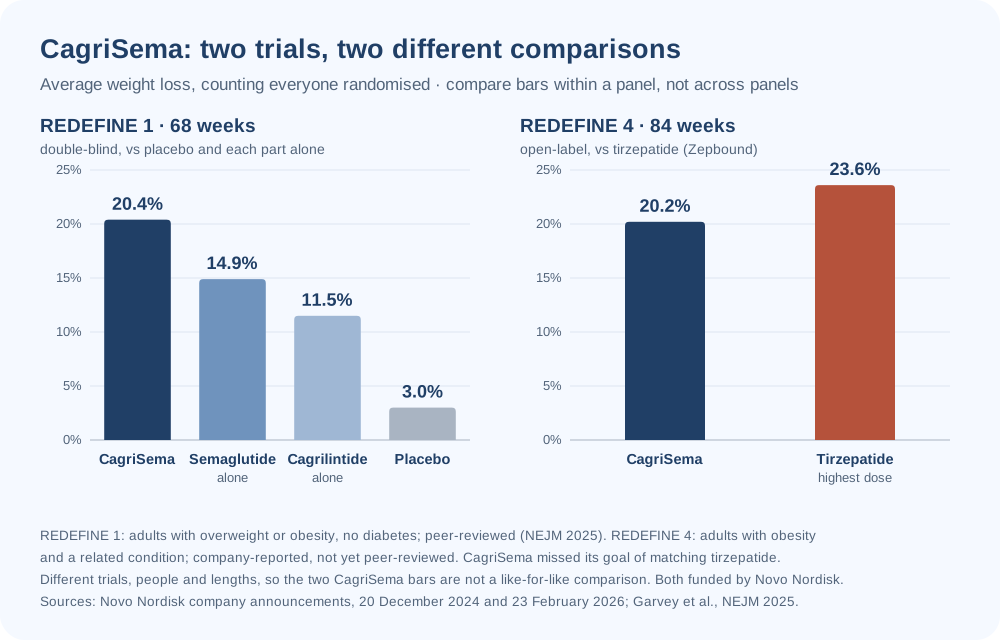
The more useful comparison in REDEFINE 1 is with semaglutide alone, because that is what Wegovy is. Novo Nordisk's topline announcement reported 14.9% weight loss with semaglutide alone and 11.5% with cagrilintide alone, against 20.4% with the combination.2 On those figures, adding cagrilintide added about five and a half percentage points on top of semaglutide, which is a real gain, though smaller than the gap between CagriSema and placebo.
A caveat on the headline number
Two figures circulate for REDEFINE 1: 20.4% and 22.7%. The larger one assumes everyone stayed on treatment for the whole 68 weeks; the smaller one counts everyone who was randomised.12 Neither is wrong, but the smaller one is closer to what happens in practice.
There is also a quirk in how the trial was run. Novo Nordisk said the protocol was "flexible", so participants could change their dose during the trial, and after 68 weeks only 57.3% of people on CagriSema were taking the highest dose. The figures were 70.2% for semaglutide alone and 82.5% for cagrilintide alone.2 That makes it hard to say what the full dose does in everyone who can tolerate it, and it hints that many people backed off because of side effects.
Against Zepbound: the trial CagriSema lost
In February 2026, Novo Nordisk reported REDEFINE 4, an 84-week, open-label trial of 809 adults with obesity and at least one related condition, comparing CagriSema with tirzepatide at its highest dose. Tirzepatide is the drug in Zepbound and Mounjaro.37
Counting everyone randomised, weight fell by 20.2% with CagriSema and 23.6% with tirzepatide. The company's own words were blunt: "The trial did not achieve its primary endpoint of demonstrating non-inferiority on weight loss." In other words, CagriSema failed to show that it was not meaningfully worse than tirzepatide.3 The full results have not been published in a journal, and none are posted on the trial registry.7
The picture in type 2 diabetes is mixed. In REIMAGINE 4, a 68-week open-label trial in people with type 2 diabetes, CagriSema was non-inferior to tirzepatide for weight loss (15.2% against 15.8%) but not for blood sugar, where A1C fell by 1.9 percentage points against 2.2. Those figures assume everyone stayed on treatment, and come from Novo Nordisk's half-year report rather than a paper.4
For a sense of where CagriSema would sit, our post on Zepbound vs Wegovy HD covers how the two current market leaders compare, and the cagrilintide vs tirzepatide page sets out the differences in how the drugs work.
Against Wegovy and Ozempic in diabetes
REIMAGINE 2, presented at the American Diabetes Association meeting in June 2026, is the largest diabetes trial so far. It randomised 2,713 adults with type 2 diabetes taking metformin, with or without an SGLT2 inhibitor, to CagriSema at two strengths, semaglutide alone at two strengths, cagrilintide alone or placebo, for 68 weeks.8
Counting everyone randomised, the higher CagriSema strength lowered weight by 12.9% and A1C by 1.80 percentage points. Semaglutide alone at the same dose as Wegovy's standard top dose lowered weight by 9.2% and A1C by 1.68 points.8 So the extra weight loss carried over into diabetes, while the extra blood-sugar effect was small. Novo Nordisk has not said it will seek a diabetes approval in the US; the current application is for weight management only.18
Side effects
The side effects are the familiar ones for this class, but more frequent than with semaglutide alone.
- In REDEFINE 1, 79.6% of people on CagriSema reported gastrointestinal side effects, against 39.9% on placebo; nausea affected 55%, constipation 30.7% and vomiting 26.1%. Most were mild to moderate and passed with time.15
- Stopping because of side effects was more common on CagriSema: 5.9% against 3.5% on placebo in REDEFINE 1, and 8.4% against 3% in REDEFINE 2.1
- In REIMAGINE 2, 8.5% of people on the higher CagriSema strength stopped because of side effects, against 6.6% on semaglutide alone at Wegovy's top dose. Gastrointestinal effects were reported by 67.2% and 53.9%.8
Novo Nordisk describes the safety profile as consistent with the GLP-1 class.13 What the trials cannot yet show is whether CagriSema reduces heart attacks and strokes, as semaglutide does in people with heart disease. That is being tested in REDEFINE 3, a trial of 7,101 adults with established cardiovascular disease, which is not expected to reach its primary completion until September 2027.910 Our overview of peptide side effects explains how trial side-effect figures differ from what users report online.
What the FDA decision will and won't settle
If FDA approves it, CagriSema becomes a prescription medicine for weight management in adults, with a label that sets out who it is for and what warnings apply. The label is the first place to look for the details trials leave out, such as how the dose is stepped up. Price and insurance coverage are separate questions that approval does not answer.
If FDA rejects it or asks for more data, Novo Nordisk would have to address the agency's concerns before trying again. Nothing public suggests either outcome is more likely, and we will not guess.
Either way, approval would not make CagriSema better than Zepbound. On the evidence so far, it is a step up from semaglutide alone and a step short of tirzepatide's highest dose, with more stomach side effects than semaglutide. Some people who do not tolerate or respond to one drug may do better on another, which is one reason more options matter. If you are not losing weight on your current treatment, our guide on what the trials say is normal is a better starting point than waiting for a new drug.
There is no legal way to buy CagriSema now. Anything sold online under that name, or as cagrilintide, is not the product tested in these trials; our explainer on "research use only" peptides sets out why. The legal route to an investigational drug is a clinical trial, and our guide to joining a weight-loss drug trial explains how.
What to watch for next
- The FDA decision itself, and the label that comes with it.34
- Novo Nordisk's nine-month results, due on 4 November 2026, which may update the timing.4
- REDEFINE 11, which Novo Nordisk expects to report in the first half of 2027, and a higher-dose CagriSema trial, which it expects to read out in the first half of 2028.34
- REDEFINE 4 in a journal, with the full side-effect and dropout data.3
Our overview of where the next weight-loss drugs stand tracks CagriSema alongside orforglipron and retatrutide. We will update this article when FDA acts.
How we reviewed this article
Sources
InsidePeptides relies on primary sources: peer-reviewed studies, trial registries and regulators’ own documents. Read our editorial policy.
- Novo Nordisk. 2025. Novo Nordisk files for FDA approval of CagriSema, the first once-weekly combination of GLP-1 and amylin analogues for weight management. Press release, 18 December 2025. Accessed 3 November 2026.
- Novo Nordisk. 2024. CagriSema demonstrates superior weight loss in adults with obesity or overweight in the REDEFINE 1 trial. Company announcement No 99/2024, 20 December 2024. Topline results. Accessed 3 November 2026.
- Novo Nordisk. 2026. CagriSema demonstrated 23% weight loss in an open-label head-to-head REDEFINE 4 trial in people with obesity. Company announcement No 13/2026, 23 February 2026. Topline results; not peer-reviewed. Accessed 3 November 2026.
- Novo Nordisk. 2026. Financial report for the period 1 January 2026 to 30 June 2026. Company announcement No 48/2026, 4 August 2026. R&D section (REIMAGINE 4, REDEFINE 9, high-dose trial) and anticipated 2026 milestones. Accessed 3 November 2026.
- Garvey WT, Blüher M, Osorto Contreras CK, et al. 2025. Coadministered Cagrilintide and Semaglutide in Adults with Overweight or Obesity. N Engl J Med 393(7):635-647. PMID 40544433. doi:10.1056/NEJMoa2502081. REDEFINE 1; funded by Novo Nordisk.
- Davies MJ, Bajaj HS, Broholm C, et al. 2025. Cagrilintide-Semaglutide in Adults with Overweight or Obesity and Type 2 Diabetes. N Engl J Med 393(7):648-659. PMID 40544432. doi:10.1056/NEJMoa2502082. REDEFINE 2; funded by Novo Nordisk.
- ClinicalTrials.gov. NCT06131437: A Research Study to See How Well CagriSema Compared to Tirzepatide Helps People With Obesity Lose Weight. REDEFINE 4; 809 participants; completed January 2026; no results posted; checked 3 November 2026.
- Novo Nordisk. 2026. CagriSema 2.4 mg/2.4 mg demonstrated significant reduction in HbA1c and weight across multiple studies in the REIMAGINE program presented at ADA 2026. Press release, 7 June 2026. Accessed 3 November 2026.
- Cavender MA, Jastreboff AM, Cheng AYY, et al. 2026. Design and baseline characteristics of the CagriSema cardiovascular outcomes trial (REDEFINE 3). Am Heart J (online ahead of print). PMID 42838477. doi:10.1016/j.ahj.2026.107626.
- ClinicalTrials.gov. NCT05669755: REDEFINE 3: A Research Study to See the Effects of CagriSema in People Living With Diseases in the Heart and Blood Vessels. Active, not recruiting; estimated primary completion September 2027; checked 3 November 2026.
History
Each entry records a dated change to this article’s content. Link and formatting changes are not listed.
Current version
Written by InsidePeptides Editorial Team
Scientific review pending
Last updated
Published


