Who Makes Peptide Drugs? What Samsung's PolyPeptide Deal Means for the GLP-1 Supply Chain
Samsung Biologics is close to owning peptide maker PolyPeptide. Who makes GLP-1 ingredients, why capacity matters and what the deal does and doesn't change.

Key takeaways
- By the end of its takeover offer on 30 October 2026, Samsung Biologics and its partners held almost 98% of PolyPeptide, a contract manufacturer of peptide drug ingredients with significant GLP-1 work; regulatory approvals are still needed and completion is expected at the end of 2026 or in early 2027.
- Branded peptide medicines are made by their owners or by contract manufacturers at sites covered by their approvals, while compounded and gray-market products rely on bulk ingredients that FDA does not review before sale.
- The deal does not change any medicine, price or supply route now; which drugmakers PolyPeptide supplies, and whether Samsung will add capacity, has not been disclosed.
In this article
Samsung Biologics is close to owning PolyPeptide, one of the specialist companies that make peptide drug ingredients for other drugmakers, including for GLP-1 medicines. By the end of its takeover offer on 30 October 2026, Samsung and its partners held almost 98% of PolyPeptide's shares. The deal still needs regulatory approvals in several countries and is expected to close at the end of 2026 or early in 2027. For anyone taking a peptide medicine, nothing changes this week. But the deal is a useful moment to look at a question most patients never ask: who actually makes the drug in the pen, and how is that different from the ingredients behind compounded and gray-market products?12
This article explains what was agreed, what a peptide contract manufacturer does, why manufacturing capacity became a public issue during the GLP-1 shortages, and what the deal does and does not change. It covers events up to 3 November 2026.
What Samsung agreed to buy
Samsung Biologics, a South Korean contract manufacturer best known for making antibody medicines for other companies, announced an all-cash offer for PolyPeptide Group on 19 July 2026. It offered CHF 44.31 per share, valuing the company at about CHF 1.46 billion (roughly $1.8 billion). PolyPeptide's independent board members recommended the offer, and its largest shareholder, with about 55.65% of the shares, agreed in advance to sell.2
The offer was made through a Swiss subsidiary, Samsung Peptide AG. According to the provisional end result published on 2 November 2026, Samsung Peptide and parties acting with it now hold 97.99% of PolyPeptide's shares and voting rights. The definitive result is due on 5 November 2026. The offer is still subject to "regulatory approvals in certain jurisdictions", including merger and foreign-investment clearances, and Samsung has postponed settlement until those arrive. Once the deal closes, Samsung plans to buy out the remaining shareholders and take PolyPeptide off the Swiss stock exchange.1
Samsung's stated reason is strategic: the deal takes it beyond antibodies into peptide-based medicines, "GLP-1 included", and adds sites in the United States, Europe and India.2 That is the company's own description of its plans, not an independent assessment.
What a peptide contract manufacturer actually does
Most people assume the company whose name is on the box made everything in it. Often that is only partly true. Drugmakers can make the active ingredient in their own plants, hire a contract development and manufacturing organisation (CDMO) to make some or all of it, or do both.
PolyPeptide describes itself as a CDMO "for peptide-based active pharmaceutical ingredients", meaning it makes the active substance rather than the finished pens or vials. It traces its history to 1952, runs six GMP-certified facilities in Europe, the United States and India, and says it has "significant exposure to metabolic diseases, including GLP-1".1 GMP stands for good manufacturing practice, the set of quality rules that regulators inspect against. Neither company's announcements say which GLP-1 products PolyPeptide makes, or for whom, and drugmakers rarely disclose their contract suppliers.
Two ways to make a peptide medicine
Peptides are short chains of amino acids, and there are two broad ways to make them at scale. Our guide to natural and synthetic peptides covers the chemistry in more detail.
Grow it, then modify it. The prescribing information for Ozempic says the peptide backbone of semaglutide "is produced by yeast fermentation". A spacer and a fatty-acid chain are then attached chemically.3
Build it chemically. Tirzepatide, the ingredient in Mounjaro and Zepbound, contains building blocks that do not occur in natural proteins, including aminoisobutyric acid.11 A 2021 paper described making it at kilogram scale under GMP using a hybrid of solid-phase and liquid-phase peptide synthesis, with continuous manufacturing.4
Chemical peptide synthesis is demanding. A review written by process chemists from eight drugmakers noted that the field still relies largely on "legacy technologies" that use "large amounts of highly hazardous reagents and solvents".5 Making long peptides in tonne quantities, purifying them and proving every batch meets specification takes specialised plants and experienced staff. That is why capacity cannot be switched on quickly, and why companies that already have it are valuable.
The ingredient is only half of it
An active ingredient is not yet a medicine. It still has to be made into a sterile solution, filled into pens or vials, inspected and packaged, a step known as fill-finish. That step has also been a bottleneck.
In December 2024, the investment company Novo Holdings completed its purchase of the contract manufacturer Catalent for about $16.5 billion. As part of the deal, three Catalent fill-finish sites, in Anagni (Italy), Bloomington (USA) and Brussels (Belgium), were transferred to Novo Nordisk, the maker of Ozempic and Wegovy.6
Why capacity became everyone's problem
From 2022, demand for the new GLP-1 medicines outran supply. FDA added Wegovy to its drug shortage list in March 2022 and Ozempic in August 2022. Tirzepatide injection products followed on 15 December 2022.78
Shortages matter beyond the pharmacy counter. While a drug is officially in shortage, US law gives pharmacies more room to compound copies of it, and that is how compounded semaglutide and tirzepatide became widely available through telehealth services. Our explainer on FDA's plan to end bulk compounding of GLP-1s sets out the legal side.
FDA decided the tirzepatide shortage was resolved on 2 October 2024, then reconsidered and confirmed that decision on 19 December 2024.7 It declared the semaglutide shortage resolved on 21 February 2025. In that order, FDA said the data Novo Nordisk provided showed supply "meeting or exceeding demand", with reserves of finished product and "significant units of semi-finished product" in stock. The agency also noted reports that some patients and pharmacists still could not get the drugs.8 In other words, the end of the shortage came down to how much product the manufacturers could make and hold, which is exactly what deals like this one are about.
Where compounded and gray-market ingredients come from
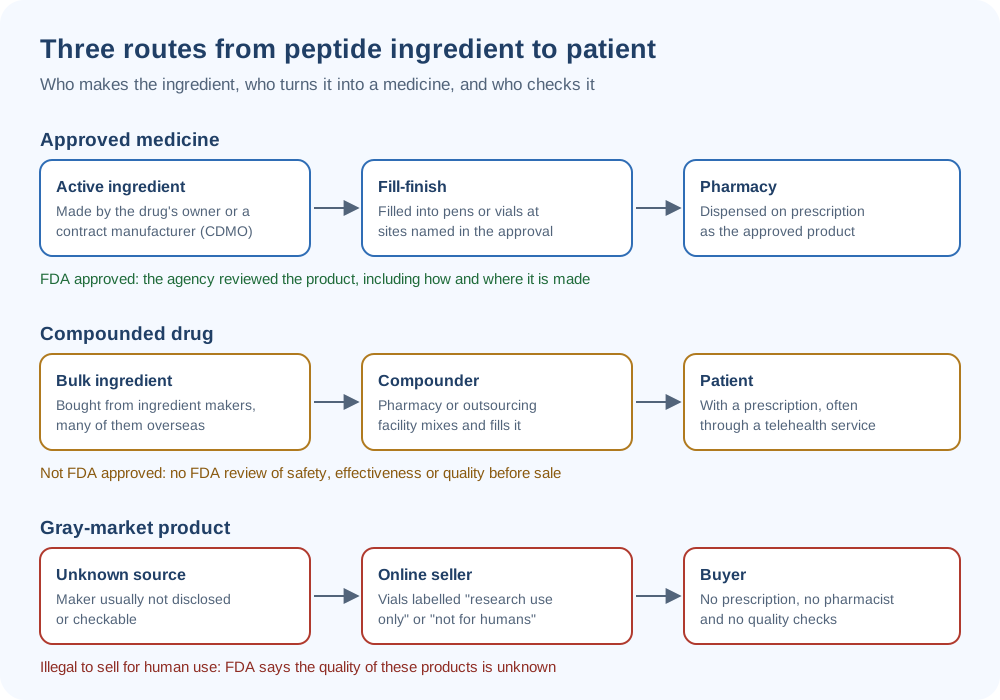
The diagram above shows the difference. An approved medicine is approved as a specific product made in specific places, not as a molecule (our guide to what FDA approval means explains this). Compounded and gray-market products follow other routes.
Compounded drugs. Pharmacies that compound semaglutide or tirzepatide buy bulk ingredient from chemical suppliers, many of them overseas. FDA states plainly that "compounded drugs are not FDA approved" and are not reviewed for safety, effectiveness or quality before they are sold. It also says ingredients made abroad "may be manufactured without appropriate controls to assure quality", and that salt forms such as semaglutide sodium and semaglutide acetate are different active ingredients from the one in approved drugs.10 In September 2025 FDA set up a "green list" for GLP-1 ingredients, so that shipments from foreign sites it has not checked can be held at the border.9 What its inspectors have since found at some of those factories is covered in our report on compounded GLP-1 ingredient factories and recalls.
Gray-market products. Vials sold online as "research" chemicals sit outside both systems. FDA has warned about sellers that label products "for research purposes" or "not for human consumption" while selling them for people to inject, and says their quality is unknown.10 The maker of the ingredient is rarely named, and there is no way for a buyer to check it. See what "research use only" really means, what lab tests of online peptides have found and our report on gray-market retatrutide.
A takeover of a contract manufacturer touches only the first route. CDMOs such as PolyPeptide make ingredients for drugmakers under contract and under regulators' inspection; that is a different supply chain from the one feeding compounding pharmacies and online sellers.
What the deal changes, and what it doesn't
What is known:
- Samsung has secured almost all of PolyPeptide's shares, but the transaction has not closed. It still depends on regulatory approvals, with completion expected at the end of 2026 or in the first quarter of 2027.1
- PolyPeptide will become a wholly owned Samsung subsidiary and leave the Swiss stock exchange after settlement.12
What it does not change, at least now:
- Your medicine. Approved products are made at sites listed in their approvals. A change of owner at a supplier does not by itself change the drug, its price or how you get it.
- Compounded and gray-market supply. The deal has nothing to do with the bulk-ingredient market behind compounded products, or with online "research" vials.
What is still unknown:
- Which drugmakers PolyPeptide supplies, and how much of its work is for GLP-1 medicines. Neither company has said.
- Whether Samsung will expand peptide capacity, where, and how quickly. Its announcements describe strategy, not specific plans for new plants.
- How regulators in the countries still reviewing the deal will rule.
Supply problems for peptide medicines have not disappeared just because the big GLP-1 shortages ended, and new drugs are on the way: our overview of where the next weight-loss drugs stand tracks the pipeline. If any of them succeed, the ability to make peptides at scale will matter again, and the companies that control that capacity will shape how quickly patients can get them.
If you use a peptide medicine and run into supply problems, your pharmacist or prescriber can tell you about approved alternatives. If you use a compounded product, it is reasonable to ask the pharmacy where its ingredient comes from and whether the supplier is registered with FDA.
This article is for general information. It is not medical or investment advice.
How we reviewed this article
Sources
InsidePeptides relies on primary sources: peer-reviewed studies, trial registries and regulators’ own documents. Read our editorial policy.
- PolyPeptide Group AG. 2026. Provisional end result of the public tender offer of Samsung Biologics Co., Ltd. Media release (ad hoc announcement pursuant to Art. 53 LR), Baar, 2 November 2026. Accessed 3 November 2026.
- Samsung Biologics. 2026. Samsung Biologics announces all-cash offer to acquire PolyPeptide, accelerating multi-modality strategy and expanding global network across U.S., Europe and India. Press release, 19 July 2026. Accessed 3 November 2026.
- Novo Nordisk. 2026. OZEMPIC (semaglutide) injection: prescribing information. DailyMed; section 11 (Description) checked 3 November 2026.
- Frederick MO et al. 2021. Kilogram-Scale GMP Manufacture of Tirzepatide Using a Hybrid SPPS/LPPS Approach with Continuous Manufacturing. Org Process Res Dev 25(7):1628-1636. DOI: 10.1021/acs.oprd.1c00108.
- Isidro-Llobet A et al. 2019. Sustainability Challenges in Peptide Synthesis and Purification: From R&D to Production. J Org Chem 84(8):4615-4628. PMID: 30900880. DOI: 10.1021/acs.joc.8b03001.
- Novo Holdings. 2024. Novo Holdings completes acquisition of Catalent. Press release, 18 December 2024. Accessed 3 November 2026.
- US Food and Drug Administration. 2024. Declaratory Order: Resolution of Shortages of Tirzepatide Injection Products (Mounjaro and Zepbound). Letter to Eli Lilly and Company, 19 December 2024. Accessed 3 November 2026.
- US Food and Drug Administration. 2025. Declaratory Order: Resolution of Shortages of Semaglutide Injection Products (Ozempic and Wegovy). Letter to Novo Nordisk Inc., 21 February 2025. Accessed 3 November 2026.
- US Food and Drug Administration. 2025. FDA launches green list to protect Americans from illegal imported GLP-1 drug ingredients. Press announcement, 5 September 2025. Accessed 3 November 2026.
- US Food and Drug Administration. 2026. FDA's concerns with unapproved GLP-1 drugs used for weight loss. Content current as of 1 October 2026. Accessed 3 November 2026.
- Eli Lilly and Company. 2026. ZEPBOUND (tirzepatide) injection: prescribing information. DailyMed, updated 28 August 2026; section 11 (Description) checked 3 November 2026.
History
Each entry records a dated change to this article’s content. Link and formatting changes are not listed.
Current version
Written by InsidePeptides Editorial Team
Scientific review pending
Last updated
Published


