
“Research Use Only” Peptides: What the Label Really Means
Gray-market peptide sales have surged. What “research use only” means legally, what lab tests of online peptides found, and what a COA cannot show.

Key takeaways
- A “research use only” label does not stop FDA treating a product as an unapproved drug for human use.
- Independent tests of online products have found wrong amounts, wrong ingredients and contamination.
- A purity certificate rarely covers identity, sterility, endotoxin or the vial you actually receive.
In this article
Interest in peptides exploded in 2025 and 2026, and much of the demand is being met by online sellers whose products carry a "research use only" or "not for human consumption" label. That label does not make a product legal to sell for personal use, and it says nothing reliable about what is in the vial. FDA warning letters say so directly, and independent laboratory tests of online products have found wrong amounts, wrong ingredients and contamination.1,2,3,4,5,6,7,8,9
This guide explains how big the trend is, what "research use only" means legally, what testing has actually found, and what a certificate of analysis can and cannot tell you. It names no sellers as recommendations and gives no dosing information.
The short version
- The market grew fast. Blockchain analysts Chainalysis estimate that crypto payments to gray-market peptide sellers rose from $12 million to $32 million between late 2025 and the first quarter of 2026, putting the market on a $100 million-plus annual run rate.1
- "Research use only" is not a legal shield. FDA judges a product by its intended use, shown by the seller's website, claims and accessories, not by a disclaimer.34
- Testing finds real problems: products with 51% to 190% of the labelled amount, a "retatrutide" vial that contained a different drug, and "semaglutide" that contained insulin.6,7,8,9
- A certificate of analysis usually covers one test on one sample. It rarely shows sterility or endotoxin results, which matter most for injections.10
- Athletes: from 1 January 2027, WADA names peptides in general under S0, its class for non-approved substances, which are prohibited at all times.16
How big is the peptide boom?
There is no official count of how many people use unapproved peptides, so the available numbers are indirect:
- Money: Chainalysis traced crypto payments to gray-market peptide vendors. They grew from about $1 million a quarter in 2024 to $32 million in the first quarter of 2026, "a 159% jump quarter-over-quarter". Chainalysis notes that "direct causation cannot be established from on-chain data alone."1
- Search: one industry search-data provider estimates US monthly searches for "peptide" rose about sixfold between April 2025 and March 2026. Its method is not published, so treat this as an estimate.11
- Social media: University of Queensland researchers counted more than 130,000 Instagram posts and more than 230 million TikTok views of peptide content as of May 2026.12
Several forces drove this. They include demand for GLP-1 weight-loss medicines, public enthusiasm from Health Secretary Robert F. Kennedy Jr., and online "biohacking" and "looksmaxxing" culture, which treats appearance as something to engineer.213 For the regulatory side, see our explainers on the FDA panel vote and the reported stopgap plan.
What "research use only" actually means
Federal rules allow some drugs to be shipped without full directions for use when they go to people "engaged in… research not involving clinical use, or in chemical analysis" and are used only for that research.14 That exemption is for laboratories. It does not cover selling to the public for self-injection.
FDA decides what a product is by its intended use, which "may be shown by labeling claims, advertising matter, or oral or written statements… or by the circumstances surrounding the distribution of the article."15 In practice, FDA looks at the whole picture:
- website claims about effects on the body, even when phrased in research language
- dosing charts and "reconstitution" instructions
- selling bacteriostatic water alongside the vials
- selling to consumers rather than to verified laboratories
In its 24 August 2026 warning letter to an online seller, FDA wrote: "Despite statements on your product labeling marketing your products for 'research use only' and 'not for human consumption,' evidence obtained from your website establishes that your products are intended to be drugs for human use." It added that selling bacteriostatic water provided "the means to prepare an injectable drug for human administration."3 FDA used near-identical wording in December 2024 letters to sellers of retatrutide, cagrilintide and other investigational peptides.4
FDA's consumer page warns that such products "could contain the wrong ingredients or harmful ingredients; could contain too little, too much or no active ingredient at all".5 Read our guides on research use only and what the term means.
What independent testing has found
Published analyses of online peptide products are small, but they point the same way:
| What was tested | What was found |
|---|---|
| "Semaglutide" bought online without a prescription (JAMA Network Open, 2024) | Semaglutide was present, but purity was far below the advertised level and content exceeded the label by 29% to 39%. One sample had raised endotoxin. Several orders never arrived.6 |
| Products sold as retatrutide in Australia (Drug and Alcohol Review, 2026) | Three vials contained 51%, 165% and 190% of the labelled amount.7 |
| A "retatrutide" product linked to a serious injury (Australian TGA, 2026) | No retatrutide was found. It contained undeclared semaglutide at roughly eight times the level in approved products, and the user was hospitalized with a torn oesophagus after uncontrollable vomiting.8 |
| "Semaglutide" linked to comas (case reports, 2026) | Vials contained insulin instead, causing dangerously low blood sugar.9 |
| Black-market "ACE-031" (Drug Testing and Analysis, 2025) | Products contained a different protein from the one claimed.17 |
| Commercially made research peptides (J Pharm Biomed Anal, 2020) | Up to 43% of the material was an undeclared ingredient, mannitol, missed by standard chromatography.18 |
These studies tested a handful of products each, so they cannot estimate how common problems are. They do show that the label cannot be trusted. Our peptide purity and peptide testing guides explain the methods.
What a certificate of analysis can and cannot tell you
Sellers often post a certificate of analysis (COA) showing a high HPLC purity. FDA's July 2026 review of BPC-157 found that "most CoAs for BPC-157 (free base) only contain purity testing results" with "no information about the impurity limits/testing results".10 It also noted that "multiple salts, and derivatives, including different active moieties" are sold under the same name.10
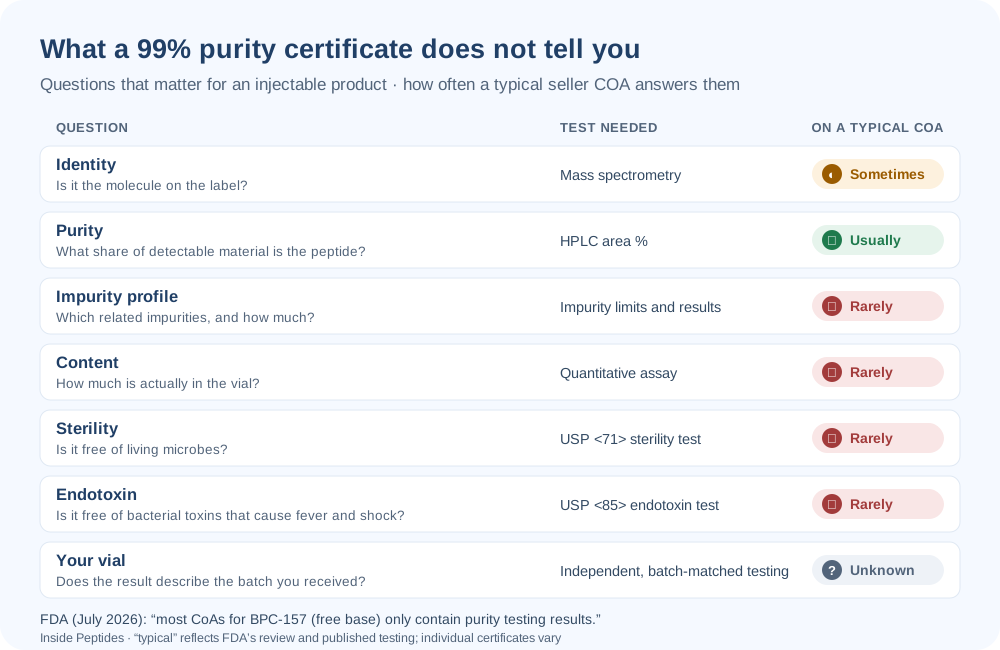
For an injectable product, FDA lists "sterility, bacterial endotoxins test (BET), and foreign particulates" as critical quality attributes.10 A purity percentage addresses none of them. Even a genuine COA describes one sample from one batch, often chosen and paid for by the seller, not the vial you receive. See certificates of analysis and peptide impurities.
Risks beyond the vial
- Preparation errors. In a 2026 study, 20 adults without training, given gray-market semaglutide kits, completed on average only 44% of the steps needed to prepare and inject the product correctly. The authors warned that errors "could result in incorrect dosing, needle sticks, or infections."19
- Unregulated settings. In July 2025, two women were hospitalized in critical condition after peptide injections at a Las Vegas wellness event. Investigators were never able to obtain the product.20
- Immune reactions. FDA has raised concerns about immunogenicity, an unwanted immune response, from impurities and aggregates in injectable peptides. See immunogenicity.
- Under-reporting. FDA says adverse events from compounded GLP-1 products are "likely… underreported". Gray-market products are even less visible.5
For athletes
From 1 January 2027, USADA says, "'peptides' in general are now named as prohibited substances in the S0 class," which applies at all times. It warns that "the current 'peptide craze' may pose serious anti-doping and health risks."16 A contaminated or mislabelled product can still produce a positive test. See WADA peptide rules.
What this means for you
- Treat "research use only" as a warning, not a reassurance. It signals a product that has not been approved for human use.
- A purity number is not a safety guarantee. Identity, actual content, sterility and endotoxin are separate questions.
- Approved versions exist for some names. Semaglutide, tirzepatide, tesamorelin and bremelanotide are approved medicines, available on prescription. A gray-market vial with the same name is not the same product. Compare in approved versus unapproved peptides.
- If you have used one and feel unwell, seek medical care and bring the product. In the US you can report problems to FDA MedWatch.
Frequently asked questions
Is it legal to buy research peptides for personal use?
FDA treats peptides marketed for human use as unapproved new drugs, whatever the label says, and has sent repeated warning letters to sellers.345
Does a 99% purity certificate mean a peptide is safe?
No. HPLC purity measures the share of detectable material in one sample. It does not confirm sterility, endotoxin levels, the exact amount in your vial, or which impurities are present.1018
Why do sellers say "not for human consumption"?
To try to avoid drug regulation. FDA has repeatedly said the disclaimer does not apply when other evidence shows the product is intended for people.34
References
- Chainalysis. Inside the $100M Gray Market Peptide Crypto Boom. 4 June 2026.
- Weiss B. I bought peptides online and helped fuel a $100 million gray-market, ‘looksmaxxing’ economy. Fortune, 4 June 2026.
- FDA. Warning letter: Peak Performance Peptides, 24 August 2026. Center for Drug Evaluation and Research.
- FDA. Warning letter: Xcel Research LLC, 10 December 2024.
- FDA. FDA's concerns with unapproved GLP-1 drugs used for weight loss. Content current as of 1 October 2026.
- Ashraf AR et al. 2024. Safety and Risk Assessment of No-Prescription Online Semaglutide Purchases. JAMA Network Open 7:e2428280. PMID: 39093567. DOI: 10.1001/jamanetworkopen.2024.28280.
- Piatkowski T et al. 2026. Composition and Labelling Accuracy of Products Sold as Retatrutide in Australia. Drug and Alcohol Review 45:e70231. PMID: 42559975. DOI: 10.1111/dar.70231.
- Therapeutic Goods Administration. TGA tests counterfeit retatrutide product following serious adverse event report. Safety alert, 14 September 2026.
- Antonacci G et al. 2026. Hypoglycaemic coma induced by a falsified semaglutide product: a case report. European Journal of Hospital Pharmacy 33:486–489. PMID: 41125326. DOI: 10.1136/ejhpharm-2025-004656. See also Stammers J et al. 2026. Insulin intoxications caused by falsified semaglutide [Dutch]. Nederlands Tijdschrift voor Geneeskunde 170:D9116. PMID: 42390457.
- FDA. Briefing document: BPC-157-related bulk drug substances. Pharmacy Compounding Advisory Committee, July 2026.
- Rising Trends. The Peptide Trend: Inside America’s Parallel Injection Economy. Industry search-volume estimate; methodology not published. Checked 12 October 2026.
- University of Queensland. Popularity of injectable peptides surges online and regulation isn’t keeping up. 16 June 2026. Related viewpoint: Piatkowski T, Ganson KT, Nagata JM. 2026. Illicit Injectable Peptides and Regulatory Gaps. JAMA 336:189–190. PMID: 42295803. DOI: 10.1001/jama.2026.10690.
- Coleman T. Peptides: the latest biohacking trend. The Week, 15 April 2026.
- 21 CFR 201.125: Drugs for use in teaching, law enforcement, research, and analysis. Electronic Code of Federal Regulations.
- 21 CFR 201.128: Meaning of "intended uses". Electronic Code of Federal Regulations.
- USADA. What's new on the 2027 WADA Prohibited List. Athlete advisory, October 2026.
- Reichel C et al. 2025. Gel Electrophoretic Detection of Black Market ACE-031. Drug Testing and Analysis. PMID: 40312924. DOI: 10.1002/dta.3898.
- Choules MP et al. 2020. NMR reveals an undeclared constituent in custom synthetic peptides. Journal of Pharmaceutical and Biomedical Analysis 178:112915. PMID: 31671336. DOI: 10.1016/j.jpba.2019.112915.
- Sedensky A et al. 2026. Ability of Adults to Correctly Use Grey Market Peptide Semaglutide GLP-1 Receptor Agonists Acquired Without a Prescription. Public Health Reports. PMID: 42541373. DOI: 10.1177/00333549261464876.
- ProPublica. Investigation Underway After Two Women Fell Ill at RAADFest, a Las Vegas Anti-Aging Conference. 29 July 2025. Follow-up: Nevada Issues Fines for Peptide Injections at RAADFest, Where Two Women Fell Ill, 13 March 2026.


