
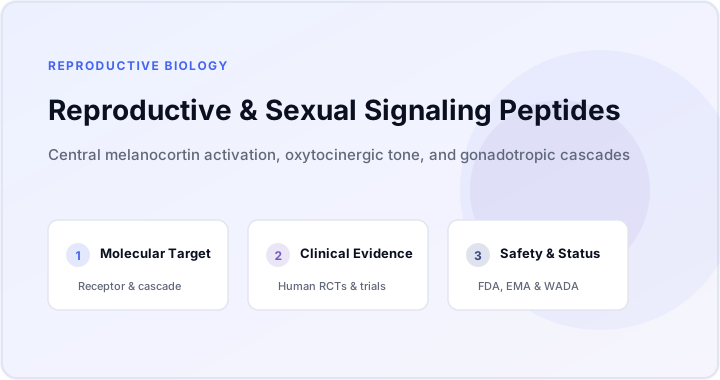
Field Summary & Status
Strong EvidenceThe Hypothalamic-Pituitary-Gonadal Axis & Neuromodulation
Human reproduction is governed by a hierarchical neuroendocrine axis centered on the pulsatile secretion of Gonadotropin-Releasing Hormone (GnRH) from the arcuate and preoptic nuclei of the hypothalamus. GnRH binds to anterior pituitary gonadotrophs to drive the synthesis and secretion of luteinizing hormone (LH) and follicle-stimulating hormone (FSH).
Peptide pharmacology has transformed reproductive medicine in multiple dimensions: GnRH agonists and antagonists provide medical castration in oncology and prevent premature LH surges in assisted reproductive technology (IVF); oxytocin serves as the global standard for labor augmentation and postpartum hemorrhage; and kisspeptin analogues offer novel physiological triggers for oocyte maturation without ovarian hyperstimulation syndrome (OHSS).
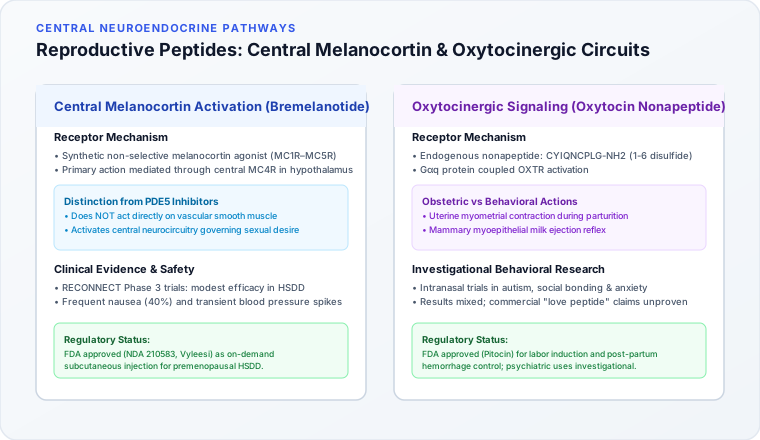
Additionally, melanocortin receptor agonist peptides like bremelanotide (Vyleesi) modulate central sexual desire pathways in the prefrontal cortex and hypothalamus, earning FDA approval for hypoactive sexual desire disorder (HSDD).
Biological Systems & Signaling Mechanisms
Reproductive peptides regulate gonadotropin pulses, myometrial contraction, and central desire circuits.
Pulsatile GnRH Receptor Signaling
Pulsatile GnRH-R activation stimulates Gq/11, raising intracellular calcium to release LH and FSH; continuous non-pulsatile stimulation causes receptor downregulation and chemical castration.
Endocrine Physiology
Gq-Coupled Myometrial Contraction
Oxytocin activates myometrial Gq-coupled OXTRs, elevating intracellular calcium and stimulating myosin light chain kinase (MLCK) for forceful labor contractions.
Obstetric Pharmacology
Central Melanocortin MC4R Agonism
Bremelanotide activates hypothalamic MC4Rs, modulating dopaminergic and noradrenergic transmission to enhance sexual arousal.
Neuropharmacology
Peptide Classes & Molecular Targets
Reproductive therapeutics divide into HPG axis regulators, uterotonics, and central melanocortin mimetics.
GnRH Receptor Agonists & Antagonists
Target: Leuprolide, Goserelin, DegarelixDecapeptides that downregulate (agonists) or immediately block (antagonists) pituitary gonadotropin secretion.
Neurohypophysial Uterotonic Nonapeptides
Target: Oxytocin, CarbetocinCyclic peptides that stimulate uterine smooth muscle cross-bridging during labor and postpartum recovery.
Synthetic Melanocortin Analogues
Target: Bremelanotide (Vyleesi)Cyclic heptapeptides acting centrally on MC4R to treat hypoactive sexual desire disorder in premenopausal women.
Human Clinical Trials & Observational Data
Landmark Phase 3 trials evaluate obstetric safety, IVF maturation, and hypoactive sexual desire.
| Trial / Study | Identifier / Compound | Phase & Cohort | Status / Duration | Primary Findings |
|---|---|---|---|---|
| RECONNECT Phase 3 Trials (Bremelanotide) |
RECONNECT Phase 3 Trials (Bremelanotide)
NCT02333071
|
Phase 3 Double-Blind RCT
1,267 premenopausal women with HSDD randomized across two trials (1,202 in the efficacy population)
|
Completed |
Statistically significant increases in sexual desire scores and decreases in distress scores compared to placebo.
Published 2019
|
| The Use of the Hormone Kisspeptin in IVF Treatment (women at high risk of OHSS) |
The Use of the Hormone Kisspeptin in IVF Treatment (women at high risk of OHSS)
NCT01667406
|
Phase 2 Open-Label Randomized Dose-Finding
60 women undergoing IVF at high risk of OHSS
|
Completed |
Oocyte maturation occurred in 95% of women; live birth rate per transfer was 45% across doses, and no woman developed moderate, severe or critical OHSS.
Published 2015
|
Approved Medicines vs. Investigational Compounds
Clear distinction between regulatory-approved prescription medicines and experimental candidates undergoing laboratory or early clinical testing.
| Compound | Target / Mechanism | Regulatory Status | Indications / Focus | Sponsor / Developer |
|---|---|---|---|---|
| Oxytocin (Pitocin) | Approved Biological Target | FDA/EMA Approved (1955) | Labor Induction & PPH Prevention | Multiple Manufacturers |
| Leuprolide Acetate (Lupron) | Approved Biological Target | FDA/EMA Approved (1985) | Prostate Cancer & Endometriosis | AbbVie |
| Bremelanotide (Vyleesi) | Approved Biological Target | FDA/EMA Approved (2019) | Hypoactive Sexual Desire Disorder in Women | Palatin / AMAG |
| Kisspeptin-54 | KISS1R agonism for OHSS-free IVF trigger | Phase 2 Clinical Development | Preclinical / Investigational | Imperial College / Biotech |
Safety Realities & Endocrine Risks
Modulating reproductive hormones requires monitoring bone density, cardiovascular blood pressure, and uterine tone.
Transient Blood Pressure Elevation (Bremelanotide)
ModerateTransient systolic and diastolic blood pressure elevations and focal hyperpigmentation reported with bremelanotide use.
Trabecular Bone Loss with GnRH Agonists
Moderate to HighLong-term chemical castration reduces bone mineral density, requiring 'add-back' estrogen therapy for non-oncology indications.
Uterine Tachysystole from Oxytocin Hyperstimulation
Severe / AcuteExcessive oxytocin dosing can induce tetanic uterine contractions and fetal distress, requiring continuous fetal heart rate monitoring.
Unresolved Scientific Questions
Key mechanistic and translational questions currently under active scientific investigation.
Will kisspeptin replace hCG as the primary IVF trigger worldwide?
Large-scale multinational non-inferiority trials comparing kisspeptin against GnRH agonist triggers in commercial IVF clinics are ongoing.
Can central melanocortin agonists be developed without transient blood pressure spikes?
Refining MC4R vs MC1R vs MC3R subtype selectivity to decouple desire enhancement from sympathetic vasoconstriction.
Evolution of Research & Milestones
Historical scientific breakthroughs, isolation events, structural discoveries, and regulatory milestones.
Oxytocin Synthesized
Du Vigneaud completes first peptide hormone synthesis.
GnRH Structure Solved
Schally and Guillemin isolate and sequence hypothalamic GnRH.
Bremelanotide FDA Approval
Vyleesi approved as first on-demand peptide for female sexual desire.
Scientific References
Primary scientific publications, randomized controlled trials, and clinical consensus papers referenced in this field overview.
-
Bremelanotide for the treatment of hypoactive sexual desire disorder: two randomized phase 3 trials Obstet Gynecol · 2019
-
Efficacy of kisspeptin-54 to trigger oocyte maturation in women at high risk of ovarian hyperstimulation syndrome (OHSS) during in vitro fertilization (IVF) therapy J Clin Endocrinol Metab · 2015
-
Uterotonic agents for preventing postpartum haemorrhage: a network meta-analysis Cochrane Database Syst Rev · 2018
Scientific & Educational Disclaimer
InsidePeptides.org provides scientific and educational analysis of peer-reviewed research for informational purposes only. This overview does not constitute medical advice, diagnosis, treatment, prescription, or clinical guidance. Incretin and metabolic peptide medicines require physician oversight, prescription authorization, and regular clinical monitoring. Never adjust, initiate, or discontinue prescribed treatments without direct consultation with a qualified medical specialist.