
Field Summary & Status
Strong Evidence for Approved Drugs; Early Human for UnapprovedSomatotropic Endocrinology & Secretagogue Modulation
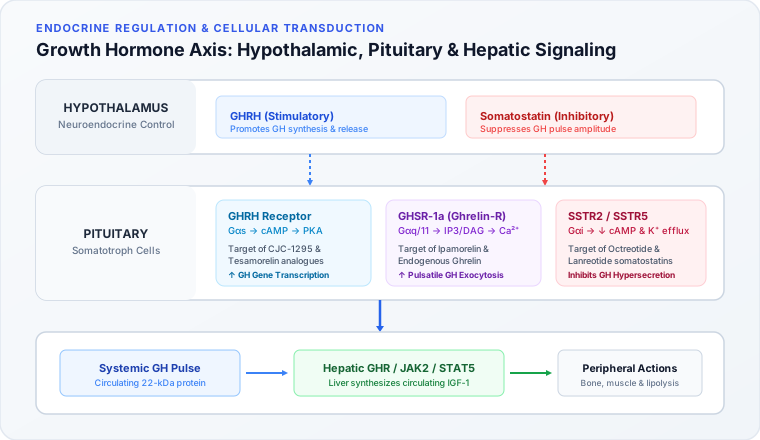
The somatotropic axis is governed by anterior pituitary growth hormone (GH) secretion, which stimulates hepatic synthesis of insulin-like growth factor 1 (IGF-1). Natural GH release occurs in pulsatile bursts coordinated by two opposing hypothalamic hormones: Growth Hormone-Releasing Hormone (GHRH, stimulatory) and Somatostatin (inhibitory).
In the late 1990s, discovery of the growth hormone secretagogue receptor (GHSR-1a) and its endogenous ligand ghrelin revealed a third regulatory input. Synthetic peptides targeting this axis divide into GHRH receptor agonists (which preserve feedback loops) and GHSR secretagogues (which trigger potent pulses).
While tesamorelin achieved FDA approval for visceral fat reduction in HIV-associated lipodystrophy, underground marketing of unapproved analogues (CJC-1295, ipamorelin) for bodybuilding is widespread and strictly banned under WADA Category S2.
Biological Systems & Signaling Mechanisms
Growth-hormone-producing cells in the pituitary gland receive signals through cell-surface receptors, including GPCRs. These signals help control the release of growth hormone (GH) from storage inside the cells.
GHRH Receptor Gs / cAMP Cascade
GHRH binding stimulates adenylyl cyclase and cAMP, activating PKA to promote somatotroph proliferation and GH transcription.
Endocrine Physiology
GHSR-1a Gq / Calcium Mobilization
Ghrelin secretagogues activate phospholipase C, mobilizing IP3 and intracellular Ca2+ to trigger immediate granule exocytosis.
Receptor Pharmacology
Somatostatin Gi Suppression
Somatostatin activates Gi-coupled receptors, inhibiting adenylyl cyclase and lowering intracellular calcium to blunt GH pulses.
Feedback Regulation
Peptide Classes & Molecular Targets
Compounds modulating the somatotropic axis divide into physiological GHRH analogues and ghrelin receptor mimetics.
Synthetic GHRH Analogues
Target: Tesamorelin, CJC-1295 (Modified GRF 1-29)Peptides modeled on GHRH(1-29) or full-length GHRH(1-44) engineered for enzymatic stability.
Growth Hormone Secretagogues (GHSR-1a Agonists)
Target: Ipamorelin, GHRP-6, GHRP-2Small synthetic peptides and peptidomimetics that stimulate GH release via ghrelin receptors.
Somatostatin Receptor Ligands (SRLs)
Target: Octreotide, Lanreotide, PasireotideCyclic peptides that suppress pathological GH and IGF-1 hypersecretion in acromegaly.
Human Clinical Trials & Observational Data
Rigorous human trials demonstrate visceral adiposity reduction and growth hormone stimulation.
| Trial / Study | Identifier / Compound | Phase & Cohort | Status / Duration | Primary Findings |
|---|---|---|---|---|
| TH9507 (Tesamorelin) in Patients With HIV-Associated Lipodystrophy |
TH9507 (Tesamorelin) in Patients With HIV-Associated Lipodystrophy
NCT00123253
|
Phase 3
412 HIV patients with abdominal fat accumulation, 26 weeks
|
Completed |
Visceral adipose tissue decreased 15.2% with tesamorelin vs a 5.0% increase with placebo; triglycerides and cholesterol-to-HDL ratio also improved.
Published 2007
|
| CJC-1295 Healthy Volunteer Pharmacokinetics |
CJC-1295 Healthy Volunteer Pharmacokinetics
JCEM-2006
|
Phase 1 Dose Escalation
66 healthy adults
|
Completed |
Sustained multi-fold increases in mean trough GH and circulating IGF-1 lasting 6-14 days.
Published 2006
|
Approved Medicines vs. Investigational Compounds
Clear distinction between regulatory-approved prescription medicines and experimental candidates undergoing laboratory or early clinical testing.
| Compound | Target / Mechanism | Regulatory Status | Indications / Focus | Sponsor / Developer |
|---|---|---|---|---|
| Tesamorelin (Egrifta / Egrifta SV) | Approved Biological Target | FDA/EMA Approved (2010) | HIV-Associated Visceral Adiposity | Theratechnologies |
| Octreotide (Sandostatin / Sandostatin LAR) | Approved Biological Target | FDA/EMA Approved (1988) | Acromegaly & Neuroendocrine Tumors | Novartis |
| Ipamorelin | Selective GHSR-1a agonist | Failed Phase 2 (Postoperative Ileus) | Preclinical / Investigational | Helse Sør-Øst / Novo Nordisk |
| CJC-1295 DAC | Albumin-conjugated GHRH analogue | Terminated Phase 2 | Preclinical / Investigational | ConjuChem |
Safety Realities & Endocrine Risks
Chronically elevating growth hormone and IGF-1 carries documented systemic, oncological, and metabolic risks.
Impaired Glucose Tolerance & Insulin Resistance
Moderate to HighExcess growth hormone stimulates hepatic gluconeogenesis and antagonizes peripheral insulin action, raising fasting blood glucose.
Water Retention & Carpal Tunnel Syndrome
Mild to ModerateFluid retention, peripheral edema, and arthralgias commonly occur during somatotropic axis elevation.
WADA Prohibition & Anti-Doping Sanctions
Regulatory DisqualificationAll GHRH analogues and GH secretagogues are classified under WADA Category S2, carrying multi-year athletic bans.
Unresolved Scientific Questions
Key mechanistic and translational questions currently under active scientific investigation.
Does long-term secretagogue therapy increase lifetime neoplasia risk?
Sustained elevation of circulating IGF-1 is epidemiologically linked to mitogenic cellular signaling; multi-decade safety data in healthy individuals is absent.
Is pulsatile GHSR stimulation superior to recombinant GH replacement?
Comparative trials evaluating secretagogues against daily recombinant somatropin for anti-aging endpoints lack clinical substantiation.
Evolution of Research & Milestones
Historical scientific breakthroughs, isolation events, structural discoveries, and regulatory milestones.
GHRH Characterized
Guillemin and Vale independently isolate and sequence human pancreatic and hypothalamic GHRH.
Ghrelin Discovered
Kojima identifies ghrelin as the natural endogenous ligand for GHSR-1a.
Tesamorelin FDA Approval
Egrifta becomes the first GHRH analogue approved by the FDA.
Scientific References
Primary scientific publications, randomized controlled trials, and clinical consensus papers referenced in this field overview.
-
Metabolic effects of a growth hormone-releasing factor in patients with HIV N Engl J Med · 2007
-
Prolonged stimulation of GH and IGF-I secretion by CJC-1295 in healthy adults J Clin Endocrinol Metab · 2006
Scientific & Educational Disclaimer
InsidePeptides.org provides scientific and educational analysis of peer-reviewed research for informational purposes only. This overview does not constitute medical advice, diagnosis, treatment, prescription, or clinical guidance. Incretin and metabolic peptide medicines require physician oversight, prescription authorization, and regular clinical monitoring. Never adjust, initiate, or discontinue prescribed treatments without direct consultation with a qualified medical specialist.