

Therapeutic Peptides Beginner

Peptides for Hair Growth: What Works and What Is Unproven

Do copper peptides and peptide hair serums work? GHK-Cu, biotinoyl tripeptide-1, acetyl tetrapeptide-3 and PTD-DBM evidence, compared with approved options.

8 min read Updated 17 sources InsidePeptides Editorial Team

A loose braid of light brown hair seen from behind against a softly blurred pale wall
Photo: Pete Bellis petebellis, CC0, via Wikimedia Commons.

Plain-English Summary

Peptides in hair serums, such as copper peptides (GHK-Cu), biotinoyl tripeptide-1 and acetyl tetrapeptide-3, are cosmetic ingredients. Their support comes from laboratory work and small human studies that are often run by ingredient makers, test blends rather than single peptides, or lack a placebo group. An experimental peptide called PTD-DBM regrew hair in mice but has not been tested in people. Minoxidil and finasteride, which are not peptides, are the hair-loss medicines with large placebo-controlled trials. Hair shedding reported with GLP-1 weight-loss medicines is usually attributed to rapid weight loss.

Key Takeaways

  • No peptide is an approved medicine for hair loss; hair serums containing peptides are sold as cosmetics.
  • The study most often quoted for copper peptides and hair tested a related peptide, AHK-Cu, on hair follicles in a dish, not GHK-Cu on people.
  • The only randomised human GHK study found combined it with another active ingredient and had mixed results.
  • Acetyl tetrapeptide-3 and biotinoyl tripeptide-1 have been studied mainly in small, industry-linked or uncontrolled studies of ingredient blends.
  • PTD-DBM, which targets the CXXC5 protein, has mouse and cell data only and no registered human trial as of 17 October 2026.
  • Minoxidil and finasteride, which are not peptides, have large placebo-controlled trials for pattern hair loss.
  • Hair loss reported with semaglutide and other GLP-1 medicines is usually attributed to telogen effluvium after rapid weight loss.
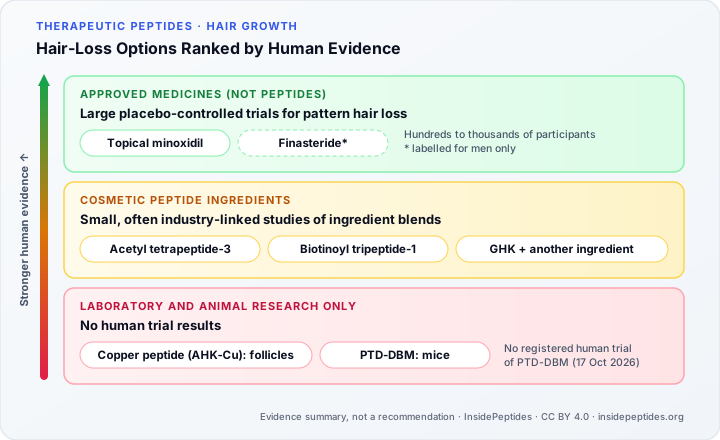
Diagram: hair-loss treatments ranked by human evidence. Top: approved non-peptide medicines with large placebo-controlled trials, topical minoxidil and finasteride for men. Middle: cosmetic peptide ingredients with small, often industry-linked studies of blends, acetyl tetrapeptide-3, biotinoyl tripeptide-1 and GHK combined with another ingredient. Bottom: laboratory and animal research only, AHK-Cu on cultured follicles and PTD-DBM in mice.
Hair-loss options by strength of human evidence: approved non-peptide medicines, cosmetic peptide ingredients with small studies, and laboratory or mouse-only peptides (status 17 October 2026). Diagram by InsidePeptides, CC BY 4.0: free to reuse with a credit and link. Download SVG

How peptides are claimed to work for hair growth

Peptides in hair serums are mostly cosmetic ingredients tested in laboratory studies and small, often manufacturer-run human studies. None is an approved medicine for hair loss, and none has the large, independent trial evidence behind the two best-studied hair-loss medicines, minoxidil and finasteride.

To see what the claims mean, it helps to know how hair grows. Each follicle cycles through a growth phase (anagen), a short transition (catagen) and a resting phase (telogen), after which the hair is shed. In common pattern hair loss, follicles gradually shrink (miniaturise), mainly under the influence of the hormone dihydrotestosterone (DHT), and the growth phase gets shorter. At the base of each follicle sits the dermal papilla, a cluster of specialised cells that signals the follicle to grow.

Hair-peptide marketing usually points to one of these targets:

  • Dermal papilla cells and blood supply: claims that a peptide stimulates the cells or vessels that feed the follicle (copper peptides).
  • The tissue around the follicle: claims that a peptide boosts collagen and other anchoring proteins (biotinoyl tripeptide-1, acetyl tetrapeptide-3).
  • Growth signalling: claims that a peptide switches on the Wnt/β-catenin pathway that starts a new growth phase (PTD-DBM).

A plausible mechanism in cells is not proof that hair regrows on a human scalp. The research background is collected in Skin and Hair Peptides, and the skin-penetration problem that affects all topical peptides is explained in Topical Peptides for Skin. This guide describes research only; it is not product advice or medical advice.

Copper peptides (GHK-Cu) for hair

GHK-Cu is a three-amino-acid peptide (glycine, histidine, lysine) bound to copper. It occurs naturally in human plasma, and laboratory and animal studies link it to wound repair and to the production and breakdown of collagen [2]. That review was written by GHK’s original researcher and his colleagues, and much of the work it summarises is cell and animal research [2].

The study most often quoted for “copper peptides for hair” did not test GHK-Cu. A 2007 laboratory study used a related copper tripeptide, AHK-Cu, and found that it lengthened human hair follicles kept alive in culture and increased the growth of dermal papilla cells [1]. Follicles in a dish are a long way from a balding scalp.

Human data are thin. In a 2016 randomised, placebo-controlled study of 45 men with pattern hair loss, a scalp product combining GHK with 5-aminolevulinic acid was compared with placebo over six months. Hair counts rose more in both active groups than with placebo, but the statistically significant ratio comparison held for only one of the two concentrations, and there was no difference in hair length or thickness [3]. Because GHK was combined with another active ingredient, the study cannot show what GHK contributed. No published randomised trial of a GHK-Cu serum on its own for hair loss was found.

Biotinoyl tripeptide-1 and acetyl tetrapeptide-3

These two peptides are cosmetic ingredients sold to manufacturers, usually as patented blends that also contain plant extracts. That makes it hard to say what any single peptide does.

  • Acetyl tetrapeptide-3. In a 2013 study by the ingredient maker’s research department, 30 volunteers with receding hair applied either a blend of the peptide with red clover extract or a placebo for four months. The treated group’s ratio of growing to resting hairs rose and the placebo group’s fell [4]. The study was small, industry-run and measured hair-phase ratios rather than visible regrowth. In a 2020 trial in 32 people with mild to moderate pattern hair loss, a blend of this peptide with biochanin A and ginseng increased terminal hair counts by a similar amount to a low-strength minoxidil solution over 24 weeks; there was no placebo group, and the authors called for larger studies [5].
  • Biotinoyl tripeptide-1 is a GHK-related peptide with biotin attached, usually sold in a blend with two plant compounds. Its published human studies test it in combinations: for example, a 2023 trial randomised 54 men to one of two topical blends, both alongside platelet-rich plasma injections, with no placebo group [6]. Results of that kind cannot isolate the peptide’s effect.

A 2025 review of popular hair-serum actives, including these peptide blends, concluded that most studies had small samples, no comparison with standard treatments, unclear types of hair loss and conflicts of interest [7]. That is a fair summary of the field: some signals, but not the kind of evidence that shows a product regrows hair.

PTD-DBM and CXXC5: an early research target

PTD-DBM is an experimental peptide from a university group in South Korea. It is designed to block CXXC5, a protein that puts the brakes on Wnt/β-catenin signalling, a pathway that helps start the hair growth phase. In a 2017 study, CXXC5 was found at higher levels in miniaturised follicles from human balding scalps. In mice, disrupting CXXC5 with the peptide sped up hair regrowth and the formation of new follicles in healing wounds [8]. A 2023 mouse study from the same group reported that CXXC5 helps drive hair loss caused by DHT and prostaglandin D2, and that PTD-DBM reversed hair loss in these models [9]. The lead investigator heads a company licensed to develop the approach [9].

This is interesting biology, but the evidence is in mice and cells. A search of ClinicalTrials.gov on 17 October 2026 found no registered human trial of PTD-DBM. Peptides marketed online under this name have not been tested in people.

For context: the approved, evidence-based options

Comparing hair peptides with established medicines shows what stronger evidence looks like. Neither of the following is a peptide, and this comparison is not a recommendation; whether any treatment suits a person depends on the cause of their hair loss, their sex, other conditions and medicines, and is a decision for a clinician such as a dermatologist.

  • Topical minoxidil. In a 48-week, double-blind trial in 393 men with pattern hair loss, the higher-strength solution produced more regrowth than the lower strength and placebo; scalp itching and irritation were more common at the higher strength [10]. In the United States, minoxidil foams and solutions are sold as non-prescription drugs labelled to regrow hair on the top of the scalp [11].
  • Finasteride. In two one-year trials of 1,553 men, finasteride tablets increased scalp hair counts compared with placebo, and the placebo groups continued to lose hair [12]. It is a prescription medicine labelled for male pattern hair loss in men only, and it is not indicated for women [13].

These medicines were tested in hundreds to thousands of people with standardised hair counts and a placebo comparison. The peptide studies above enrolled dozens. See Randomized Controlled Trials and Understanding Sample Size for why that difference matters.

Cosmetic claims versus drug claims

In the United States, whether a product is legally a cosmetic or a drug depends on its intended use, shown by what it claims. FDA gives claims that a product will “restore hair growth” as an example of a claim that makes a product a drug [14]. Cosmetics and their ingredients do not need FDA approval before sale, whereas drugs generally need FDA approval or must meet an over-the-counter monograph [14].

In practice, this means a peptide serum sold as a cosmetic can talk about hair that looks fuller, thicker or healthier, but it has not been shown to FDA to regrow hair. Wording such as “clinically tested” or “boosts follicles” does not tell you whether a placebo-controlled trial of that finished product was done or what it found. Laboratory results for an ingredient do not transfer automatically to a finished product either, because the concentration, the formula and how well the peptide gets into the skin all differ.

Injectable or oral “hair peptides” sold online are a different matter. They are not cosmetics, and as unapproved drugs they have no tested quality or safety for human use; see what “research use only” means and approved versus unapproved peptides.

Hair loss with GLP-1 weight-loss medicines

Many people search for hair peptides after noticing shedding while taking a GLP-1 medicine such as semaglutide or tirzepatide. Hair loss is listed in the Wegovy prescribing information: in pooled weight-management trials it was reported in 3.3% of people on semaglutide and 1% on placebo, more often in women, and the label notes that it was associated with weight reduction [15].

The usual explanation is telogen effluvium: after a physical stress such as rapid weight loss, more follicles than usual enter the resting phase together and shed some weeks later. A 2026 review by hair specialists notes that most evidence comes from drug-safety databases and retrospective studies, that causality has not been established, and that rapid weight loss is one likely mechanism [16]. A 2026 meta-analysis of observational studies estimated about 40% higher odds of non-scarring hair loss among GLP-1 users, with the clearest signals for telogen effluvium and pattern hair loss [17].

No peptide serum has been tested for this kind of shedding. Anyone concerned about hair loss on a prescribed medicine should speak to the prescriber rather than stopping it. Background on these medicines is in How GLP-1 Drugs Work and Peptides for Weight Loss.

Frequently asked questions

How do peptides work for hair growth?

In laboratory studies, some peptides stimulate dermal papilla cells, support the tissue around the follicle or switch on growth signalling [1][8]. Whether a topical product does any of this on a human scalp, at the concentration it contains, has rarely been tested in well-designed trials.

Do copper peptides work for hair?

The evidence is weak. The best-known hair study used a related copper peptide on follicles in culture [1], and the only randomised human study found combined GHK with another active ingredient and had mixed results [3]. No randomised trial of GHK-Cu alone for hair loss was found.

Do peptide hair serums work?

Some small studies of peptide blends report changes in hair counts or growth-phase ratios, but most are industry-linked, short, small or lack a placebo group [4][5][7]. As cosmetics, these products did not have to prove hair regrowth before sale [14].

Can peptides regrow hair lost to male pattern baldness?

That has not been shown. The treatments with large placebo-controlled trials for male pattern hair loss are minoxidil and finasteride, which are not peptides [10][12]. A dermatologist can confirm the type of hair loss and discuss options.

Does semaglutide (Ozempic or Wegovy) cause hair loss?

Hair loss was reported more often with semaglutide than placebo in weight-management trials, and the label links it to weight reduction [15]. It is usually attributed to telogen effluvium, though causality is not fully established [16]. Questions about it belong with the prescriber.

Is GHK-Cu safe on the scalp?

GHK-Cu has a long history in cosmetic products, but scalp-specific safety studies are few. Evidence from skin creams does not apply to injected GHK-Cu, which is an unapproved drug; see the GHK-Cu profile.

Core Scientific Definitions

Precise biomedical definitions for terms used throughout this guide.

Anagen and telogen
The growth phase and the resting phase of the hair cycle. A higher share of follicles in telogen means more shedding.
Androgenetic alopecia
Pattern hair loss, the most common type in men and women, in which follicles gradually shrink under the influence of hormones such as dihydrotestosterone (DHT).
Dermal papilla
A cluster of specialised cells at the base of each hair follicle that sends the signals controlling hair growth; many hair-peptide claims target these cells.
Telogen effluvium
Temporary, diffuse hair shedding that follows a physical or emotional stress, such as illness or rapid weight loss, when many follicles enter the resting phase together.
Cosmetic claim
A claim about appearance, such as hair that looks thicker. A claim to restore or regrow hair is a drug claim under U.S. law.

Peer-Reviewed References & Primary Sources

This educational guide is built strictly upon peer-reviewed literature, official regulatory guidance, and authoritative biochemical repositories.

  1. The effect of tripeptide-copper complex on human hair growth in vitro Pyo HK et al. Arch Pharm Res 2007;30:834-9. Arch Pharm Res · 2007
  2. GHK Peptide as a Natural Modulator of Multiple Cellular Pathways in Skin Regeneration Pickart L, Vasquez-Soltero JM, Margolina A. Biomed Res Int 2015;2015:648108. Biomed Res Int · 2015
  3. Efficacy of a Complex of 5-Aminolevulinic Acid and Glycyl-Histidyl-Lysine Peptide on Hair Growth Lee WJ et al. Ann Dermatol 2016;28:438-43. Ann Dermatol · 2016
  4. A new strategy to modulate alopecia using a combination of two specific and unique ingredients Loing E et al. J Cosmet Sci 2013;64:45-58. PMID 23449130. J Cosmet Sci · 2013
  5. An Herbal Extract Combination (Biochanin A, Acetyl tetrapeptide-3, and Ginseng Extracts) versus 3% Minoxidil Solution for the Treatment of Androgenetic Alopecia: A 24-week, Prospective, Randomized, Triple-blind, Controlled Trial Lueangarun S, Panchaprateep R. J Clin Aesthet Dermatol 2020;13:32-37. PMID 33584955. J Clin Aesthet Dermatol · 2020
  6. A Comparative Study of Topical Procapil With Platelet-Rich Plasma Therapy Versus Topical Redensyl, Saw Palmetto, and Biotin With Platelet-Rich Plasma Therapy in the Treatment of Androgenetic Alopecia Tr P et al. Cureus 2023;15:e38696. Cureus · 2023
  7. Topical Alternatives for Hair Loss: Beyond the Conventional Bikash C. Int J Trichology 2025;17:13-19. Int J Trichology · 2025
  8. Targeting of CXXC5 by a Competing Peptide Stimulates Hair Regrowth and Wound-Induced Hair Neogenesis Lee SH et al. J Invest Dermatol 2017;137:2260-9. J Invest Dermatol · 2017
  9. CXXC5 Mediates DHT-Induced Androgenetic Alopecia via PGD(2) Ryu YC et al. Cells 2023;12:555. Cells · 2023
  10. A randomized clinical trial of 5% topical minoxidil versus 2% topical minoxidil and placebo in the treatment of androgenetic alopecia in men Olsen EA et al. J Am Acad Dermatol 2002;47:377-85. J Am Acad Dermatol · 2002
  11. Minoxidil topical aerosol foam (men): OTC Drug Facts label Kenvue Brands LLC. Minoxidil topical foam for men, OTC Drug Facts label, DailyMed, published 14 November 2024. DailyMed, U.S. National Library of Medicine · 2024
  12. Finasteride in the treatment of men with androgenetic alopecia. Finasteride Male Pattern Hair Loss Study Group Kaufman KD et al. J Am Acad Dermatol 1998;39:578-89. J Am Acad Dermatol · 1998
  13. PROPECIA (finasteride) prescribing information Organon LLC. Propecia (finasteride) tablets prescribing information, DailyMed, published 14 October 2024. DailyMed, U.S. National Library of Medicine · 2024
  14. Is It a Cosmetic, a Drug, or Both? (Or Is It Soap?) U.S. Food and Drug Administration. Is it a cosmetic, a drug, or both? (Or is it soap?). Content current as of 11 September 2024. U.S. Food and Drug Administration · 2024
  15. WEGOVY (semaglutide) prescribing information Novo Nordisk. Wegovy (semaglutide) injection and tablets prescribing information, DailyMed, revised June 2026. DailyMed, U.S. National Library of Medicine · 2026
  16. Hair Loss in Patients on Glucagon-Like Peptide 1 Receptor Agonists: Understanding Risks and Managing Outcomes Piraccini BM et al. Dermatol Ther (Heidelb) 2026;16:3345-60. Dermatol Ther (Heidelb) · 2026
  17. GLP-1 Receptor Agonists and Alopecia: A Systematic Review and Meta-Analysis of Incidence, Risk, Subtypes, and Mechanisms Viquez Burboa GU et al. Skin Appendage Disord 2026 (published online 30 June 2026). Skin Appendage Disord · 2026
Written By InsidePeptides Editorial Team
Review Status Scientific review pending
Last Updated
Last Evidence Review Pending verification

Educational Disclaimer: This guide is for education only and is not medical advice, diagnosis or treatment. Many peptides discussed here are not approved for human use. Talk to a licensed clinician before making any health decision.