

Therapeutic Peptides Beginner

Peptides for Muscle Growth: What the Evidence Shows

Do ipamorelin, CJC-1295 and other growth hormone peptides build muscle? What human trials of growth hormone, IGF-1 and myostatin drugs actually show, plus risks and WADA status.

12 min read Updated 18 sources InsidePeptides Editorial Team

A woman lifting a hexagonal dumbbell beside a long rack of weights in a bright gym
Photo: Shixart1985, CC BY 2.0, via Wikimedia Commons.

Plain-English Summary

The peptides most often promoted for muscle growth, such as ipamorelin, CJC-1295, sermorelin, GHRP-2, GHRP-6 and hexarelin, work by making the pituitary gland release more growth hormone. No randomised trial has tested whether any of them builds muscle or strength in healthy people. Trials of growth hormone itself in healthy adults found more lean body mass, much of it water and non-muscle tissue, but no reliable gain in strength. Drugs that block the muscle-limiting protein myostatin can add muscle but are experimental antibodies and proteins, not the peptides sold online. All of these substances are banned in sport at all times.

Key Takeaways

  • Peptides promoted for muscle growth are mostly growth hormone secretagogues: GHRH analogues such as CJC-1295, sermorelin and tesamorelin, and ghrelin mimetics such as ipamorelin, GHRP-2, GHRP-6 and hexarelin.
  • No published randomised trial has measured muscle size or strength in healthy people taking ipamorelin, CJC-1295 or the other popular research peptides, alone or combined.
  • In randomised trials of growth hormone in healthy young adults, lean body mass rose by about 2 kg on average, but strength and exercise capacity did not reliably improve.
  • Part of the extra “lean mass” seen with growth hormone is water and non-muscle tissue, not contractile muscle.
  • Tesamorelin, the only approved GHRH analogue in the U.S. as of 17 October 2026, is approved for abdominal fat in HIV lipodystrophy, not for muscle.
  • Myostatin-pathway drugs can increase muscle in trials, but they are antibodies or fusion proteins in clinical development, not short research peptides.
  • WADA prohibits growth hormone releasing factors, secretagogues and myostatin inhibitors at all times, in and out of competition.
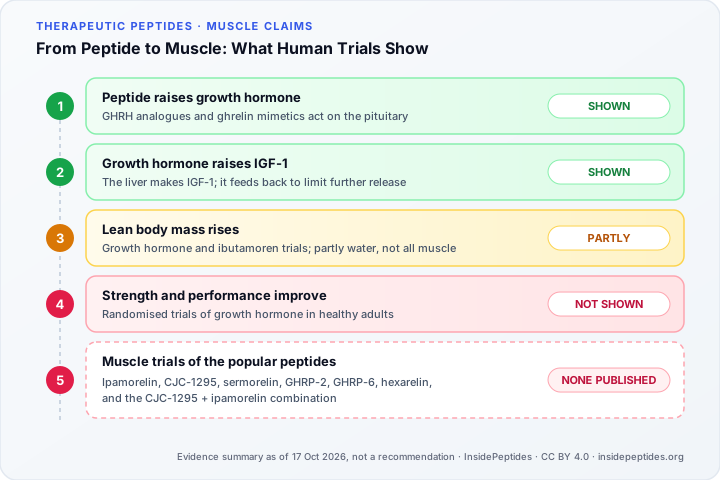
Diagram: the evidence chain from growth hormone peptide to muscle. Step 1, the peptide raises growth hormone: shown in short human hormone studies. Step 2, growth hormone raises IGF-1: shown. Step 3, lean body mass rises: shown in trials of growth hormone and an oral ghrelin mimetic, partly as water. Step 4, strength and performance improve: not shown in healthy adults. For ipamorelin, CJC-1295 and similar peptides, no randomised trial has measured muscle or strength.
Where the evidence chain breaks: growth hormone peptides reliably raise hormone levels, and growth hormone adds lean mass, but trials in healthy adults have not shown gains in strength, and no trial has measured muscle outcomes for the popular research peptides. Diagram by InsidePeptides, CC BY 4.0: free to reuse with a credit and link. Download SVG

What “peptides for muscle growth” usually means

When people talk about peptides for muscle growth, they almost always mean peptides that make the body release more growth hormone. The best known are ipamorelin, CJC-1295, sermorelin, tesamorelin, GHRP-2, GHRP-6 and hexarelin. Together they are called growth hormone secretagogues, and the biology is covered in depth in Growth Hormone Secretagogues.

The idea behind them is a chain of reasoning: growth hormone helps children grow, growth hormone raises IGF-1, IGF-1 can stimulate muscle cells, so raising growth hormone should build muscle. Each link sounds plausible. The question this guide asks is which links have actually been tested in people, and with what result.

The short answer is that the chain breaks at the end. Growth hormone peptides do raise hormone levels in people. Growth hormone itself, given in randomised trials, adds lean body mass. But in healthy adults that extra lean mass has not translated into reliable gains in strength or performance [1], and no randomised trial has measured muscle outcomes for the popular research peptides at all.

A smaller group of online claims concerns the myostatin pathway, a separate brake on muscle growth. That research is real, but the drugs involved are large antibodies and engineered proteins in clinical development, not the short peptides sold online (see section 6). This guide describes evidence and regulatory status only. It gives no doses or instructions, and decisions about any treatment belong to a licensed clinician.

How growth hormone peptides are supposed to work

Growth hormone is released by the pituitary gland in pulses, mostly during sleep. Two signals push it up and one holds it back. Growth hormone-releasing hormone (GHRH) from the hypothalamus stimulates release, ghrelin from the stomach amplifies it, and somatostatin brakes it. Growth hormone then prompts the liver to make IGF-1, which carries many of its effects and feeds back to slow further release.

Muscle-marketed peptides copy one of the two “go” signals:

  • GHRH analogues act on the GHRH receptor. Sermorelin is the first 29 amino acids of human GHRH. Tesamorelin is a stabilised GHRH analogue. CJC-1295 was engineered to last much longer: in healthy adults, a single injection raised growth hormone and IGF-1 for days, with an estimated half-life of roughly a week [3].
  • Ghrelin mimetics, also called growth hormone-releasing peptides (GHRPs), act on the ghrelin receptor (GHS-R1a). These include GHRP-2, GHRP-6, hexarelin and ipamorelin. Ipamorelin was developed to be more selective for growth hormone than older GHRPs, which also raise cortisol and prolactin.

Because the two receptor routes are different, the two classes can add together, which is the rationale behind the widely promoted “CJC-1295 and ipamorelin” combination. Synergy on hormone levels, however, has only been shown for the natural hormones in short laboratory studies, as explained in Growth Hormone Secretagogues. It says nothing about muscle.

Secretagogues also keep some of the body's own controls in place. IGF-1 feedback and somatostatin still limit release, so the effect differs from injecting growth hormone directly. That difference is often marketed as a safety advantage, but it has not been tested as one in long-term trials. For how peptides act on cell-surface receptors in general, see Peptide Receptors.

What raising growth hormone does to muscle in human trials

Because the popular peptides have not been tested for muscle, the closest evidence comes from trials that gave growth hormone itself, or a ghrelin mimetic, and measured body composition and strength.

  • Healthy young adults. A 2008 systematic review in the Annals of Internal Medicine pooled randomised trials in physically fit people aged 13 to 45 (303 participants given growth hormone). Lean body mass rose by about 2.1 kg compared with controls, but strength and exercise capacity did not appear to improve. Soft-tissue swelling and fatigue were more common with growth hormone, and the authors concluded that claims of better performance are not supported [1].
  • Growth hormone plus weight training. In a 12-week randomised trial of 16 young men doing identical resistance training, fat-free mass rose more with growth hormone than with placebo, but muscle protein synthesis, limb size and strength did not. The researchers concluded the extra lean mass was probably tissue other than skeletal muscle [2].
  • Recreational athletes. A randomised trial of 96 recreationally trained adults found that growth hormone increased lean body mass mainly through extracellular water. Sprint capacity rose modestly, but strength, power and endurance did not change, and the sprint effect was gone six weeks after stopping [6].
  • Healthy older adults. A 2007 systematic review of trials in people with an average age of 69 found about 2 kg more lean mass and 2 kg less fat, with more swelling, joint pain, carpal tunnel syndrome and breast enlargement in men, and a trend towards diabetes. The authors concluded growth hormone could not be recommended as an anti-ageing therapy [5].
  • An oral ghrelin mimetic. In a two-year trial in 65 healthy older adults, ibutamoren (MK-677, a small molecule rather than a peptide) raised growth hormone and IGF-1 to young-adult levels and increased fat-free mass, but strength and function did not change. Fasting glucose rose and insulin sensitivity fell [7].
  • Muscle wasting in cancer. Anamorelin, a ghrelin-receptor drug, increased lean body mass in two phase 3 trials in 979 people with advanced lung cancer, but handgrip strength did not improve [8].

The pattern is consistent across populations: more lean mass on a scan, without a matching gain in strength. Part of the reason is that “lean body mass” includes water, connective tissue and organs, not just contractile muscle. For how to judge outcomes like these, see Statistical vs Clinical Significance.

For the specific peptides promoted to build muscle, the human evidence looks like this, as of 17 October 2026:

PeptideU.S. statusMain human evidenceMuscle or strength trials in healthy people
TesamorelinApproved for excess abdominal fat in HIV lipodystrophy [4]Randomised trials in people with HIVNone
SermorelinFormerly approved; products discontinuedOlder diagnostic and paediatric growth studiesNone
CJC-1295Not approvedShort hormone-response studies in healthy adults [3]None
IpamorelinNot approvedPhase 2 trial for bowel recovery after surgery, which found no benefit [9]None
GHRP-2, GHRP-6, hexarelinNot approvedShort hormone-response and diagnostic studiesNone

Tesamorelin is the only one with an approved use in the U.S., and its label is precise about what that covers: reducing excess abdominal fat in adults with HIV-associated lipodystrophy. The label adds that it is not indicated for weight loss, that long-term cardiovascular safety has not been established, and that the effects of prolonged IGF-1 elevation are unknown [4]. Muscle growth is not part of the approval.

Ipamorelin reached phase 2 trials, but for a gut problem, not muscle. In a randomised trial in 114 people after bowel surgery, it did not shorten the time to tolerating solid food compared with placebo [9].

CJC-1295 and ipamorelin together is one of the most searched combinations. A PubMed search on 17 October 2026 for both names returned review articles and a laboratory testing paper, but no clinical trial of the combination. Claims about it rest on mechanism and anecdote. For why combining unapproved peptides adds uncertainty rather than removing it, see Peptide Stacks, and for direct comparisons see CJC-1295 vs Ipamorelin and GHRP-2 vs GHRP-6.

Why there are no muscle-gain trials for these peptides

It can seem strange that compounds discussed so widely have never been tested for the use they are known for. There are several reasons.

  • No approvable indication. Drug companies run large trials to win approval for a medical condition. Building muscle in healthy people is not a disease, and regulators would not approve a drug for it. The companies that developed these peptides aimed at growth hormone deficiency, HIV-related fat, gut motility or diagnostic testing instead.
  • Development went elsewhere or stalled. Where these peptides were tested in patients, it was for other problems, and results were often disappointing, as with ipamorelin after bowel surgery [9]. None is in late-stage development for muscle, so no sponsor is paying for such trials.
  • The growth hormone results were discouraging. If growth hormone itself does not reliably improve strength in healthy adults [1][2], a peptide that raises growth hormone less directly is unlikely to do better, which removes the scientific case for an expensive trial.
  • Ethics and sport. Trials giving performance-enhancing substances to healthy people are hard to justify, and all of these compounds are banned in sport.

The result is an evidence gap that marketing fills with mechanism diagrams, animal studies and personal reports. Those are the weakest kinds of evidence for answering whether something works in people, as explained in Human vs Preclinical Research and Understanding Evidence Levels. Because no muscle-building trials exist, there is also no evidence-based human dose for this purpose, and any figure circulating online is not derived from controlled studies.

Myostatin-pathway research

Myostatin is a protein that limits muscle growth. In 1997, mice bred without the myostatin gene were found to have individual muscles weighing two to three times more than normal [11]. In 2004, a child born with mutations disabling both copies of the human gene was reported to have greatly enlarged muscles [12]. Those findings started a search for drugs that block myostatin or its receptor.

Human trials have so far been in muscle diseases and sarcopenia, with mixed results:

  • MYO-029, an antibody against myostatin, was tested in 116 adults with muscular dystrophy. It showed no improvement in strength or function, although the trial was mainly designed to check safety [13].
  • ACE-031, a decoy receptor protein, showed trends towards more lean mass in boys with Duchenne muscular dystrophy, but the trial was stopped early because of nosebleeds and small dilated blood vessels [14].
  • Bimagrumab, an antibody that blocks the activin type II receptor, increased thigh muscle volume in a small 24-week trial of 40 older adults with sarcopenia, and improved walking in those who were slowest at the start [15].

Two points matter for readers. First, these are large antibodies and engineered proteins given in supervised trials, not short peptides. Products sold online as “follistatin” or “myostatin-blocking peptides” have not been tested in these trials, and their identity is not assured. Second, none of these drugs was approved for muscle growth as of 17 October 2026. The research shows that the pathway can be targeted, not that any available product does so safely.

Risks, and are peptides safer than steroids?

The known and suspected risks of raising growth hormone come mostly from trials of growth hormone, tesamorelin and ibutamoren:

  • Blood sugar. Growth hormone opposes insulin. Tesamorelin users had a higher rate of diabetes-range HbA1c than placebo users (5% versus 1%) [4], and ibutamoren reduced insulin sensitivity [7].
  • Swelling, joint pain and carpal tunnel syndrome, seen more often with growth hormone in healthy older adults [5].
  • IGF-1 and cancer. Because IGF-1 promotes cell growth, the tesamorelin label excludes people with active cancer and calls the effects of prolonged IGF-1 elevation unknown [4].
  • Product quality. FDA has placed GHRP-2, GHRP-6 and ipamorelin in its category of bulk substances that may present significant safety risks in compounding, citing risks of immune reactions and impurities. It notes a death in a study where ipamorelin was given intravenously, though without establishing cause, and serious adverse events including increased heart rate and a vasodilatory reaction with CJC-1295 [10].

Are peptides safer than steroids? The honest answer is that the comparison cannot be made on current evidence. Anabolic steroids clearly build muscle: in a randomised trial, high-dose testosterone increased muscle size and strength in healthy men, especially with training [16]. Their harms are also well documented, including cardiovascular, psychiatric, liver and hormonal effects, and an increased risk of death among users [17]. Growth hormone peptides have far weaker evidence of benefit and almost no long-term safety data in healthy users. “Less studied” is not the same as “safer”. The differences in chemistry and mechanism are explained in Peptides vs Steroids, and wider safety questions in Are Peptides Safe? and Peptide Impurities. Whether any treatment is appropriate is a decision for a licensed clinician.

Status in sport

The World Anti-Doping Agency (WADA) 2026 Prohibited List bans all of the substances in this guide at all times, in and out of competition [18]:

  • Class S2.2.4, growth hormone releasing factors, names GHRH analogues including CJC-1295, sermorelin and tesamorelin; secretagogues including ipamorelin, ibutamoren and anamorelin; and GH-releasing peptides including GHRP-2, GHRP-6 and examorelin (hexarelin).
  • Class S2.2.3 covers growth hormone, its analogues and fragments, and S2.3 covers growth factors including IGF-1 and its analogues.
  • Class S4.3 covers agents preventing activin receptor IIB activation, which names myostatin inhibitors, myostatin-binding proteins such as follistatin, ACE-031 and bimagrumab.

The list also bans substances with a similar chemical structure or biological effect, so an unnamed analogue is not automatically permitted. Athletes with a genuine medical need use the therapeutic use exemption process. See WADA Peptide Rules and Peptides and Athletes.

Frequently asked questions

Do peptides help build muscle?

No peptide has been shown in a randomised trial to build muscle or strength in healthy people. Growth hormone, which these peptides release, increased lean mass in trials but did not reliably improve strength [1][2].

How do peptides work for muscle growth?

The popular ones make the pituitary release more growth hormone, either by mimicking GHRH (CJC-1295, sermorelin, tesamorelin) or ghrelin (ipamorelin, GHRP-2, GHRP-6, hexarelin). Growth hormone raises IGF-1, which in theory supports muscle growth. The theory has not been confirmed by muscle outcomes in trials of these peptides.

What are the benefits of ipamorelin?

Ipamorelin reliably raises growth hormone in short studies. Its only published phase 2 trial, in recovery after bowel surgery, did not find a benefit over placebo [9]. Claimed benefits for muscle, fat loss, sleep or recovery have not been tested in controlled human trials, and it is not an approved medicine.

Does CJC-1295 with ipamorelin work better than either alone?

The combination targets two different receptors, so it may raise growth hormone more than either alone. No clinical trial of the combination has been published, so there is no evidence that it builds muscle or is safe for repeated use.

Are peptides safer than steroids?

That cannot be stated on current evidence. Steroids have proven muscle effects and well-documented harms [16][17]. Growth hormone peptides have little evidence of muscle benefit and very little long-term safety data, and unregulated products add quality risks [10].

What is the right dose of peptides for muscle growth?

There is no established human dose for this purpose, because no trial has tested these peptides for muscle growth. Questions about approved medicines such as tesamorelin belong with the prescriber and the product label.

Core Scientific Definitions

Precise biomedical definitions for terms used throughout this guide.

Growth hormone secretagogue
A substance that makes the pituitary gland release more of the body's own growth hormone, either by mimicking GHRH from the hypothalamus or ghrelin from the stomach.
IGF-1
Insulin-like growth factor 1, made mainly in the liver in response to growth hormone; it carries many of growth hormone's effects and is the usual blood marker in studies of these substances.
Lean body mass
Everything in the body that is not fat, including muscle, organs, bone, connective tissue and water; an increase in lean body mass is not the same as an increase in muscle.
Myostatin
A protein made by muscle cells that limits muscle growth; animals and people born without working myostatin have unusually large muscles.
Surrogate outcome
A measurement, such as a hormone level, used in place of the outcome people actually care about, such as strength or function; a change in a surrogate does not guarantee a change in the real outcome.

Peer-Reviewed References & Primary Sources

This educational guide is built strictly upon peer-reviewed literature, official regulatory guidance, and authoritative biochemical repositories.

  1. Systematic review: the effects of growth hormone on athletic performance Liu H et al. Ann Intern Med 2008;148:747-58. PMID 18347346. Ann Intern Med · 2008
  2. Effect of growth hormone and resistance exercise on muscle growth in young men Yarasheski KE et al. Am J Physiol 1992;262:E261-7. PMID 1550219. Am J Physiol · 1992
  3. Prolonged stimulation of growth hormone (GH) and insulin-like growth factor I secretion by CJC-1295, a long-acting analog of GH-releasing hormone, in healthy adults Teichman SL et al. J Clin Endocrinol Metab 2006;91:799-805. PMID 16352683. J Clin Endocrinol Metab · 2006
  4. EGRIFTA WR (tesamorelin) prescribing information Theratechnologies Inc. Egrifta WR (tesamorelin for injection) prescribing information, DailyMed, accessed 17 October 2026. DailyMed, U.S. National Library of Medicine · 2026
  5. Systematic review: the safety and efficacy of growth hormone in the healthy elderly Liu H et al. Ann Intern Med 2007;146:104-15. PMID 17227934. Ann Intern Med · 2007
  6. The effects of growth hormone on body composition and physical performance in recreational athletes: a randomized trial Meinhardt U et al. Ann Intern Med 2010;152:568-77. PMID 20439575. Ann Intern Med · 2010
  7. Effects of an oral ghrelin mimetic on body composition and clinical outcomes in healthy older adults: a randomized trial Nass R et al. Ann Intern Med 2008;149:601-11. PMID 18981485. Ann Intern Med · 2008
  8. Anamorelin in patients with non-small-cell lung cancer and cachexia (ROMANA 1 and ROMANA 2): results from two randomised, double-blind, phase 3 trials Temel JS et al. Lancet Oncol 2016;17:519-31. PMID 26906526. Lancet Oncol · 2016
  9. Prospective, randomized, controlled, proof-of-concept study of the Ghrelin mimetic ipamorelin for the management of postoperative ileus in bowel resection patients Beck DE et al. Int J Colorectal Dis 2014;29:1527-34. PMID 25331030. Int J Colorectal Dis · 2014
  10. Certain Bulk Drug Substances for Use in Compounding that May Present Significant Safety Risks U.S. Food and Drug Administration. Certain bulk drug substances for use in compounding that may present significant safety risks (content current as of 22 April 2026; accessed 17 October 2026). U.S. Food and Drug Administration · 2026
  11. Regulation of skeletal muscle mass in mice by a new TGF-beta superfamily member McPherron AC et al. Nature 1997;387:83-90. PMID 9139826. Nature · 1997
  12. Myostatin mutation associated with gross muscle hypertrophy in a child Schuelke M et al. N Engl J Med 2004;350:2682-8. PMID 15215484. N Engl J Med · 2004
  13. A phase I/II trial of MYO-029 in adult subjects with muscular dystrophy Wagner KR et al. Ann Neurol 2008;63:561-71. PMID 18335515. Ann Neurol · 2008
  14. Myostatin inhibitor ACE-031 treatment of ambulatory boys with Duchenne muscular dystrophy: Results of a randomized, placebo-controlled clinical trial Campbell C et al. Muscle Nerve 2017;55:458-64. PMID 27462804. Muscle Nerve · 2017
  15. Treatment of Sarcopenia with Bimagrumab: Results from a Phase II, Randomized, Controlled, Proof-of-Concept Study Rooks D et al. J Am Geriatr Soc 2017;65:1988-95. PMID 28653345. J Am Geriatr Soc · 2017
  16. The effects of supraphysiologic doses of testosterone on muscle size and strength in normal men Bhasin S et al. N Engl J Med 1996;335:1-7. PMID 8637535. N Engl J Med · 1996
  17. Adverse health consequences of performance-enhancing drugs: an Endocrine Society scientific statement Pope HG Jr et al. Endocr Rev 2014;35:341-75. PMID 24423981. Endocr Rev · 2014
  18. World Anti-Doping Code International Standard: Prohibited List 2026 World Anti-Doping Agency. World Anti-Doping Code International Standard: Prohibited List 2026, in force from 1 January 2026. World Anti-Doping Agency · 2026
Written By InsidePeptides Editorial Team
Review Status Scientific review pending
Last Updated
Last Evidence Review Pending verification

Educational Disclaimer: This guide is for education only and is not medical advice, diagnosis or treatment. Many peptides discussed here are not approved for human use. Talk to a licensed clinician before making any health decision.